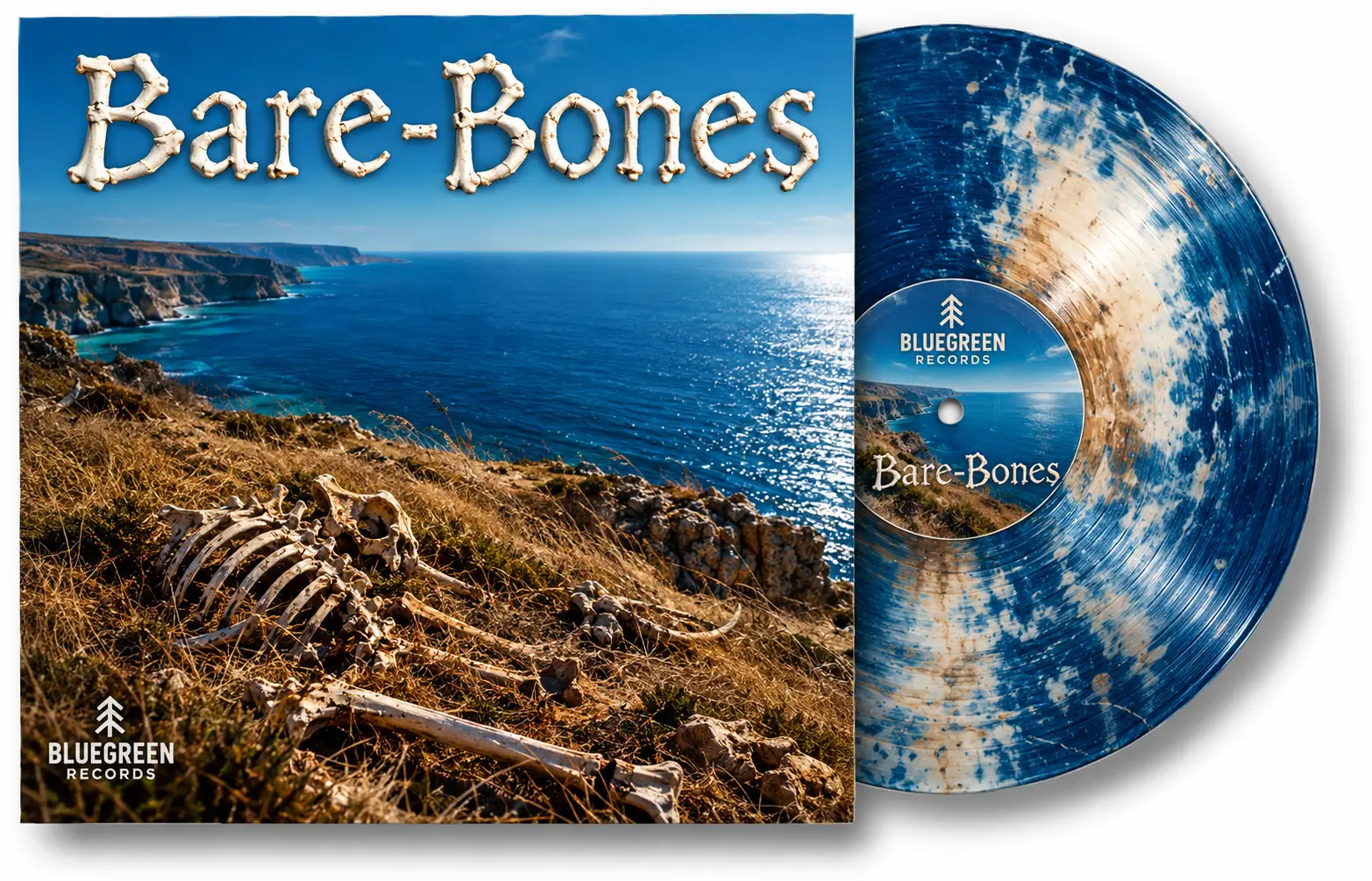
Andalusia to Anatolia
AI Process/Open Source Software: HUMAN, Google Flow Music (Lyria 3.5), Claude.ai, ChatGPT, Perchance.org – DAW: Audacity 4 (alpha), OS: Linux (Ubuntu 26.04)
Bare-Bones – Full Album (1:08:32)
Liner Note from JJ. Sound Designer
There is a moment, just before a song begins, when a guitar is still warming in someone’s hands, when a voice hasn’t yet decided whether to whisper or cry out. That moment is where this record lives.
Bare-Bones was not meant to be polished. It was meant to be honest. Recorded the way records used to be made, to tape, in a room, with the windows open and the microphones close enough to catch a breath, a fingernail against a string, the creak of a chair. No drum machines. No walls of sound. Just wood, wire, and the human voice doing what it has always done: telling the truth in a melody.
The songs here don’t belong to one country. They wander, from the fire and heartbreak of flamenco, through the modal ache of Arabic maqam, into the swirling dance rhythms of the Aegean and the aching, ornamented lines of Anatolia. These are cousins, not strangers. Trace any of them back far enough and you find the same roots, a guitar (or an oud, or a bouzouki) crying in a minor key, a singer answering it in kind.
This is a record about restraint. About what’s left when you take everything away except what matters. A melody. A voice. Six strings and a little bit of skin on a drumhead. It’s a love letter to the 1970s sessions where musicians sat in a circle instead of isolation booths, where the imperfections were the point, and the warmth came from tape, not plugins.
Play it late.
Play it with the lights low.
Let the hiss of the tape and the space between the notes do some of the talking.
This is Bare-Bones.
Everything essential.
Nothing else.
Text to Music Prompt
A warm, analog-recorded acoustic piece blending Flamenco, Arabic, Greek, Turkish, and Egyptian guitar traditions into one intimate, stripped-down sound. Fingerpicked and rasgueado nylon-string guitar carries the melody, weaving in modal, Phrygian-dominant scales (Hijaz/Freygish flavor) with quarter-tone bends reminiscent of oud phrasing. The rhythm alternates between hypnotic 9/8 Middle Eastern groove and passionate Flamenco compás, occasionally settling into slow, meditative 4/4 passages.
A single expressive vocalist, soulful, breathy, close-mic’d, moves fluidly between minor-key longing and major-key uplift, singing with raw emotional restraint rather than power. Vocal delivery is intimate, almost whispered in verses, opening into fuller-throated, melismatic runs in the chorus, evoking both Mediterranean folk singers and 1970s singer-songwriter warmth.
Instrumentation stays minimal and organic: one or two guitars (classical nylon-string, lightly reverbed), hand percussion (darbuka, doumbek, or cajón with brushed textures), subtle finger snaps or palmas, and occasional atmospheric touches, a bowed string drone, distant bouzouki, or soft tambourine shimmer. No drums kit, no electric instruments, no synths.
Production is vintage and analog: warm tape saturation, natural room reverb, gentle tube compression, slight wow-and-flutter, and the sonic character of a 1970s live studio session, think Laurel Canyon meets a Mediterranean taverna, recorded to reel-to-reel. Mix is intimate and close, with audible breath, finger squeaks on strings, and room ambience left in for authenticity.
Tempo: slow-to-moderate (68–86 BPM). Mood: bittersweet, sensual, nostalgic, meditative, a late-night, candlelit atmosphere. Dynamic arc: begins sparse (solo guitar + voice), builds gently with percussion and a second guitar layer by the second verse, and resolves back to bare simplicity in the outro.