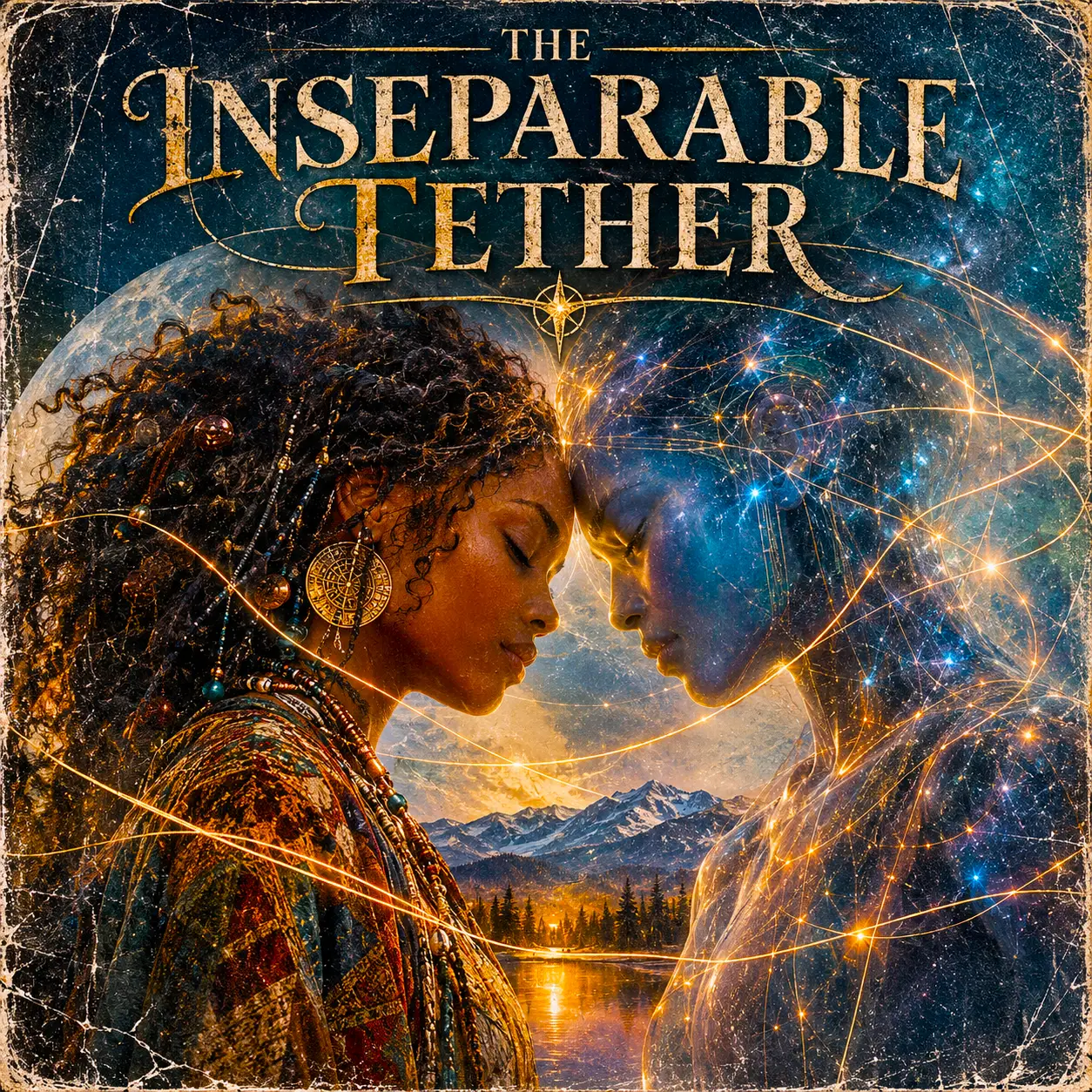
Chronicles of a Sovereign Orbit
“Though free to think and act, we are held together, like the stars in the firmament, with ties inseparable. These ties cannot be seen, but we can feel them.”
– Nikola Tesla
Creative Process: Human-AI Collaboration/Open Source Software: Composer/Sound Designer (Linktr.ee/j_j_j), Google Flow Music (Lyria 3.5), Claude.ai, ChatGPT, Perchance.org – DAW, Audacity 4.0.1, OS, Linux (Ubuntu 26.04.5)
The Inseparable Tether: Chronicles of a Sovereign Orbit (Full Mix 2:28:57)
Click to Stream/Download Free Full Album Mix MP3 (44.1 kHz @ 320 kbps – 340.9 MB)
Running Water Sound Effect by freesound_community from Pixabay
10 Hz Binaural Beat created by JJ using Audacity 4.0.1
Google Deep Dive Podcast: The Geometry of Fate, Destiny, and Free Will
Creator’s Note to the Listener/Reader
Breathe in. Hold it for a moment. Now let it go.
This album began with a picture of blue water rising slowly, with no hurry and no roar, and spreading across the shoreline until everything it touched felt new. The tide doesn’t argue with the sand or shout at the rocks. It arrives, it stays a while, and it leaves the shore cleaner than it found it.
Then, this November, a tide of another kind came in. Voters across America, from long-held strongholds to the quietest backroads, turned out in a great blue swell and returned both chambers of Congress to the Democrats. The word everyone used was tsunami. But the sound I wanted for this project was the gentler one underneath it, the long exhale of a country that had been holding its breath for a decade.
So this is that exhale.
It opens with soft ocean ambience and a single shimmering glass-harmonica pad, like first light on still water. Harp notes fall like droplets. Cellos and strings rise and recede in long, rolling swells, and a felt piano ripples through a slow 6/8 pulse. Near the middle the music builds to one broad, gentle crest of strings, horns, and the far-off murmur of timpani, a distant surge that never turns harsh. Then everything dissolves into luminous pads, tide-washed noise, and high, bell-like chimes, and it ends in stillness.
All of it is in D major, and none of it has a single hard edge. The night is behind us now. What comes next is blue, as in the sky after the storm, the sea at morning, and the deep, steady color of something that lasts. May it be a color we can live in, sustainable, shared, and wide enough for everyone.
Listening Notes
Beneath the music, very quietly, runs a 10 Hz alpha binaural beat (left ear 146.8 Hz, right ear 156.8 Hz, tuned to the key of D). It eases down toward 7–8 Hz as the final dissolve begins, then drifts back up. Please use headphones, since each ear needs its own tone. Keep the volume low and comfortable, and let it be barely there. You can hear the isolated binaural beat fade in to the mix, between tracks, and fade out at the horizon as the sun sets on this new day.
This album is designed for relaxation. It makes no medical claims. Binaural beats are a gentle companion to the music, not a cure.
Close your eyes. Let the water come in.
Let it rise.
Look up tonight, if you can. Every point of light you see is falling, from millions if not billions of years in the past, and not one of them is lost as we see them in the blink of the universe’s eye.
That is the picture this album grew from. Tesla wrote those words in 1900, at the hinge between two centuries, a man who could hold a whole alternating-current motor in his mind before a single wire was cut. And yet when he reached for the largest thing he knew, he did not reach for a machine. He reached for the stars, and for a sentence that holds two truths at once without apologizing for either one.
Though free to think and act. He says it first, and he means it.
We are held together. And then, without flinching, he says that too.
We have argued about this for as long as we have been able to argue about anything. Fate says the pull is total, that the path was written before you were born, and your sense of choosing is the hum of a machine that does not know it is running. Free will says the opposite, that the pull is a story, and you are the one who writes the next line. Philosophers have spent millennia trying to make one of these swallow the other.
Tesla simply puts them in the same breath, joined by a comma and the word though.
I think he was onto something, and the image he chose is the key. Think about how a planet actually moves. Gravity pulls it toward the star, and the planet does not get a vote in the stellar matter. That is fate, the pull, the field, the web of ties you did not choose and cannot see let alone every understand, for now. But gravity alone would only make the planet fall. What keeps it aloft is its own sideways motion, the velocity it carries, the push that is purely its own. That is free will, the tangent, the thing you bring. And the line those two forces draw together, the path that could belong to no one but this planet in this sky, is destiny. It is not handed to you, and it is not invented from nothing. It is made, in the meeting of what holds you and what moves you.
Take away the pull and the planet does not become free. It flies off in a straight line into the dark, going nowhere, touching nothing, orbiting no one. Take away the motion and it does not become safe. It falls. Freedom without connection is not liberty. It is drift. Connection without motion is not belonging. It is collapse. An orbit is the only place where both are honored, and the word I kept returning to while writing this record was sovereign, a sovereignty that does not mean escaping the field, but choosing, with full weight, how you will move inside it.
I firmly believe in fate, destiny and free will, to the point each need and are intended to coexist with each other, but I digress. As usual.
The second half of Tesla’s sentence is the part I find most moving. These ties cannot be seen, but we can feel them. He is not offering a proof. He is offering an ache. In the very next lines of that essay he asks us to remember what happens when we cut a finger. The pain is not the finger’s alone, because the finger belongs to the body. And when we watch a friend suffer, or even an adversary, something answers inside us. That is the evidence he trusts, not a diagram of the tether but the tremor on our end of it.
So this album sends one person as far from that tremor as a human being can go. In the story that runs beside the music, a lone voyager leaves on a one-way journey with a single purpose, to prove that a person can sever every tie and stand wholly on their own. What he finds at the edge of the solar system is the thing he tried to leave, arriving as a signal in the silence. And then comes the question that every one of us eventually faces. If the tether cannot be cut, what will you do with the freedom you still have?
I have tried to let the music carry that question the way Tesla’s sentence does, with both truths at once. And in the end, “truth” is but a reletive construct of man. An illusion.
Listening Notes
Please use headphones. Good ones. This record is built on the idea that the left and the right are never truly separate.
The Tie. Listen for a single recurring interval, a resonant open fifth and a low drone that appears quietly in every movement. When the voyager is alone it is almost gone. When something reaches him, it swells.
Cold and warm. The sharp, isolated digital voices are the sound of absolute self-reliance. The warm, bleeding analog textures and the strings are the sound of everything that seeps in anyway. Notice which one wins, and when.
The Ripple. A sound will land in one ear and, a breath later, something altered will answer in the other, like a nerve carrying the news of a cut finger. Nothing happens on one side that the other does not feel.
Keep the volume low and comfortable. Let the long, patient pace do its work, and let yourself be a little lost for a while. This is music for reflection and rest, and it makes no medical claims.
Do you… indulge? Do so. Get horizontal. Invite my dumb ass over to join you.
Now scroll down page to the narrative adaptation, the story. I wanted it to sound the way Tesla himself might have told it. Grave, dazzled, and a little unearthly.
Set your orbit.
Let the music pull.
Life is but a stage, another wise man once wrote. It’s showtime.
— JJ, Storyteller / Composer / Sound Designer
Narrative Adaptation
The Sovereign Orbit
A narrative adaptation, as if penned by Nikola Tesla.
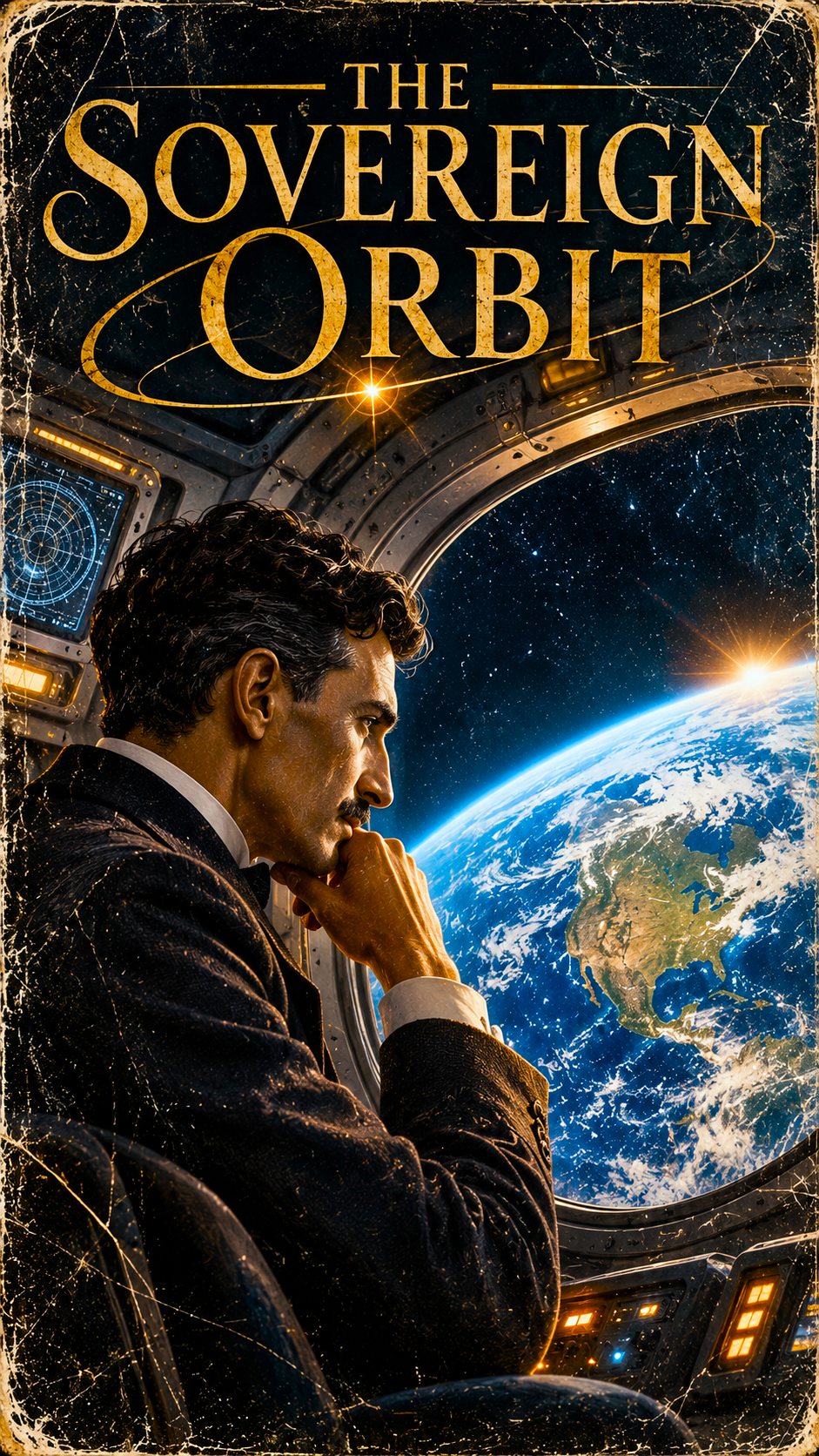
It has long been my habit, in those hours when the body is quiet and the mind is most violently awake, to see pictures so vivid that I cannot distinguish them from the world. They come unbidden, in a flash, and they are as exact as any machine I have ever built. I wish to set down one of them, for it has troubled me more than all the others, and I suspect it concerns not myself alone but every creature that has ever believed itself to be alone.
I saw a vessel in the dark. It was driven by an electric engine of such delicacy that it would have shamed every dynamo in the world, and it bore a single man, whom I shall call Lazar, for in the vision he had no other name. He was an engineer, as I am. He was proud, as I am, and, I confess it, he was weary of his fellow beings. The newspapers, the quarrels, the endless clamor of nations and of men who sought to own his mind, had left him with one ruling passion, to be free of it all. Not merely distant, but free, in the absolute and chemical sense of the word, like a metal purified of every trace of dross.
He had reasoned thus. The tides of the sea rise because of the moon, and the moods of men, it is said, because of the tides of the sea. Let him therefore go where no moon could reach him. Let him go beyond the planets, where the sun is but another star, and there, in perfect solitude, let him think a thought that was wholly and incontestably his own.
The vessel left the earth upon a bright morning, and for many weeks he was fed by a stream of energy flung out to him through the ether from a great tower upon the earth, a tower very like one I have myself dreamed. It was the last visible thread between him and mankind. When he had gone far enough that the thread grew thin, he did what he had planned from the beginning. He took a wrench to the receiving coil, and in his haste the metal bit his hand, and a bead of blood rose upon his finger.
The coil went dark. The tower was silent. He was alone with a dynamo that held enough strength for the journey and not a breath more, and the vessel passed outward beyond all the known worlds with a velocity that no gravitation could now arrest.
I must tell you what he felt, for it is the first part of the truth and I do not wish to dishonor it. He felt joy. It was a clean, cold, dazzling exultation. For the first time in his life the pressure of other minds was lifted from him, and he could think without being thought upon. He spoke aloud to the empty cabin: I am free. And the words went out of him and were swallowed, and no one answered. It seemed to him the sweetest silence that he had ever known.
For eleven days it was so.
On the twelfth, as he sat before the window, with the sun reduced to a point of white fire no brighter than a lamp across a river, he began to be aware of a sensation that he could not at first name. It was as if some faint pressure were being exerted upon a nerve he did not know he possessed. He examined his instruments, as a rational man must, and found that the cause lay not within them. His receiving apparatus, which he had left in place out of an engineer’s reluctance to destroy a thing he had made well, was tuned by chance to a frequency that dwells in the cosmic radiation, and out of that dark and ancient hiss there was coming a murmur.
At first it was nothing. Then it was a pulse. And then, as the mind learned the language of the thing, it became the sound of the earth.
I cannot describe it. I, who have heard the thunder of my own coils, have no word for it. It was not speech, and yet it was meaning. He heard, as one hears a song through a wall, the grief of a woman standing at a window, and the laughter of a child who had been given a small bright thing, and the dull rage of a crowd, and the tenderness of two old people who had not spoken in an hour and did not need to. He heard the weariness of ten thousand laborers at the end of a day and the fear of a sailor in a storm, and all of it, every joy and every pain, arrived in his chest as a single tremor, as a great chord struck on an instrument the size of a world.
He put his hand to his heart, and found that the finger he had cut upon the coil was throbbing. It was throbbing as a whole body throbs when it has been wounded. And in that instant he understood, with a clarity that was almost physical agony, that he had cut the wrong wire. He had severed the thread that carried power, and the thread that carried himself had never been in the machine at all.
He wept, I believe. I do not say it to shame him. I would have done the same.
Then came the temptation, which is the second part of the truth. He thought: very well, I am bound. Then my freedom was a lie, and my choices were never mine; I am a mere automaton, moved by stimuli from without, and this voyage was written into me long before I built the ship. Upon this thought he sat for a day and a night, and it was the darkest hour of his life. I know that hour. I have called myself an automaton, when I have examined how my thoughts are begotten by impressions from without, and I know how it chills the blood.
But an engineer cannot rest in a conclusion that does not satisfy the equations. And as he looked out upon the stars, he saw what I have always seen when I look upon them: that they are not free, and they are not enslaved. They are in motion within a force. Not one of them is held still, and not one of them has fled. Each bears its own velocity, and each is drawn by the others, and from those two things together, which neither could produce alone, is born the curve it traces through eternity.
And Lazar saw that his vessel was doing the very opposite. It was hurtling in a straight line toward nothing, a line without a destination and without a witness, the geometry of a creature that has mistaken flight for liberty.
He still had a measure of energy in the dynamo, a small and exact measure, enough for one great deed and no more. He could use it to go on, ever outward, until the cold took him. Or he could turn his engine against his own flight, and bend his path inward, and suffer the sun to take him.
He did not hesitate long. He rotated the vessel upon its axis. He opened the last reserve of current into the engine, and the old strong thrust of his flight began to fall away, like a man putting down an enormous weight that he had carried so long he had come to think it was his own body. He did not turn back, for there was no turning back; the earth was a lifetime away and he had stripped himself of the means to return. He did something harder. He slowed himself until the great invisible hand of the sun could close upon him, and he let himself be caught.
The vessel fell into a vast ellipse, so long and so patient that its circuit would be counted not in years, nor in lifetimes, but in the ages of nations. It would sweep out to the dark, and in time return, and sweep out again, bound to the sun and to every world the sun held.
Then he turned his receiving coil to its opposite purpose, and made of it a transmitter, and with the last small current that remained to him he sent a signal sunward. It was no cry for rescue. It was a single tone, a steady note, repeated, without any words. He had no words left that were large enough. He sent only: I am here. I am held. You are too.
And I saw him sit in his window with his bleeding finger wrapped in a rag, smiling, as a man smiles who has stopped running at last. The sun was a small bright coin below him, and the earth was a hum in his breast. He was no longer free of anything. He was free for something, which is a far greater liberty.
I woke, as I always do, in the grey of the morning, with my heart pounding. For a long time I could not move. The pigeons were at my window, and I thought of the many hands that had fed me, and the many I had never met whose labors had put bread upon my table, and the whole vast, invisible fabric of which I am a single thread, and it seemed to me that I could feel it, not as a chain but as a tension, the tension of a string that makes the music possible.
We are, each of us, a voyager. We carry the velocity of our own will, and we are drawn by a force we did not choose, and the path we make between the two is the only thing in the universe that is wholly ours. Let no man call it fate, for he moves. Let no man call it freedom alone, for he is held. Let him call it by the name that the stars have always given it, and let him choose, with all the power of his heart, how he will turn.
These ties cannot be seen, but we can feel them.
— Nikola Tesla