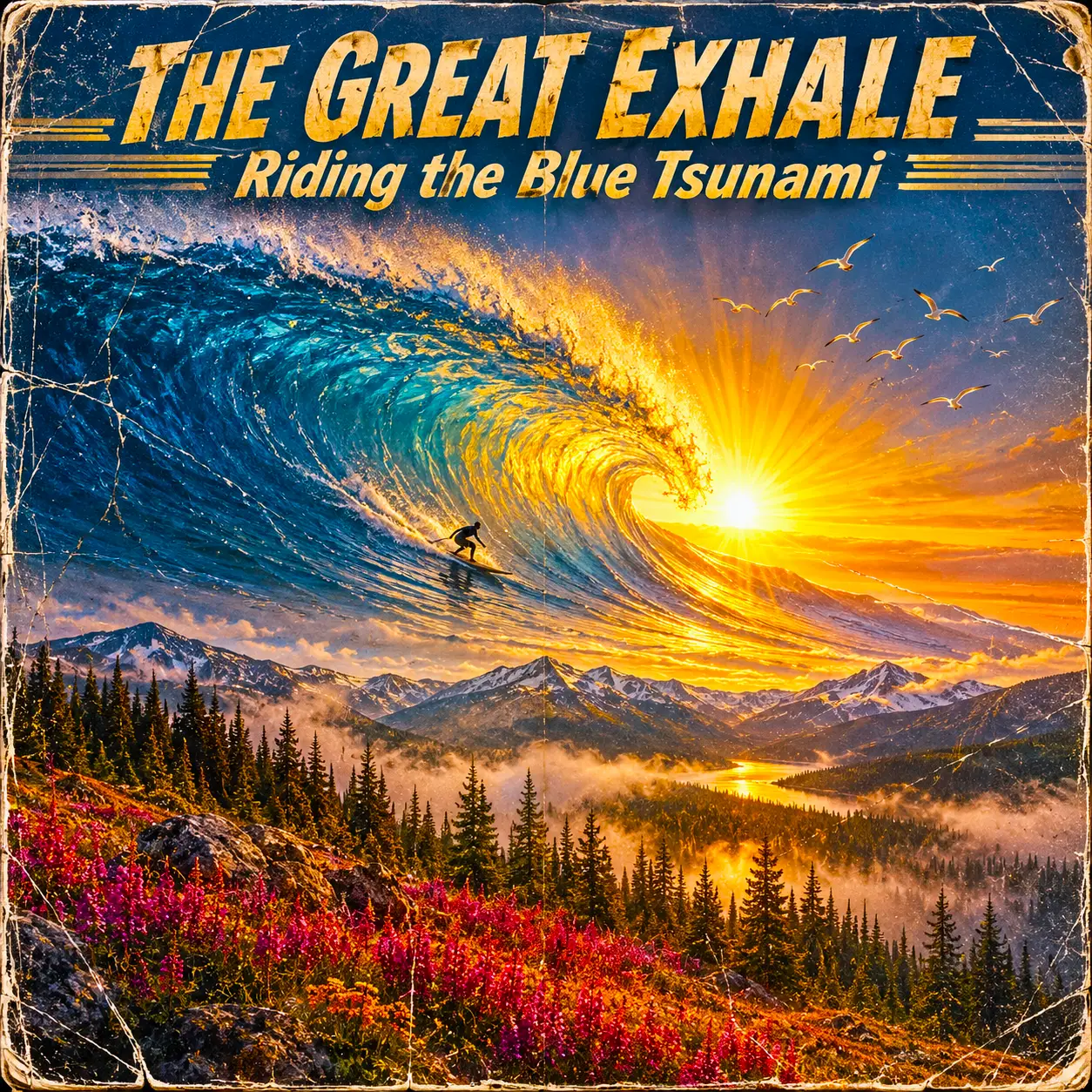
Riding the Blue Tsunami
Read First:
Human-AI Collaboration/Open Source Software: Composer/Sound Designer(Linktr.ee/j_j_j), Google Flow Music (Lyria 3.5), Claude.ai, ChatGPT, Perchance.org – DAW, Audacity 4.0.1, OS, Linux (Ubuntu 26.04.5)
Twelve Songs for the Wave That Carried Us Toward a Beautiful Human Future
The Great Exhale: Riding the Blue Tsunami – Full Album (34:16)
Click to Download Free Full Album Mix MP3 (44.1 kHz @ 320 kbps – 81.3 MB)
Project Decisions
The essay falls naturally into 12 chapters, so the album has 12 songs, one chapter each, in three movements. The tone is uplifting from the first bar. The “warning label” years appear only as the shore we are leaving, never as a place the music lingers. The sequence runs as a roller-coaster of three rises and two valleys (the third rise lands softly into the closer), so the listener climbs, rests, and climbs again, much like paddling out, catching a swell, and riding it in.
| # | Song | Essay Chapter | Movement | BPM | Intensity (1-10) |
| 01 | Peel the Warning Label | The years that looked like a warning label | I. Gathering Swell | 96 | 4 |
| 02 | Wisdom Catches Up | Tools outran our wisdom | I. Gathering Swell | 108 | 5 |
| 03 | Noise Becomes Chorus | Told our voices were noise | I. Gathering Swell | 118 | 7 |
| 04 | Through the Filter | The Level 1 civilization test | I. Gathering Swell | 124 | 8 |
| 05 | No Gurus | “We are saving ourselves” | II. The Turn | 76 | 4 |
| 06 | The Whole Sea Turns | The collective exhale | II. The Turn | 112 | 7 |
| 07 | Build, Don’t Burn | Build or burn | II. The Turn | 128 | 9 |
| 08 | The Ones Who Watch | Others watching, hoping | II. The Turn | 68 | 3 |
| 09 | Kinda | The skeptic, breathing anyway | III. Exhale | 100 | 5 |
| 10 | A Story, Not a Law | Inevitability was only a story | III. Exhale | 112 | 7 |
| 11 | The Reflection Looks Like Hope | The artist’s mirror | III. Exhale | 132 | 10 |
| 12 | Behold, the Spring | We are truly free now | III. Exhale | 60 | 2 |
A Note From The Sound Designer To You, The Listener
Before you press play, here is a short guide to what you’re about to hear and how it was made.
What This Is
The Great Exhale: Riding the Blue Tsunami is a 12-track album of uplifting, vocal, anthemic music. It runs [insert final runtime]. It is meant to play from start to finish, like a single long wave, though every song also stands on its own.
About The Title, The Great Exhale
An exhale is the moment you finally let go of a breath you didn’t know you were holding. The album grew out of an essay I published the same day I started it, about a feeling I had that a very large number of ordinary people, tired and stretched thin, quietly decided together to steer toward something better. “The Blue Tsunami” is what I called that wave. Please look past the colors; to me it was never about one side, it was about a shared sigh of relief. The subtitle is simple: this album is about riding that wave toward a human future worth building.
The Journey In Three Movements
I. Gathering Swell (Tracks 1-4) is the build. The old fear is peeled away, wisdom catches up with our tools, and our voices turn out to be a chorus, not noise.
II. The Turn (Tracks 5-8) is the wave itself. We have no gurus, the whole sea turns at once, we choose to build, and a quiet moment looks to the sky.
III. Exhale (Tracks 9-12) is the ride in. Skepticism and hope share a seat, the old story turns out to be only a story, and the album lands on a sunrise.
Track Summaries
- Peel the Warning Label. The album’s first breath. The caution stickers curl in the morning sun.
- Wisdom Catches Up. Our tools ran ahead, and now the heart is catching up, with humans and machines learning to walk together.
- Noise Becomes Chorus. Voices we were told were noise tune themselves into harmony.
- Through the Filter. Every young civilization faces a test. This is the song about walking through the door.
- No Gurus. A choir with no lead singer. “We are saving ourselves.”
- The Whole Sea Turns. The collective exhale, the moment the wave lifts everyone at once.
- Build, Don’t Burn. The album’s big answer to the question the universe asks.
- The Ones Who Watch. A quiet, spacious pause beneath the stars, imagining others hoping for us.
- Kinda. The skeptic’s anthem. Hopeful, a little cautious, and breathing anyway.
- A Story, Not a Law. The inevitability I feared turned out to be a story, and stories can be rewritten.
- The Reflection Looks Like Hope. The peak of the album, an artist’s mirror finally showing sunrise.
- Behold, the Spring. A gentle landing. The title echoes the words of Sitting Bull, whose voice and the name Tatanka inspire this project; I have written the song in respect and not as imitation.
The Sound
Think luminous, cinematic Americana meeting surf-shimmer: reverb-washed electric guitar, pedal steel, warm acoustic strumming, round bass, handclaps and stomps, glowing synth pads, and a gospel-style crowd choir, with ocean, prairie wind and a real human breath woven through. The energy is intentionally a roller-coaster. Songs rise and relax in waves, so please don’t be surprised when a gentle track follows a big one. That is the swell and the trough.
Lyrics, Lyrical Themes And Vocalists
This album has lyrics throughout. They are written to be universal and hopeful, about breath, wave, light and community, and about choosing to build. The voices you hear, both the lead and the choir, are AI-generated; no real singer’s voice was recorded or imitated. [Confirm before publishing.]
How It Was Made: A Human-AI Collaboration
This album was built by one human working with several AI tools, with the artist steering at every step:
- Human (the Sound Designer, JJ): concept, essay, direction, selection, arrangement, editing, sequencing, and final decisions on everything you hear.
- Google Flow Music (Lyria 3.5): AI music and vocal generation, used to produce raw musical material.
- Claude.ai and ChatGPT: AI assistants used for planning, lyric drafting, music prompting, track naming and notes like these.
- Perchance.org: a free, open web generator used for [specify, e.g. names, ideas or artwork].
- Audacity 4 (alpha): the audio editor where the material was shaped, trimmed, layered and mixed.
- Linux (Ubuntu 26.04): the operating system everything was assembled on.
The AI produced raw material only after the human songwriter decided what the album’s themes and construction would be, what stayed on the record, what was cut, and how it all fits together. Please treat the result as a collaboration, not a push-button product.
Listen And Download
- Watch and listen on YouTube (audio/visual stream): [insert YouTube link]
- Free MP3 download, highest quality (320 kbps): [insert download link]
The download is free and it’s the best-sounding version, so it’s worth grabbing for headphones or offline listening.
A Few Listening Suggestions
- Start at track 1 and let it run. The album is paced like breathing in, riding, and breathing out.
- Headphones or decent speakers will reveal the choir layers and the room around the guitars.
- Play it on a walk, a drive, a sunrise, or any moment you want to remember that the future is still being written.
- Read the companion story, “The Night the Whole Planet Exhaled,” while you listen. It follows the same themes with a different set of characters.
Transparency And Sharing
This album was made with AI assistance, and I’m saying so openly. I compose with AI assistance because it opens new artistic pathways and lets me explore far more sonic ideas than I could alone, while I still shape, edit and decide every detail of the final music. All of my work is free and not monetized in any manner, so please download this and my other projects at will.
Thank You For Listening
Thank you for giving this time to the music. I hope it gives you a little room to breathe, and a little wave to ride.
JJ, Composer / Sound Designer
Theme Rendering / Summary
The Great Exhale is the sound of a held breath finally let go. It takes the essay’s central image, a very large and ordinary crowd quietly deciding together to steer, and turns it into a wave you can ride: blue and gold, rising, buoyant, and shared. The music is joyful without being naive. It keeps the author’s “kinda” skepticism as a companion, not an enemy, because hope that carries its own doubt is the kind that lasts.
Within the broader TATANKA narrative, the album carries forward the project’s core convictions: community over charisma (“We have no gurus”), humans and their tools learning to walk together, inclusion as a source of strength, and a nurturing, family-first view of civilization, the “life we can make for our children.” The Level 1 civilization idea, a species that stops warring with its planet and itself, is the album’s long horizon.
Tone indicators: luminous, buoyant, anthemic, communal, cinematic, grounded, gently defiant. Genre fusion: cinematic Americana, surf-guitar shimmer, anthemic folk-rock, gospel crowd choir, and warm ambient synth pads.
Narrative Arc Adaptation for Lyrics
Prelude (Track 1): Peel the Warning Label. The listener stands on the shore at first light. The old caution stickers are curling in the sun. The emotional state is relief edged with anticipation.
Symphony, Movement I: Gathering Swell (Tracks 2-4). The swell builds. Wisdom starts to catch up with our tools, scattered voices find a shared pitch, and the great test of a young civilization is reframed as a doorway. The journey is from fear to recognition.
Symphony, Movement II: The Turn (Tracks 5-8). A hush, a stomp, and a choir with no leader. The whole sea turns at once, the question “build or burn?” is answered with joy, and the album pauses beneath the stars to imagine being watched with hope. The journey is from recognition to collective action, then to wonder.
Symphony, Movement III: Exhale (Tracks 9-11). The skeptic lets doubt ride along. The inevitability we feared is revealed as a story, and an artist’s mirror finally shows sunrise. The journey is from cautious hope to wholehearted joy.
Coda (Track 12): Behold, the Spring. The wave reaches shore. Everything slows to a breath, a meadow, a sunrise, and a final exhale into silence.
Key motifs and archetypes:
- The Breath: inhaling in the opening, exhaling in the close, the album’s heartbeat.
- The Wave: the shared surge that lifts everyone, surfers and landlubbers alike.
- The Choir: the leaderless crowd, where “noise” becomes harmony.
- The Skeptic: the narrator who keeps one eyebrow raised and breathes anyway.
- The Watchers: the unseen others, hoping for us.
- The Builder: hands, hammers, barns, roofs, a species choosing to make rather than unmake.
Each song borrows a motif from the one before it, such as a returning guitar figure, a breath sound, or a recurring phrase like “hold it light and let it go,” so that every track feels like one verse of a single unfolding narrative.
General Text-to-Music Prompt (Album-Level)
Best-fitting genre fusion: Because the story is about a wave, a crowd, an open landscape and a shared sunrise, the best fit is cinematic Americana meets surf-shimmer and gospel-choir anthem folk-rock. Americana grounds it in the heartland and the porch. Surf guitar supplies the wave. A communal gospel choir carries “no gurus, only us.” Warm synth pads supply the cosmic horizon.
Create an uplifting, cinematic Americana anthem with surf-shimmer electric guitar (clean tone, spring reverb, gentle tremolo), warm pedal steel swells, bright acoustic strumming, round upright-style bass, handclaps, stomps and rolling toms. Add a leaderless gospel-style crowd choir with warm layered harmonies and a lead vocal that is honest, warm and sincere. Layer glowing Lydian-leaning synth pads, distant ocean swells, prairie wind and an occasional natural breath. Convey the feeling of riding a golden-blue wave toward a hopeful sunrise: relief, awe, community and joy. Dynamics should rise and fall like a swell, each song building into big open choruses and then easing back to a soft, spacious release. Tempo 60-132 BPM. Major keys with occasional Lydian lifts. No dark or menacing textures.
Song-by-Song Development
Every song shares the album’s sound DNA (cinematic Americana, surf-shimmer guitar, pedal steel, gospel crowd choir, glowing pads, ocean and wind) and differs only in tempo, density and dynamics.
01 Peel the Warning Label
Theme Summary: The album’s first breath. The listener stands on a shore at first light while the old caution stickers curl and lift in the morning sun, revealing clean paint underneath. This song sets the emotional contract: the fear was real, but it was never the final word. It kindles the swell that the next three tracks will build.
Sound:
Uplifting cinematic Americana surf-shimmer anthem, clean electric guitar with spring reverb, soft ocean swells, warm acoustic guitar strumming, round bass, light hand percussion, leaderless gospel crowd choir on chorus, pedal steel swells, glowing Lydian synth pads, sincere warm lead vocal, 96 bpm
Lyrics:
Intro
One breath in before the light,
Salt on the wind, a hum in the night,
Somewhere past the sleeping town
A tide is gathering its sound.
Verse 1
We read the label every day,
Caution, fragile, look away,
We learned the warnings word by word
Till all we heard was what we feared.
Verse 2
But labels peel when the sun climbs high,
Corners curl in a morning sky,
Underneath, the paint is clean,
Brighter than we’d ever seen.
Verse 3
Old rooftops hold the first warm gold,
Porch lights fade as the dark lets go,
Strangers waving from the street,
Same slow rhythm, same heartbeat.
Verse 4
Don’t tell me it’s too late to start,
Hope is a hammer, hope is an art,
Every hand that lifts a stone
Builds a road we call our own.
Chorus
Peel it off, peel the warning label,
Let the morning read us what we’re able,
Light on the water, wind in our sails,
Every small voice is a gathering gale.
Bridge
Say it was heavy, say it was long,
Say we forgot the words to the song,
Now they’re coming back one by one,
Humming up from the rising sun.
Outro
Peel it off, let it drift away,
Breathe in the beginning of the day,
The swell is rising, soft and slow,
Come on, come on, let’s go.
02 Wisdom Catches Up
Theme Summary: The essay’s observation that our tools outran our wisdom becomes a hopeful forward run. Rather than lamenting the gap, the song celebrates the heart and conscience sprinting to meet the machines, and imagines humans and their tools (including AI) learning to walk side by side. A brisk, bright step up in energy from the opener.
Sound:
Cinematic Americana, Surf Dream Pop, shimmering tremolo guitar, vintage pedal steel haze, driving mid-tempo drum machine, warm analogue bass, soft synth swells, airy detached female vocal, layered backing harmonies, desert warmth, uplifting, 112 BPM, Key of G Major
Lyrics:
[Verse 1]
Red dust on the line
Fast iron in the sun
I ran beside the noise
To see how far you run
[Chorus]
Now wisdom catches up at last
We walk side by side
No need to beat the wind
Learning to be unafraid
(Unafraid)
[Verse 2]
My hands know every bolt
Your pulse is slowing down
The desert turns to blue
Above the quiet ground
[Chorus]
Now wisdom catches up at last
We walk side by side
No need to beat the wind
Learning to be unafraid
(Unafraid)
[Bridge]
Rest your heat against the land
I will stay right here
No more distance left to cross
(No more fear)
[Chorus]
Now wisdom catches up at last
We walk side by side
No need to beat the wind
Learning to be unafraid
[Outro]
Side by side
(Side by side)
Under open sky
(Side by side)
Unafraid
(Unafraid)
03 Noise Becomes Chorus
Theme Summary: The voices the essay says were told for years they were just noise find each other and tune themselves into harmony. The song moves from private hums to a town-wide chorus without a conductor. This is the first big emotional lift of the album, where the “supermajority of humanity” becomes audible.
Sound:
Uplifting cinematic Americana surf-shimmer anthem, building crowd-choir arrangement, sparse acoustic guitar opening to layered humming, heavy stomps and claps, rolling toms, shimmering surf guitar, soaring pedal steel, full communal chorus, 118 bpm
Lyrics:
Intro
They called it noise, the sound of us,
Kitchen tables, bus-stop dust,
Tired voices, tired feet,
Stuck inside a hush too deep.
Verse 1
Night-shift nurses, farm-truck dads,
Teachers keeping what they had,
Kids on porches, cooks at dawn,
Every one a quiet song.
Verse 2
Told to whisper, told to wait,
Told the door was closed, too late,
But a whisper in a crowd
Is just a chorus not yet loud.
Verse 3
One hum here and one hum there,
Rising through the evening air,
Not a word was planned or sent,
Still we found the same intent.
Verse 4
Voices tuning, find the key,
Falling into harmony,
Ten, a thousand, million, more,
Shaking windows, shaking floors.
Chorus
Noise becomes chorus, the whole town sings,
Every small voice has its wings,
Louder than doubt and brighter than fear,
Hear that sound? It’s all of us here.
Bridge
No conductor, no baton,
Just the dawn we’re leaning on,
Count it in on a breath, then go,
Let the whole wide world just know.
Outro
We were never noise,
We were never noise,
We were the first notes of the song,
And the song is going strong.
04 Through the Filter
Theme Summary: The essay’s idea that every young civilization faces a filter, a test of whether it can hold power without destroying itself, is reimagined as a luminous doorway. The song looks up at the stars, names the test, and walks through it together toward a Level 1 world. It is the first big peak of the album, the crest of the opening wave.
Sound:
Uplifting cinematic Americana surf-shimmer anthem at full lift, soaring surf guitar with spring reverb, big pedal steel and synth-pad swells, driving drums with four-on-the-floor kick, heavy stomps and handclaps, huge gospel choir on chorus, key change up whole step before final chorus, 124 bpm
Lyrics:
Intro
Stars above the prairie floor,
Every species meets one door,
Some turn back and some turn through,
Tonight the door is open for you.
Verse 1
They say there is a filter, wide and steep,
Where young worlds stumble in the deep,
Learn to hold the fire you’ve found,
Or lose the light and lose the ground.
Verse 2
We held a fire in clumsy hands,
Fought each other for the sands,
Burned the forests, scarred the sea,
Asked the sky what we should be.
Verse 3
Now the answer, small and strong,
Gathers where we all belong,
One planet, many names,
One long family, many flames.
Verse 4
Level One, a world at peace,
Sun and wind and tides released,
Not a conquest, not a crown,
Just a family settling down.
Chorus
Through the filter, bright and wide,
Whole world walking side by side,
Every hand a rising tide,
We were made for this ride.
Bridge
Scientists count in watts and wire,
But we count in hands and choir,
Level One is just a name
For a family sharing flame.
Outro
Through the filter, into the day,
Rising up and on our way,
The old test ends, the real work begins,
Open sky and wide-open wins.
05 No Gurus
Theme Summary: The first valley and the album’s heart. After the peak, the wave pulls back into a hush and a stomp. This is the literal expression of the essay’s line, “We have no gurus. We are saving ourselves,” built from dozens of layered individual voices with no lead singer. It begins nearly a cappella and grows from a single stomp into a field of voices.
Sound:
Intimate uplifting communal folk anthem, single foot stomp and handclaps opening, layered unison and harmony voices with no lead singer, sparse acoustic guitar, warm upright bass, faint ocean swell, blooming choir with soft pedal steel on final chorus, 76 bpm
Lyrics:
Intro
No throne, no crown, no voice on high,
Just a crowd beneath one sky,
Stomp the ground and clap it in,
Let the singing now begin.
Verse 1
Nobody’s coming down the hill,
Nobody’s riding in to heal,
We’re the ones we have been waiting for,
Every neighbor, every door.
Verse 2
No prophet on a mountaintop,
No salesman with a golden prop,
Just hands that mend and hands that feed
And hands that plant the common seed.
Verse 3
Everybody carries a piece,
A little map, a little peace,
Put them all together, see,
It’s the whole of what we need to be.
Verse 4
Lead from the middle, lead from the side,
Lead from the back where the doubters hide,
Everyone’s invited, everyone’s in,
Every voice is where we begin.
Chorus
We have no gurus, we are saving ourselves,
Every voice a lantern, every hand a help,
Nobody above us and nobody below,
Just a million of us, learning how to grow.
Bridge
If you’re tired, lean on me,
If you’re lost, then sing with me,
If you’re scared, then stand with me,
We’ll all stand, we’ll all be free.
Outro
No gurus, no gurus,
Only us, only us,
Singing in the open air,
Everybody, everywhere.
06 The Whole Sea Turns
Theme Summary: The Blue Tsunami as the essay saw it: not a mob or a movement run by one personality, but a collective exhale of ordinary people reaching the same conclusion at once. The song begins with the tide pulling back and the long inhale before the swell, then lifts everyone together. The lyrics honor the essay’s plea to look past the colors.
Sound:
Uplifting cinematic Americana surf-shimmer anthem, low ocean pull intro with sustained synth pad, sudden release into rolling surf-guitar arpeggios, driving drums, shimmering synths, audible breath exhale downbeat on chorus, rising gospel choir harmonies, 112 bpm
Lyrics:
Intro
Listen, listen, the water’s low,
The tide is pulling back, and slow,
Everyone on the shore can feel
Something big about to heal.
Verse 1
Quiet at the edge of morning,
Not a trumpet, not a warning,
Just a million breathing in,
Counting down to begin.
Verse 2
Then at once, without a sign,
Ordinary lines align,
Every shoulder, every sail
Leaning into the same gale.
Verse 3
It was blue, but look past the hue,
It was colors running through,
Every shade, every name,
Gathered underneath one flame.
Verse 4
No mob, no master, no flag to wave,
Just the people, calm and brave,
Rising like a gentle tide,
Carrying everyone inside.
Chorus
The whole sea turns, and we ride the swell,
Every voice a wave, and every wave a bell,
Salt and sun and a breath let go,
Carry us home, carry us home.
Bridge
Hold the board, feel the lift,
Every grain a little gift,
Don’t fight the water, join the roll,
Let it carry you home whole.
Outro
Exhale, exhale, the whole sea turns,
Everything we’ve feared, we’ve learned,
Hold it light and let it go,
Ride it in, nice and slow.
07 Build, Don’t Burn
Theme Summary: The universe’s question in the essay, “When it truly mattered, did you choose to build or to burn?”, gets an exuberant answer. This is the album’s second peak: a barn-raising, hammer-swinging, hand-clapping celebration of making things. It turns the author’s confession (“for a long time I thought the answer was burn”) into a joyful reversal.
Sound:
Uplifting cinematic Americana surf-shimmer anthem, fast driving drums, galloping bass, bright strummed acoustic guitar, cresting surf-guitar leads, handclaps, stomps, rhythmic hammer percussion, triumphant pedal steel, massive call-and-response gospel choir, 128 bpm
Lyrics:
Intro
Somebody asked the universe’s question:
Build or burn, and what’s your confession?
We looked at our hands, at the fire, the grain,
And said, “We’ll build, and we’ll build again.”
Verse 1
There’s a hammer in the heartland, there’s a spark in the stone,
There’s a thousand little workshops where the future’s being grown,
Every kitchen table’s blueprint, every garage a start,
Every good idea a seed in a frightened heart.
Verse 2
We could’ve lit the whole thing up and called it clean,
Watched it all go down in a dazzling scene,
But the thing about a flame is it forgets the home,
And we would rather raise a roof than dance alone.
Verse 3
Solar on the barn, wind along the plain,
Rivers running clear again,
Teachers, tinkers, nurses, kids,
Building what the old world never did.
Verse 4
Make it balanced, make it last,
Plant for futures, not the past,
Every mind and every hand
Aimed at the world we planned.
Chorus
Build, don’t burn, build, don’t burn,
Every lesson that we learn,
Raise the roof and raise the sun,
Build it, we have just begun.
Bridge
Burning’s easy, burning’s quick,
Building takes a patient trick,
Brick by brick and breath by breath,
Love outlasting even doubt.
Outro
We build! (We build!)
We build! (We build!)
Shoulder to shoulder, rising through,
Look what a world can do.
08 The Ones Who Watch
Theme Summary: The second valley, and the album’s most spacious moment. The essay’s intuition that others, “in whatever form or dimension,” watch young species reach this threshold and hope for them becomes a quiet, starlit lullaby. It is wonder instead of worry: the sense of being gently seen. It lets the listener rest before the final climb.
Sound:
Spacious uplifting cinematic Americana lullaby, soft fingerpicked acoustic guitar with long spring reverb, distant pedal steel swells, slow glowing synth pads, hushed breathy lead vocal, gentle choir pad, starlit and wide atmosphere, 68 bpm
Lyrics:
Intro
Up beyond the bluest air,
Somewhere someone’s leaning there,
Not to judge and not to blame,
Just to whisper out our name.
Verse 1
Maybe in a different light,
Maybe past the edge of sight,
Older worlds with patient eyes
Watch young stars begin to rise.
Verse 2
Not a throne and not a test,
Just a hand against a chest,
Hoping, hoping, quiet as snow,
That the young ones learn to grow.
Verse 3
I have felt it all my life,
A gentle glance, a guiding light,
Call it faith or call it poem,
Call it echo, call it home.
Verse 4
If you’re out there, here we are,
Small and bright, a baby star,
We are learning how to share,
Thanks for being there.
Chorus
The ones who watch are hoping,
The ones who watch are near,
Every time we choose the better,
Somewhere out there, a cheer.
Bridge
Hush, now, hush, the night is wide,
Stars are windows lit inside,
We are not alone in this,
Every star’s a kind of wish.
Outro
Hoping, hoping,
Hoping with us,
Watch us rise,
We’re on our way.
09 Kinda
Theme Summary: The album’s emotional center, built from the essay’s most honest line: “I remain a skeptic, but am allowing myself this breathing room.” It is playful, warm and self-aware, a shrug with a smile. It tells the listener that doubt and hope can share the same seat, which is exactly why this hope is believable.
Sound:
Warm playful uplifting Americana-pop, bouncy acoustic guitar strum, light shaker and brushed snare, bright clean surf-guitar hook, singalong whistling, conversational lead vocal with a smile, small gospel choir answering on chorus, pedal steel sighs, 100 bpm
Lyrics:
Intro
Am I hopeful? Kinda, yeah,
Is it over? Not quite clear,
But I’m standing in the sun
And I like how it’s begun.
Verse 1
I’m a skeptic, I admit,
I read the fine print, bit by bit,
I’ll check the claim, I’ll count the cost,
But I won’t call the morning lost.
Verse 2
Hope’s a muscle, hope’s a door,
It’s been quiet, it’s been sore,
So I’ll use it just a bit,
Let it stretch and see it fit.
Verse 3
Take a breath, don’t promise me
That tomorrow’s guaranteed,
Nothing worthy ever was,
Still I’ll sing, because, because.
Verse 4
Call it breathing room, call it grace,
A little sunlight on my face,
I’ll keep my eyebrow raised and still
Dance a little on this hill.
Chorus
Kinda hopeful, kinda free,
Kinda ready, wait and see,
Kinda breathing, kinda glad,
Best kind of kinda I’ve ever had.
Bridge
Let doubt ride shotgun, that’s alright,
Hope can drive into the light,
Both of them can read the map,
Both can sing the chorus back.
Outro
Kinda, kinda, kinda yes,
Kinda more and kinda less,
Breathe in, breathe out, all is well,
Kinda, kinda, time will tell.
10 A Story, Not a Law
Theme Summary: The essay’s turning insight: “The inevitability I feared turned out to be a story, not a law of nature.” This song is the intellectual and emotional unlock of the third movement. It is about discovering that the ending we assumed was written is still wet ink. The energy grows as the listener realizes they are holding the pen.
Sound:
Uplifting cinematic Americana-surf anthem in a rising groove. Driving mid-tempo drums, pulsing bass, chiming surf-guitar arpeggios that climb, steady handclaps, pedal steel soaring above, and a choir that grows with each chorus. A short breath-pause before the final chorus. Tempo 112 BPM. Convey the thrill of discovering the ending can be rewritten. Intensity 7 of 10, climbing
Lyrics:
Intro
They said it was written in the stars,
Carved in stone, and so it goes,
But the stars were only waiting
For a people who would grow.
Verse 1
I believed the ending, I believed the plot,
Thought the tragedy was all we’d got,
Told myself the dark was destiny,
That nobody could rewrite me.
Verse 2
But a story’s just a tale we tell,
Not the tide and not the swell,
Not the law of wind or sun,
Just a page that isn’t done.
Verse 3
Turn the page and find the ink
Still is wet, so stop and think,
Every hand holds a pen,
Every morning writes again.
Verse 4
Write it kind and write it true,
Write a verse for me and you,
Write the neighbor in the line,
Write the whole world, redefine.
Chorus
It’s a story, not a law,
Not a wall, but an open door,
We can change the ending now,
Pick up the pen, and show us how.
Bridge
Gravity is gravity, that’s physics, that’s real,
Fear is a story, and stories can heal,
So lift the sail and turn the page,
This is a brand-new age.
Outro
A story, a story,
Not a law, not a law,
And the next chapter’s ours,
And the next line starts with us.
11 The Reflection Looks Like Hope
Theme Summary: The album’s third and highest peak. In the essay, the artist’s job is to reflect what is in front of him, and “for the first time, likely ever, the reflection looks like hope.” This song is the whole wave at full height: sunrise on every surface, the biggest chorus, the widest sound. It is joy without apology.
Sound:
Euphoric, uplifting cinematic Americana-surf anthem at maximum lift. Blazing surf-guitar leads with spring reverb, huge pedal steel and string-pad swells, pounding drums with crash cymbals, stomps, handclaps, bright tambourine and the largest gospel choir of the album with soaring harmonies. A key change up for the last chorus. Tempo 132 BPM. Convey sunrise on a breaking wave, pure triumphant joy. Intensity 10 of 10, the highest peak
Lyrics:
Intro
I hold the mirror up to the days,
Like I always do, in all the ways,
And for the first time in my life
The glass is full of morning light.
Verse 1
For years I painted what I found,
Smoke on the water, cracks in the ground,
An honest brush, an honest eye,
Nothing but a stormy sky.
Verse 2
Now the colors are changing, now the hues are warm,
Gold on the mountain, calm after the storm,
Same honest brush, same honest hand,
But the picture’s a brand-new land.
Verse 3
Flowers on the ridgeline, magenta and gold,
Mist on the valley, young and old,
Children running through the light,
I just paint what’s in my sight.
Verse 4
If you see it too, then say so loud,
Let it ring out through the crowd,
Every mirror, every screen,
Show the future we can be.
Chorus
The reflection looks like hope,
Gold on the water, gold on the slope,
Look how far we’ve come, look how we glow,
Riding the wave, and we’re ready to go.
Bridge
Paint it bright and paint it wide,
Paint the ones who stood beside,
Paint the dawn on every wall,
Paint a place for one and all.
Outro
Hope in the mirror, hope in the sea,
Hope in the world that’s waiting for me,
Hope in the water, hope in the air,
Hope is the picture, and we’re all there.
12 Behold, the Spring
Theme Summary: The coda and the landing. The wave reaches shore and everything slows to a breath, a meadow and a sunrise. The title and spirit draw on the closing words of Sitting Bull quoted in the essay, an invitation to see spring arrive and to put our minds together for our children. This is the album’s final exhale, ending in silence.
Sound:
Tender, uplifting cinematic Americana closer in the album’s sound world. Slow fingerpicked acoustic guitar, warm pedal steel, soft shimmering surf-guitar harmonics, sustained golden pads, light shaker, a gentle lead vocal and a hushed choir that swells once on the chorus. Prairie wind and morning birds underneath. The final seconds fade to a single slow human exhale, then silence. Tempo 60 BPM. Convey a sunrise landing, peace and gratitude. Intensity 2 of 10, the gentle shore
Lyrics:
Intro
Behold, the spring has come again,
After the long cold, the gentle rain,
The earth receives the morning sun,
And a new day has begun.
Verse 1
Mountains turning gold and rose,
Wildflowers where the cold wind blows,
Mist is lifting off the stream,
Waking from a heavy dream.
Verse 2
Let us gather, heart and mind,
Make the life they hope to find,
Our children running through the grass,
Free as the wind that’s moving past.
Verse 3
Every neighbor, near and far,
Every creature, every star,
Each has the right to this wide land,
Held in an open, gentle hand.
Verse 4
We are free to rest and start,
Free to open up the heart,
Free to look ahead and see
All that we are meant to be.
Chorus
Exhale, exhale, let it go,
Let the golden river flow,
We were carried, we were free,
Home at last in the open sea.
Bridge
Not an ending, only dawn,
Not a victory, just going on,
Gentle as the first green shoot,
Strong as every growing root.
Outro
Breathe in the spring,
Breathe out the cold,
Behold, behold,
The sun, the gold.
Narrative Adaptation
The Night the Whole Planet Exhaled
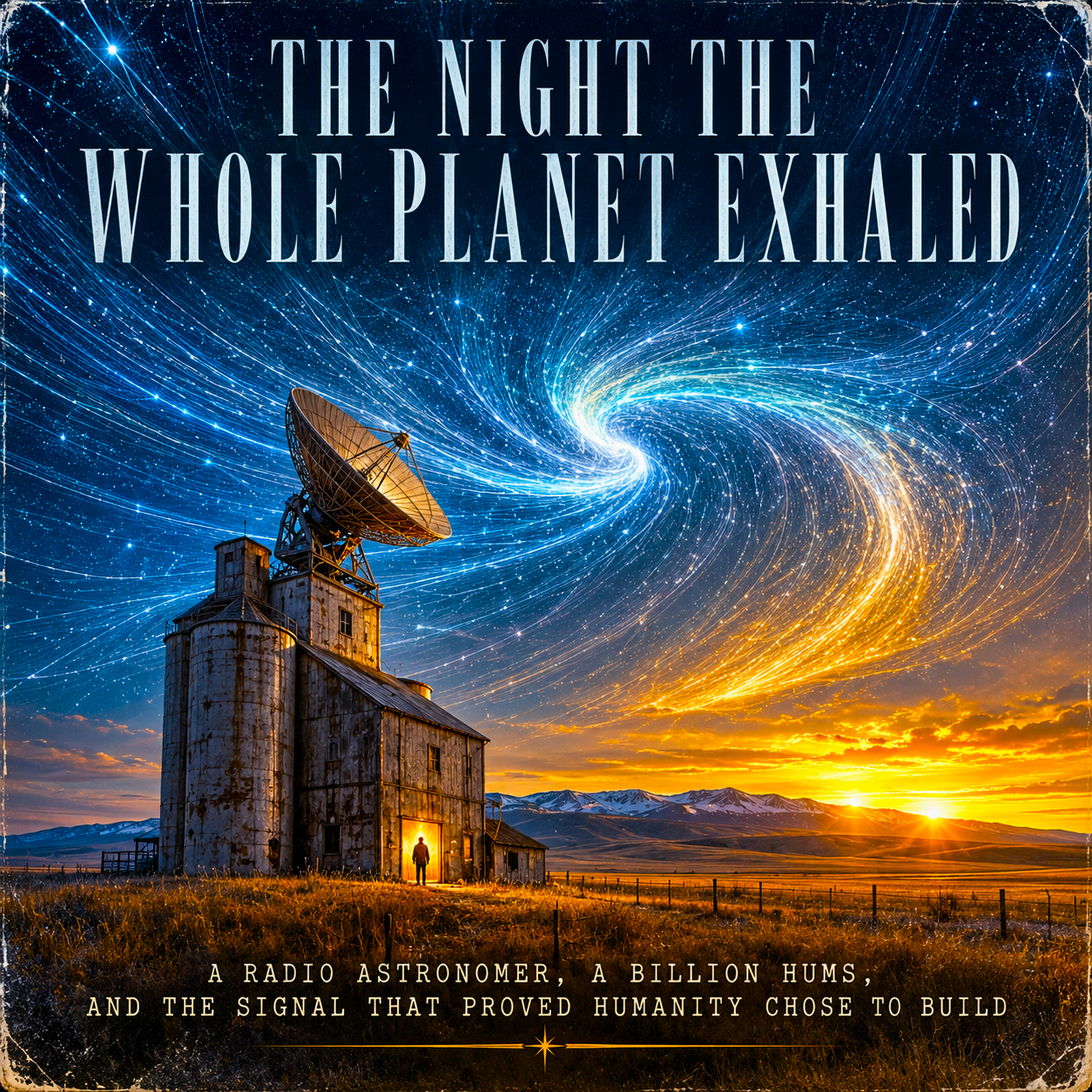
A Radio Astronomer, a Billion Hums, and the Signal That Proved Humanity Chose to Build
I used to listen for aliens for a living. By the autumn I’m telling you about, I mostly listened to us, and we were unbearable.
My name is Ines Varga, and I ran the Cedar Fork Listening Station, which is a grand name for a decommissioned grain elevator on the high plains with a radio dish bolted to its shoulder like a hawk on a fence post. Out there the sky does most of the work. There are more stars than people, more wind than either, and a horizon so far away you can watch tomorrow’s weather walk toward you. My father built his first receiver at a kitchen table not forty miles from where I’m sitting now. He taught me that a radio is just a patient ear, and that the hardest thing in the world is to listen to something without deciding what it ought to say.
For eleven years I had listened for a signal from beyond. Lately the instruments kept catching something closer: the sound of our own planet leaking into space. Every phone call, broadcast, argument and alarm we had ever made rose through the atmosphere as a kind of roaring static, and in those years the roar had turned jagged. You could see it on the waterfall display, the long scrolling screen where frequencies bloom and die: a smear of red and white, spiking and spiking, the visible shape of a species shouting itself hoarse.
My director, Dr. Osgood Pike, had a name for it. The Noise Floor. He had drafted a report under that title, forty pages with handsome charts, and its conclusion was that civilizations, like stars, burn out on schedule, and ours had a date on it. He planned to present it in the morning and then, quietly, close the station. “Nobody funds a hospice for the obvious,” he told me, and I’m ashamed to say I didn’t argue. I had caught the same weather he had. I had started to think the loudest thing about us was our certainty that we were finished.
My assistant that autumn was a sixteen-year-old named Tobias Aldana, a kid whose family had moved inland for reasons nobody explained, who had never touched an ocean in his life but spoke about waves like scripture. He read the displays the way other kids read comics. Beside him, humming in a steel rack, ran Kestrel, the station’s analysis model, which sorted the noise into categories so we didn’t have to. Pike distrusted Kestrel. I trusted it the way you trust a good dog: warmly, and without handing it the car keys.
Pike was due at nine the next morning. It was past midnight. I was sorting boxes into “keep” and “recycle,” and Tobias was at the console eating sunflower seeds, when he stopped chewing.
“Ines,” he said. “The floor’s moving.”
I looked up. On the waterfall, the red static, the roar I had stopped seeing, was thinning. Not stopping. Thinning, the way a crowd thins when someone steps up to a microphone. And in the middle of the screen something new was rising: a single pale band, narrow as a thread, getting brighter.
“Instrument error,” I said, because that is what you say.
“I have checked for artifacts,” Kestrel said in its mild voice. “I can tell you it is real. I cannot yet tell you what it means.”
We watched it for an hour. The thread became a rope. I zoomed in until the screen was nothing but grain, and the grain was voices. Not words, just hums. Millions of tiny narrowband signals from everywhere at once, phones and radios and old garage transmitters and baby monitors, each one drifting, tuning, nudging itself toward the same slow pulse. It was like standing outside a stadium while a hundred thousand people hunted for the same note.
“It’s a set,” Tobias whispered. “That’s a set rolling in. Look at the period.”
I looked. The pulse rose and fell about six times a minute. Slow. Even. I have stared at waveforms for thirty years, and it took me a long, humbling minute to realize why the rhythm felt so familiar. It was the pace of a resting human breath.
Tobias, who read everything, said the phrase quietly, the way you say a word in church. “Level One.” A civilization that stops fighting its own planet and starts acting like one household. “It’s not a ladder, Ines,” he said. “It’s a door.”
We hadn’t picked up a message. We had picked up a sigh. A planet’s worth of tired people, in a thousand time zones, had set down something heavy at the same moment, and the whole sky could hear it.
Then Kestrel said, “I am detecting a second source.”
It was faint, so faint I thought Kestrel had miscalibrated. It came from high and far, a narrow, patient carrier with nothing on it. No message, no pattern. It didn’t speak. The closest word I have is attention. It was the feeling of someone leaning toward a door because they have heard footsteps and hope they belong to someone they love. And it grew stronger as the human pulse steadied, as if whatever it was could only come closer when we gave it somewhere quiet to land.
I wish I could say I was awed. I was terrified. Awe is just fear that has decided to trust you, and I wasn’t there yet. My whole career had been the discipline of not believing, of eliminating the hopeful explanation, and now I felt the old machinery grind: it’s an artifact, it’s feedback, it’s a prank, it’s wishful thinking dressed up as physics. The skeptic in me gripped the console like a railing on a ship.
At two in the morning, the storm arrived.
Out there, weather doesn’t knock. A wall of black cloud came over the wheat stubble, the lights shuddered, and the grid died like a pinched candle. The backup generator coughed on, and the gauge told me what I already knew: forty minutes of fuel, maybe less. Headlights swung into the gravel lot. Pike, early, soaked and furious, carrying his report in a plastic sleeve.
“Shut it down,” he said, the moment he saw the screen. “Power off the dish before the surge fries it. Whatever that is, it’s a calibration ghost, and if we announce a miracle and we’re wrong, we’ll be a punchline for a generation.”
“It’s not a ghost,” Tobias said.
“It’s sixteen years old and sunflower seeds,” Pike said, not unkindly. “Power it down.”
Here is the thing about that moment. I could feel both futures. In one, I switched off the dish, filed it as an anomaly, and kept my dignity and my pension and my certainty. In the other, I did something stupid and hopeful in the middle of a thunderstorm with forty minutes of fuel.
“Kestrel,” I said. “What do we need to send back?”
“A coherent carrier at the planetary pulse,” Kestrel said. “The dish can transmit it. But the dish needs more power than the generator can give, and the pulse needs more voices than three people can hold.”
“More voices,” I said.
That is when I remembered the old public-address system in the elevator, the one the grain co-op used to call the trucks. I could patch the dish feed into it. And I knew exactly who to call, because in a town of eleven hundred people, everybody’s number is on the diner wall.
I won’t give you every detail. I’ll only say that at three in the morning, in a thunderstorm, the lot filled with trucks. Marguerite came from the diner in her apron. A school-bus driver named Dale. A night-shift nurse still in scrubs. Two brothers who hadn’t spoken in a year, suddenly carrying cable together. Tobias’s mother, with a thermos. People who disagreed about nearly everything stood on the same concrete floor because someone had asked, and because nobody in the room was telling them what to think. We had no guru, no program, no speech. We had a bicycle generator that a farmer rigged to the dish in eleven minutes, and a line of people willing to pedal it.
And Pike stood in the doorway with his forty-page report, the storm behind him, the woodstove glowing beside him. He looked at the stove. He looked at the report. I watched a man decide between the two things a person can do with a finished story: burn it, or build on it. His thumb moved along the plastic sleeve.
Then he set the report on the table, weighted it with a coffee mug, took off his wet coat, and climbed onto the bicycle.
“Cadence,” he said gruffly. “Somebody give me a cadence.”
“Six a minute,” said Tobias, grinning. “In, and out. Hold the board, Doc. Don’t fight the water.”
We hummed. I don’t know what else to call it. Forty people and a bicycle and a dish, all of us breathing to the same slow count while Kestrel stitched our little voices into a carrier and fed it up into the dark. In. Out. In. Out. I felt the elevator hum in my ribs. On the screen, our thread joined the planet’s thread, and the two lit together, and for one long moment the waterfall was not red or white at all. It was gold.
The second signal answered. Not with words. It brightened, warm and steady, like a hand settling on a shoulder, like someone who has been holding their breath on your behalf finally letting it out. And then, at the edge of the sky, the first line of dawn came up over the stubble, and the storm broke apart as if it had never meant it.
Pike presented his report that morning, after all. He changed the title. It’s called The Signal Floor now, and its first page is a single sentence he wouldn’t let me edit. The station is still open. We still listen. The roar is still out there. People are still people, they still argue, and in my professional opinion they will for a long time. I am not a convert, and I want that on the record. I’m a skeptic. Hope, to me, is a hypothesis I intend to keep testing.
But some nights, when the wind comes off the plains, I put my father’s old receiver on the windowsill and turn the dial to nothing in particular, and I listen. Underneath the static there is a slow, steady pulse, six times a minute, in and out. And somewhere far beyond the stars, I like to think, someone who has been leaning toward that door all these years hears it too, and exhales.
Am I sure? Kinda.
That’s enough to ride.
Literary Elements Map (for your reference, not for reading aloud)
| Element | Where it lives in the story |
|---|---|
| Character | Ines Varga (skeptical protagonist), Tobias (young believer in waves), Dr. Pike (the doubter who chooses), Kestrel (the AI ally), and the townspeople as a collective character |
| Plot | A mysterious thread in the noise leads to a second signal, a storm, a choice, and a communal answer |
| Setting | A converted grain elevator and radio dish on the high plains, one stormy night before dawn |
| Theme | Hope is built, not found. Skepticism and hope can share a seat. Ordinary people, with no gurus, can change a story that seemed inevitable |
| Conflict | Ines vs. her own certainty (internal); Ines and Tobias vs. Pike, the storm and the fuel gauge (external) |
| Point of View | First person, retrospective: Ines telling it afterward, wry and honest |
| Tone & Diction | Warm, wry, luminous. Plain, concrete language borrowed from radio, weather and breath |
| Structure | Exposition (the station, the Noise Floor); rising action (the thread, the second signal, the storm); climax (the bicycle, the choir of voices, Pike’s choice); falling action (the answer and dawn); denouement (the report, the windowsill, “Kinda”) |