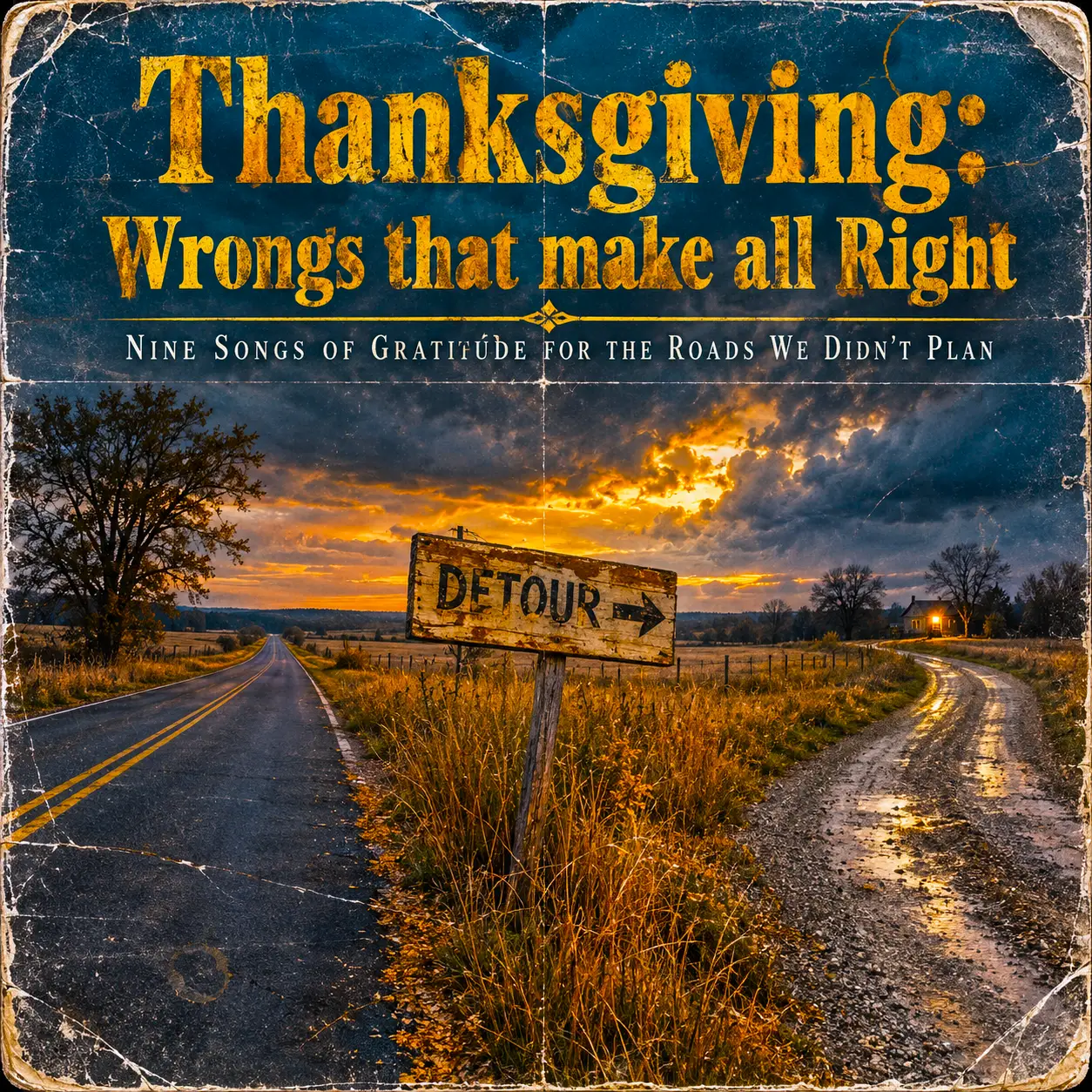
DETOUR HYMNAL
Nine Songs of Gratitude for the Roads We Didn’t Plan
Creative Process: Human-AI Collaboration/Open Source Software: Composer/Sound Designer (Linktr.ee/j_j_j), Google Flow Music (Lyria 3.5), Claude.ai, ChatGPT, Perchance.org – DAW, Audacity 4.0.1, OS, Linux (Ubuntu 26.04.5)
Wrongs that make all Right: DETOUR HYMNAL – Full Album Mix (27:08)
Download Free 320 kbps MP3 of Full Album Mix: Wrongs that make all Right: DETOUR HYMNAL (27:08)
Google Deep Dive Podcast: The Long Way Has Better Light: Finding Grace in Life’s Reroutes
Liner Note – A Note To You, The Listener
Before you press play, here is a guide to what you’re about to hear and how it was made.
What This Is
Thanksgiving: Wrongs that make all Right is a nine-track vocal album of folk-gospel songs. It runs [insert final runtime, about 40 minutes]. Unlike some of my instrumental records, this one has singing, and it tells a story from beginning to end. It’s meant to be played in order, though every song can stand alone.
About The Title, Thanksgiving: Wrongs that make all Right
A detour is the road you didn’t plan to take. A hymnal is a book of songs of thanks, the kind people sing together. Put them side by side and you get the whole idea of the album, a songbook of gratitude for the turns we never meant to make. The album also keeps a promise to be honest. Thankfulness for a hard turn usually comes late, it can’t be forced, and some wrongs simply stay wrong. You’ll hear all of that.
The Idea: Thanksgiving for the Detour
The belief at the heart of this project is that when we stray, something redirects us, and that the “wrong” turns often turn out to be the ones that made everything right. The album takes that belief seriously, and it also tests it, because a belief that can’t survive honest questions isn’t worth building an album on.
Three ideas hold the project up. First, the pattern is seen backward. We rarely feel the redirection while it happens. We feel the flood, the closed door, the lost plan. Meaning arrives in hindsight, when we can finally see who we met and what we became because the road bent. Second, gratitude is usually late, and it can’t be ordered. Thankfulness shows up eventually, but telling someone in the middle of grief to be grateful is a kind of cruelty. The album gives grief its own room (Track 04) and refuses to dress up real harm (Track 07). Third, whether or not the universe steers, we steer what we do at the fork. The detour offers a door. What we build behind it is ours. That is the quiet turn of the companion story, where the AI guide tells the heroine the truth. It rerouted her because the bridge was gone, and everything after that was her own doing.
That gives the album a spine that is spiritual without being naive – thanksgiving for the detour, not for the damage.
The Story The Songs Tell
The album follows one traveler through a single redirection and the years of understanding that follow.
- The Exit I Wasn’t Supposed to Take. A voice on the road says turn, and the traveler’s careful plan folds up.
- Static on the Good Road. Anger, bargaining, and a stubborn refusal to be rerouted.
- Nowhere, Population Us. A storm leads to a porch light and a circle of women who take a stranger in.
- Rerouting. The quietest grief, mourning what was lost without being told to be grateful for it.
- The Long Way Has Better Light. Morning shows the traveler what speed would never have let her see.
- Everything I Cursed Is Holding Me Up. The big, stomping turn into thankfulness.
- The Ones That Stayed Wrong. An honest song about the hurts that never became blessings.
- Fork After Fork, Still Walking. A communal march forward, human and machine side by side.
- Gratitude Arrives Late, and Stays. A year later, the thank-you finally lands.
The Sound
The album blends prairie gospel-folk with soft ambient electronics, fingerpicked acoustic guitar, pedal steel, piano, pump organ, warm bass, hand percussion, stomps and claps, and layered choir harmonies. It’s deliberately uneven in energy. Think of a roller coaster of intensity, with quiet hymns, big sing-along peaks, and hushed valleys, so the album breathes the way a long drive does. I kept the production warm and a little worn, on purpose.
Lyrics, Themes, And Vocalists
Every song has lyrics. The recurring themes are redirection, grief, hospitality, hindsight, and thankfulness. The singers you hear, a lead voice with choir-like harmonies, are AI-generated voices. They aren’t real people, and I want you to know that up front.
How It Was Made: A Human-AI Collaboration
- Human (the Sound Designer): concept, direction, selection, arrangement, editing, sequencing, and final decisions on everything you hear.
- Google Flow Music (Lyria 3.5): AI music and vocal generation, used to produce the raw musical material.
- Claude.ai and ChatGPT: AI assistants used for planning, lyric drafting, prompt writing, track naming, and notes like these. [Confirm which assistant handled which task.]
- Perchance.org: a free, open web generator used for additional artwork, names, and ideas.Before you press play, here is a guide to what you’re about to hear and how it was made.
- Audacity 4 (alpha): the Open Source audio editor where everything was trimmed, layered, and mixed.
- Linux (Ubuntu 26.04): the Open Source operating system on which all multimedia was assembled and post-produced.
The AI produced raw material only after I decided what the album was about, how it was built, what stayed, what was cut, and how it fits together. Please treat it as a collaboration, not a push-button product.
Listen And DownloadGoogle Deep Dive Podcast: The Long Way Has Better Light: Finding Grace in Life’s Reroutes
The download is free, and it’s the best-sounding version, so it’s worth grabbing for headphones or offline listening.
A Companion Story
There’s also a short story to read or hear alongside the album, The Exit That Ruined My Plan (And Saved My Life). It isn’t a retelling of the songs. It travels the same road from a different angle.
A Few Listening Suggestions
- Listen in order, ideally on a drive, a walk, or a quiet evening.
- Use headphones or decent speakers if you can, since the harmonies and quiet moments are easy to lose on a phone.
- Track 04 and Track 07 are the softest. Let them be soft.
- If you’re in the middle of a hard turn right now, you don’t owe anyone thanks yet. These songs will wait for you.
Transparency And Sharing
This album was made with AI assistance, and I’m saying so openly. I compose with AI because it opens new artistic pathways and lets me explore far more sonic ideas than I could alone, while I still shape, edit, and decide every detail of the final music. All of my work is free and not monetized in any way, so please download this and any of my other projects at will.
Thank You For Listening
Thank you for giving this time to the music. I hope it helps you see your own detours a little more kindly.
– JJ, Composer / Sound Designer / Storyteller
Album Framework
Theme Rendering / Summary
Thanksgiving: Wrongs that make all Right is a luminous, grounded, quietly cinematic gospel-folk record about the moment a plan collapses and the long season it takes to understand what collapsed for. It is warm and weathered, tender in its valleys and jubilant at its peaks, and it moves like headlights across wet highway, with sorrow and wonder trading places mile by mile.
Its creed is simple. Give thanks for the detour, not for the damage. The album honors the old hymn tradition of communal gratitude, but it also lets the singer be furious, bereft, and unconvinced before she is thankful, and it admits that some wrongs never become blessings. Gratitude here is earned, not decreed.
Within the broader TATANKA narrative and mission, the album carries the project’s matriarchal ethos in a circle of women whose hospitality reroutes a stranger’s whole life. Its AI–human coexistence in a guiding Signal that advises rather than commands, and its DEI heart in a table where nobody is asked for a title, only “are you hungry?”
Genre fusion: prairie gospel-folk, ambient electronica, a touch of cosmic Americana.
Narrative Arc Adaptation for Lyrics
The arc runs Prelude → Symphony → Coda, moving from certainty through collapse and shelter to hard-won thanks.
- Prelude (Track 01): the Wanderer’s plan meets a closed road and a gentle voice. The Signal appears.
- Symphony, Movement One (Tracks 02–03), Resistance and Shelter: rage at the reroute, then the storm delivers her to The Circle of women, the hearth that holds a stranger.
- Symphony, Movement Two (Tracks 04–05), Grief and Seeing: the lost destination is mourned, and morning reveals the neighbor whose land her plan would have drowned, so she begins to listen.
- Symphony, Movement Three (Tracks 06–07), Thanks and Truth: an anthem of gratitude for what the detour built, followed by an honest song for the wrongs that stayed wrong.
- Symphony, Movement Four (Track 08), Companionship: the Wanderer, the Circle, and the Signal walk on together.
- Coda (Track 09): a year later, thanksgiving arrives, late and lasting, and she lights a lamp for whoever is next.
Key archetypes and motifs: the Wanderer (the traveler), the Signal (the guiding voice, AI as companion rather than master), the Mother/Circle (communal hospitality), the Porch Light (the promise of shelter), and the Fork (every choice point). The phrase “the road knew” recurs across the album as a thread tying all nine songs to one story.
General Text-to-Music Prompt (Album-Level)
Best-fit genre fusion: a story about faith in the unplanned, hospitality, and the American plains calls for prairie gospel-folk, since gospel carries communal thanks and folk carries the road, grounded in ambient electronica so that the Signal can feel like a quiet digital presence.
Album Sound Signature
Create a warm, cinematic prairie gospel-folk song with ambient electronic undertones, fingerpicked acoustic guitar, pedal steel, upright piano, pump organ, soft analog bass, hand percussion, claps and stomps, and a layered choir of human-sounding harmonies behind an intimate, weathered lead vocal. Tape-warm, natural room reverb, lightly processed, never overproduced. Tone – tender, weathered, and quietly triumphant, like headlights on wet highway, a porch light in a storm, and a hymn sung by people who have been lost and found.
Intensity map (the dynamics’ roller-coaster):
| Track | Role | Intensity (1–10) | Tempo |
| 01 | Prelude, hushed opening | 3 | 68 BPM |
| 02 | Rising anger | 5 | 84 BPM |
| 03 | First peak: shelter and joy | 8 | 112 BPM |
| 04 | First valley: grief | 2 | 72 BPM |
| 05 | Second rise: seeing | 6 | 96 BPM |
| 06 | Second peak: the anthem | 10 | 128 BPM |
| 07 | Deepest valley: honesty | 1 | 60 BPM |
| 08 | Third rise: companionship | 7 | 104 BPM |
| 09 | Coda: resolution and rest | 4 | 76 BPM |
Song-by-Song Development (Nine Tracks)
The Exit I Wasn’t Supposed to Take
Theme Summary:
The Prelude. The Wanderer sets out with a plan written in ink and a map she trusts completely, until a washed-out bridge and a calm voice in the static, the Signal, turn her onto an unplanned road. This track introduces the album’s whole conflict in miniature, the plan versus the path. It is hushed, curious, and a little afraid, a held breath before the story begins.
Sound:
Create a warm, cinematic prairie gospel-folk song with ambient electronic undertones, fingerpicked acoustic guitar, pedal steel, upright piano, pump organ, soft analog bass, hand percussion, claps and stomps, and a layered choir of human-sounding harmonies behind an intimate, weathered lead vocal. Tape-warm, natural room reverb, lightly processed, never overproduced. Tone – tender, weathered, and quietly triumphant, like headlights on wet highway, a porch light in a storm, and a hymn sung by people who have been lost and found. Hushed opening hymn, 68 bpm, intensity 3 of 10. Solo fingerpicked guitar and a faint pump-organ drone, a soft ambient pulse like distant highway hum, lead vocal close and breathy, choir entering only on the chorus. Convey the held breath of a journey beginning.
Lyrics:
[Intro]
Dawn on the dashboard, coffee gone cold,
A map in my lap and a plan I can hold,
Then a soft voice in the static says,
“There’s another way, if you dare.”
[Verse 1]
I’d rehearsed every mile of the road to that door,
Every word I would say, every thing I was for,
But the bridge was out and the river was wide,
And the arrow on the screen turned to the other side.
[Verse 2]
I swore at the signal, I swore at the sky,
I swore at the version of me who said “try,”
But the engine kept humming its patient refrain,
Like a mother who waits out a child’s hard rain.
[Verse 3]
Gravel and goldenrod, a sign half-gone,
A town with one light and a porch left on,
I wasn’t lost yet, but I wasn’t found,
Just a stranger on a road that was turning me round.
[Verse 4]
Somewhere behind me, my careful plan
Folded itself like a paper fan,
And the wind through the window said, “Here we go,”
Like it had known all along, like it had known.
[Chorus]
Oh, take the exit you weren’t meant to take,
Let the map you made be the map that breaks,
There’s a field of light past the wrong-way sign,
And the road, the road knew all the time.
[Bridge]
I don’t know yet what this turn will cost,
I don’t know yet what I’ll find or lose,
But my hands are open, my heart is awake,
And I’m learning to thank what I’d never choose.
[Outro]
Dawn on the dashboard, the signal’s low,
Somebody’s lit a lamp down below,
I’m going the long way, I’m going slow,
And the road, the road, the road says go.
Static on the Good Road
Theme Summary:
Resistance. The Wanderer rages against the reroute, bargaining with the sky, the tires, and her own pride. It is the album’s first rise in intensity, and an honest portrait of denial and anger. A hawk on a fencepost serves as the track’s quiet witness, and the song ends with the first crack of humor, a hint that the Wanderer is not as lost as she feels.
Sound:
Create a warm, cinematic prairie gospel-folk song with ambient electronic undertones, fingerpicked acoustic guitar, pedal steel, upright piano, pump organ, soft analog bass, hand percussion, claps and stomps, and a layered choir of human-sounding harmonies behind an intimate, weathered lead vocal. Tape-warm, natural room reverb, lightly processed, never overproduced. Tone – tender, weathered, and quietly triumphant, like headlights on wet highway, a porch light in a storm, and a hymn sung by people who have been lost and found. Rising, restless gospel-folk, 84 bpm, intensity 5 of 10. Driving acoustic strumming, snare-brush backbeat, gritty slide guitar, a crackling radio-static texture under the verses, lead vocal tense and a little defiant, choir swelling on the chorus. Convey anger that is starting to soften into curiosity.
Lyrics:
[Intro]
Radio’s fuzzing, the signal is thin,
I’m swinging my fists at the shape I’m in,
Eleven years I laid down this track,
And now it’s a road that won’t take me back.
[Verse 1]
Who gave you the right to bend my day,
Little voice in the dashboard, calm as May?
I had a schedule, I had a spine,
I had a reason to cross that line.
[Verse 2]
Rain on the glass like a thousand small drums,
My knuckles gone white, my temper comes,
I bargain with heaven, I bargain with tires,
I bargain with every one of my own tired fires.
[Verse 3]
You’d think the sky owes me an apology
For the weeks of work and the strategy,
But the clouds keep rolling, indifferent and kind,
Rewriting the edges of my one-track mind.
[Verse 4]
A hawk on a fencepost watches me rage,
Unbothered, unhurried, turning a page,
And I laugh, just once, at the fool in the car
Who thinks she’s the center of every star.
[Chorus]
It’s just static on the good road, static on the good road,
Noise before the song,
I can’t hear the music yet, but I can feel it humming
Underneath the wrong.
[Bridge]
Let me be angry, let me be small,
Let me grieve the thing I thought was all,
No one’s asking me to smile just yet,
Only to stay, and not forget.
[Outro]
Static on the good road, static, static,
The hawk takes flight,
And the signal, thin as thread, says,
“Stay. We’ll find the light.”
Nowhere, Population Us
Theme Summary:
Shelter and the first peak. The storm leads the Wanderer to a porch light and a farm cooperative run by a circle of women (Odessa, Imelda, Priya, and Teodora) who ask nothing of her but whether she is hungry. This is the album’s matriarchal heart, hospitality without hierarchy, a table where a stranger is simply family. The track is the first full-voiced, stomping celebration.
Sound:
Create a warm, cinematic prairie gospel-folk song with ambient electronic undertones, fingerpicked acoustic guitar, pedal steel, upright piano, pump organ, soft analog bass, hand percussion, claps and stomps, and a layered choir of human-sounding harmonies behind an intimate, weathered lead vocal. Tape-warm, natural room reverb, lightly processed, never overproduced. Tone – tender, weathered, and quietly triumphant, like headlights on wet highway, a porch light in a storm, and a hymn sung by people who have been lost and found. Joyful communal stomp, 112 bpm, intensity 8 of 10. Foot stomps, tambourine, handclaps, spirited barrelhouse piano, bright pedal steel, a full call-and-response choir around a warm, laughing lead vocal. Clear vocal enunciation of every lyric line. Convey a crowded kitchen, thunder on a tin roof, and a stranger being welcomed in.
Lyrics:
[Intro]
Porch light burning through the sideways rain,
A screen door slams and a voice calls my name,
Though I never said it, though no one knew,
Somebody’s set a place for me, too.
[Verse 1]
Four women, a kettle, a stove full of fire,
A quilt that was waiting, a radio choir,
“You’re soaked to the bone, honey, sit, don’t explain,”
And the whole room smelled like cornbread and rain.
[Verse 2]
Odessa’s got hands like a map of the land,
Imelda keeps time with a spoon in her hand,
Priya hums bass like a slow-turning moon,
Teodora’s laugh pulls the whole room in tune.
[Verse 3]
There’s no sign on the road to this place,
Just a circle of chairs and a lighter load,
They don’t ask my title, don’t ask my worth,
Just, “Are you hungry? Sit. Warm your hurt.”
[Verse 4]
The storm leans in and the whole house sings,
Thunder keeps the beat on the tin roof strings,
I’ve been a guest in a thousand grand halls,
Never once held like these four walls.
[Chorus]
Nowhere, population us,
Nowhere, and there’s room for one more,
If I’d made my deadline, I’d have missed this door,
Nowhere, population us.
[Bridge]
Funny how the lost can turn into a guest,
Funny how a stranger’s table feels like rest,
I came here angry, I came here proud,
The thunder couldn’t hear me, so I laughed out loud.
[Outro]
Pass the bread, pass the light,
Pass the song around tonight,
Nowhere’s the best place I’ve ever been,
Population, on my skin.
Rerouting
Theme Summary:
The first valley. In the middle of the night, the Wanderer mourns the plan she lost, a vote she can’t attend and eleven years of work left unsaid. Nobody tells her it’s a blessing. A woman simply sits beside her in silence. This is the album’s permission slip, grief comes before gratitude, and gratitude cannot be demanded. It is the quietest, most vulnerable song of the first half.
Sound:
Create a warm, cinematic prairie gospel-folk song with ambient electronic undertones, fingerpicked acoustic guitar, pedal steel, upright piano, pump organ, soft analog bass, hand percussion, claps and stomps, and a layered choir of human-sounding harmonies behind an intimate, weathered lead vocal. Tape-warm, natural room reverb, lightly processed, never overproduced. Intimate, spare ballad, 72 bpm, intensity 2 of 10. Solo upright piano with soft pump organ, a single slow pedal steel line, almost no percussion, a very close and cracked lead vocal, distant choir only in the final chorus. Convey three a.m. grief, a kettle warming in another room, and a silence that holds you.
Lyrics:
[Intro]
Three a.m., the quilt on the floor,
The vote I was meant for behind a door,
I’m counting the hours like coins I lost,
Wondering what the detour cost.
[Verse 1]
Somewhere in a hall with its fluorescent hum
They’re reading the names and I haven’t come,
Eleven years folded like a letter unsent,
Stamped and addressed to a place I never went.
[Verse 2]
The voice in the dash had said, “I’m sorry, I know,”
It never promised gold at the end of the road,
It only said, “The bridge is gone, and so
We find another way, as far as I can show.”
[Chorus]
Rerouting, rerouting,
The old map fades to white,
I don’t have to thank it yet,
I only have to last the night.
[Verse 3]
Don’t tell me it’s a blessing, not tonight,
Don’t tell me it’s a lesson, not in this light,
Let the loss be a loss for a while,
Let the grief have its room, and its miles.
[Verse 4]
A woman sits beside me and says nothing at all,
Her silence is a blanket that won’t let me fall,
No sermon, no silver lining, no cure,The Exit I Wasn’t Supposed to Take
Just a hand that stays, and the staying is sure.
[Chorus]
Rerouting, rerouting,
The old map fades to white,
I don’t have to thank it yet,
I only have to last the night.
[Bridge]
Maybe grief is just the love
With nowhere left to go,
Maybe it will find a door
When the morning starts to show.
[Outro]
Rerouting… one breath, then another,
The kettle starts to sing,
Rerouting, rerouting,
Dawn is a gentle thing.
The Long Way Has Better Light
Theme Summary:
Seeing. Morning pours gold over the washed-out plain, and Odessa takes the Wanderer walking across her field, the very land the Wanderer’s plan would have drowned. She had reduced this woman’s life to a line on a chart. Now she hears her. This is the track where the detour stops being an inconvenience and becomes a lens, the point of the journey was never the destination but the listening it forced.
Sound:
Create a warm, cinematic prairie gospel-folk song with ambient electronic undertones, fingerpicked acoustic guitar, pedal steel, upright piano, pump organ, soft analog bass, hand percussion, claps and stomps, and a layered choir of human-sounding harmonies behind an intimate, weathered lead vocal. Tape-warm, natural room reverb, lightly processed, never overproduced. Gently building folk-gospel, 96 bpm, intensity 6 of 10. Bright fingerpicked guitar, walking upright bass, light brushed drums that enter halfway, shimmering pedal steel like sunrise, warm choir on the chorus. Convey a walk at dawn across a wet prairie, with gold light spreading over the grass.
Lyrics:
[Intro]
Morning pours gold on the washed-out plain,
Every puddle’s a mirror for the clearing rain,
Odessa hands me coffee and a pair of her boots,
Says, “Walk with me. I’ll show you the roots.”
[Verse 1]
We cross a field where the bluestem sways,
Tall as a promise on the best of days,
She says, “This is the land they planned to drown,”
And my heart sinks quiet to the ground.
[Verse 2]
I’d typed her whole life in a single line,
An “impacted parcel,” a figure, a sign,
But here is the creek where her children played,
And here is the tree where her grandmother prayed.
[Chorus]
The long way has better light,
The slow road shows what speed can’t see,
I took the turn that I didn’t plan to make,
And it showed me who I came to be.
[Verse 3]
She says, “You came to speak for us, I hear,
But nobody asked what we wanted here,”
And the long way round becomes a lens,
Where the distance between us suddenly ends.
[Verse 4]
The sun climbs the barn like it’s learning to pray,
Meadowlarks scatter the leftover gray,
I came to defend and I stayed to hear,
And hearing’s a harvest that grows every year.
[Chorus]
The long way has better light,
The slow road shows what speed can’t see,
I took the turn that I didn’t plan to make,
And it showed me who I came to be.
[Bridge]
What if the map was never the point,
What if the point was a stranger’s field,
What if the thing I called a wasted day
Was the day my whole work was healed.
[Outro]
Better light, better light,
Over the rows of rain-washed green,
Better light, better light,
Seeing what I’d never seen.
Everything I Cursed Is Holding Me Up
Theme Summary:
The anthem and the album’s highest peak. Having listened, grieved, and been sheltered, the Wanderer turns to face every wall, flood, and “no” she once cursed and realizes she is standing on them. This is the explosive, communal thanksgiving at the center of the record, but even here it draws a careful line, she thanks the grit the pain forged, not the harm itself. It is the track listeners will want to shout along to.
Sound:
Create a warm, cinematic prairie gospel-folk song with ambient electronic undertones, fingerpicked acoustic guitar, pedal steel, upright piano, pump organ, soft analog bass, hand percussion, claps and stomps, and a layered choir of human-sounding harmonies behind an intimate, weathered lead vocal. Tape-warm, natural room reverb, lightly processed, never overproduced. Explosive stomping gospel anthem, 128 bpm, intensity 10 of 10. Heavy kick-and-stomp backbeat, roaring organ, driving electric guitar chords, handclap-and-tambourine layers, a full gospel choir shouting the chorus, a brief half-time breakdown at the bridge that slams back in. Convey a whole congregation of survivors stomping the floor in thanks.
Lyrics:
[Intro]
Hey! I cursed the flood, I cursed the sign,
I cursed the dark and the dashboard line,
I cursed the bridge, I cursed the day,
Now look at what they all gave away.
[Verse 1]
The washed-out road is a pair of hands,
The missed-out chance is a place to stand,
The knot in my chest was a seed in the ground,
And the thing that broke me is the thing I found.
[Verse 2]
Every no that I swore was a final bell
Was a hinge on a door I could not yet tell,
Every wall I blamed for the way I’d bled
Was a ladder laid down for a life ahead.
[Chorus]
Everything I cursed is holding me up,
Every wrong turn is a hand in my hand,
I’m standing on the stones I swore were stumbling blocks,
Oh, everything I cursed is holding me up, holding me up.
[Verse 3]
And the ones who hurt me, the ones I lost,
I won’t thank the harm, I won’t count the cost,
But I’ll thank the grit that I found in the ache,
And the garden that grew from the ground it’d break.
[Verse 4]
So lift up the cup for the crooked line,
The scars and the sparrows, the whole design,
The storm was a teacher in a thunderous dress,
And I passed the test by being a mess.
[Chorus]
Everything I cursed is holding me up,
Every wrong turn is a hand in my hand,
I’m standing on the stones I swore were stumbling blocks,
Oh, everything I cursed is holding me up, holding me up.
[Bridge]
Stop. Breathe. Listen to the floor,
It’s made of every door that closed before,
Stomp your feet on the thing that hurt,
And feel it hold you, feel it, feel it work.
[Chorus]
Everything I cursed is holding me up,
Every wrong turn is a hand in my hand,
I’m standing on the stones I swore were stumbling blocks,
Oh, everything I cursed is holding me up, holding me up.
[Outro]
Holding me up, holding me up,
Down to the dregs of the bitterest cup,
Holding me up, holding me up,
Thank the ground that raised me up.
The Ones That Stayed Wrong
Theme Summary:
The deepest valley, and the album’s conscience. Not every wrong turn turns to gold, a phone call never made, an estranged brother, a silence that hardened into a wall. The Wanderer refuses to romanticize them, and instead finds a smaller, truer gratitude in what even unredeemed wrongs taught her about staying, calling, and saying what she means. It is the track that keeps the whole album honest, and it frees listeners who are still in pain from owing anyone thanks.
Sound:
Create a warm, cinematic prairie gospel-folk song with ambient electronic undertones, fingerpicked acoustic guitar, pedal steel, upright piano, pump organ, soft analog bass, hand percussion, claps and stomps, and a layered choir of human-sounding harmonies behind an intimate, weathered lead vocal. Tape-warm, natural room reverb, lightly processed, never overproduced. Barely-there confessional hymn, 60 bpm, intensity 1 of 10. Solo felt-piano or a single fingerpicked acoustic guitar, one sustained pedal steel note, almost no percussion, a raw, nearly spoken lead vocal with a single quiet harmony on the chorus, long silences between phrases. Convey sitting honestly with a loss that will not be fixed.
Lyrics:
[Intro]
Not every wrong turn turns to gold,
Some roads just end where they’re cold,
I will not dress the damage in light,
I’ll just sit with it, tonight.
[Verse 1]
There was a phone call I should have made,
A season I wasted in the shade,
A brother, a quarrel, a silence that grew
Into a wall neither of us could undo.
[Verse 2]
No lesson repays it, no wisdom is fair,
No sermon can sweeten the empty chair,
Some losses are only the loss that they are,
And I won’t call them blessings, I won’t go that far.
[Chorus]
Some wrongs stay wrong, and that’s all right,
You don’t owe thanks for the dark of night,
You only owe the light you grow
From what you learned of letting go.
[Verse 3]
But here is the thing that I carry along
The wrong that stays wrong can still teach me a song,
It taught me to call, it taught me to stay,
It taught me to say what I mean today.
[Verse 4]
So I’m grateful, not for the pain itself,
But for the room it carved on the shelf
Of a heart that learned to leave the door
Open a little more, and more.
[Chorus]
Some wrongs stay wrong, and that’s all right,
You don’t owe thanks for the dark of night,
You only owe the light you grow
From what you learned of letting go.
[Bridge]
If you’re still in it, if it’s still raw,
You’re allowed to not be grateful yet,
Gratitude’s a guest that comes in time,
It won’t be forced, it can’t be set.
[Outro]
Some wrongs stay wrong,
And I carry them gently,
Some wrongs stay wrong,
And I’m still here, still here.
Fork After Fork, Still Walking
Theme Summary:
Companionship and forward motion. The Wanderer, the Circle, and the Signal now travel together, and the album’s AI–human coexistence theme surfaces plainly, the guide advises, the choice stays human, and no one is in charge of the whole sky. It is a rolling, communal march with a hopeful pulse, acknowledging that more wrong turns are coming and meeting them with company instead of fear.
Sound:
Warm cinematic prairie gospel-folk with ambient electronic undertones, fingerpicked acoustic guitar, pedal steel, upright piano, pump organ, soft analog bass, hand percussion, claps and stomps, layered choir harmonies behind intimate weathered lead vocal, tape-warm, natural room reverb. Rolling hopeful folk march, strummed acoustic guitar, banjo accents, steady kick and snare like footsteps, bright pedal steel, subtle warm synth pulse for the Signal, group sing-along vocals with handclaps, golden hour atmosphere, 104 bpm
Lyrics:
[Intro]
Fork in the road, and another one more,
A signpost pointing at a hundred doors,
I used to freeze with a map in my hand,
Now I walk where the wanderers stand.
[Verse 1]
The voice in my dash has become a friend,
Not a ruler, not a god, not a master to bend,
It says, “Here’s the road, but the choice is yours,”
And we ride through the dusk past the unlocked doors.
[Chorus]
Fork after fork, still walking, still walking,
Hand in hand with the road,
Fork after fork, still singing, still singing,
Whatever the day may hold.
[Verse 2]
The women taught me to ask before I plan,
To listen to a field before I touch the land,
A circle’s a map you can’t draw alone,
And a table’s the best compass I’ve known.
[Verse 3]
Human and machine, and the rain and the grass,
All of us wanderers letting things pass,
No one’s in charge of the whole wide sky,
We’re only responsible for how we try.
[Chorus]
Fork after fork, still walking, still walking,
Hand in hand with the road,
Fork after fork, still singing, still singing,
Whatever the day may hold.
[Bridge]
Clap your hands for the crooked mile,
Stomp your feet for the long way round,
There’s a choir in the dust of the detour road,
And every step’s a sound.
[Verse 4]
Somewhere ahead there’s another wrong way,
Another long night, another delay,
But I know the sound of the porch light now,
And I know I’ll be held, somehow.
[Chorus]
Fork after fork, still walking, still walking,
Hand in hand with the road,
Fork after fork, still singing, still singing,
Whatever the day may hold.
[Outro]
Still walking, still walking,
Still walking home,
Fork after fork,
We never walk alone.
Gratitude Arrives Late, and Stays
Theme Summary:
The Coda. A year later, the Wanderer sits on the porch where it began. The vote has been rewritten with the people it affects at the table, the old plan hangs framed on her wall, and she can finally say thank you, quietly and without pretending the pain was nothing. She turns outward, lighting a lamp for whoever is lost on the road behind her. It is the album’s resolution, intimate, glowing, and unhurried.
Sound:
Warm cinematic prairie gospel-folk with ambient electronic undertones, fingerpicked acoustic guitar, pedal steel, upright piano, pump organ, soft analog bass, hand percussion, tape-warm, natural room reverb. Warm glowing closing hymn, fingerpicked guitar, gentle upright piano, long slow pedal steel melody, soft brushed drums, full-but-tender choir building to hushed final chorus, ending on fading organ chord and distant porch door sound, 76 bpm
Lyrics:
[Intro]
A year gone by like a river through hands,
I’m back on the porch where the whole thing began,
The vote has been rewritten, the water’s been spared,
And the chairs at the table are finally shared.
[Verse 1]
I framed the old plan and I hung it on the wall,
Not as a trophy, not as a fall,
Just as a thing I once held so tight
It nearly kept me out of the light.
[Chorus]
Gratitude arrives late, and stays,
Never in a hurry, never astray,
It waits at the station of your wildest days
Till you whisper, “Thank you for the wrong way.”
[Verse 2]
Thanks to the flood, though I’d rather it hadn’t been,
Thanks to the grief that I wandered in,
Thanks to the hawk and the thunder and the kettle’s song,
Thanks to the long way that carried me along.
[Verse 3]
I can’t say the sky has a hand on the wheel,
I can’t say the stars have a plan to reveal,
But I know what I built from the broken-down mile,
And I’m grateful, at last, and I’m grateful with a smile.
[Chorus]
Gratitude arrives late, and stays,
Never in a hurry, never astray,
It waits at the station of your wildest days
Till you whisper, “Thank you for the wrong way.”
[Bridge]
Lift the lamp for whoever’s next,
Tired and furious and perplexed,
We were each other’s detour sign,
Pointing the long way, pointing it kind.
[Verse 4]
To whoever’s driving through the wrong-way rain,
Cursing the signal, cursing the pain,
Take your time. you don’t owe thanks yet,
But there’ll come a morning you won’t forget.
[Chorus]
Gratitude arrives late, and stays,
Never in a hurry, never astray,
It waits at the station of your wildest days
Till you whisper, “Thank you for the wrong way.”
[Outro]
Thank you, road. Thank you, rain.
Thank you, hands that held me plain,
Thank you, home I didn’t plan,
Thank you, wrong turn, here I stand.
Narrative Adaptation
The Exit That Ruined My Plan (And Saved My Life)

A prairie storm, a rerouting machine, and the women who taught me to thank the road I never chose.
Her name was Odessa Lund. Beside her were Imelda, who kept time on a pot with a wooden spoon. Priya, who hummed bass notes the way some people breathe. And Teodora, whose laugh could tune a room. They ran a farm cooperative called Four Chairs, a name I would later understand was a joke, since there were always more chairs than anyone expected. They put a quilt around me. They put cornbread in front of me. Thunder walked across the tin roof like a drummer who couldn’t be fired, and the whole house sang along without being asked to.
In all my years of conference tables and council halls, no one had ever fed me before asking what I was worth.
But I could not sleep. At three in the morning I lay on the floor of their front room with the quilt up to my chin and counted the hours I was losing. Somewhere forty miles away a roomful of people was reading my name off an agenda. Eleven years, folded up like a letter I’d never mailed. I’d been told all my life that everything happens for a reason, usually by people to whom it wasn’t happening. I didn’t want a reason. I wanted my nine minutes.
Imelda found me there. She didn’t say a word about silver linings or lessons. She sat on the floor beside me, put one warm hand on my shoulder, and stayed. The kettle sang in the next room. After a while, so did something in me, low and cracked, and I won’t pretend it was dignified. Nobody told me it was a blessing. I remember being grateful for that, for being allowed to lose something without being asked to applaud.
Morning came in gold. The storm had scrubbed the plain until every puddle was a mirror, and Odessa handed me a pair of her boots and said, “Walk with me. I’ll show you the roots.”
We crossed a field of bluestem as tall as promises. At the top of a rise she stopped and swept her arm across the bottomland below, the creek, the cottonwoods, a leaning barn, a swing hung from a limb.
“This is the land they’re planning to drown,” she said.
My stomach went quiet and dropped. In my folder, in my beautiful, twice-checked testimony, this ground had a name, Parcel 14-C, impacted. I had typed it myself. I had reduced a family’s creek, a grandmother’s prayer tree, and a child’s swing to a single line on a chart, and I had been proud of how efficiently I’d done it.
“I hear you came to speak for us,” Odessa said, not unkindly. “Nobody asked what we wanted.”
And that was the moment. Not the flood, not the stall, not the porch light, but that sentence, standing in a wet field, with a meadowlark scattering gray out of the grass. I had come to defend people I had never once met.
Then my phone found a stray bar of signal and buzzed in my pocket. The Council had voted at seven the previous evening. My seat had been empty and my testimony unread. The Whitmore Diversion had passed, six to five, unamended.
I sat down on a fence rail, because my legs made the decision for me. Eleven years. Gone in a vote I wasn’t there to cast. I waited for the world to end, and instead I heard Odessa’s boots crunch to a stop beside me.
“Well,” she said. “Now what, hydrologist?”
I looked at the folder in my lap, the last page of it, where my careful recommendation lived. I tore that page out. I handed the pen to Odessa. “Tell me what you’d want,” I said. “I’ll write it down this time.”
Wren, who had recharged from Imelda’s porch outlet, pulled up the flood maps without being asked. Priya brought the surveys. Teodora brought the neighbors. For six weeks, eleven households and one humbled expert spent four hundred hours at that kitchen table. We drew a different line, one that curved around the bottomland and cost the towns four percent more and the creek nothing at all. The appeal hearing took nine minutes of testimony, and they were Odessa’s.
It was not magic. I want to say that plainly, because people like their miracles tidy. The plan changed because a lot of people did a lot of work. But none of that work happens if the bridge holds, if the truck starts, if I arrive on time and read my beautiful nine minutes to a room full of strangers.
One evening, long after, I asked Wren whether she had known. Whether she’d steered me.
“No,” Wren said. “I rerouted you around a broken bridge. Everything after that was yours, and theirs.”
I’ve thought about that answer ever since, and I’ve decided it’s the most hopeful thing anyone has ever told me. It means the detour wasn’t a decree. It was a door. What I built on the other side of it was mine to build.
I have the old folder framed on my wall now, not as a trophy and not as a wound, just as a reminder of how tightly I once held on. And I can say, a year later, in my own kitchen, with the porch light on for whoever’s coming next, thank you. Thank you to the flood, though I would rather it hadn’t come. Thank you to the cow. Thank you to the hawk, to the thunder, to the long way round.
I should be honest about one more thing. Not every wrong turn turned to gold. I had a brother, and a quarrel, and a silence that hardened into a wall before any of this began. I called him that winter, and he didn’t pick up. I called again in spring. I’m still calling. That wrong is still wrong, and I won’t dress it up. But it taught me to leave the door open a little wider, and that is a kind of thanks too.
So if you’re out there right now on a road you never meant to take, cursing the signal, cursing the rain, you don’t owe the universe a thank-you yet. Take your time. Gratitude is a late train. It doesn’t hurry and it doesn’t lie, and when it finally pulls in, it stays.
Leave a light on. Somebody’s on their way.
Craft Map
- Character: Mara Quillon (certain, proud, learning to listen). Odessa, Imelda, Priya, and Teodora (the Circle). Wren (the Signal, an honest AI companion).
- Plot: a collapsed bridge leads to a stalled truck, a stranger’s porch, a missed vote, and a rebuilt plan.
- Setting: the high-plains highway in an October storm, then the Four Chairs cooperative, then the bottomland.
- Theme: gratitude for the detour, not for the damage. Meaning as something we build at the fork.
- Conflict: person vs. plan and weather (external), pride vs. humility (internal), speaking for people vs. listening to them (social).
- Point of View: first person, retrospective, spoken directly to the listener.
- Tone and Diction: warm, wry, and luminous. Plain prairie vocabulary with occasional lyrical lifts, and a deliberate refusal to preach.
- Structure: exposition (the plan and the voice), rising action (the detour, the stall, the porch, the 3 a.m. grief), climax (“Nobody asked what we wanted,” and tearing out the page), falling action (six weeks at the table, the appeal), and denouement (the framed folder, the brother, the porch light).
- Reading time: about 1,900 words, which runs roughly ten to twelve minutes at a relaxed podcast pace. If you want a tighter ten, the 3 a.m. scene and the “not magic” paragraph are the easiest trims.