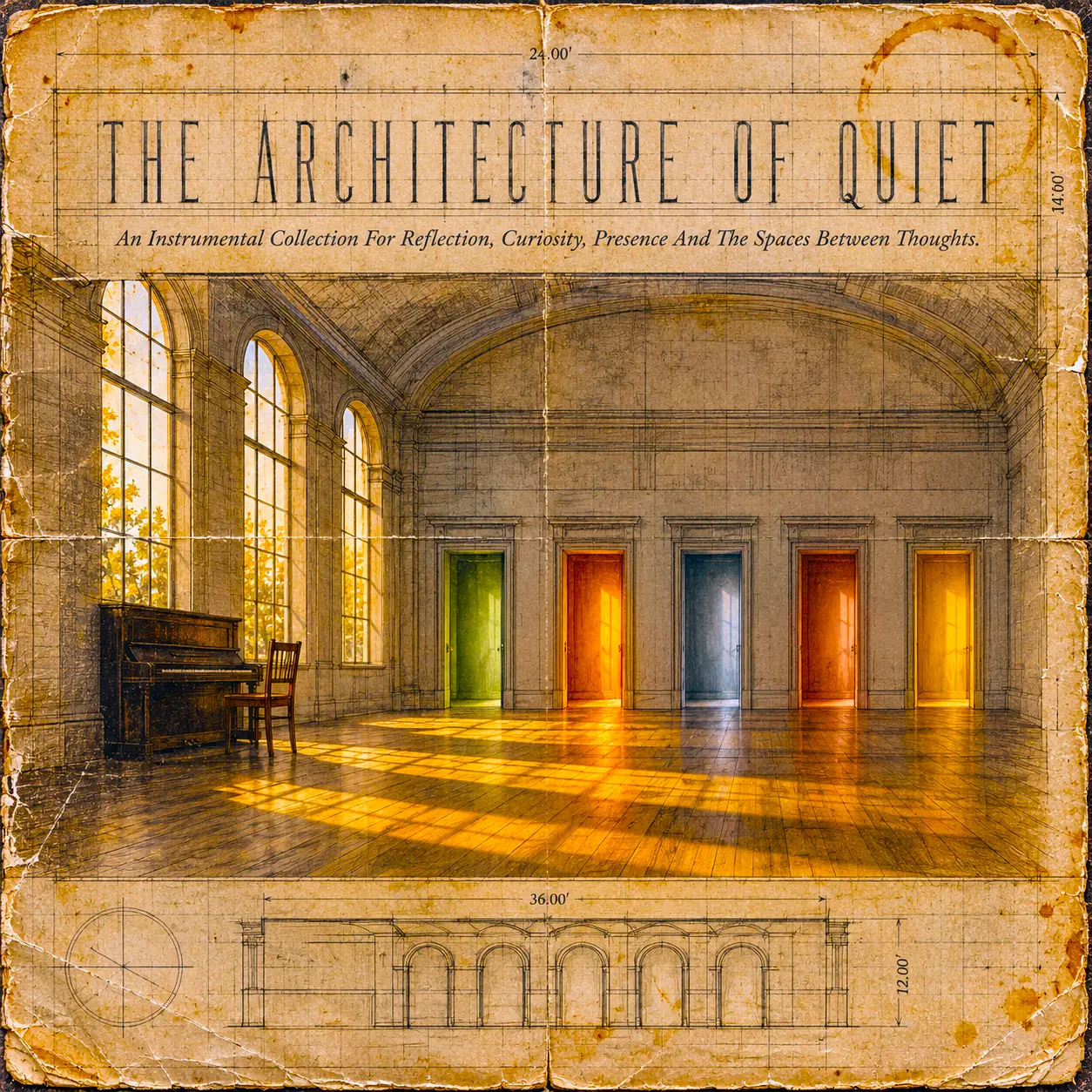
An Instrumental Collection For Reflection, Curiosity, Presence And The Spaces Between Thoughts
Creative Process: Human-AI Collaboration/Open Source Software: Composer/Sound Designer (Linktr.ee/j_j_j), Google Flow Music (Lyria 3.5), Claude.ai, ChatGPT, Perchance.org – DAW, Audacity 4.0.1, OS, Linux (Ubuntu 26.04.5)
The Architecture of Quiet: An Instrumental Collection For Reflection, Curiosity, Presence And The Spaces Between Thoughts – Full Mix (58 Tracks – 2:42:24)
Download Free MP3 of Full Album Mix: The Architecture of Quiet: An Instrumental Collection For Reflection, Curiosity, Presence And The Spaces Between Thoughts (2:42:24)
Please note: If used in a professional setting, feel free, but please do not monetize this in any way.
Google Deep Dive Podcast – Silence as Built Material: “Quiet vs. Abandoned”
| Project Snapshot | |
| Format | 58 instrumental tracks in 5 movements |
| Runtime | 2:42:24 |
| Vocals / lyrics | None. Fully instrumental |
| Sound world | Neoclassical piano, minimalist chamber strings, deep ambient, organic electronics, chamber jazz, acoustic and pastoral instrumental |
| Movements | I. Arrival, II. Observation, III. Contemplation, IV. Connection, V. Stillness |
| Companion piece | Short story, “The Room That Swallowed Every Sound” (podcast-length) |
Adaptation Notes
- Instrumental adaptation. The project notes rule out lyrics, even processed or wordless vocals. So wherever the template calls for 4-line lyric stanzas, this framework supplies a Sonic Stanza Map: the same skeleton (intro, four verses, chorus, bridge, outro) written as musical events instead of words. Nothing in it requires a voice.
- Hypotheses, not facts. The notes are explicit that nothing establishes the intended listener’s actual taste. Every musical choice below is a creative hypothesis about a thoughtful, research-minded listener, never a claim about a real person.
- Privacy. All public-facing material (liner note, story, metadata, social post) is written for any listener and carries no personal or professional details from the private project notes.
- Restraint rules carried through every prompt: no vocals, no dramatic crescendos, no dark or unsettling textures, no sentimental piano, no spa clichés, no intrusive percussion, no binaural or frequency claims. The goal is an environment, not a prescribed emotional state.
A Note from the Creator to You, the Listener
Before you press play, here is a guide to what you’re about to hear and how it was made.
What This Is
The Architecture of Quiet is a single instrumental album in 58 tracks, arranged in five long movements of multiple tracks each. It runs 2:42:24. It has no singing and no spoken words. It is meant to play from start to finish, though every track also stands on its own.
About The Title, The Architecture of Quiet
Architects know that a good room isn’t only walls. It is also the air, the light and the silence inside it. Quiet works the same way. It isn’t the absence of sound; it is something that gets built, with space, restraint and care. This album treats silence as a material, something to shape and leave room for. The subtitle says the rest: reflection, curiosity, presence, and the spaces between thoughts.
The Five Movements
- I. Arrival: warm, understated piano and ambient, like setting down your bags.
- II. Observation: minimalist classical and chamber music, patient and precise, noticing details.
- III. Contemplation: deep ambient and organic electronics, the most open and spacious stretch.
- IV. Connection: chamber jazz and acoustic instrumental, warmer and a little more conversational.
- V. Stillness: spacious piano and pastoral ambient, settling into quiet, peace, silence.
The Sound
This is intelligent, quiet instrumental music: neoclassical piano, soft strings, ambient textures, gentle chamber jazz and acoustic guitar. It was deliberately kept from sounding overproduced, and I steered away from the familiar spa-music and meditation clichés. You won’t find big crescendos, dark or unsettling moods, or busy melodies competing for your attention. Silence and space are treated as instruments here, so please don’t mistake the pauses for gaps or errors. They are part of the composition.
What This Is Not
This is not a meditation album, and it is not a treatment, therapy or health product. It makes no medical or scientific claims, and it doesn’t use binaural or frequency tricks. It is simply music meant to be a pleasant environment for thinking, working, reading or resting. It offers a room, and you decide what to do in it.
Lyrics And Vocalists
There are none. Every track is instrumental, so there are no lyrics to follow, no lyrical themes and no vocalists. The mood is carried entirely by the sound itself.
How It Was Made: A Human-AI Collaboration
This album was built by one human sound designer working with several AI tools, with the human steering at every step. In plain terms:
- Human (the Sound Designer): concept, direction, selection, arrangement, editing, sequencing, and final decisions on everything you hear.
- Google Flow Music (Lyria 3.5): AI music generation, used to produce raw musical material.
- Claude.ai and ChatGPT: AI assistants used for planning, prompt drafting, track naming and writing support, including notes like these.
- Perchance.org: a free, open web generator used for [specify, e.g. title ideas or artwork drafts].
- Audacity 4 (alpha): the audio editor where the material was shaped, trimmed, layered and mixed.
- Linux (Ubuntu 26.04): the operating system everything was assembled on.
The AI produced raw material only after the human decided what the album’s themes and construction would be, what stayed, what was cut, and how it all fits together. Please treat the result as a collaboration, not a push-button product.
Listen And Download
The download is free (Please note: If used in a professional setting, feel free, but please do not monetize this in any way.), and it’s the best-sounding version, so it’s worth grabbing for headphones or offline listening.
A Few Listening Suggestions:
Where This Music Can Live
I made this album as an environment rather than an event, so it works best when it’s allowed to sit in the background of an ordinary day. Here are some places it might belong.
At your desk or in your studio.
There are no lyrics to pull your attention, no big crescendos to interrupt a train of thought, and no busy melodies to compete with your own. That makes it good company for writing, coding, designing, spreadsheets, studying, or any task that needs your focus. At 2:42:24, the full mix covers a long working session without asking you to choose another playlist.
At home.
It can play while you cook, tidy, read, garden, paint, or fold laundry. It also suits the slow edges of the day: a first coffee, a quiet dinner, an evening wind-down.
In shared spaces.
Because it stays soft and even, it can sit under a small office, a studio, a library corner, a waiting area, a cozy café table, or a quiet gathering of friends without taking over the room.
On the move.
Headphones on a train, a long drive with the volume low, or a walk when you want the world a little softer.
A Note for Counselors and Therapists
I want to speak directly to those who sit with other people for a living. Many professionals already think carefully about the sound of a room, such as the waiting area, the office, or the first few minutes of a session. This album was built with that kind of room in mind.
To be clear, this is not a therapy or treatment product, and I make no clinical claims. I’m offering a quiet, instrumental backdrop that you can use if it suits your practice and your clients. Several of its qualities may make it a good fit:
- No vocals or lyrics, so nothing competes with the voices in the room.
- No dramatic dynamics, so there are no sudden swells to startle anyone mid-sentence.
- Generous silence, so a pause in the conversation doesn’t feel awkward. The music’s own pauses can make a client’s silence feel less exposed.
- A gentle arc from Arrival through Stillness, which lets a session settle in and wind down without the music making a statement.
For a few suggestions on how it might sit in different such settings:
- Therapy for depression and anxiety. Soft, steady, and unhurried, it offers a calm acoustic presence without pushing a mood in either direction. Played at a low volume, it can take the edge off a very quiet room for clients who find silence uncomfortable.
- Couples counseling. Two people often arrive tense, with each waiting to be heard. A low, neutral soundscape can soften the room without taking sides, and Movement IV, Connection, with its conversational chamber jazz and acoustic guitar, may suit the middle of a session.
- Family counseling. Rooms with several people, including children or teens, can feel crowded. Gentle instrumental music can make the space feel less formal and give everyone a shared, neutral thing to settle into.
- Parenting support. For parents who arrive stretched thin, a calm, unobtrusive soundtrack can mark a small pocket of quiet in a busy week, whether in an office or a virtual session.
- Grief counseling. Grief often needs room more than it needs words. The album’s spacious, unsentimental piano and ambient textures were chosen to leave space for whatever a client brings, without telling them how to feel. You may find Movements III and V especially suited to this.
- Work and career issues. For conversations about burnout, transitions, or decisions, a neutral, focused background can help the session feel more like thinking space and less like a performance review.
- Stress management. The slow tempos (roughly 56 to 92 BPM) and soft, even dynamics suit sessions that involve slowing down, reflecting, or practicing in-session techniques. It’s an environment, not a technique, and it works alongside whatever method you use.
- Conflict resolution. In tense conversations, a quiet, low-key background can lower the room’s temperature a little without becoming a distraction. Keep it very soft so it never competes with careful listening.
A few practical notes for professionals:
- Keep the volume low enough that it fades into the room, and always ask clients whether they’d like music at all. Some people prefer silence, and that’s a perfectly good answer.
- Be ready to pause or turn it off at any point. A session’s needs come first.
- If you’re considering this for ongoing use in a practice, consider choosing a movement or a handful of tracks instead of looping the whole album.
However you use it, whether you press play at a desk, in a kitchen, or in a counseling office, I hope it offers a little room to think.
Transparency And Sharing
This album was made with AI assistance, and I’m saying so openly. I compose with AI because it opens new artistic pathways and lets me explore far more sonic ideas than I could alone, while I still shape, edit and decide every detail of the final music, so the result stays warm and human-directed. All of my work is free and not monetized in any manner, so please download this and any of my other projects at will. However, please note: If used in a professional setting, feel free, but please do not monetize this in any way.
Thank You For Listening
I am grateful to you for giving this time out of your day to the music and stories. I hope it gives every listener a little more room to breathe.
– JJ, Composer / Sound Designer / Storyteller
Theme Rendering / Summary
The Architecture of Quiet proposes that silence is not a void but a built environment, something designed with proportion, warmth and care, so that other people can enter it and think. Each movement is a room in one house. We arrive and set things down, observe with patience, drift into open space, meet one another in warm company, and finally rest in a quiet that feels inhabited rather than empty. The album’s central conviction is that music can offer an environment without dictating an emotional state, and that respecting the complexity of the human mind means leaving it room to move.
Within the broader TATANKA narrative and mission, this is the album of attentive care as strength, a matriarchal ethos of listening, tending and holding a circle open, AI–human coexistence in which the machine supplies raw material and measurement while a human makes every meaningful decision, and DEI expressed as hospitality, a room built so that many kinds of people, histories and ways of thinking can each feel at home in it.
Tone indicators: contemplative, warm, luminous, grounded, spacious, intelligent, quietly curious, never patronizing, never sentimental.
Genre fusion guidance: a base of neoclassical piano and minimalist chamber strings, held in deep ambient space, with organic downtempo electronics for gentle motion, chamber and ambient jazz for conversation, and acoustic guitar and pastoral textures for groundedness. Everything stays acoustic-feeling and warm, with analog-style softness and generous silence.
Narrative Arc Adaptation for the Instrumental Score
Because there are no lyrics. The sonic story is carried by form, instrumentation and motif. The arc runs Prelude → Symphony in five movements → Coda.
- Prelude: the threshold. A single warm piano voice and a faint room tone introduce the album’s two central ideas: the question (a rising open interval) and the answer (a falling step).
- I. Arrival, the setting down: the listener lets go of the day. Piano and soft ambient bloom; nothing is asked of them.
- II. Observation, the noticing: minimalist repetition and chamber strings teach attention. Patterns appear, shift slightly, and are noticed. Curiosity replaces hurry.
- III. Contemplation, the opening: the walls dissolve into slow ambient space and organic electronics. This is the album’s deepest and most spacious stretch, the “space between thoughts.”
- IV. Connection, the company: brushed percussion, upright bass, woodwinds and fingerpicked guitar enter. Music becomes conversation, two or three voices listening to one another.
- V. Stillness, the settling: sparse piano and pastoral ambient bring everything to rest in a quiet that now feels shared and inhabited.
- Coda: “Room Tone.” The music thins into the actual sound of a quiet room, the thing every earlier track was built around.
Emotional journey: arrival → attention → openness → companionship → rest. No climax is manufactured; the high point is a moment of warmth, not volume.
Key motifs and archetypes:
- The Listener: the album’s implied protagonist, represented by a lone piano line.
- The Architect: the quiet builder, represented by patient repeating figures and long sustained strings.
- The Threshold: doors and windows, represented by the opening and closing of a rising fifth.
- The Lamp: a warm, low, sustained tone (soft analog pad or bowed cello) that returns in each movement.
- The Pause: deliberate silence, treated as a note.
The question-and-answer figure from Track 01 reappears, transformed, in every movement, so even stand-alone tracks feel like rooms in the same house.
General Text-to-Music Prompt (Album-Level – Google Flow Music)
Best-fitting genre fusion: because the story is about silence as hospitality and the mind as complex space, the best fit is contemporary neoclassical and deep ambient, warmed by chamber jazz, organic downtempo and acoustic pastoral touches.
“Create an entirely instrumental, spacious, contemplative soundscape blending intimate neoclassical piano, restrained chamber strings (cello and viola), slow deep-ambient textures, warm organic electronics and, in places, brushed chamber jazz and fingerpicked acoustic guitar. Tempo is slow to gently moving, roughly 56 to 92 BPM, with long decays and generous silence between phrases. Keep the dynamics soft and even, with no dramatic crescendos, no vocals or vocal textures, no dark or unsettling tones, no sentimental melodies and no intrusive percussion. Convey the feeling of a warm, beautifully proportioned room at dusk, a place to think rather than a place to be told how to feel.“
Narrative Adaptation (Companion Short Story)
A parallel narrative drawn from the album’s themes, not a retelling of its tracks. Written in continuous first-person prose, about 1,550 words, for a read-aloud of roughly ten minutes as a podcast script.
The Room That Swallowed Every Sound

She Was Hired to Build Perfect Silence. One Storm and a Town Full of Strangers Taught Her What Silence Is Really For.
I measure rooms for a living. Not their size. Anyone can do that with a tape. I measure how long a room holds on to a sound after the sound has gone. Engineers call it reverberation time. I call it a room’s memory.
The November I turned sixty-three, I drove to Harrow Point, a fishing town so wrapped in fog that the road seemed to be erased a few meters ahead of the car, to build the quietest room in the world.
The client was a man named Dorian Pike, soft-spoken, in a very clean coat. He had bought the old herring cannery on the harbor and meant to turn it into what his brochure called The Stillhouse, a sanctuary of absolute silence, forty sessions a day, forty-five dollars each. “Zero decibels, Ms. Oyelaran,” he said, standing in the cavernous hall while the wind found every gap in the tin roof. “People are starving for it. Give me nothing.”
I should say that I was the wrong person to ask, for reasons that had nothing to do with acoustics. My husband Teo had died the previous spring. Since then I had not sat in a quiet room. The radio awoke when I woke. The television tuned in when I returned home. Quiet, to me, had stopped being the absence of noise and become the sound of his empty chair.
But the work was good and the fee was better, and a person can build what she cannot bear to enter.
I brought a colleague, of a sort. “Tally” was an acoustic-modeling system that listened through a ring of small microphones I hung from the rafters, and spoke to me through a speaker the size of a teacup. Tally could simulate a thousand wall treatments overnight and tell me how any of them would behave. What it could not do, what I insisted it never do, was decide. “You measure,” I told it on the first day. “I choose.”
“Understood,” Tally said. “Though I may ask you why.”
For three weeks we built the prototype, a box within a box, mineral wool wedges as tall as children, a floor suspended on springs. When we closed the door and the last flutter of harbor wind vanished, the room reached something close to nothing. Tally’s meters showed a number that would have made Dorian weep with pleasure.
Then we invited the town.
Imelda Santos went first. She was a night-shift nurse who had come from Manila twenty years before, and she was used to long hours in rooms full of other people’s fear. She sat in the center chair for three minutes. When we opened the door she was gripping the armrests, and she laughed, a shaky laugh. “I could hear my own blood,” she said. “And nobody else. It’s like a room where no one is listening to you.”
Abdi Warsame, who guides boats through the harbor fog by ear, lasted ninety seconds. “A man should be able to hear the world coming,” he said. Birgit Halvorsen, eighty-one, head of the Tuesday Circle, a gathering of grandmothers who had met in the cannery’s old lunchroom since before the cannery closed, stayed the full ten minutes and came out unimpressed. “Silence is not what you take out,” she told me. “It is what you make room for. You have made room for nothing.”
The last volunteer was Wren, nine years old, who went in smiling and came out serious. “It sounds,” she said, “like nobody’s home.”
Tally recorded all of it. Later, in the empty hall, it said, “Margit, the pattern is consistent. People do not rest in the room. They brace. May I say what I think I am measuring?”
I said yes.
“A room can be quiet, or it can be abandoned. The numbers are the same for both.”
I called Dorian that night. He was polite, but he remained immovable. “The metric is silence. The product is silence. The panels ship Thursday.” I hung up and sat in my rented kitchen, and for the first time since spring I turned off the radio. I listened to the refrigerator hum, and the harbor bell, and my own breath, and I thought that it isn’t the quiet I’m afraid of.
It’s being alone in it.
The storm arrived on Thursday. It came off the water at dusk, a wall of wind that took the power lines down in the first hour. By eight o’clock half of Harrow Point was walking up the hill to the one building with a generator and a roof that had held for a hundred years. By nine there were ninety people in the cannery hall, in wet coats, with crying babies and real fear, and the sound was a roar. The bare hall, ribbed with concrete and tin, threw every voice back four seconds later. Ninety frightened people, and ninety echoes of them. Nobody could hear anybody. A man shouted, and the room shouted back.
I stood in that noise and understood the whole thing at once. The dead room would have failed these people in the opposite way. No echo, no company, no sense of one another. The room we needed was neither. It had to hold sound just long enough to be warm, and let it go just fast enough to be heard.
“Tally,” I said, “tell me what you hear.”
“Reverberation time is four point one seconds. Speech is unintelligible beyond three meters.”
“Not what the numbers say. What do you hear?”
There was a pause. “Ninety people trying to be heard by a room that will not let them.”
So we rebuilt it by hand, in the dark, by lantern light. Birgit’s Tuesday Circle emptied the lunchroom of its quilts and wool blankets. Abdi and his crew dragged old fishing nets down from the loft, and we hung them in loose curtains from the rafters, stuffed with felt. Imelda, who knew how to be useful in an emergency, sent people to the places I pointed to. Sol and Jun, who ran the bakery, carried sacks of flour for the reason bakers carry anything: because it was there and heavy and could help. And Wren hummed one low note and kept humming while I walked the hall, listening for where it died.
I made every decision. Tally measured every one. “Three point two seconds.” “Two point six.” “One point eight.” Soft things in some places, hard wood in others; a rug here, an open door there. A room is a conversation between absorbing and reflecting. When I looked up, the number was one point two, and the roar had folded down into something I can only call company. People could hear one another again. They stopped shouting. And then, one by one, they stopped talking, and the quiet that settled over ninety people on a night of wind was not the quiet of the box. It was full. It was somebody’s home.
Dorian arrived after midnight, soaked to the knees, having left his car in a ditch. He stood in the doorway with his clean coat ruined and looked at his cannery, and then he sat down on an upturned crate beside Abdi, and for a long time he said nothing at all. I did not tell him I had been right. There is no need to say it to a man who is listening.
In the morning he canceled the order for the panels.
By spring, The Stillhouse had been renamed The Listening Room, and Dorian, who turned out to be a better man than his brochure, let the Tuesday Circle keep the lunchroom. We did build one small room, a modest one, a place to sit alone on weekday afternoons. On the plans I labeled it a room with a pause in it. Wool and wood, one window, a door that closes gently and never locks.
On the day it opened, I went in by myself. I sat in the chair. Tally, in its teacup speaker, said nothing. Outside, the fog moved against the glass. For a minute I heard the room, the soft hum of the wires, the creak of the wood. Then I heard something under all of it, the thing every room has, whether or not anyone is there to hear it. Room tone. A kind of breathing.
I did not turn on the radio.
I stayed.
It was not Teo’s chair. It was only a chair, in a room I had built for other people, and now, just a little, for myself.
Elements of Literature
- Character: Margit Oyelaran (narrator, acoustician, grieving), Tally (AI collaborator, measures but never decides), Dorian Pike (client, antagonist who changes), Imelda, Abdi, Birgit, Wren, Sol and Jun (the community).
- Plot: Exposition (arrival, the brief), rising action (prototype, volunteers, Tally’s finding, Dorian’s refusal), climax (the storm and the hand-rebuilt hall), falling action (Dorian arrives, panels canceled), denouement (the small room, room tone, “I stayed”).
- Setting: Harrow Point, a fog-bound harbor town; a decommissioned herring cannery; November through spring.
- Theme: Silence is hospitality, not absence; listening is something built for others; human judgment and AI measurement work best together.
- Conflict: Margit versus Dorian (perfect silence versus a livable room), Margit versus her own grief, and the town versus the storm.
- Point of View: First person, past tense, Margit speaking to the listener.
- Tone and Diction: Spare, warm and precise, using acoustic vocabulary (reverberation, room tone, absorption) as emotional metaphor.
- Structure: Five movements echoing the album, from arrival to stillness, with the storm as the single dynamic peak.