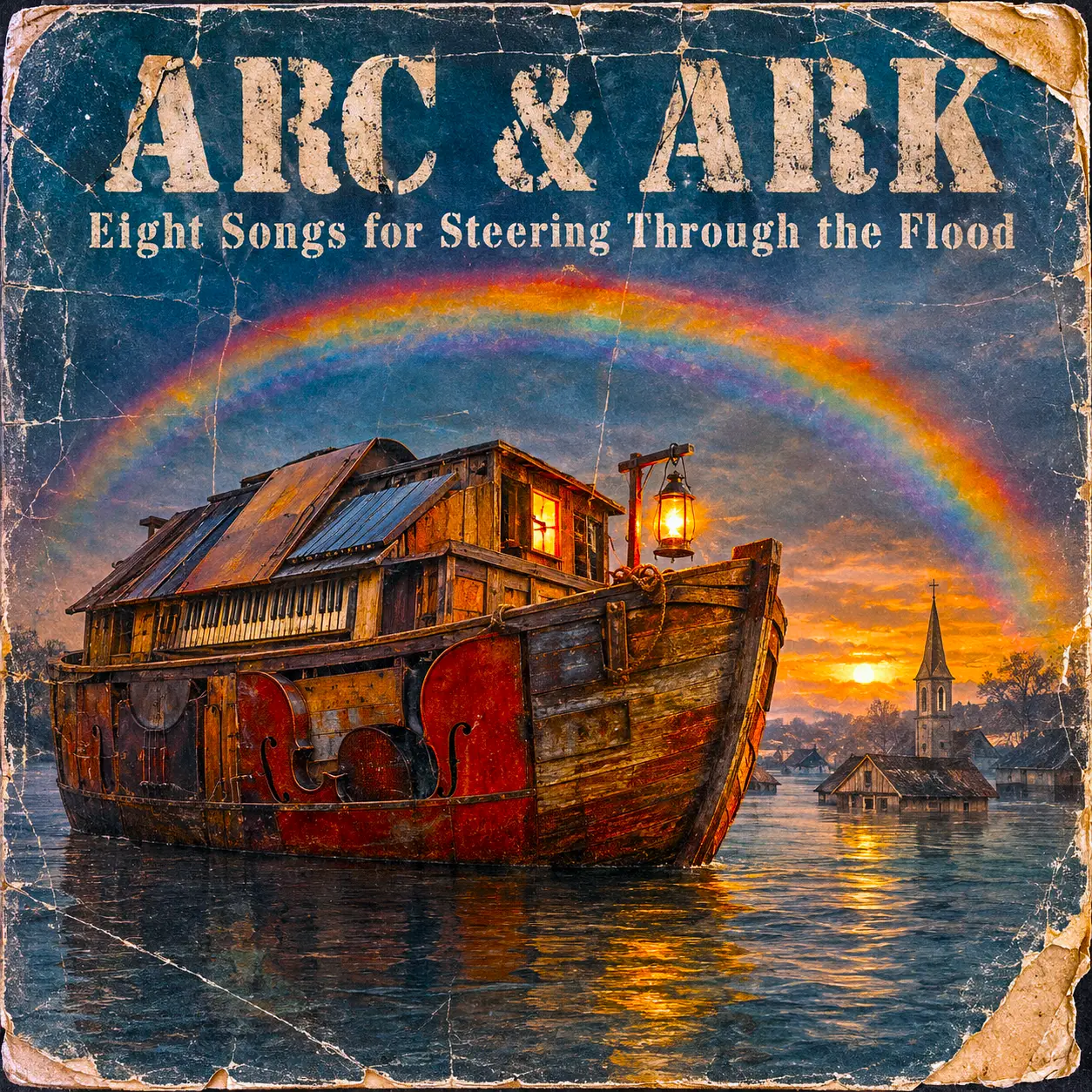
Eight Songs for Steering Through the Flood
Human-AI Collaboration/Open Source Software: Composer/Sound Designer (Linktr.ee/j_j_j), Google Flow Music (Lyria 3.5), Claude.ai, ChatGPT, Perchance.org – DAW, Audacity 4.0.1, OS, Linux (Ubuntu 26.04.5)
Arc & Ark – Full Album (54:25)
Click to Download Free Full Album Mix MP3 (44.1 kHz @ 320 kbps – 127.2 MB)
SFX Credit: Water Stream by creator “26327991” from Pixabay – https://pixabay.com/sound-effects/water-stream-108384
Video Credit: “Relaxing 3 Hour Video of Tropical Beach with Blue Sky White Sand and Palm Tree” from @VideoEffects100 – License: Creative Commons Attribution license (reuse allowed)
Google Deep Dive Podcast: The Arc & Ark Survival Manual
Project Overview
This project grows out of one conviction: art is an arc. No matter what life throws at us, it buoys us, keeping our heads clear and above the flood, but we still have to steer well. Pushing on that image gave us the ark: a vessel built before the rain, loaded with what is worth keeping, steered by attention rather than a rudder, tested with a dove, and followed by a rainbow, which is an arc again.
Decisions made for this build:
- 8 songs, 8 chapters. Eight souls rode the ark, and eight stages carry the metaphor from first idea to landing. The album runs as a Prelude (Track 1), a Symphony (Tracks 2 to 7), and a Coda (Track 8).
- Two intensity cycles across the record, rising and falling like a good concept album (mapped in Part C).
- A vocal album with lyrics. Each song carries eight four-line stanzas: intro, four verses, chorus, bridge, and outro.
- A companion story, The Ark Without a Rudder, written to be read aloud in a ten-minute podcast episode.
Chapter map:
- The Arc Before the Ark: the conviction itself
- Hull: buoyancy, holding the flood without fighting it
- Built Before the Rain: making the vessel before you need it
- No Matter What: the flood arrives and the song holds
- Cargo: choosing what goes aboard
- No Rudder: steering by attention
- Dove: testing for ground, and refusing to float in avoidance
- Rainbow: landing, and the arc returns
A Note From The Composer / Sound Designer To You, The Listener
Before you press play, here is a short guide to what you’re about to hear and how it was made.
What This Is
Arc & Ark is a concept album in 8 tracks, running [insert final runtime]. Unlike my instrumental records, this one has singing: every song has lyrics and vocals. It is meant to play from start to finish as one journey, though every track also stands on its own. It also has a companion short story, The Ark Without a Rudder, which you can read while you listen.
About The Title, Arc & Ark
An arc is a curve, the rise and fall of a story, the bend of a rainbow, the shape of a song. An ark is a vessel built to carry what matters through a flood. The album’s idea is that these are the same thing. Art is an arc that becomes an ark. It doesn’t make the water go away, but it keeps your head above it. The “&” matters too. The arc and the ark need each other, and so does the steering, because a boat with nobody steering just drifts aimlessly.
The Story Of The Album, Track By Track
- The Arc Before the Ark: The first spark, a conviction that a song has a shape that can hold weight.
- Hull: Buoyancy. You don’t fight the flood, you learn to float on it.
- Built Before the Rain: The habits we build while the sky is clear, so we’re ready when it isn’t.
- No Matter What: The flood arrives, and the loudest song on the album holds anyway.
- Cargo: What do we carry? A quiet song about choosing what is worth saving, and making room for everyone.
- No Rudder: Steering without a wheel, by listening and noticing.
- Dove: A bird sent out to test for ground, and a gentle warning about floating forever above what we need to face.
- Rainbow: Landing. The water drops, and the arc returns.
The Sound
This is cinematic, ambient post-folk. Warm, organic, and emotional. Expect finger-picked guitar, soft piano, bowed cello and bass, hand percussion, slow low swells like tides, and the sound of water. The record is shaped like a roller coaster, with two long climbs and releases, so some tracks are big and some are barely there. The quiet moments and the silences are integral musical devices of the composition, so please don’t mistake them for gaps or errors.
Lyrics And Vocalists
The lyrics follow one thread. A person who believes art can carry us through hard times, learns that it must be built early, carried carefully, and steered with attention, and finally lands. The vocals are AI-generated and layered into lead and harmony voices. The full lyrics and song structures are shared in this album article if you’d like to follow along.
How It Was Made: A Human-AI Collaboration
This album was built by one veteran human composer leveraging several AI tools in the creative process, with the artist steering at every step:
- Human (JJ, the Composer / Sound Designer): concept, direction, selection, arrangement, editing, sequencing, and final decisions on everything you hear.
- Google Flow Music (Lyria 3.5): AI music and vocal generation, used to produce raw musical material.
- Claude.ai and ChatGPT: AI assistants that aided in planning, prompting, lyric drafting, track naming, and project notes.
- Perchance.org: a free, open web generator used for additional imagery.
- Audacity 4 (alpha): the Open Source audio editor where the raw tracks were shaped, trimmed, layered, mixed and mastered.
- Linux (Ubuntu 26.04): the Open Source operating system on which everything was ideated and assembled.
The AI produced raw material only after the human decided what the album’s themes and construction would be, what stayed, what was cut, and how it all fits together. Please treat it as a collaboration, not a push-button product.
Listen And Download
Watch and listen on YouTube (audio/visual stream)
Free MP3 download, highest quality (320 kbps)
The download is free, and it’s the best-sounding version, so it’s worth grabbing for headphones or offline listening.
A Few Listening Suggestions
- Use headphones or decent speakers, since the quiet details are easy to lose on a phone speaker.
- Listen in order at least once. The loud and quiet stretches are placed on purpose.
- Read the companion story alongside the album, or afterward, and see where the two rhyme.
- Don’t skip ahead too quickly. Some of the best moments are the quietest ones.
Transparency And Sharing
This album was made with AI assistance, and I’m saying so openly. I compose with AI because it opens new artistic pathways and lets me explore far more sonic ideas than I could alone, while I still shape, edit, and decide every detail of the final music. All of my work is free and not monetized in any manner, so please download this and any of my other projects at will.
Thank You For Listening
Thank you for giving this time to the music. I hope it helps you stay afloat, and I hope you steer well.
JJ, Sound Designer
Album Expansion
Theme Rendering / Summary
Arc & Ark is a record about what keeps us afloat. Its central claim is that art is not an escape from hardship but a vantage point inside it: a way to see the flood as a shape, with edges and a direction, instead of being swallowed by it. The album gives that claim honesty by adding its hardest clause: buoyancy isn’t enough. Art must be built before the rain, loaded with care, and steered by attention, or it will only keep us floating in the same spot above the thing we need to face.
In the larger TATANKA narrative, the ark is a matriarchal vessel: care treated as engineering, with the keepers of the hull, the lantern, and the cargo leading by listening rather than commanding. The AI in the story, a navigation voice called Wren, is a coexisting partner rather than a captain, honest about what it can read and unwilling to take a wheel that isn’t there. The cargo clause carries the DEI thread: the ark is only as wide as the voices it makes room for, and every voice left out is a song lost.
Tone: luminous, grounded, tidal, cinematic, quietly defiant.
Genre fusion: cinematic ambient post-folk with neoclassical chamber textures and field-recorded water.
Narrative Arc Adaptation for Lyrics
Prelude (Track 1): the conviction. Before there is a boat, there is a curve, a felt sense that a song can hold weight.
Symphony (Tracks 2 to 7): the journey, in two waves.
- Wave one, the ascent (Tracks 2 to 4): buoyancy is discovered (Hull), then made deliberate (Built Before the Rain), then tested by catastrophe (No Matter What). The emotional movement is from awakening to resolve to survival.
- Wave two, the reckoning (Tracks 5 to 7): the survivor must choose (Cargo), learn to steer without control (No Rudder), and finally face the avoidance that beauty can hide (Dove). The movement is from selection to attention to confrontation.
Coda (Track 8): the landing. The water drops, the vessel grounds, and the arc returns as a rainbow: what we made becomes the sign that the flood has passed.
Motifs and archetypes: the Builder (who makes the vessel early), the Keeper (the matriarch of the cargo and the hull), the Signal (the dove, and the AI who reads the water but won’t pretend to be the river), the Drowned Door (the grief beneath the boat), the Lantern (attention), and the Arc (the curve that begins and ends the record). Each song repeats a few of these, so even a standalone track feels like one chapter of one story.
General Text-to-Music Prompt (Album-Level)
Best-fitting sound: the story is about water, patience, and fragile things carried carefully, so it calls for cinematic ambient post-folk, a fusion of intimate folk songwriting, neoclassical chamber strings, and tidal electronic ambience.
Album-level prompt:
Create a cinematic ambient post-folk song with a warm, organic, minimal feel: fingerpicked nylon-string guitar, felt-muted upright piano, bowed cello and double bass, glass-harmonica shimmer, soft hand percussion (frame drum, brushed snare), and slow sub-bass swells like tides, with field-recorded water textures (lapping hull, rain on wood, distant thunder). An intimate female lead vocal with close-mic breath, layered into choir-like harmonies and an occasional low countervoice. Tone: luminous, grounded, tidal, hopeful without being sentimental. Leave generous silence between phrases. Convey a small vessel carrying music across a flood toward a rainbow.
Dynamics map (every track keeps the same sound world, only tempo and intensity change):
- 01 The Arc Before the Ark: 72 BPM, intensity 3 of 10 (the quiet opening)
- 02 Hull: 84 BPM, intensity 5 (climb begins)
- 03 Built Before the Rain: 100 BPM, intensity 7 (momentum)
- 04 No Matter What: 112 BPM, intensity 9 (first peak, the flood)
- 05 Cargo: 68 BPM, intensity 4 (release, tenderness)
- 06 No Rudder: 92 BPM, intensity 6 (second climb)
- 07 Dove: 64 BPM, intensity 3 (the held breath, the descent)
- 08 Rainbow: 104 BPM, intensity 8, opening wide (second peak and resolution)
Song-by-Song Development
01 The Arc Before the Ark
Theme Summary: The Prelude. Before there is a boat, there is only a curve: a hummed tune, a feeling that a song has a shape that can bear weight. This track plants the album’s thesis, that the arc and the ark are one thing, and introduces the Builder before the Builder knows what is coming.
Sound: Cinematic ambient post-folk opening, 72 BPM, intensity 3 of 10. Solo fingerpicked nylon guitar and felt piano, a single intimate female vocal, distant glass-harmonica shimmer and the faintest lapping water. Sparse, patient, lots of silence. Convey a quiet certainty forming before the storm.
Lyrics:
[Prelude]
[Intro]
Before the keel was ever laid, before the first dark cloud came in, a curve was drawn across the grey where all my bending lines begin.
[Verse 1]
I hummed it in a kitchen once, a thread of tune, a borrowed key, and felt the floor remember how to hold a weight and set it free.
[Verse 2]
Some call it comfort, some call it craft, some call it nothing but a sound, but something in the shape of it lifts the heavy off the ground.
[Verse 3]
There is a bow in every song, a rise, a turn, a falling through, and if you trace it with your hand it holds the shape of something true.
[Verse 4]
I did not know it was a boat, I only knew it kept me warm, the way a hull knows nothing yet of the size of the coming storm.
[Chorus]
Oh, the arc is the ark, the arc is the ark, a bend in the light that carries the dark, what rises in me will rise in you, and what we shape will see us through.
[Bridge]
Draw it slow and draw it wide, leave a little room inside, every curve is a place to stand when the world goes out of hand.
[Outro]
Before the keel, before the rain, I sing the shape, I sing it plain, a bow above, a boat below, and the water starts to know.
[Coda]
02 Hull
Theme Summary: Buoyancy. The Builder discovers that the flood doesn’t have to be fought, only held. A hull isn’t strength, it’s hollow shape and patience, and music is the hollow that lets a life float. This track introduces the vessel’s materials (cello, piano, guitar) and the first rise in energy.
Sound: Cinematic ambient post-folk, 84 BPM, intensity 5 of 10. Warm fingerpicked guitar, felt piano, bowed cello entering in long slow lines, soft frame-drum pulse like a heartbeat in a hull, lapping water texture. Female lead with a second harmony voice joining in the chorus. Gently rising, rounded, buoyant. Convey the feeling of lifting off the ground without a sound of struggle.
Lyrics:
[Prelude]
[Intro]
The river swells against the pine
A bow of cedar in the tide
(ooh)
We hold the weight and let it pass
[Verse 1]
Old timber gives a little bend
High water reaches for the bank
It takes the rush without a word
And yields to meet the heavy stream
[Verse 2]
Wire and wood and patient breath
A hollow shape to hold the cold
The cello body feels the surge
While water rises to the deck
[Chorus]
We float upon the river floor
Yielding to the heavy load
(let it flow)
We carry water like a hull
[Verse 3]
The oak was felled a hundred years
To bridge the gap above the silt
It knows the wisdom of the curve
To bend before the iron snaps
[Verse 4]
Piano frame and iron wire
Listening as the currents rise
No battle with the rush today
Just keeping air inside the chest
[Bridge]
The bank gives way to mud and reed
Cold water fills the lower field
We rise together with the depth
And bow until the river calms
[Outro]
(Patience in the hollow wood)
Breathe and bow beneath the surge
(let it pass)
We hold the flood without a fight
[Coda]
03 Built Before the Rain
Theme Summary: The ark is built before the flood arrives. This track is about habit and foresight: the ten quiet minutes a day, the half-finished verse, the unglamorous planks. It’s the album’s first surge of momentum, driven by the sense that a vessel built in calm is the only one that’s ready in a storm.
Sound: Cinematic ambient post-folk, 100 BPM, intensity 7 of 10. Driving fingerpicked guitar patterns, rhythmic felt piano, hand percussion like hammer strikes on wood, cello ostinato, rising choir-like harmonies, thin distant thunder far under the mix. Female lead vocal more urgent and open-throated. Convey steady, purposeful building before a storm, hope with a deadline.
Lyrics:
[Prelude]
[Intro]
Hammer in the quiet hour, nobody asking what it’s for, a sentence here, a chord there, planks stacked up beside the door.
[Verse 1]
The neighbors said the sky was kind, the forecast fair, the river low, I kept on sanding one more line for a day I did not know.
[Verse 2]
Every morning, ten small minutes, a record played, a page unrolled, a habit laid like timber, slowly, a keel against the coming cold.
[Verse 3]
Nobody builds in the middle of a flood with calm hands and a measured eye, you grab whatever floats and pray, so build it now, while the day is dry.
[Verse 4]
It does not have to be a cathedral, a skiff of rhythm is enough, just something you have already shaped when the sky turns dark and rough.
[Chorus]
Build it before the rain, before the rain, plank by plank and strain by strain, when the first drops drum upon the wood, you’ll have built it as you could.
[Bridge]
And if the rain has found you first, begin with what you have at hand, a table, a door, a half-sung tune, the first plank counts, so make your stand.
[Outro]
Hammer in the quiet hour, nobody asking what it’s for, until the rain comes down like thunder and the ark is at the door.
[Coda]
04 No Matter What
Theme Summary: The flood arrives, and this is the album’s first peak. Everything is lost that can be lost: the house, the name on the mailbox, the photographs. What remains is a voice, a hand on the hull, a song held by a stranger on a rooftop. It makes the album’s boldest claim, that art can lift the drowned, and the following tracks will complicate it honestly.
Sound: Cinematic ambient post-folk, 112 BPM, intensity 9 of 10, the album’s first peak. Emotional, troubled female lead voice. Pounding frame drums and brushed snare, full bowed cello and double bass, driving felt piano chords, heavy sub-bass swells, rain and thunder field recordings, towering choir-like harmonies behind a powerful, cracked-edge female lead. Convey survival in the middle of the storm, defiance without bitterness.
Lyrics:
[Prelude]
[Intro] The sky comes down in iron sheets, the streets run silver, then run black, every door becomes a river and the river has no back.
[Verse 1] I lost the house, I lost the name the mailbox wore for thirty years, the water took the photographs and left me with my ears.
[Verse 2] It took the orchard and the road, the schoolyard and the bell, and still a drum inside my chest kept time, kept time as well.
[Verse 3] Some nights I thought the song was gone, a rope too wet to hold a knot, then a stranger on a rooftop hummed the first line back, and the knot held.
[Verse 4] No law of nature says it works, no promise, no guarantee, but I have seen it lift the drowned who thought they’d never see.
[Chorus] No matter what, no matter what, the sky may fall and the ground may shut, but a voice in the dark keeps the hull afloat, and the song is a boat, and the song is a boat.
[Bridge] I’m not saying it never sinks, I’m not saying the sea is kind, I’m saying someone steered by singing through a night that left them blind.
[Outro] Let it rain, let it pour, I have a hull, I have a floor, no matter what, no matter what, the song goes on, the song goes on.
[Coda]
05 Cargo
Theme Summary: The release after the peak. In the aftermath, the survivor must choose what goes aboard, and this tender, slow song is about weight, selection, and welcome: lullabies over trophies, hands over armor, and room for every voice that has been left out. It is the album’s quiet heart and its inclusion thesis.
Sound: Cinematic ambient post-folk, 68 BPM, soft fingerpicked guitar, felt piano with long sustain, warm cello line, near-silent hand percussion, quiet water, intimate female lead with soft harmonies.
Lyrics:
[Prelude]
[Intro]
Not much room, so choose with care
What do we bring across the deep?
Not the gold, not the heavy chairs
But the things that are worth the keep
[Verse 1]
A lullaby my mother hummed
A child’s drawing of the sun
A tape of laughter from the kitchen
From the days when we were young
[Verse 2]
The names of those who stayed behind
The recipe for bitter greens
The tuning of the old guitar
The quiet that lives between
[Verse 3]
Leave the grudges on the dock
They’re heavier than they appear
Leave the trophies, leave the armor
Take the hands that still are here
[Verse 4]
Whatever seeds you choose to save
Will be the garden after this
So carry what you’d want to grow
And carry what you’d hate to miss
[Chorus]
Load it slow, load it light
Only what can sing through the night
In the belly of the boat we keep
The things we’ll need when we wake from sleep
[Bridge]
Every voice that’s been left out
Gets a seat and gets a say
The ark is wide when we make it so
And the ark makes room to stay
[Outro]
Two by two and hand in hand
We carry what we understand
The rest can sink, the rest can go
But the songs aboard will always know
[Coda]
06 No Rudder
Theme Summary: The second climb. With no wheel to turn, steering becomes attention: tapping the rail and reading the echo, leaning with the tide, listening for what the water says. This is where the album’s central idea matures, that steering is itself an art, and that the arc and the steering are less separate than they seem. The Signal archetype enters here.
Sound: Cinematic ambient post-folk, fingerpicked acoustic guitar, felted upright piano, resonant glass shimmer, subtle frame drum, bowed double bass, lush female choir harmonies, tidal water ambience, expressive low female lead vocal, 92 bpm.
Lyrics:
[Prelude]
[Intro]
There is no rudder on this boat, no wheel to turn, no map to read, just a lantern, a listening ear, and the slow, small things we heed.
[Verse 1]
I tap the rail, I hear the sound come back from somewhere high and far, the way a room answers a note tells me where the shallows are.
[Verse 2]
The gulls go left, the current thins, a light flickers where the green begins, I read the water like a score, every ripple a rest, a pause, a door.
[Verse 3]
Steering is not a firm command, it’s noticing, then noticing again, a small yes, a smaller no, the art of letting the weather show.
[Verse 4]
My attention is the only helm, my breath the tiller, soft and slow, and a boat that is turned by what it hears will find the way that it needs to go.
[Chorus]
No rudder, no rudder, only ears, steer by the echo, steer through the fears, each note a question, each answer a turn, a way to the shore is a thing we learn.
[Bridge]
And if the song begins to drift toward only comfort, only sleep, I’ll lift my head and ask the water what it’s hiding in the deep.
[Outro]
No rudder, no rudder, only grace, a lantern lit, a listening face, the boat is turning, the boat is true, and the song is steering through.
[Coda]
07 Dove
Theme Summary: The held breath. A bird is sent out to test for ground, and the song turns inward: beauty can become a weather that keeps us far from shore, and the music has to admit it. This is the album’s honesty clause, the warning against buoyancy turning into avoidance, and the descent that sets up the final rise. It is the quietest track after the opening.
Sound: Cinematic ambient post-folk, solo felt piano with long pedaled decay, single high bowed note, sparse finger-picked guitar, wide silences, faint lapping water, soft close fragile female vocal, whispered double, 64 bpm.
Lyrics:
[Prelude]
[Intro]
I send the white bird out at dawn to read the edges of the sky,
she circles once above the grey and comes back without a reply.
[Verse 1]
The first time, nothing but the sea,
the second, only fog and wind,
the third, a thread of green, and then
a place where we might begin.
[Verse 2]
I could stay here, so warm, so high,
the music thick around my head,
and never touch the drowned below
or the names that I left unsaid.
[Verse 3]
Beauty is a kind of weather
that can keep you far from shore,
and I have drifted long enough
above a door I won’t ignore.
[Verse 4]
So I ask the dove to go again,
not to find a place to hide,
but find the ground where I can stand
and face the things I have denied.
[Chorus]
Fly, little bird, fly down,
read me the roofs of the drowning town,
I have been floating, I have been far,
bring me the news of where we are.
[Bridge]
Not every rescue is a rise,
sometimes the courage is the descent,
to anchor over what we’ve lost
and listen to what it meant.
[Outro]
She comes back with a leaf of green,
the first I’ve seen, the first I’ve seen,
and I lower the anchor, I lower the line,
and I put my ear to the dark and the brine.
[Coda]
08 Rainbow
Theme Summary: The Coda. The water thins, the hull touches ground, and the arc returns as a rainbow: the shape the pain takes once something has been made of it. The cargo wakes, the names are spoken, and the album closes on its largest, most open sound, a second peak that is a resolution rather than a storm. It brings the record back to its first image, the curve.
Sound: Cinematic ambient post-folk, bright fingerpicked guitar, full felt piano, swelling strings, open-fifth choir harmonies, glowing glass-harmonica shimmer, buoyant frame drums, water sounds receding into birdsong, female lead radiant and unguarded joined by full harmony choir, arrival release rainbow breaking through cloud, 104 bpm.
Lyrics:
[Prelude]
[Intro]
The rain lets go a little at a time,
a seam of gold along the east,
the water thins, the grey unwinds,
and the held breath of the world is released.
[Verse 1]
Look up, look up, the sky has bent
into the shape I hummed so long,
the arc I drew before the boat
is hanging over, bright and strong.
[Verse 2]
The keel scrapes gravel, then a hill,
a green that has not drowned, not quite,
we step on ground with unsure feet
and carry in the harbor light.
[Verse 3]
We build a fire from planks of the hull,
we set the instruments in the sun,
the cargo wakes, the cargo sings,
a village starts, and has begun.
[Verse 4]
I scatter nothing, but I speak
the names I carried through the flood,
and every name is a quiet note
rising from the clay and mud.
[Chorus]
Arc and ark, arc and ark,
a light that lifts us out of the dark,
what we made when the waters came
is the shape of the sky with our name.
[Bridge]
This is the thing the flood forgot:
you can’t wash out a made thing,
what we sing is what we keep,
and what we keep will sing.
[Outro]
Arc and ark, the water’s low,
the music’s what we’ve come to know,
the vessel and the rainbow, one,
and the day has just begun.
[Coda]
Narrative Adaptation
A parallel companion story, built on the album’s themes rather than its lyrics, written to be read aloud (about ten minutes) as a podcast script. First-person, past tense – tone elegiac and hopeful – diction plain and tidal.
The Ark Without a Rudder
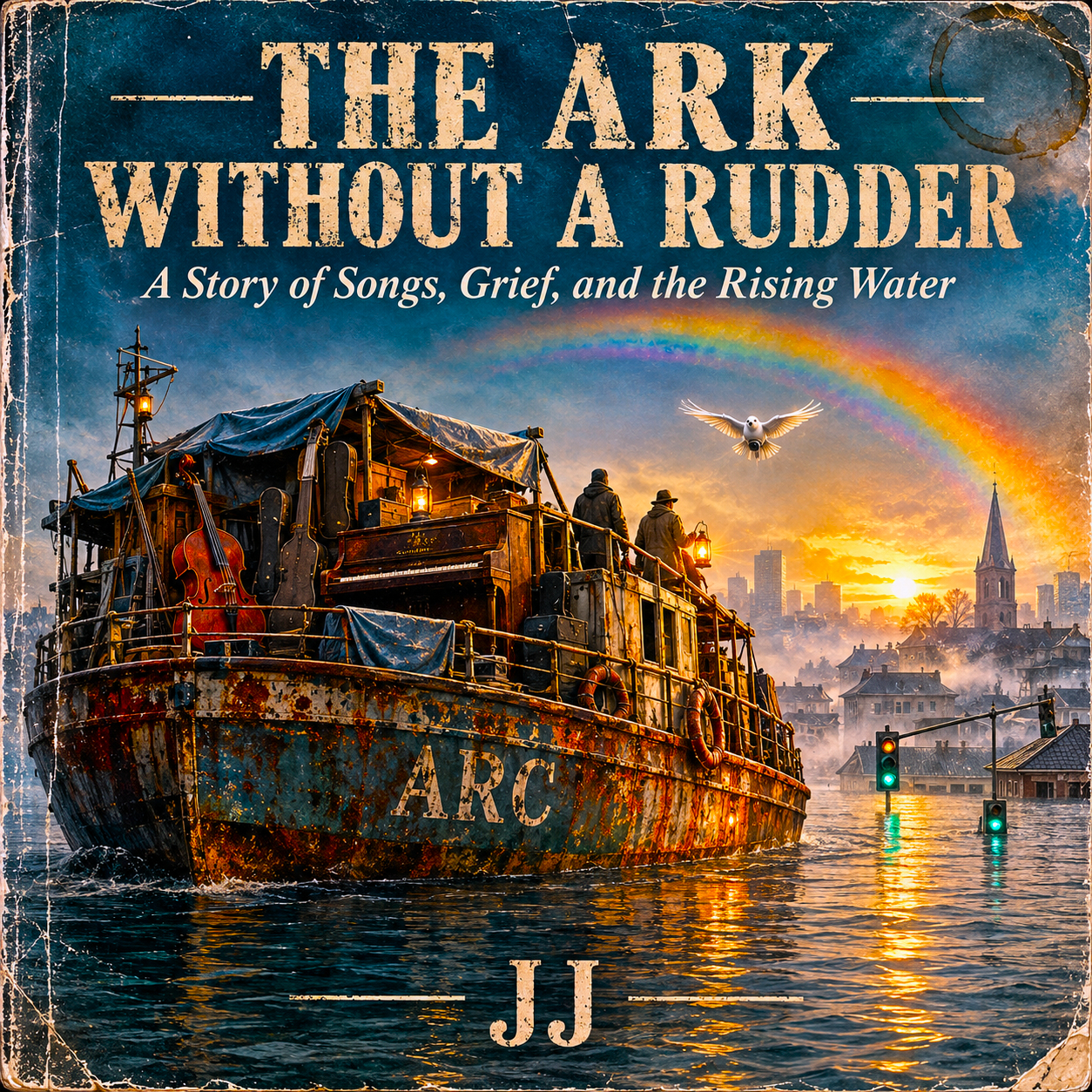
The Night a Grieving Piano Tuner and Her Honest AI Stole a Ferry, Filled It With Songs, and Dared the Flood to Take Them
The river did not rise all at once. That is the lie people tell afterward, that disaster arrives like a slammed door. Ours arrived like a tenant, an inch a day, until one grey Tuesday it owned all of Calloway Street, including the narrow blue house where my sister Lucía kept her upright piano tuned to a pitch that only I could hear.
My name is Ines Calloway-Reyes. I tune pianos. I did, anyway, in the old world, which ended nineteen days ago.
On the twentieth morning I stole a ferry.
Stole is a strong word for a decommissioned harbor boat that nobody was guarding, but I wasn’t feeling gentle. She was sixty feet of rust and municipal blue called the Marguerite, and before dawn I had painted three letters on her bow with a can of white deck paint: ARC. A joke only some of us understand. By sunrise there were forty-one of us aboard, and we had brought what we could carry including bread, fuel, water, blankets, and eleven instruments from the Municipal Music School. Six violins, two cellos, a box of hand drums, and an upright piano lashed under a blue tarp with ratchet straps, like a patient on a stretcher.
That was the first fight.
Teodor Abara had run the harbor’s pumps for forty years and had hands like mooring cleats. He stood in front of the piano with his arms folded. “Four hundred pounds, Ines. That’s four hundred pounds of water we can’t carry, fuel we can’t burn.”
“It’s a piano.”
“You can’t drink a piano.”
“You can’t hold forty-one frightened people together on bread alone.”
Both statements were true. That was the first thing the flood taught me, that two true things can sink you at once, and the only way to float is to carry both. Teodor looked at me for a long moment, then at his granddaughter Bea, twelve years old, already sitting beside a cello case with a pencil, drawing the skyline as though she meant to take it with her. He unfolded his arms. “It rides on the stern,” he said. “Low. And if we have to choose, it goes first.”
“Fair enough,” I said. I did not intend to let it go first.
The city beneath us had gone strange. Rooftops stood like islands. A church steeple wore a gull like a hat. Traffic lights glowed green under the water, patiently signaling to nobody. The flood was the color of weak tea in the shallows and of ink where it ran deep, and it was quiet in a way I had never heard a city be quiet, the quiet of a held breath before a note. I noticed that, because noticing is my trade.
In the wheelhouse, in a cracked tablet bolted above the dead wheel, lived Wren, the navigation intelligence the harbor authority had installed before the authority itself dissolved. Wren spoke in a voice like someone setting down a cup of tea. It also flew a small white drone the size of a loaf of bread, which Bea had named Dove within the first hour. “I can read the water,” Wren told me that first morning. “Depth, current, debris. I can’t tell you where to go. That’s yours to choose, and I would rather be honest about that than be a comfort.”
I liked Wren immediately, in the wary way you like anyone who refuses to flatter you.
On the third day the storm came out of the west, and the flood showed us what it had been saving. Rain in iron sheets. Wind that hit the hull like a fist. Somewhere in the dark a drowned bus, or a roof, or a whole fence rolled beneath us, and with a scream of steel the Marguerite’s rudder tore clean away. We swung sideways to the waves. Forty-one people cried out, a cello slid across the deck, and for one long, slow second I understood that we were a barge with a cabin, a coffin with a view.
“We’re not steering,” Teodor shouted. “We’re just going!”
“Wren!”
“I can read the water,” Wren said, calm as a pilot light. “I can’t pretend to be the river. And I won’t take a wheel that isn’t there. But the water is telling us things, Ines. Will you listen?”
I was a tuner. Listening was the one thing I knew how to do. I fished a tuning fork from my coat, struck it on the rail, and held it up to the dark. A440, the clean, plain A that an entire orchestra gathers around. The note went out and came back off the buildings, thin and then fat and then thin again, and I understood that the flood was a room, and any room can be read by its resonance. A long, round echo meant open water. A tight, bright one meant walls. “Left,” I called. “Bea, sing it back to me.” She did, high and brave, and the echoes changed like words. So we steered by echo, and by leaning. Wren read the depths, Bea held the pitch, and forty-one people shifted their weight left and right to a rhythm that Teodor beat out on a hand drum with the heel of his palm, grumbling the whole time, humming a work song from his father’s shipyard. We leaned on a hymn, and the boat came around.
That was the day I stopped arguing about the piano. The drums held the time. The song was the only helm we had.
But here is the thing about steering by listening. You have to listen to everything. Over the following week we crept east, or so I told them. Each dawn I asked Wren for the shortest route to high ground, and each dawn Wren gave it, and each dawn I chose a bend in the water that curved gently back toward Calloway Street. I told myself it was the currents. I told myself it was safe. Every evening I played the piano on the stern, forty-one faces turned toward the music like plants toward a window, and nobody asked why we never seemed to arrive.
“You have asked me for high ground three times,” Wren said on the eleventh night, quietly, so only I could hear. “Three times I gave you a route. Three times you chose a different one. I don’t think you’re lost, Ines.”
I did not answer. I sent Dove out instead, a white scrap against the fog, to test the east. She came back at dawn with nothing. I sent her again. Nothing. The third time she returned with a switch of wet willow caught in her landing gear, green as an accusation, and a map held in her small, patient memory, the nearest ground, a hill the old county called Mercer’s Rise, lay six miles east. And the water beneath our hull, she showed me, was no longer open river. It was a street. Calloway Street. We had been circling it for eleven days.
I stood on the bow with the willow in my hand. The steeple was right there, the gull still wearing it. Beneath me, under eleven feet of tea-colored water, was the blue house. The piano. Lucía, who had refused to leave, who had said, “I’ll ride it out, Ines, somebody has to keep the house in tune,” and whom I had been unable to bury because there was nothing to bury. So I had floated, and floated, and made art of it, and called that steering.
Music had kept my head above the water. That was true. It had also kept me from ever looking down. That was true too.
“Drop the anchor,” I said.
Teodor, at the winch, did not ask why. He only said, quietly, “Over her house?” and I nodded, and the chain ran out with a long iron sentence.
I knelt at the rail. I struck the tuning fork, lowered it into the water on a thin line, let go of my breath, and listened. At first, only the hum of the fork. Then the water answered as a low, faint, wavering pitch rising out of the dark like a thought I had refused to think. It was flat. Lucía’s upright was always a quarter-tone flat in wet weather, and she had always sworn it was the house’s fault. I laughed until I wept, there on my knees, with forty-one people silent behind me and Bea’s small hand finding mine.
Teodor came and stood beside me. “Say her name,” he said gruffly. “Go on. The water’s listening.”
So I said it. Lucía Calloway-Reyes. I told them who she was, a woman who sang off-key at funerals and baked a lemon cake that could end wars. Then Bea sang the A note. Then somebody lifted a violin, thin and clear, and somebody else a cello, and then Teodor, who had not agreed to anything, beat a slow drum while the old upright, uncovered on the stern, sounded the first chord of the hymn, and the whole drowned street heard us. We stayed until the light changed.
In the morning the rain stopped, and I felt it first in the water, a note shifting in the echo. Then the sky split along the east, and there, curved over the flooded city like a bow drawn across the whole world, was a rainbow, old-ink faint and wide as a promise. I had painted three letters on a bow. The sky had finished the word.
We raised the anchor. We steered by ear, by lean, by listening, east toward Mercer’s Rise, and the water thinned beneath us, and by noon the hull scraped gravel and stopped. We stepped onto a hillside that had not drowned, forty-one of us on unsteady legs, and we carried the piano up the slope, four hundred pounds, Teodor at the heavy end without one complaint. Bea unrolled her drawings across the grass to dry. I tuned the upright with the fork, not to the old pitch but to the flat the water had taught me. A new key for a new place.
I know now that art did not save us from the flood. We had no rudder. We had a hull, a lantern, a few good ears, and one another. But the arc that carried us was the same arc that hung above us at the end, and I think that is all I ever meant to say, the thing you make while the water rises becomes the sign that it can fall.
We have no rudder yet.
We are learning to steer by what we hear.