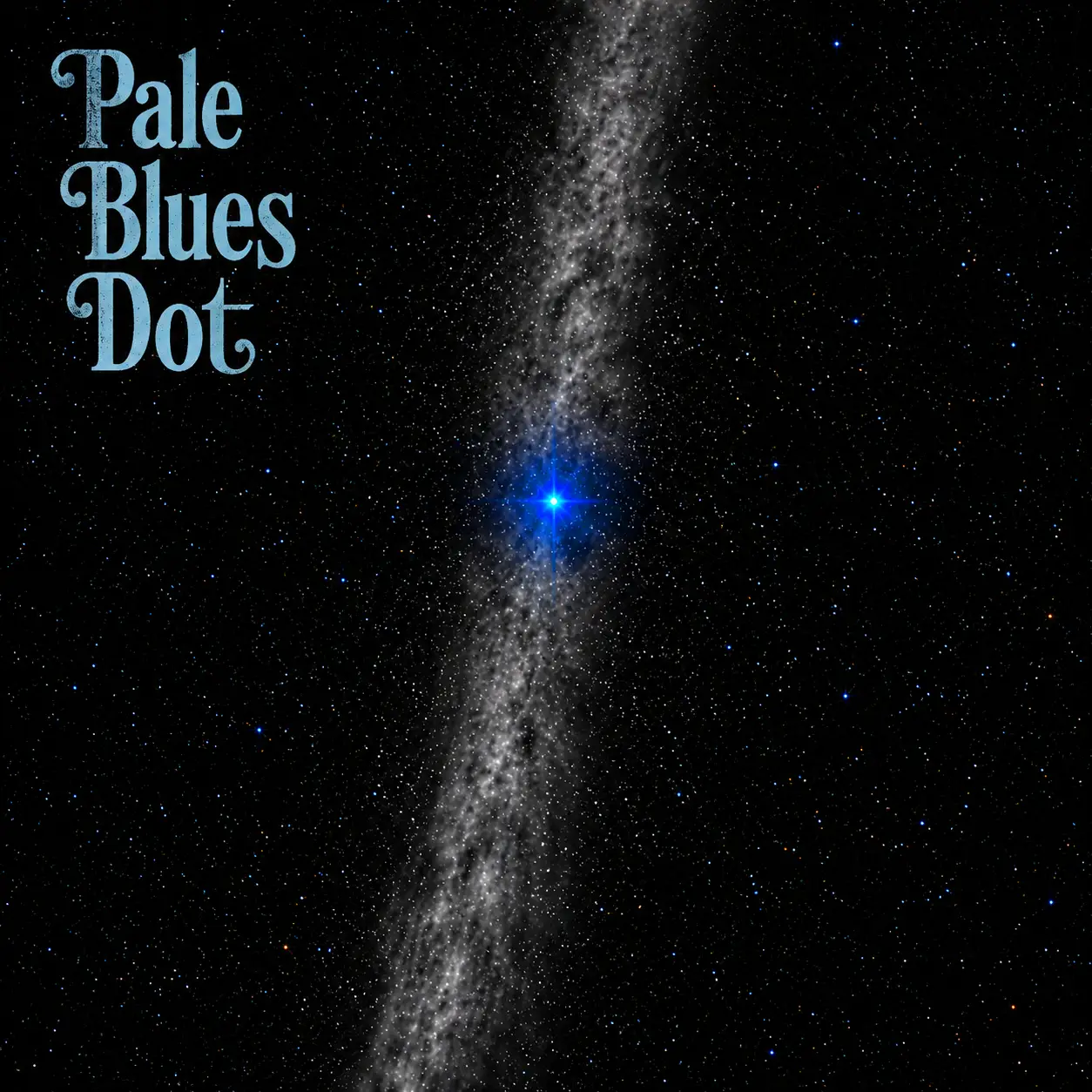
Even Gaia Gets The Blues
AI Process/Open Source Software: HUMAN, Google Flow Music (Lyria 3.5), Claude.ai, ChatGPT, Perchance.org – DAW: Audacity 4 (alpha), OS: Linux (Ubuntu 26.04)
Pale Blues Dot: Even Gaia Gets The Blues – Full Album (34:33)
To the listener,
I want to tell you where this album came from, because it didn’t come from any one place, and that’s the whole point.
It started with a photograph. You know the one. Voyager 1, six billion kilometers out, turning around one last time to take a picture of home before the dark swallowed it for good. A single pixel. A mote of dust suspended in a sunbeam. Carl Sagan looked at that pixel and said everyone you have ever loved, every war ever fought, every hero and coward in the history of our species, lived out their entire lives there. On that dot.
I couldn’t stop thinking about it. Because the blues does the same thing that photograph does, It zooms out just far enough that all our borders stop meaning anything, and all that’s left is the ache underneath them. Longing sounds the same in the Sahara as it does in the Delta. Grief doesn’t need a passport. Resilience hums in the same key whether it’s strummed on a National steel guitar in Mississippi or a desert electric in the Sahel, whether it’s carried on reggae bass in Aotearoa or Hammond organ in East Berlin or a sitar drone in Rajasthan.
So this album went looking for the blues everywhere I could find it, not American blues exported, but the blues as something older and stranger than any one country’s claim on it. A feeling the whole planet seems to know how to sing, each place in its own tongue, its own rhythm, its own instrument reaching for the same note.
Gaia gets the blues too, I think. She’s earned them. And maybe that’s what you’re hearing in these songs, not different countries taking turns, but one world, working through the same three chords and the truth, over and over, everywhere at once.
Thanks for putting this on. Turn it up. Let it travel with you the way it traveled to get here.
From one dot to another,
JJ
TRACKLIST / DESCRIPTION
1. Desert / Tuareg Blues 🌵
What it is
Often called desert blues, this is the guitar music associated particularly with Tuareg musicians of the Sahara and Sahel. Tinariwen is the obvious gateway, but Tamikrest and Mdou Moctar demonstrate how broad the tradition has become.
The fascinating thing is that it doesn’t feel like American blues transplanted into Africa. It has its own musical grammar:
- hypnotic, repeating guitar figures
- modal rather than strongly major/minor blues harmony
- cyclical structures
- hand percussion
- call-and-response
- electric guitars functioning almost like voices
- long, trance-like grooves
- relatively sparse harmonic movement
- an enormous sense of space
The emotional vocabulary can range from celebratory to political to intensely contemplative.
Google Flow Music prompt
Hypnotic Saharan desert blues, Tuareg-inspired electric guitars, interlocking repetitive guitar riffs, modal melodies, dry hand percussion, deep organic bass, call-and-response vocals, spacious desert atmosphere, gradual instrumental development, earthy analog production, raw and trance-like, no polished American blues clichés.
2. Aotearoa / New Zealand Blues 🇳🇿
What it is
This isn’t really a single codified genre called “New Zealand Blues.” That’s precisely what makes it interesting.
New Zealand’s roots music ecosystem has absorbed blues, rock, reggae, soul, Pacific music and Māori musical traditions. Artists such as Herbs, Katchafire, House of Shem, Fat Freddy’s Drop and Cornerstone Roots demonstrate various points along that continuum.
The resulting vocabulary often emphasizes:
- deep bass
- relaxed rhythmic pocket
- reggae influence
- roots-rock guitars
- Pacific rhythmic sensibilities
- spacious production
- communal rather than purely individualistic feeling
- landscape and ocean imagery
And there’s an important conceptual distinction: the landscape isn’t the Mississippi Delta.
The emotional geography becomes oceanic.
Google Flow Music prompt
Aotearoa roots blues, warm electric guitar, deep reggae-influenced bass groove, relaxed Pacific rhythm, soulful blues guitar phrases, organic live drums, subtle Māori and Polynesian rhythmic atmosphere, spacious production, earthy vocals, oceanic and reflective mood, roots-rock energy, authentic New Zealand feel.
3. West African / African Blues 🌍
What it is
This is where the historical story gets fascinating.
Musicians such as Ali Farka Touré demonstrated how West African guitar traditions and the blues could reveal an almost uncanny family resemblance without being identical.
Instead of thinking:
Africa → America → blues → Africa again
you can think of it as a musical conversation between related traditions.
Characteristics can include:
- intricate repetitive guitar patterns
- pentatonic and modal melodies
- polyrhythmic percussion
- call-and-response
- dry, woody guitar tone
- minimal chord changes
- earthy vocals
- cyclical grooves
- tremendous rhythmic subtlety
The result can sound ancient and modern simultaneously.
Google Flow Music prompt
West African blues, Mali-inspired electric guitar, intricate cyclical guitar riffs, pentatonic modal melodies, hypnotic bass, hand percussion and polyrhythmic African groove, earthy expressive vocals, call-and-response guitar phrases, sparse harmonic movement, warm analog recording, organic and deeply rhythmic.
4. Polish / Eastern European Blues 🇵🇱
What it is
Poland has an unusually deep blues tradition, with festivals, dedicated musicians and a history of blues-rock stretching back decades.
But here’s the interesting part for a project: Eastern European blues often feels emotionally different from American blues.
You can emphasize:
- minor-key harmony
- melancholy
- dramatic guitar
- European folk melodic shapes
- blues-rock
- darker vocal delivery
- spacious arrangements
- existential rather than barroom themes
There’s often a quality of yearning rather than swagger.
Google Flow Music prompt
Dark Polish blues-rock, Eastern European melancholy, expressive electric guitar with sustained bends, minor-key blues harmony, dramatic soulful male vocals, restrained live drums, warm bass, subtle Central European folk influence, spacious cinematic atmosphere, brooding and introspective, slow-burning emotional intensity.
5. Japanese Blues 🇯🇵
What it is
Japan has had a long fascination with American blues, particularly guitar-centered blues and blues-rock.
What becomes interesting is the collision between extremely disciplined musicianship and an inherently loose, emotionally expressive form.
For an experimental project, I’d push beyond imitation and introduce Japanese musical colors:
- spacious guitar
- precise rhythm section
- restrained dynamics
- pentatonic melodies
- Japanese modal colors
- atmospheric arrangements
- occasional traditional instrumentation
- immaculate production
- emotional understatement
Think less “Japanese guy playing Chicago blues” and more blues translated through Japanese musical sensibility.
Google Flow Music prompt
Japanese atmospheric blues, expressive electric guitar, blues bends and vibrato, Japanese pentatonic melodic colors, precise restrained rhythm section, deep warm bass, spacious drums, subtle traditional Japanese tonal atmosphere, elegant dynamics, introspective vocals, cinematic night-time mood, sophisticated analog production.
6. German Blues 🇩🇪
What makes this particularly interesting
Germany has a long blues tradition, but East German blues culture is especially fascinating because blues became intertwined with youth culture and a desire for personal freedom.
That gives the music an entirely different historical weight.
For a contemporary project, I’d emphasize:
- dark blues-rock
- minor tonalities
- electric guitar
- organ
- restrained vocals
- psychedelic elements
- long instrumental passages
- analog recording character
- a slightly austere atmosphere
Google Flow Music prompt
East German-inspired blues rock, dark expressive electric guitar, Hammond organ, minor-key blues, deep bass, restrained live drums, smoky male vocals, subtle psychedelic atmosphere, long instrumental guitar passages, analog 1970s production, melancholic and rebellious, austere European character.
7. Scandinavian Blues ❄️
What it is
Scandinavian blues is particularly interesting because blues often intersects with rock, jazz, folk and eventually metal.
The geographical stereotype actually gives you a useful creative direction:
cold atmosphere + warm guitar.
You can emphasize:
- enormous reverberant spaces
- minor modes
- restrained arrangements
- clean guitar tones
- slow blues
- Scandinavian folk influence
- jazz harmony
- occasional heavy guitar
- melancholy
Google Flow Music prompt
Nordic blues, spacious Scandinavian atmosphere, slow-burning electric guitar, warm tube-amp tone, minor-key blues melody, deep restrained bass, spacious live drums, subtle Nordic folk influence, atmospheric reverb, melancholic vocals, cinematic winter mood, gradual emotional crescendo.
8. French Blues 🇫🇷
What makes it different
French musicians have historically absorbed blues through jazz, chanson, gypsy jazz, African music and French rock.
That gives you a much more sophisticated harmonic playground.
I’d lean into:
- blues guitar
- chanson-style vocals
- jazz chords
- accordion or organ
- gypsy-jazz guitar colors
- smoky café atmosphere
- French lyrical sensibility
- sophisticated arrangements
Google Flow Music prompt
French chanson blues, smoky Parisian atmosphere, expressive electric blues guitar, sophisticated jazz harmony, warm upright bass, brushed drums, subtle accordion, intimate soulful vocals, gypsy-jazz guitar touches, elegant melancholy, late-night café atmosphere, organic vintage recording.
9. South African Blues 🇿🇦
What makes it special
South Africa brings blues into contact with an enormous musical ecosystem:
jazz + township music + mbaqanga + African guitar + gospel + rock + blues.
Rhythm becomes particularly important.
Rather than centering everything around the twelve-bar structure, you can allow the groove to become the organizing principle.
Google Flow Music prompt
South African roots blues, rhythmic African guitar, blues-inflected electric guitar, rolling bass groove, township-inspired rhythm, live percussion, soulful call-and-response vocals, subtle gospel influence, warm organic production, uplifting but emotionally deep, infectious rhythmic guitar interplay.
10. Indian Blues 🇮🇳
Why this one could get wonderfully strange
Indian musicians bring an entirely different concept of melody and rhythm to blues.
You can experiment with:
- Indian classical modes
- blues guitar
- tabla
- drone
- sitar textures
- extended improvisation
- unusual rhythmic cycles
- blues-rock
- modal guitar
This is where I would not try to make a conventional twelve-bar blues.
Let the blues vocabulary encounter Indian melodic architecture.
Google Flow Music prompt
Indian blues fusion, soulful electric blues guitar, Indian modal melodies, sustained drone, tabla and organic percussion, deep bass, expressive vocal improvisation, blues bends combined with Indian classical ornamentation, hypnotic rhythmic cycles, atmospheric and psychedelic, organic live performance.
The American Blues Trilogy – Tracks 10-12
I had to illustrate what I consider the finest of American blues, with that signature Lone Star star-shine. Then of course I had to take my hat off to the roots, Mississippi Delta, circa 1930. And for shits and giggles, I tried to sonically imagine what American blues *might* sound like in the year 2200.
- Texas Blues. Think SRV and all of the Texas blues guitar and songwriting masters. Generate THE quintessential Texas blues track, with a fitting lyrical theme and vocalist.
- Please generate a typical, quintessential 1930s acoustic Mississippi Delta instant classic.
- Please generate what might be a futurist American blues song, circa 2200. Think outside the box on this track. Imagine how American blues might evolve as of the year 2200, and generate that far-off future instant classic.