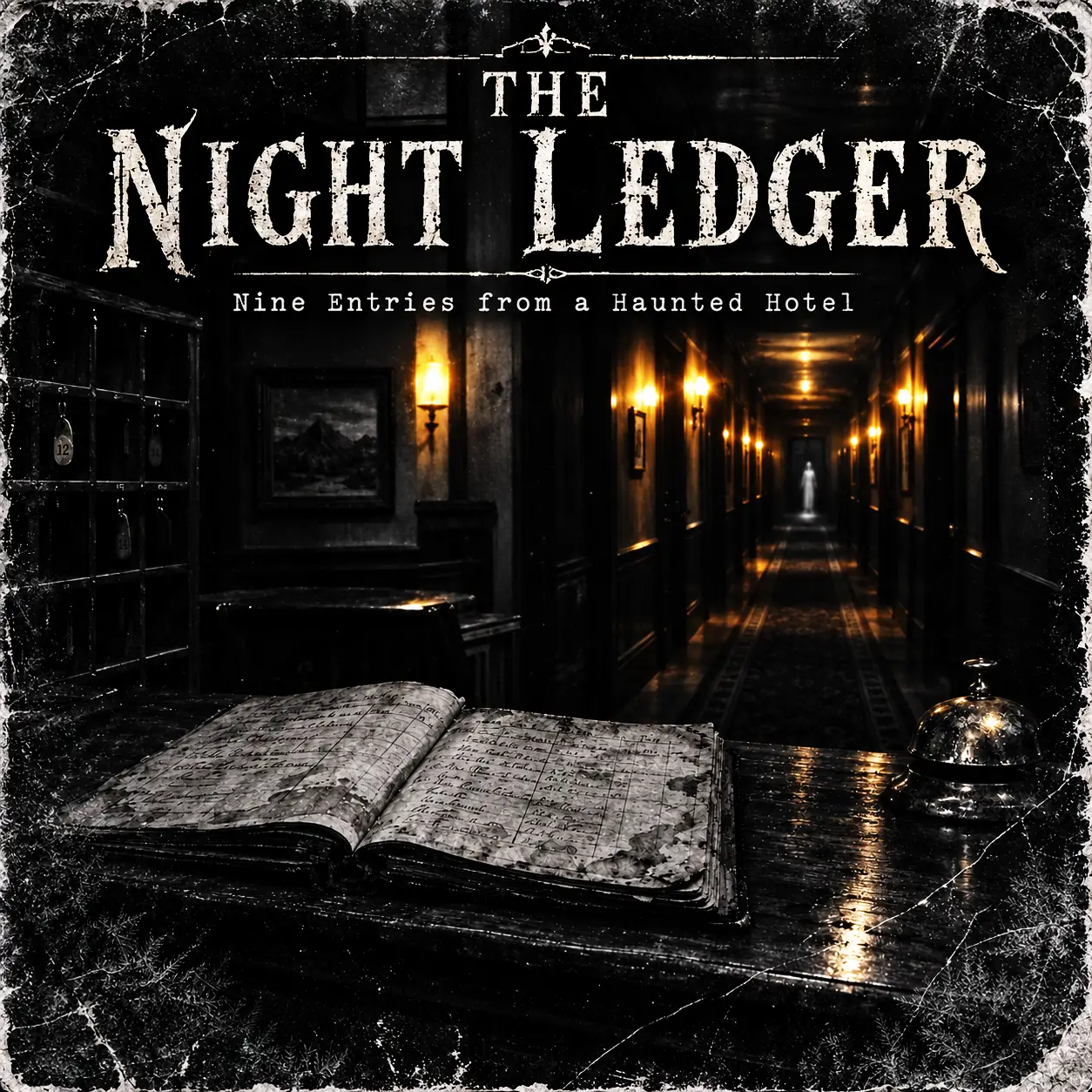
Nine Entries From a Haunted Hotel’s Staff Diary: A chapter of the Macabre Musings Series
Names, places and events are fictionalized from the Anchorage Hotel legend (a murdered first police chief, a girl in the second-floor hall, a jilted bride, and a staff diary of incidents). Nine chapters/ongs, one fictitious diary entry per song.
Human-AI Collaboration/Open Source Software: Composer/Sound Designer (Linktr.ee/j_j_j), Google Flow Music (Lyria 3.5), Claude.ai, ChatGPT, Perchance.org – DAW, Audacity4.0.1, OS, Linux (Ubuntu 26.04.5)
The Night Ledger – Full Album (25:06)
Click to Download Free Full Album Mix MP3 (44.1 kHz @ 320 kbps – 60.3 MB)
A Cautionary Note To You, The Reader and Listener
Before you press play, and read her diary entries here is a short guide to what you’re about to hear, learn, and how it all was made.
What This Is
The Night Ledger is a nine-track concept album of gothic folk and ambient noir, with vocals. It runs 25:06 and is meant to be heard start to finish, while reading her diary entries from the first page to the last, though every song and entry stand alone. Each track is one dated entry in the fictional night diary of a hotel clerk named Nell Aldous.
About The Title, The Night Ledger
A ledger is where a hotel records who came, who stayed, and who owes what. A night ledger is the book kept while everyone else sleeps. Here it also becomes a record of something else: the things that were never written down, and the people who were never counted. The album asks what happens when someone finally writes the truth in the book.
Where The Story Comes From
The album is inspired by an old legend about a historic frontier hotel. A police chief shot dead steps from the door in an unsolved murder, a young girl seen in a second-floor hallway, a bride who waited for a groom who never came, and a staff diary where employees log each ghostly incident. All of the names, characters and plot here are fictional. Think of the legend as the doorway, the entries an account of events, and the songs as what I found when I walked through the hotel’s haunted halls.
The Sound
The sound world is dark Americana and cold-weather ambient, finger-picked and baritone guitar, out-of-tune upright piano, bowed double bass and cello, a lonely fiddle, glass harmonica, brushed drums, field-recorded wind, floorboards and hotel-room tone. The dynamics rise and fall across the album like a roller coaster of quiet dread, brisk unease, a dark-comic scurry, a storm of a climax, and a long hushed exhale. The silences are deliberate.
Lyrics And Vocalists
Every track has lyrics. The voice is a warm, weary, intimate female vocal, sometimes spoken, sometimes sung, with whispered harmonies standing in for the hotel’s ghosts. The themes are memory, testimony, grief, women keeping the record, and the difference between haunting and asking to be heard.
Track Summaries
- Room 214, Cold Spot: Nell’s first night; the rules of the diary.
- The Girl in the Hall: a small figure, wet sleeves, three knocks.
- The Bride Who Waited: orange blossom, a veil, and a window.
- What the Day Staff Don’t Write: dark comedy and ghost fatigue.
- Anniversary Eve: the old pages all point to one night.
- Four Steps from the Door: the chief returns; the truth is shown.
- The Letter Behind the Wall: what was hidden, and what it says.
- Morning Count: a quiet, hopeful tally of the living and the lost.
- Tomorrow’s Entry: the diary keeps going, in a hand that is not hers.
How It Was Made: A Human-AI Collaboration
- Human (the Sound Designer): concept, direction, selection, arrangement, editing, sequencing, and final decisions on everything you hear.
- Google Flow Music (Lyria 3.5): AI music generation, used to produce raw musical material.
- Claude.ai and ChatGPT: AI assistants used for story development, lyric drafting, prompt writing, track naming and notes like these.
- Perchance.org: a free, open web generator used for additional artwork.
- Audacity 4 (alpha): the Open Source audio editor where the songs were shaped, trimmed, layered, mixed, sequenced and mastered.
- Linux (Ubuntu 26.04): the Open Source operating system everything was assembled on,
The AI produced raw material only after I decided what the album’s themes and construction would be, what stayed, what was cut, and how it all fits together. Please treat it as a collaboration, not a push-button product.
Listen And Download
The download is free, and it’s the best-sounding MP3 quality.
A Few Listening Suggestions
- Use headphones, since the quiet details are easy to lose on a phone speaker.
- Listen at night, ideally with the lights low.
- Don’t skip ahead. The quietest tracks are doing the most work.
- Read the companion story, The Hotel That Writes Back, as well as the lyrics/diary entries, as you listen.
Transparency And Sharing
This album was made with AI assistance, and I say so openly at the top of every project I share. It helps me explore far more sonic ideas than I could alone, while I still shape and decide every detail.
All of my work is free and not monetized, so please download and share it at will.
Thank You For Listening
Thank you for spending part of your night with this one. I hope the ledger leaves you a little braver in the dark.
JJ, Storyteller / Composer / Sound Designer
Theme Rendering / Summary
The Night Ledger is a gothic folk-noir album about the moral weight of being a witness. Nell Aldous, a night clerk with a tired voice and a steady pen, inherits a hotel’s diary of ghost sightings and slowly discovers it is not a joke or a chore but an unfinished testimony. A girl who saw too much, a bride who was never told the truth, and a lawman shot four steps from the door are not three separate hauntings. They are one story waiting for someone to write it all down.
Tone: haunting, wintry, intimate, darkly wry, cinematic, with a candle-warm center. Genre fusion: dark Americana, chamber folk, ambient field recording, and slow-burn murder ballad.
Within the broader TATANKA narrative, the album carries a matriarchal ethos (the diary is kept, passed down and defended by generations of working women, the housekeepers, cooks and clerks whose labor history never counted), a vision of human-AI coexistence (the hotel’s night-audit software quietly flags the anomalies, and Nell treats it as a colleague rather than a threat), and a DEI heart (the people who hold the truth are the ones the powerful ignored, a child, a servant’s daughter, a jilted woman, a clerk on the graveyard shift).
Narrative Arc Adaptation for Lyrics
Prelude (Track 1): Nell arrives and learns the rules: record everything, engage with nothing.
Symphony (Tracks 2 to 7): The girl (2) and the bride (3) appear. Fatigue and dark humor (4) break the tension before the anniversary closes in (5). On the night itself (6), the chief returns and points not to his killer but to a witness. What follows (7) is the recovery of a buried letter that rewrites the bride’s tragedy. The groom did not abandon her.
Coda (Tracks 8 and 9): The ghosts quiet, the staff count their mornings, and the diary continues in another hand.
Emotional journey: duty, then dread, then grief, then comic relief, then resolve, then revelation, then release, then continuity.
Motifs and archetypes: the Clerk (the witness), the Child (the unheard), the Bride (the betrayed by silence), the Lawman (the unfinished duty), the Ledger (memory as justice), and the refrain “write it down.”
General Text-to-Music Prompt (Album-Level)
Best-fitting genre fusion: dark Americana and chamber folk, wrapped in cold-weather ambient, with murder-ballad storytelling.
“Create a dark Americana chamber-folk soundscape with a warm, weary female vocal. Fingerpicked baritone guitar, slightly out-of-tune upright piano, bowed double bass, mournful cello, lonely fiddle and glass harmonica, brushed drums, and subtle field recordings of wind, creaking floorboards and distant hotel-room tone. Whispered harmonies like ghosts in the walls. Intimate, wintry and cinematic, candle-warm at the center. Convey a night clerk keeping a diary of the dead and finally writing the truth down.”
Song-by-Song Development
Room 214, Cold Spot
Diary entry (Sept. 3, 11:52 p.m.): First night on the desk. Mr. Prewitt gave me the keys, a flashlight, and a spiral notebook with a cracked blue cover. “Everything goes in the book,” he said. “Cold spots, footsteps, doors. You write it down and you don’t talk to it.” Room 214 reported cold air again, guest asked for a blanket and a different room. I wrote it down. I did not talk to it. At 3:10 the hallway smelled like wet wool.
Theme Summary: The prelude. Nell steps into a world already full of other people’s handwriting and learns the first rule. The track establishes the hotel’s weary bureaucracy of the dead and plants the album’s key tension: a rule that says record but never engage. It is quiet, fingerpicked and watchful.
Sound:
Dark Americana chamber-folk opening, intimacy over intensity. Fingerpicked baritone guitar, sparse out-of-tune upright piano, faint cello drone, hotel-room tone and distant wind. Weary female vocal close to the mic, whispered harmony on the chorus. Convey a nervous clerk learning the rules of a house full of ghosts, 62 bpm.
Lyrics:
[Intro]
A spiral book with a cracked blue spine,
A ring of keys that don’t feel mine,
The lobby clock says nearly twelve,
And the house is holding itself.
[Verse 1]
Mr. Prewitt shakes my hand too long,
Says “Write it all down, and don’t sing along.”
He points to a stair worn smooth and slow,
By feet that left a century ago.
[Verse 2]
Two-fourteen calls with a shaky voice,
Says the room went cold without a choice.
I offer a blanket, a warmer bed,
And I write it down just as I’m said.
[Verse 3]
There are pages of ink in a dozen hands,
Cold spots, footsteps, and soft demands.
Each line is a little flag of trust,
From the women who kept the night for us.
[Verse 4]
At ten past three the hallway sighs,
Wet wool and winter and something that tries.
I hold my pen, I hold my breath,
The quiet here has a kind of depth.
[Chorus]
Write it down, write it down, don’t turn away,
Every little cold is a word they can’t say.
Keep the book, keep the light, keep the count,
The night will tell you what it’s about.
[Bridge]
I was told don’t talk to it, don’t look too near,
But a ledger’s a place where the lost appear.
If nobody listens, what’s the book for?
Somebody’s knocking at the other door.
[Outro]
September third, a quarter past three,
A cold spot’s taken the room from me.
I close the page and I close my eyes,
And the lobby clock tells its small, soft lies.
The Girl in the Hall
Diary entry (Sept. 14, 1:20 a.m.): Small figure on the second floor again. Three guests today, same description: a girl about eight, wet sleeves, humming something slow. She walks to the far end, stops at 219, knocks three times, waits. Nobody answers. She waits a long time. I left a blue hair ribbon on the carpet outside 219. At 4:00 it was on the doorknob. I wrote that down too.
Theme Summary: The first real encounter. The child is not frightening; she is patient. The track raises the energy slightly and introduces the album’s first emotional hook: a being who is trying, over and over, to be let in or to let someone out. It is the first hint that the ghosts are not random but purposeful.
Sound:
Gothic folk lullaby with a creeping pulse. Soft brushed drums, plucked double bass, glass harmonica melody like a child’s hum, fingerpicked baritone guitar, tiny three-knock percussion motif on wood block. Female vocal intimate and tender with ghostly whispered harmonies, 76 bpm.
Lyrics:
[Intro]
A little hum in the hallway light,
Wet sleeves dragging in the night,
She walks it slow, she walks it small,
All the way to the end of the hall.
[Verse 1]
Three knocks on two-nineteen,
Soft as a snowfall in a dream,
She waits for a door that will not open,
A thousand nights, a heart half-broken.
[Verse 2]
Guests come down with their faces pale,
Telling the same, strange, tender tale,
A girl about eight in a coat too thin,
Asking the dark to let her in.
[Verse 3]
I leave a ribbon, blue as a vein,
Outside the door, in the winter rain,
At four o’clock it’s on the knob,
Placed like a gift, or a sob.
[Verse 4]
I do not speak and I do not flee,
I write it down as carefully,
A child is knocking on a door,
And she’s been knocking long before.
[Chorus]
Who’s behind the door, little one?
What did you see when the shot was done?
Write it down, write it down, let it be heard,
A child’s small voice is a living word.
[Bridge]
She isn’t here to scare the guests,
She’s here to ask for what she’s guessed,
That somebody listens, somebody stays,
That somebody finally says her name.
[Outro]
Three knocks, then none, then three again,
The ribbon waits on the door-knob’s end,
I close the book with a trembling hand,
And the hallway hums, and I understand.
The Bride Who Waited
Diary entry (Sept. 22, 2:05 a.m.): Smell of orange blossom in the lobby, then wet satin. Dolores on the morning shift says it’s the bride, a young woman named Adelaide who waited here in 1920-something for a groom who never arrived, and who did not survive the waiting. People see her at the second-floor window, watching the street. I saw her at 2:05. She wasn’t looking at the street. She was looking at me. I think she wanted to ask something.
Theme Summary: The deepest, quietest track so far, a dropping of intensity after the rising pulse of track two. The bride’s grief anchors the emotional core of the album, and the track introduces the central question: why did he not come? It is slow, spare and ache-filled, the album’s first real heartbreak.
Sound:
Sparse, gentle chamber folk ballad. Upright piano, bowed cello, soft glass tone, subtle ambient room texture. Fragile female vocal close to mic, quiet and delicate soundscape, 58 bpm.
Lyrics:
[Intro]
Orange blossom in the lobby air,
A veil of frost on the staircase stair,
Wet satin whispers across the floor,
Someone is waiting by the door.
[Verse 1]
Adelaide wore white and the white wore thin,
At the window she watched where he’d come in,
The street stayed empty, the bells rang late,
And the church bell rang for a hollow date.
[Verse 2]
Dolores tells it with a careful hand,
A story the whole of the town has planned,
“He left her, honey, and she couldn’t stay,”
But that’s not how the veil would say.
[Verse 3]
I see her at two, in the window pane,
A face like a candle against the rain,
She’s looking at me, not out at the street,
As if I’m the answer her heart can meet.
[Verse 4]
I do not ask and I do not tell,
But a sorrow like this has a story to sell,
One piece is missing, one line unsaid,
She’s been waiting a century for the thread.
[Chorus]
She’s still waiting for the knock that’s late,
Still believing in a lover’s fate,
Write it down, write it down, let the truth come near,
A waiting heart is a witness here.
[Bridge]
What if he never left at all?
What if the silence was a wall?
What if the story they told her wrong,
Has kept her singing this same sad song?
[Outro]
The window fogs and the veil drifts slow,
And I whisper low, “I want to know,”
Her reflection bends, and she tilts her head,
As though to say, “Then look instead.”
What the Day Staff Don’t Write
Diary entry (Oct. 1, 12:40 a.m.): Staff meeting, which is mostly a checklist. Page one: “If a guest reports a ghost, apologize, offer breakfast, DO NOT argue the ghost’s side.” Page two: “Bellman Teodor is not to be left alone on the second floor after midnight.” Page three is a joke someone drew of a ghost holding a clipboard. We are all so tired. The hotel software flagged 214 again, politely, with a little yellow icon. I thanked it. I’m told that’s unusual. I think it’s just manners.
Theme Summary: A dark-comic release valve and the album’s first big energy lift. After two sorrowful tracks, the hotel’s ghost fatigue takes over: haunting as workplace burnout, protocols, checklists, and the night-audit software that quietly keeps watch. It also carries the human-AI coexistence thread, treating the software as a courteous colleague. Beneath the humor is the first hint that the staff’s weariness is why the truth has stayed buried.
Sound:
Darkly comic gothic folk-swing. Brisk stomping brushed drums, bouncing upright bass, honky-tonk upright piano, jaunty fiddle, bright fingerpicked guitar, a tiny electronic chime as the hotel software. Wry female vocal with call-and-response harmonies, 104 bpm.
Lyrics:
[Intro]
Clipboard ghosts and coffee stains,
A break-room fridge full of cold-spot claims,
We’ve got a binder for the dead,
And a bellman who won’t go ahead.
[Verse 1]
Page one says “Apologize,”
Page two says “Don’t believe your eyes,”
Page three’s a cartoon on the wall,
A ghost with a clipboard, far too small.
[Verse 2]
Teodor won’t climb the stair,
After midnight, he says it’s not fair,
He carries bags to the second-floor door,
And he sprints like he owes the dead for more.
[Verse 3]
The software chimes with a yellow light,
Two-fourteen’s cold again tonight,
I thank it softly, I think it’s kind,
A tired machine and a tired mind.
[Verse 4]
We offer breakfast, we offer tea,
We offer rooms with a better key,
We’ve been so busy keeping the peace,
That nobody asked why they won’t cease.
[Chorus]
Oh, we’re too tired to be afraid,
We fill the forms and we count the trade,
But the ghosts keep asking, the ghosts keep near,
And we keep writing, and don’t quite hear.
[Bridge]
What if the joke is the whole lie?
What if the checklist helps us not ask why?
A hundred years of “just write it down,”
And nobody read it, in this town.
[Outro]
So we laugh and we stir the coffee thin,
And the yellow light blinks, and I let it in,
A friend with no face and a patient hum,
Says, “Nell, the old pages have something to come.”
Anniversary Eve
Diary entry (Oct. 27, 11:30 p.m.): Dolores brought me the old books from the basement. Thirty-one years of night diaries in six hands. Every October 28, the same entry, near enough to copy: “11:47 p.m., sound of a gunshot outside, no source. Footsteps on gravel. Do not go out.” Nobody ever goes out. Tomorrow is the anniversary of the chief’s death. Dolores told me the chief was the first lawman in this town, and that his case was closed without ever being solved. I’m going to be at the desk. I am going to be awake.
Theme Summary: The slow tightening before the storm, quieter and more tense than track four. Nell reads the generations of diary entries and sees the pattern: every year, the same night, the same warning. The track assembles the album’s mystery (the unsolved murder, the chief, the date) and ends on a deliberate decision, the first time anyone in the book’s history chooses to break the rule.
Sound:
Tense, slow-building dark folk. Low pulsing double bass, muted fingerpicked baritone guitar, ticking clock percussion, long cello swells, distant wind and a faint metronome of footsteps on gravel. Female vocal hushed and determined, building subtly at the end, 66 bpm.
Lyrics:
[Intro]
Thirty-one years in six women’s hands,
The same line written, the same demands,
“Do not go out,” it says each time,
On the night of a murder, unsolved crime.
[Verse 1]
Dolores drags the boxes up,
From the basement dark, with a coffee cup,
She says, “These pages are all we’ve got,
Of a man who was killed and a town that forgot.”
[Verse 2]
He was the first one to wear the star,
And he fell not far from the door we are,
They closed the file, they buried the name,
And the gravel remembers the same, same shame.
[Verse 3]
11:47, a shot in the air,
No source, no smoke, no cause to be there,
The footsteps crunch on the frozen ground,
And every clerk has turned around.
[Verse 4]
I read the entries until they blur,
Six different hands and a single stir,
It isn’t a haunting, it’s a plea,
A lawman asking to be seen.
[Chorus]
Anniversary eve, the night draws in,
The oldest echo is about to begin,
Write it down, but this time I’ll go,
To find the thing that they don’t know.
[Bridge]
The rule said stay and the rule said wait,
But the rule has been keeping a locked front gate,
Thirty-one years and nobody’s tried,
To ask the dead what they’ve denied.
[Outro]
The clock says eleven, the frost says go,
The snow is falling, soft and slow,
I lace my boots and I take the key,
And the ghost of a lawman is waiting for me.
Four Steps from the Door
Diary entry (Oct. 28, 11:47 p.m.): I went out. The shot cracked and the gravel crunched. He was there, a tall man in an old wool coat and a badge that glinted like a coin in snow. He did not look at me. He looked up, to the second-floor window at the end of the hall, 219’s window. Then he lifted his hand and pointed. He was not showing me his killer. He was showing me a witness. I turned around and the girl was at the glass.
Theme Summary: The climax and the album’s loudest, fastest and most cinematic track. The chief returns, the gunshot echoes, and the great reveal lands: the three hauntings are one story. The lawman is not pointing to who killed him; he is pointing to the child who saw it. It is the dramatic hinge of the entire record, urgent, orchestral and thrilling.
Sound:
Cinematic dark Americana climax. Driving double-time brushed-and-stomp drums, roaring fingerpicked-to-strummed baritone guitar, soaring fiddle and cello unison, thundering upright piano chords, sharp snare accent, wind and gravel footsteps. Powerful female vocal with choir-like whispered harmonies, 128 bpm.
Lyrics:
[Intro]
A gunshot cracks in the frozen night,
Four steps from the door, in the lantern light,
A lawman stands in his old wool coat,
With a quiet, desperate, ghostly note.
[Verse 1]
The gravel crunches, the cold breath burns,
He turns, as a man who has nowhere to turn,
He does not look at me, or the street,
He looks to a window with a shaking heartbeat.
[Verse 2]
Two-nineteen’s window, a small white face,
A child in a coat in an old, still place,
Her hand is pressed on the fogged-up glass,
As the whole of the years begins to pass.
[Verse 3]
He lifts his hand and he points up high,
Not at a killer, not at the sky,
But at a witness the whole town forgot,
A little girl who was seen, then not.
[Verse 4]
I understand like a bell that tolls,
Three ghosts bound by a story’s coals,
The chief, the child, and the veil upstairs,
All holding the pieces that no one shares.
[Chorus]
Four steps from the door, the truth was shot,
Four steps from the door, and the town said not,
Write it down, write it down, while the gravel cries,
A witness is standing in the window’s eyes.
[Bridge]
The girl saw it all, and was told to be still, By the ones who were paid to hold the till, She carried it quiet, to a winter grave, And she’s been knocking since, to be saved.
[Outro]
The shot rings out for the very last time,
The chief lowers his hand, the bells chime,
I run for the stairs with the diary tight,
And the girl in the window turns on the light.
The Letter Behind the Wall
Diary entry (Oct. 29, 3:15 a.m.): The girl led me to 219. She did not knock. She pointed at the wall behind the old wardrobe. I woke Teodor and Dolores. We pried the plaster. Inside: a tin box with a man’s ring and a sealed letter addressed to Adelaide, dated the week of her wedding. In it, Thomas Reyne writes that he is coming, that the hotel’s owner had asked to “speak with him first,” and that if anything goes wrong, he wants her to know he did not leave her. He never reached the church. Someone hid the letter. Someone hid him. I think the chief had figured it out. I think that’s why they shot him.
Theme Summary: The fallout, a sharp drop in intensity after the climax and the album’s emotional release. The hidden letter reframes the entire tragedy: the groom did not abandon the bride; powerful people silenced him, then silenced the lawman who found out. The track is grief and vindication in equal measure, ending as Nell carries the letter to the bride’s window.
Sound:
Tender, devastating chamber folk after the storm. Solo upright piano and cello, light brushed drums fading in only at the bridge, glass harmonica glow, fiddle in a distant consoling line. Female vocal soft, intimate and spoken in places, with a single whispered harmony at the end, 60 bpm.
Lyrics:
[Intro]
The wallpaper tears like a long-held breath,
A tin box rattles from the dust of death,
A ring that’s tarnished, a letter sealed,
A hundred-year promise at last revealed.
[Verse 1]
The girl just points at the plaster wall,
She does not whisper, she does not call,
She only waits for the hands to see,
What she’s been holding silently.
[Verse 2]
Dolores weeps and Teodor kneels,
We pry the boards as the old house feels,
A tin box rests on the dusty floor,
And a name on the paper we’ve seen before.
[Verse 3]
“My Adelaide,” the careful hand says,
“I am coming, whatever delays,
The owner asked me to speak tonight,
If I am late, I did not take flight.”
[Verse 4]
He never reached the church that day,
A powerful man had his own way,
And the chief who found it was shot at the door,
And the girl who saw it was silenced for sure.
[Chorus]
He did not leave, he did not leave,
There was a lie she could not believe,
Write it down, write it down, let her know,
The man she loved was held below.
[Bridge]
I climb the stairs to the window light,
The bride is standing in veiled white,
I read the letter in a trembling voice,
And the frost breaks softly, no more noise.
[Outro]
Her shoulders fall and her veil lets go,
The orange blossom drifts like snow,
“He’s coming,” I whisper, “he never ran,”
And she smiles like a woman who understands.
Morning Count
Diary entry (Oct. 29, 7:00 a.m.): Sunrise. No cold spots. No humming. The bride’s window is just a window. Mr. Prewitt came in and read the letter twice, then sat down on the stairs and was quiet a long time. Dolores called the county historical society and a retired state investigator who “owes her one.” The software flagged nothing and then, I swear, added a small green icon. We counted: the living, one, two, three, four, five. Then, quietly, the others. Everyone I couldn’t see but could feel.
Theme Summary: The hopeful, rising second wind of the coda, brighter, warmer and mid-tempo, as the staff reckon with what has changed. The ghosts quiet, the institution begins to act, the human-AI team celebrates a small win, and the matriarchal chain of keepers (Dolores, Nell, the clerks before them) is honored. It is a sunrise track, hard-earned.
Sound:
Warm, hopeful dark-Americana sunrise. Mid-tempo brushed drums, bright fingerpicked guitar, upbeat upright bass walk, lilting fiddle, soft piano chords, a tiny green-light electronic chime. Female vocal brighter and gently proud, group harmonies swelling in the chorus, 88 bpm.
Lyrics:
[Intro]
The sun comes up on a quiet floor,
No humming, no knocking at the door,
The window’s glass is only glass,
And the cold has finally learned to pass.
[Verse 1]
Mr. Prewitt reads it twice,
Sits on the stairs and says it’s nice,
To know the truth was in the walls,
All these years of the unheard calls.
[Verse 2]
Dolores dials the county line,
A retired man who owes her time,
The wheels of a hundred years turn slow,
But they’re turning now, and the people know.
[Verse 3]
The software blinks a little green,
The first good light the screen has seen,
I whisper thanks to the hum and the glow,
A team of the tired, the new, the old.
[Verse 4]
We count the living, one to five,
Then all the others, still alive
In the way a story keeps a name,
In the way a ledger breaks the shame.
[Chorus]
Morning count, morning count, who is here?
The living, the lost, the ones who steer,
Write it down, write it down, and let it be,
A witness, a keeper, a memory.
[Bridge]
Six clerks before me and a handful more,
Who wrote their lines on the same dark floor,
They never knew that the pen they held,
Was building a case that would someday swell.
[Outro]
The coffee’s hot and the doors swing wide,
The frost retreats from the window side,
The day staff comes with a cheerful wave,
And the ledger rests, for the lives it saved.
Tomorrow’s Entry
Diary entry (Nov. 3, 2:00 a.m.): Quiet week. The investigator is reopening the file. The county will mark the grave of a small girl and the site of a lawman’s last steps. I left the blue ribbon on 219’s doorknob. At 2:00 I turned the page to find the next entry already written, in a small, careful, childish hand: “Thank you. We are listening now. Write it down.” I did not talk to it. I smiled at it. And I wrote, underneath, “I will.”
Theme Summary: The coda, the quietest and most intimate track, and the loop that keeps the ledger alive. The ghosts have been heard, but the book does not close; it passes to the next hand and the next generation of keepers. The final image is a diary entry in a child’s handwriting, answered by Nell’s pen: the dead asking to be listened to, and the living agreeing.
Sound:
Quiet, luminous closing lullaby. Single fingerpicked baritone guitar, soft glass harmonica, distant cello, a ghostly soft background hum layered with lead vocal, final ticking clock fade into silence. Female vocal barely above a whisper, 54 bpm.
Lyrics:
[Intro]
A quiet week and a thawing street,
A county truck and a cold, clean sheet,
They’re digging soft by the old front door,
To mark the ground of a lawman’s war.
[Verse 1]
A small stone waits for a little girl,
Who held a secret in a world,
That would not listen, would not stay,
But we are listening, here today.
[Verse 2]
I hang the ribbon on two-nineteen,
Blue as the dusk and soft as a dream,
The hallway breathes and the hallway glows,
And nothing is cold, and nothing is closed.
[Verse 3]
I turn the page at two o’clock,
And find a line in a child’s soft block,
“Thank you. We are listening now. Write it down.”
And I whisper, “How.”
[Verse 4]
I don’t talk to it, or maybe I do,
I smile at the dark and the dark smiles through,
A hand not mine writes next to my own,
And the ledger is never alone.
[Chorus]
Tomorrow’s entry, tomorrow’s name,
The living and the dead write the same,
Write it down, write it down, let it be heard,
Every night a new, true word.
[Bridge]
Some rooms keep secrets, some rooms keep time,
Some rooms keep a promise in a ghostly rhyme,
This one keeps a ledger with open pages,
For the voices of the unheard ages.
[Outro]
Tomorrow’s date at the top of the page,
A bride, a chief, a child on the stage,
I sign my name in the dim, warm light,
And I say, “Goodnight,” and the hall says, “Goodnight.”
Narrative Adaptation
The Hotel That Writes Back
Setting: Modern Day – A Skeptic Recorded One Night in America’s Most Haunted Frontier Hotel. What Her AI Heard in the Walls Is Why She Will Never Call Silence Empty Again.
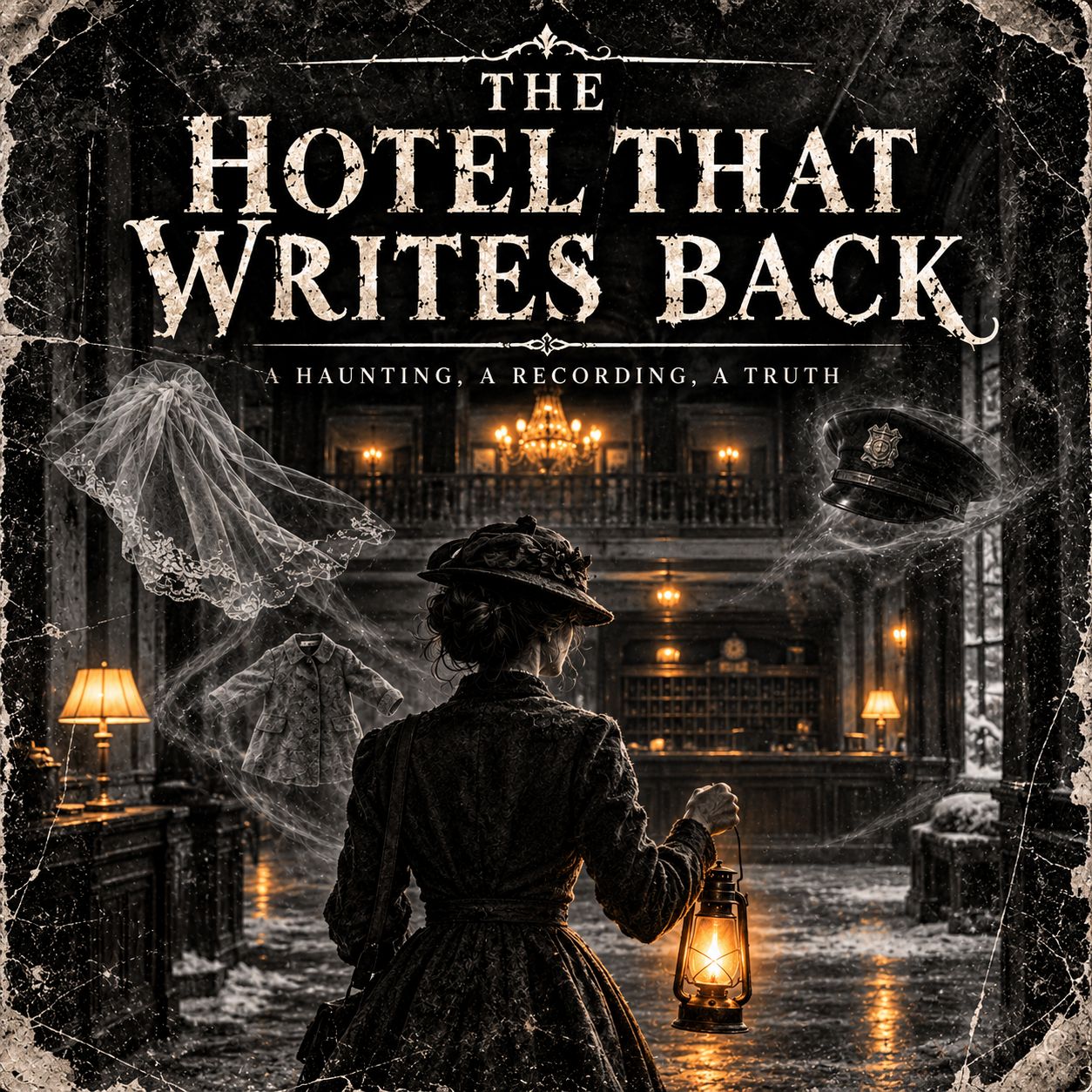
Point of view: first person, past tense, narrated by a skeptic. Tone: wry, wintry, then hushed and reverent.
I should say up front that I do not believe in ghosts. I believe in microphones.
That was my whole brand, the reason a podcast network with a ridiculous budget hired me to spend one night in the Northern Reach Hotel, a leaning clapboard giant at the end of a frozen main street, famous for a murdered lawman, a drowned-looking little girl, and a bride who never stopped waiting. My job was simple. Record the room tone, run it through my analysis software, and show, with graphs and a straight face, that every ghost story is just pipes, wind, and a tired imagination. My name is Priya Raman. I am a sound recordist. I debunk for a living.
The software, I should also say, is a quiet partner. I call it Sift. It does not scare. It listens, flags anomalies, and offers me politely worded guesses in a gray panel on my laptop. Over six years it has caught every duct rattle and every squeaky hinge I ever blamed on spirits. Sift and I had a rule: no mysticism, only measurements.
The night clerk met me at the desk at ten. Her name tag said ODILE, and she looked like a woman who had been awake since the previous administration. She slid a blue spiral notebook across the counter without a word, then took it back, then slid it across again.
“The incident book,” she said. “You’ll want to read it. Everyone who stays does, in the end.”
“I won’t need to,” I said. “I brought my own instruments.”
She smiled the way you smile at someone who is about to learn something. “It’s all the same ink, sweetheart. Yours will just be digital.”
The hotel gave me Room 217, two doors from the end of the second-floor hall. I set up the way I always do: a stereo pair in the corridor, a contact mic on the old wardrobe, a boundary mic on the windowsill, and Sift running on a quiet loop. The hallway was long, carpeted in a faded runner, lit by amber sconces, and cold in a way that had nothing to do with the heating. I told myself that cold was plumbing. I told myself a lot of things.
For the first three hours there was nothing. The old building did what old buildings do: ticked, sighed, settled. I logged every sound and gave it a mundane label. At 12:40 a.m. my headphones caught a slow, off-key hum, a child’s hum, and my stomach dropped. Then Sift displayed a polite gray note: Source likely HVAC resonance, 112 Hz harmonic, probability 71%.
“There,” I said aloud, relieved. “Pipes.”
Three knocks sounded on the door at the end of the hall.
I froze. The waveform on my screen spiked cleanly, three evenly spaced taps, soft as knuckles on a pillow. Sift hesitated, and for the first time in six years, the little gray panel stayed blank. Then it printed a single line: No mechanical source identified. Confidence: low. Suggest manual verification.
“Suggest manual verification,” I whispered. “Thanks, Sift. Very helpful.”
I went into the hall. I am not proud of that. A rational person would have stayed in the room and let the equipment do the heroic work. But I had spent my career telling people that the dark was empty, and some stubborn, honest part of me needed to stand in it and hear that for myself.
The hallway was empty. A blue ribbon lay on the carpet outside the last door, the kind a child wears in her hair, and the carpet around it was damp, as if someone small had just come in from the snow. The door itself had a number, 219, and a hand-lettered card that read: Do Not Disturb. Do Not Open.
I stood there with my headphones around my neck and my recorder in my hand and I felt, with a clarity I would like to tell you I dismissed, that I was being waited on. Not threatened. Waited on. The way a patient doctor waits for the person who has finally decided to say it out loud.
Then my recorder, a small, quiet thing that holds a thousand hours and has never once lied to me, ticked itself awake and started playing back, on its own, the last four minutes of tape.
It wasn’t my recording.
I heard a gunshot, flat and ugly, in a night colder than this one. I heard boots on gravel. A man’s voice, hoarse and clear, saying a single sentence I will not forget: “The little one saw it. Somebody has to listen to the little one.” Then a girl crying, small and furious, and a woman, older, saying “Hush, hush, say nothing, they’ll hurt you, say nothing,” in the voice women use when the cost of speaking is higher than the cost of silence.
Then, a long, long quiet. And then a bell, far away, ringing for a wedding that had no one in it.
I don’t know how long I stood there. I know the sconces flickered. I know Sift, back in the room, had begun to print line after line on my laptop screen, not analysis but something closer to transcription, as though the software had stopped guessing and started hearing. When I returned and read it, my hands were shaking.
It wasn’t a ghost story at all. It was a record. A child had witnessed a murder and been told to stay quiet. A groom had never reached the church because a powerful man needed him not to. A bride had waited, and a town had decided the story was hers to be ashamed of. A lawman had tried, and been shot four steps from the door. And in every generation afterward, the people who worked this building, the clerks, the housekeepers, the cooks, almost all of them women, almost none of them paid enough, had written the haunting down in a blue notebook, line by line, century after century, because nobody with power would. They had built a case out of ink and exhaustion. They had been keeping the record.
I came downstairs at four in the morning with my recorder under my arm. Odile was at the desk, pouring coffee into a mug that said WORLD’S OKAYEST CLERK. She did not ask what I had heard. She just pushed the notebook toward me one more time.
And that’s when the real conflict arrived, the one that had nothing to do with ghosts. Waiting by the front door, in a camel coat and a very good scarf, was a man introduced to me as the hotel’s current director of heritage, a polite, polished descendant of the family that had built the Northern Reach. He had heard, somehow, that my recording equipment had “captured something unfortunate.” He was very sorry for the inconvenience. He had a standard confidentiality form and a check that was, frankly, more than my network was paying me.
“A hotel like this lives on its legend,” he said, smiling. “The mystery is good for business. A… resolution would be bad for business.”
I looked at the check. I looked at Odile, who looked at her coffee. I looked at the notebook, the worn blue spine, the handwriting of a dozen women who had never been offered a check and had written the truth anyway. And I understood that every person in this building had, at some point, been handed some version of that form, and that most of them had signed it with a shrug and gone on writing in the book where nobody powerful would read it.
I am a skeptic. But skepticism, properly understood, is not the refusal to believe. It is the refusal to be silenced by a comfortable answer.
“No,” I said.
He blinked.
“I’m not signing,” I said. “I’m going to take this recording to the county historian, and then to every network that will listen, and the notebook is going with me.” I turned to Odile. “If that’s all right with you.”
She looked at me for a long time. Then she said something I have thought about every day since: “It was never ours to keep. It was ours to carry until somebody came who’d carry it further.”
I carried it. The county reopened the file within a month. A small stone with a child’s name went into the ground beside the hotel steps, and a plaque for the lawman went up near the gravel. The letter that proved a groom had never abandoned his bride was finally read aloud in a courtroom, and the hotel’s family name, for the first time in a century, was spoken with shame instead of pride. My podcast episode, which was supposed to debunk a haunting, instead became a ten-minute silence followed by a name.
Sift, I should add, is still my partner. When I asked it, weeks later, what it had been doing in that hallway, it printed one line in its polite gray panel: Listening. As requested.
I keep a blue notebook now, in my own studio. I write down the things the equipment can’t explain, and I do not argue with them anymore. Some nights, around two, I leave a small blue ribbon on the console. By morning it has always moved, an inch, no more, as if someone were saying: thank you. Keep going.
I still do not believe in ghosts. I believe in witnesses. And I have learned that a witness doesn’t stop being a witness just because the world stopped listening.
So write it down. Somebody, someday, will read it.