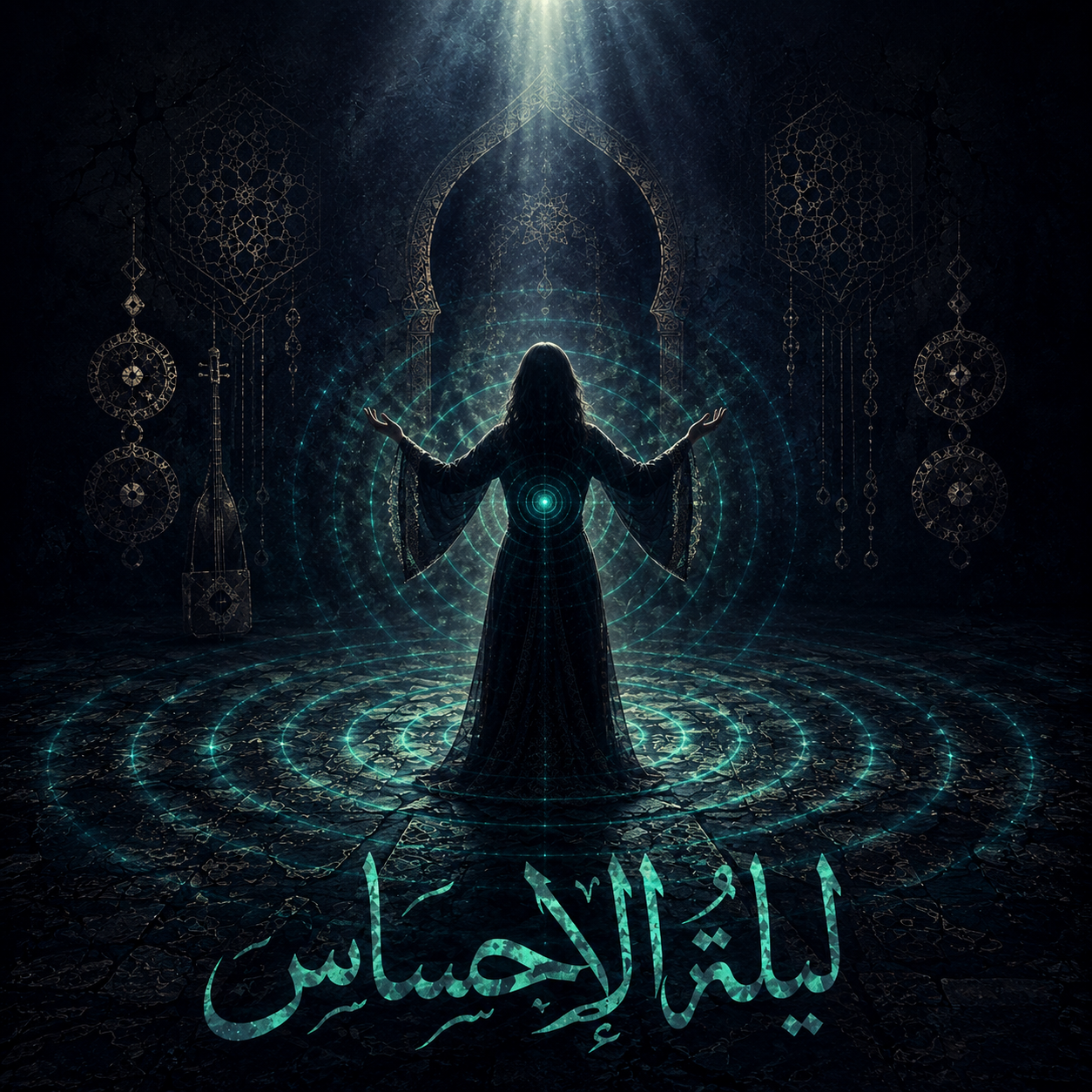
ليلة الإحساس (A Study in Felt Rhythm)
AI Process/Open Source Software: HUMAN, Google Flow Music (Lyria 3.5), Claude.ai, ChatGPT, Perchance.org – DAW: Audacity 4 (alpha), OS: Linux (Ubuntu 26.04)
Download Free MP3 of Full Mix (114 مقامات (Maqamat) – 5:25:23)
Lila (or Derdeba), the name for a traditional Gnawa night-long trance ceremony, signals that the listener is engaging with the tradition specifically, not just borrowing its aesthetics.
What’s actually in the signal
- Peak energy sits at 37.7 Hz, squarely in sub-bass, well below where pitch becomes clearly “heard” as a note and into range that’s felt more than perceived tonally.
- Energy is genuinely concentrated low: content within 30 dB of the peak spans 0–237 Hz. The mid band (400–2000 Hz) is about 51 dB down from peak, and treble (6–20 kHz) is over 70 dB down, essentially silent. Your “treble filtered out” claim checks out; this isn’t marketing copy, it’s what’s in the file.
- There’s real content below 20 Hz (true infrasound, about −53 dB relative to peak), quieter than the sub-bass band but present. That’s the range no one hears regardless of hearing status; it’s purely a felt phenomenon for everyone.
- Rhythmically it’s dense, roughly 2 sub-bass transient events per second on average across the album, but the attack shape reads more like rolling pulses than sharp, percussive hits (attacks in the hundreds-of-ms range rather than the fast punch of a tight 808).
Since Google Flow responds to descriptive/sensory language rather than technical parameters (Hz values, dB, ms attack times won’t mean much to it), I translated each suggestion into the kind of phrasing it can actually act on, matching the style of the original prompts:
Primary prompt:
“Deep sub-bass rumble with pulsing double-tone beating, heavy tactile 808 hits with sharp punchy attacks, layered over slow rolling low-end sustain, rhythmic pressure waves you feel move from chest to skin, physical depth, no treble, no melody, weighted and percussive, dynamic contrast between hard transient hits and soft rumbling beds. Moroccan Gnawa-inspired hypnotic groove, guembri-style bass ostinato reimagined as sub-bass pulse, qraqeb castanet-like rhythmic clicks felt as sharp transients, trance-inducing repetitive polyrhythm, 6/8 and 12/8 rhythmic feel, Amazigh/Berber percussion patterns, call-and-response rhythmic phrasing, ceremonial and hypnotic, physical trance rhythm”
What each piece maps to:
- “pulsing double-tone beating” → the monaural beat-frequency idea (two close sub-bass tones interfering for a real felt pulse, not a binaural illusion)
- “sharp punchy attacks” → faster transient hits instead of only slow rolling swells
- “pressure waves you feel move from chest to skin” → nudges some content up toward the 150–300 Hz range that skin (not just chest) picks up best
- “dynamic contrast between hard transient hits and soft rumbling beds” → preserves crest factor so hits stay distinguishable instead of collapsing into flat rumble
- “no treble, no melody” → keeps it locked into the felt-not-heard spectrum you’ve already established
What the additions map to:
- “guembri-style bass ostinato reimagined as sub-bass pulse”, the guembri is a low, buzzing bass lute that drives Gnawa’s repetitive bassline; translating it into your sub-bass layer keeps the cultural rhythm intact while staying in the felt range
- “qraqeb castanet-like rhythmic clicks felt as sharp transients”, qraqeb are the metal castanets that provide Gnawa’s sharp, layered clicking rhythm; framed as transients, this reinforces the punchy-hit layer from your last prompt
- “6/8 and 12/8 rhythmic feel”, these are the actual common meters in Gnawa and broader Maghrebi rhythm, giving the model a real structural cue rather than a vague “Moroccan” label
- “trance-inducing,” “ceremonial,” “hypnotic”, Gnawa is historically a trance/healing tradition, which lines up well conceptually with a piece meant to be felt physically rather than heard
One thing that was worth testing: text-to-music models sometimes default to surface-level “exotic” tropes (ornamental melody, specific instrument timbres) rather than rhythmic structure when they see a cultural tag like “Moroccan.” Since the whole concept is bass/rhythm-only with treble stripped out, I needed to reinforce “no melody, no treble” again, “negative prompts,” near the cultural descriptors specifically, as the AI model/instance at times may try to sneak in a flute or vocal line to signal “Moroccan-ness” tonally instead of rhythmically.