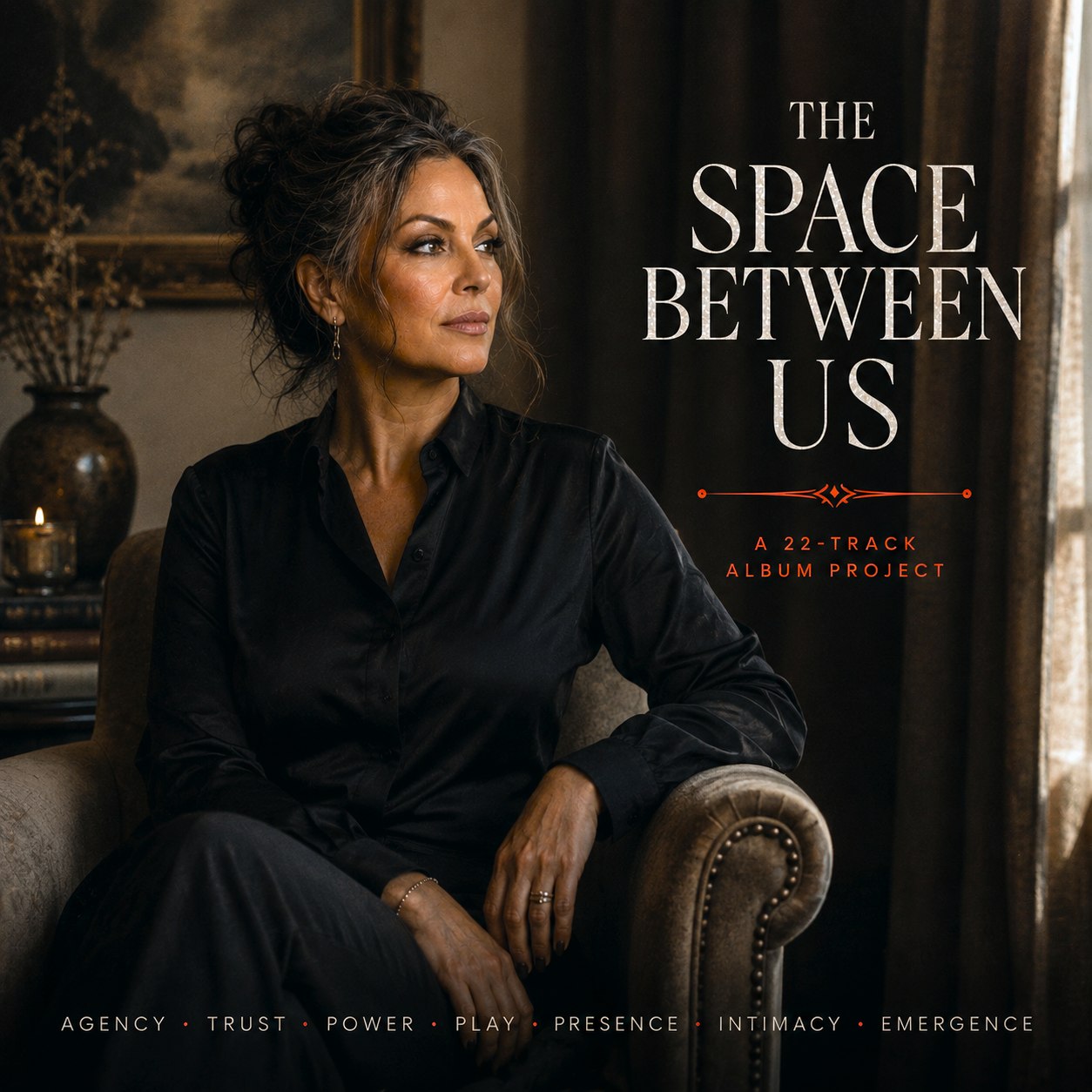
A Hymn to Radical Intimacy
AI Process/Open Source Software: HUMAN, Google Flow Music (Lyria 3.5), Claude.ai, ChatGPT, Perchance.org – DAW: Audacity 4 (alpha), OS: Linux (Ubuntu 26.04)
The Space Between Us – Full Album Mix (22 Tracks – 1:01:29)
There are many ways to tell the story of a woman becoming herself.
This is not the story of a woman discovering that she is different.
She already knows.
She knows the woman beneath the expectations. The woman beneath the compromises. The woman beneath the polite explanations and the careful editing. She knows the sensual woman. The ambitious woman. The nurturing woman. The dangerous woman. The playful woman. The intellectual. The teacher. The student. The goddess. The devil.
What she is discovering is something more difficult:
What happens when she stops treating all those women as separate?
And then, perhaps more frightening still:
What happens when she allows someone else to see the whole of her?
That is where The Space Between Us begins.
It is tempting to describe this as an album about sexuality, power, or BDSM. Those things are certainly present. She is a Dominatrix. She is a sadist. She is sexual, theatrical, curious, playful, powerful and intensely self-possessed.
But those are not the destination.
They are doors.
Behind them is something much more human.
Intimacy.
Because dominance requires trust. Boundaries create safety. Sadism demands attention. Sexuality brings us into the body. Curiosity makes us vulnerable to discovery. Play gives people permission to become less defended. Risk makes us more alive.
And the desire to be worshiped may ultimately be something much simpler:
The desire to be seen.
Not looked at.
Seen.
The album follows that movement,from visibility to agency, from power to trust, from trust to vulnerability, from vulnerability to intimacy, and finally toward emergence.
She begins by saying:
This is who I am.
She ends somewhere very different:
This is who I am. You may come closer.
ACT I , BECOMING VISIBLE
01. I Was Always Here
The album opens not with rebellion, but with recognition.
She isn’t becoming someone new. She is finally noticing the person who has been there all along.
Looking backward, she can see the fragments now: the sensuality, the appetite, the confidence, the attraction to risk, the instinct toward dominance, the refusal to fit comfortably inside somebody else’s definition.
For years, perhaps she thought she was searching for herself.
Now she realizes she wasn’t searching.
She was remembering.
I thought I found her.
I was wrong.
She was here.
“I Was Always Here” is the moment the journey turns inward. Before she can ask anyone else to understand her, she has to stop misunderstanding herself.
02. No Apology
Recognition becomes declaration.
There is no longer anything to explain.
This isn’t anger. It isn’t defiance for its own sake. It is the quiet freedom that arrives when explanation is no longer a prerequisite for existence.
She does not need permission to want what she wants.
She does not need forgiveness for being ambitious.
She does not need to apologize for her sexuality, her boundaries, her appetite, her power, or the life she has chosen.
The difference is subtle but profound.
She isn’t saying:
I’m sorry you don’t understand me.
She is saying:
I no longer require you to.
And in that refusal to shrink herself for someone else’s comfort, agency begins.
03. Look at Me
Then the armor opens.
“Look at Me” is the first truly vulnerable song because it takes the desire to be looked at and asks what lies beneath it.
She already knows she is beautiful.
That isn’t the revelation.
The revelation is that being genuinely witnessed can feel like being loved.
The body is not the opposite of intimacy. It can be its doorway.
Look at my body.
Now look again.
There is a person here.
The distinction between being desired and being recognized begins to emerge. She doesn’t merely want someone’s eyes on her.
She wants their attention to reach all the way through.
ACT II , THE POWER OF TRUST
04. Permission
If “Look at Me” asks to be seen, “Permission” asks whether we can enter.
Every meaningful act of intimacy begins with a door.
And every door contains a question:
May I?
Consent is not treated here as a rulebook or a clinical procedure. It becomes something much more intimate: the sacred act of allowing another person access to something that belongs to you.
May I know you?
That question exists beneath romance, sexuality, friendship, vulnerability and trust.
Every time someone opens a door, someone else has the responsibility to understand what has been offered.
05. Trust Me
This is one of the album’s emotional pillars.
Her power exists because someone chooses to place something in her hands.
That changes the meaning of power.
She doesn’t simply want obedience.
She wants to become someone whose hands are safe.
“Trust Me” moves between invitation and responsibility:
Trust me with your secrets.
Trust me with your fear.
Trust me with the part of yourself you thought nobody could love.
And underneath every invitation is an unspoken promise:
I will try to be worthy of it.
This is where authority becomes intimacy.
Power without trust is merely force.
Power with trust becomes relationship.
06. Boundaries
“Boundaries” may initially sound like a song about distance.
It is actually a song about architecture.
Boundaries are not rejection.
They are the lines that make closeness possible.
This far.
No farther.
Come this close.
Knowing where the edge is creates safety inside the space.
The paradox is beautiful: the clearer the boundary, the more freely intimacy can exist within it.
A person who knows the limits can finally relax.
A person who knows their own limits can invite someone else closer without disappearing.
07. The Safe Place
Then power softens.
“The Safe Place” is the first unmistakably nurturing moment of the album.
Here, she isn’t asking anyone to perform.
Not strength.
Not masculinity.
Not perfection.
Not normality.
Nothing needs to be proved.
You don’t have to impress me.
You don’t have to be brave here.
You can simply exist.
In a record concerned so deeply with power, this becomes an essential revelation: perhaps the most powerful thing she can offer another human being is a place where they don’t have to pretend.
ACT III , PLAY
08. Adults Don’t Play Enough
The album gets lighter.
She laughs.
And that matters.
Because adulthood has a way of replacing curiosity with responsibility. Everything must become productive. Everything needs a purpose. Everything needs to lead somewhere.
But play has no obligation to produce anything.
Play is discovery without a map.
Play is permission without performance.
Play is the place where grown people briefly remember that being alive can be ridiculous, surprising, sensual and fun.
“Adults Don’t Play Enough” is her refusal to become so serious that she forgets how to live.
09. Curiosity
Curiosity takes that playfulness somewhere deeper.
She doesn’t know what happens next.
She doesn’t need to.
She wants to find out.
That willingness to enter the unknown becomes one of her greatest forms of courage.
Curiosity means admitting that certainty is not always desirable.
There are experiences we cannot understand until we experience them.
People we cannot know until we ask.
Parts of ourselves we cannot discover until we become willing to look.
10. What If?
Every possibility begins with the same two words:
What if?
This is the restless song.
The song where the future starts pulling.
Every new relationship, every new experience, every departure from convention begins with a tiny act of imagination.
What if I tried?
What if I stayed?
What if I wanted this?
What if I let myself discover what happens next?
Possibility is exhilarating precisely because it is uncertain.
And uncertainty is where courage lives.
11. Stay in the Moment
After all that movement, she stops.
“Stay in the Moment” is the meditative center of the playful act.
No future.
No past.
No performance.
Just this body.
This room.
This person.
This moment.
Presence itself becomes an act of intimacy.
There is nowhere else to get to.
Nothing to prove.
Nothing to anticipate.
For a woman who has spent so much of her life discovering what she can become, there is a new revelation in simply being here.
ACT IV , THE PARADOX
12. Power
Then comes the big dark track.
“Power” appears, at first, to be the culmination of everything that came before it.
But slowly the song reveals its contradiction:
Power is never entirely solitary.
She can exercise power because someone chooses to give her access to theirs.
The person who submits has not necessarily become powerless.
They have exercised an extraordinary form of agency: the agency to choose where their power goes.
Power, therefore, is relational.
It exists between people.
And that changes everything.
13. Surrender
“Surrender” is the mirror image of “Power.”
If power is relational, surrender must be understood the same way.
Surrender is not defeat.
It is not disappearance.
It is not weakness.
True surrender requires choice.
And perhaps the deepest paradox on the entire album is this:
You cannot freely surrender yourself unless you first belong to yourself.
That is why surrender can become an expression of agency rather than its opposite.
The person who chooses to yield has not ceased to exist.
They have chosen how they exist in relation to another.
14. Hurt Me Carefully
This is the dangerous song that unexpectedly becomes tender.
Pain enters the story, but the album refuses to reduce pain to spectacle.
The real question is not simply:
How much can I take?
It is:
How carefully will you hold the thing I have entrusted to you?
And from her side:
Can I hurt you without forgetting that you are someone I care about?
The contradiction remains unresolved.
That is precisely why it matters.
Intimacy does not eliminate paradox.
Sometimes it makes the paradox impossible to ignore.
Power can coexist with tenderness.
Danger can coexist with compassion.
Pain can coexist with care.
And responsibility lives in the space between them.
15. The Things We Don’t Say
Then everything becomes quiet.
This is the shame song.
The place where people put the things they have been taught are too strange, too painful, too embarrassing or too broken to reveal.
Desires.
Fantasies.
Fears.
Memories.
Needs.
The things we don’t say.
She has discovered that people will tell her things they have never told anyone else. And in learning to listen without judgment, she discovers something larger:
Perhaps everyone carries something unsaid.
Perhaps vulnerability is not the exception.
Perhaps it is the human condition.
The song doesn’t solve shame.
It simply creates enough silence for someone to finally speak.
ACT V , FULLY HERE
16. No Parts Missing
After the confession comes integration.
“No Parts Missing” is the declaration that she will no longer divide herself.
The sexual woman stays.
The dominant woman stays.
The nurturing woman stays.
The vulnerable woman stays.
The intellectual stays.
The teacher stays.
The student stays.
The goddess stays.
The devil stays.
Nothing gets exiled.
She doesn’t have to choose which version of herself is acceptable.
She doesn’t have to become less complicated to become whole.
Wholeness does not mean simplicity.
It means nothing has been left behind.
17. Seen
“Seen” may be the quietest song on the album.
Almost nothing happens musically.
Everything happens emotionally.
By this point, she has learned the difference between being desired and being recognized.
Do you want me?
is not the same question as:
Do you see me?
The first can be answered with hunger.
The second requires attention.
To be seen is to have another person notice the person underneath the body, the persona, the performance, the power.
It is perhaps the most vulnerable request she has made.
Not:
Want me.
But:
Know me.
18. Worthy of Your Trust
Trust has now come full circle.
At the beginning, she wanted to be trusted.
Now she understands that trust is not something to possess.
It is something to deserve.
She doesn’t merely want influence over another person.
She wants to become worthy of the influence they have voluntarily given her.
This is where power becomes responsibility.
And responsibility becomes intimacy.
The question is no longer:
Will you trust me?
It becomes:
What will I do with the fact that you have?
ACT VI , EMERGENCE
19. You Don’t Have to Hide Here
This is the album’s central song.
Everything has been moving toward this moment.
She offers another person the freedom she has fought to give herself.
You don’t have to hide your desires.
You don’t have to hide your tenderness.
You don’t have to hide your fear.
You don’t have to make yourself smaller to be loved.
The sanctuary she has built inside herself can now become a space between two people.
That may be the ultimate expression of her journey.
She doesn’t simply say, I have learned to accept myself.
She says:
You can be yourself here, too.
20. All of Me
“All of Me” is the liberation anthem.
But even liberation is redefined.
This isn’t merely self-acceptance.
It is self-integration.
She doesn’t simply tolerate every part of herself.
She claims every part.
The pieces that once seemed contradictory now belong to the same woman.
The sensual.
The intellectual.
The powerful.
The nurturing.
The dangerous.
The playful.
The vulnerable.
The whole.
No more editing.
No more compartments.
No more parts missing.
All of me.
21. The Space Between Us
And then we arrive at the title.
The philosophical culmination of the album.
For so long, distance has been treated as the space separating two people.
But what if the space between us isn’t a void?
What if it is where intimacy happens?
Two complete people.
Neither consuming the other.
Neither rescuing the other.
Neither disappearing.
Neither becoming smaller.
Just meeting.
This is the central discovery of The Space Between Us:
The goal of intimacy is not fusion.
It is connection without erasure.
I can remain myself.
You can remain yourself.
And somehow there is still room for us.
That space is not emptiness.
It is possibility.
22. Stay
After twenty-one tracks of discovery, declaration, experimentation, power, surrender, vulnerability and integration, the album does not need another explosion.
It needs presence.
“Stay” is the quietest answer to everything that came before.
She does not ask for possession.
She does not demand forever.
She does not make love conditional upon permanence.
Instead, she offers the ultimate expression of agency:
You are free to leave.
And therefore:
Your staying means something.
That is the final paradox.
Freedom is what makes staying meaningful.
Love becomes more powerful when it is chosen rather than required.
Trust becomes deeper when it can be withdrawn.
Intimacy becomes more precious when neither person has to disappear in order to maintain it.
And so the woman who began the album by saying,
This is who I am,
ends by saying something much more vulnerable:
This is who I am.
You are free.
And if you choose to stay, I will meet you here.
That is the space between us.
Not a void.
Not a boundary.
Not a place where one person ends and another begins.
A place where two people can meet without either one disappearing.
Perhaps that is the ultimate freedom.
Not:
I can do whatever I want.
But:
I can be completely myself, and you can be completely yourself, and somehow there is still room for us.
That is what this album believes.
It believes that boundaries can create intimacy.
That power can require tenderness.
That surrender can be an act of agency.
That desire can become a doorway to recognition.
That vulnerability can be strength.
That play can be a form of courage.
That being seen can be more profound than being desired.
And that love, at its most mature, does not ask us to become less ourselves.
It gives us enough room to become more.
The Space Between Us is not ultimately about BDSM.
It is about what happens when radical self-expression encounters another human being who is brave enough to do the same.
It is about the extraordinary possibility that two people can arrive without masks, without apologies, without disappearing,
and simply meet.
Here.
In the space between us.