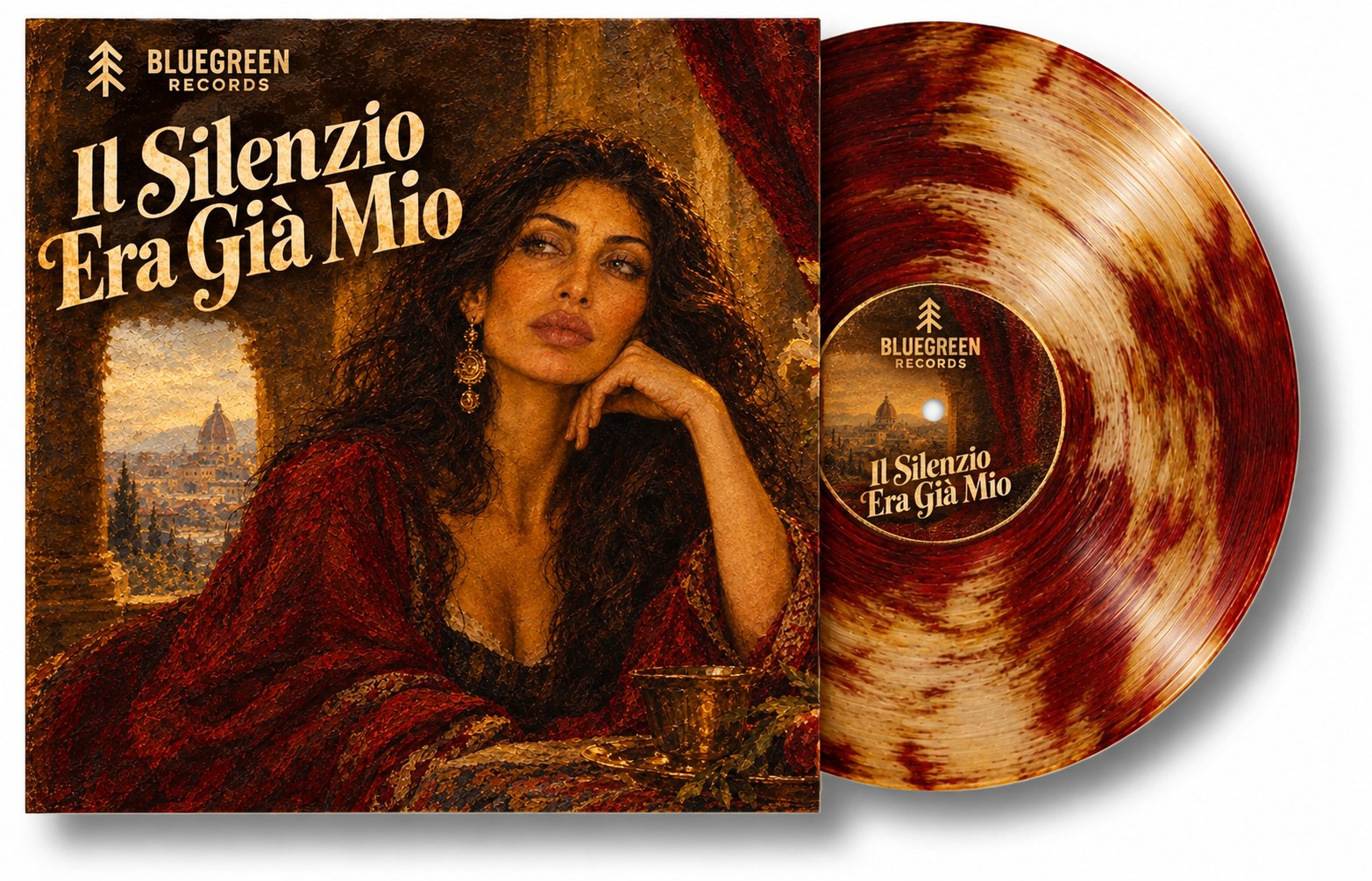
Il Silenzio Era Già Mio – Full Vinyl LP (26:32)
AI Process/Open Source Software: HUMAN, Google Flow Music (Lyria 3.5), Claude.ai, ChatGPT, Perchance.org – DAW: Audacity 4 (alpha), OS: Linux (Ubuntu 26.04)
Free Streams/Download (320 kbps MP3)
Text to music prompt – general – album-wide:
Cinematic Italian chamber-pop ballad with 1960s-70s canzone d’autore soul and a hint of Parisian jazz noir. Slow, 62 BPM, A minor, 3/4 waltz-like sway. Solo female vocal in Italian: low, smoky, intimate contralto with a slight break on the high notes, close-mic’d and breathy, restrained rather than belted, like someone crying quietly and refusing to make a scene. Arrangement: felt upright piano opening alone, then warm brushed drums, slow walking upright bass, a solo cello playing the counter-melody, and a muted flugelhorn in the second verse. Subtle string quartet swells in the chorus, a nylon-string guitar pluck in the bridge, and faint tape hiss and room reverb for a vintage velvet texture. The mood is melancholic elegance, solitude in a beautiful room, and quiet dignity after heartbreak. Dynamics build slowly to a restrained emotional peak, then strip back to piano and voice. Analog, warm, intimate, film-score production. No electronic drums, no heavy autotune, no EDM.
Note from JJ, Sound Designer
Most portraits are made for the eyes, and this record is meant for the ears.
We tend to judge a face in a glance and move on. A glance is fast, and it is where the cruelty lives. A song can’t be taken in at a glance. It has to be sat through, and it asks you to stay for the second verse and the bridge, and for the moment the cello arrives and says what the singer won’t.
So I asked what the singer’s face would sound like if you gave it the time a song demands.
The answer was not a shimmer. It was a felt piano, because a hammer wrapped in wool is a soft thing that still strikes a hard note. It was a contralto that doesn’t reach for the high notes and breaks a little when it does, because she isn’t pretending the breaking didn’t happen. It was a cello, the instrument closest to a speaking voice, playing what she leaves unsaid. It was brushed drums and upright bass, in the rhythm of someone walking home alone who has decided to be at peace with it.
Every song here belongs to the same quiet room. There is an ornate table, a cup gone cold, a chin resting on a hand, and a window full of late gold light. No one is with her. Anyone who has sat through a dinner like that knows how much it can teach.
These songs don’t ask you to admire her. They ask you to lean in, which is a different act and the one that counts. Look closely at a face and you find what you brought to it. Listen to a voice and you find what it carries, the longing and the dignity, the sentence swallowed and the sentence finally said. Her eyes are tired and her mouth is unafraid, and the record is built to hear both.
There is no rage in these songs and no plea, and nothing in them asks for pity or forgiveness for how she appears compared to others and others’ absurd standards. There is a woman in a beautiful room who has understood something, gathers her bag, and leaves without raising her voice. In the first song she cries without a sound, and it’s the loudest moment on the record.
She herself is a portrait, drawn with human hands and imagined machines. What makes her real is that the grief in these songs is one anyone can recognize, and the elegance is one anyone might claim. If you have ever been misread by life, these songs are for you.
Play it late, alone, with the lights low, and let the silence at the end of each song stay a moment. It was already hers.