Full Album (45.24)
AI Process/Open Source Software: HUMAN, Google Flow Music (Lyria 3.5), Claude.ai, ChatGPT, Perchance.org – DAW: Audacity 4 (alpha), OS: Linux (Ubuntu 26.04)
hymns 4 Her – Full Album (45.24)
There are people who disappear, and then there are people whom the world allows to disappear. Those are not the same thing. This album is about the second kind.
Across the United States, Indigenous women and girls continue to disappear, to be murdered, to go unidentified, to be entered incorrectly into databases, or never entered at all. Families report loved ones missing and encounter a bewildering maze of tribal, municipal, county, state, and federal jurisdictions. Information can fail to travel from one system to another. A woman’s race can be recorded incorrectly. A case can be classified in ways that obscure what happened. A family can be left doing the work of searching while institutions debate whose responsibility it is.
The U.S. Department of Justice now explicitly recognizes Missing or Murdered Indigenous Persons as an ongoing national crisis. Federal research has documented persistent problems with data collection and cross-jurisdictional investigations, and recent audits and studies continue to find disproportionate violence and significant gaps in the systems meant to count, investigate, and resolve these cases.
The numbers are therefore important. But numbers are also part of the problem, because behind every number is a chair. A bed. A toothbrush. A phone that rings and rings. A mother who keeps looking toward the door. A sister who still has her number saved. A daughter who grows older without knowing what her mother would have said about the woman she became.
The statistics can tell us that Indigenous people are dramatically overrepresented among missing-person cases, that violence against American Indian and Alaska Native women is disproportionately severe, and that the systems collecting the data do not always agree with one another, that jurisdictional boundaries can become barriers to justice. But statistics cannot tell you what it feels like to leave a light on for someone who may never come home. That is where music can begin.
hymns 4 Her is not a documentary, and the woman at the center of its companion narrative is fictional. She does not represent one particular missing woman, one particular Nation, or one particular family. She is an imagined sister assembled from the realities of many families who have endured the unbearable condition of not knowing. She is deliberately not given a spectacular death. There is no cinematic monster, no convenient confession, no detective who arrives at precisely the right moment and puts everything back in order. Instead there is something more frightening: absence, and then the machinery of indifference that can grow around it.
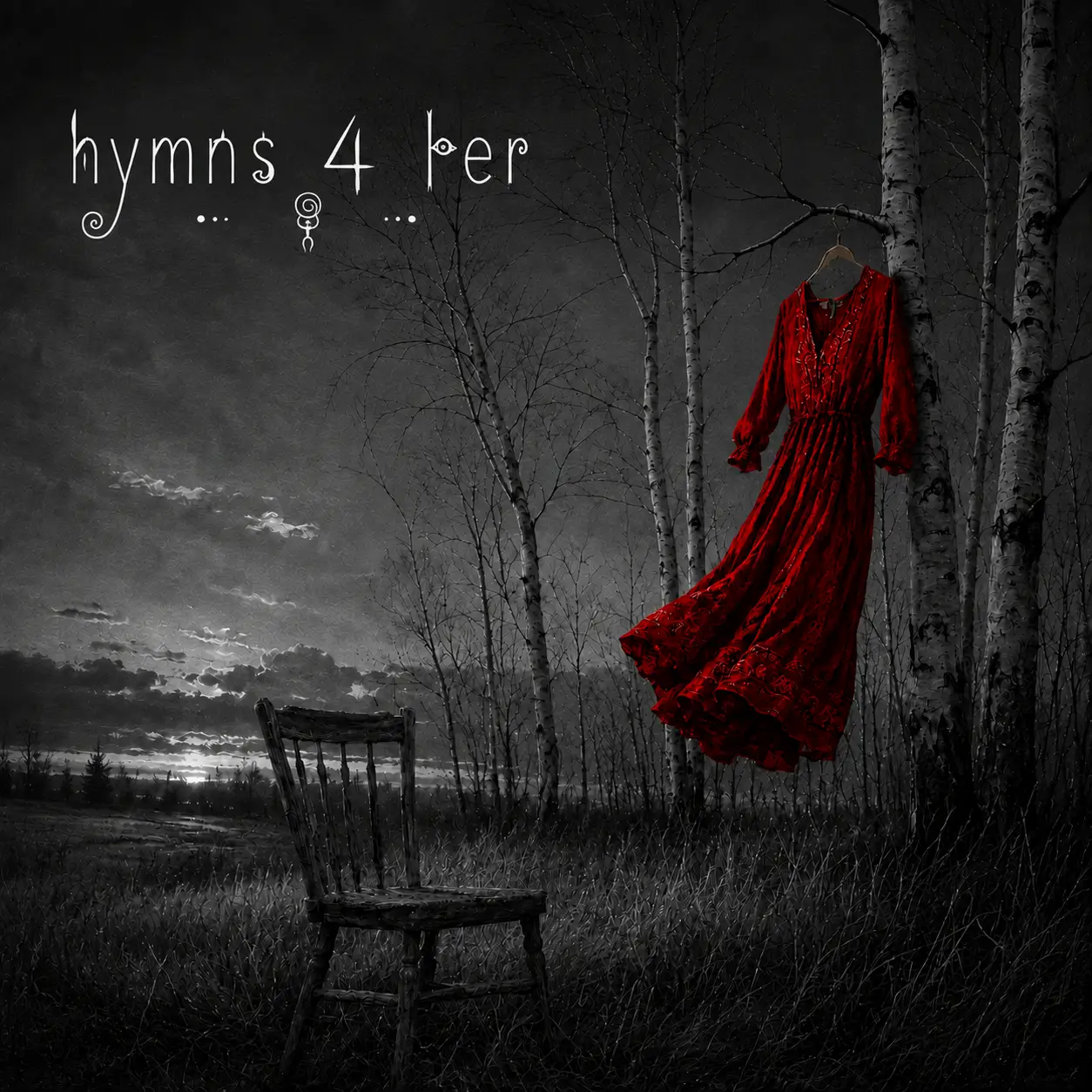
The album begins with “The Empty Chair.” That is where this story really begins, not with a crime scene, but with a place at a table. Her absence enters the house physically. It becomes furniture. It becomes routine. It becomes the thing everyone notices and nobody can fix.
“Black Water” is the terrible middle of every disappearance: the unanswered phone, the unanswered question, the search that produces nothing. There is no clean boundary between hope and grief when nobody knows whether someone is dead, alive, trapped, afraid, or waiting somewhere for help.
Then comes “Red Dress on the Wind.” The red dress is not a costume here. It is a symbol of remembrance and visibility associated with the REDress movement: an empty garment standing in for an absent body, a presence made visible precisely through absence. The album’s visual concept deliberately uses the dress without a figure inside it, refusing to turn another woman’s suffering into spectacle.
From there, the story moves outward, to the river, to the land, to the places where families search because water, earth, roads, fields, woods, and abandoned spaces may remember what people refuse to say.
“Say Her Name” is the first act of resistance. A missing woman is not merely a case. She has a name. She had a laugh. She had opinions. She had songs she liked. She had people who knew exactly how she took her coffee. She was somebody’s daughter, somebody’s mother, somebody’s sister, somebody’s friend.
“Braid” carries that recognition across generations, grandmother, mother, daughter, what is inherited, what is taught, what is remembered, and what violence attempts to sever.
“Her Song Isn’t Over” asks the question that statistics cannot answer: who would she have become? Every missing person carries an unwritten future. Every empty chair contains a thousand unrealized conversations. Every family member who survives the disappearance must somehow live alongside all the birthdays, graduations, grandchildren, arguments, reconciliations, jokes, mistakes, triumphs, and ordinary Tuesdays that might have happened.
Then the machinery appears. “Jurisdiction.” The word itself sounds clinical, almost harmless. But jurisdiction can become a labyrinth. Who investigates? Who has authority? Where did the disappearance occur, and where was she last seen? Who has jurisdiction over the person suspected? Who enters the case, who shares the information, who owns the database, who answers the phone? The federal government has acknowledged that responsibility for public safety in Indian Country can be divided among tribal, federal, state, and local governments, producing serious challenges in investigation and accountability.
And then comes “Man Camp.” This song does not claim that every worker at an extractive-industry camp is violent, nor that every disappearance near a work camp has the same cause. The point is more specific: federal research recognizes the potential relationship among extractive industries, human trafficking, and missing or murdered Indigenous persons, while researchers and advocates have documented concerns about temporary workforces, isolated communities, and increased vulnerability.
“Counted for Nothing” brings us to the cruelest irony: you cannot adequately solve what you cannot adequately count. When a woman is missing but absent from the databases, absent from the headlines, misclassified, or trapped between systems, her disappearance can become statistically invisible. She can become missing twice, first from her family, then from the record. That is why “Say Her Name” matters, and why “Every Time I Leave the House” matters. Because this crisis does not belong only to the women who disappear. It changes the behavior of the women who remain. It teaches vigilance, checking the car before getting in, sharing locations, calling when you arrive, watching the stranger, watching the friend, watching the road, watching the clock. Survival becomes a skill you practice every day.
Then, finally, there is “I Made It Home.” Not triumph. Not closure. Home, and the complicated gratitude of surviving when someone else did not.
From there, grief becomes movement: “We Wear Red.” “March for the Ones Who Can’t.” “Auntie Network.” The private becomes public. The individual becomes collective. Families, aunties, elders, friends, advocates, volunteers, and communities continue searching, organizing, remembering, demanding answers, and refusing disappearance as an ending. The DOJ itself now emphasizes Tribally driven solutions, community response plans, data sharing, and collaboration among Tribal, state, and federal partners.
And that brings us to the final hymn, “Sister, I’ll Look for You.” It is a promise, not that every missing woman will be found, not that every family will receive justice, not that grief can be repaired. It is the simpler, and perhaps more radical, promise that nobody should have to search alone.
This album is dedicated not only to the women who are missing or murdered, but to the people who refuse to stop looking: the mothers, the fathers, the daughters, the brothers, the aunties, the elders, the friends, the volunteers who walk roads and riverbanks, the people who put up posters, who make phone calls, who keep photographs on their phones, who say a name when the world has moved on, and to every family living in that impossible space between hope and mourning.
The woman in the Companion Narrative Adaptation that follows is fictional. Her absence is not. Listen to these songs as a story. Then listen again as testimony. And when the music ends, remember that the empty chair is not empty because she was forgotten. It is empty because someone is still waiting for her. And somewhere, someone is still looking.
Companion Narrative Adaptation
Sister, I’ll Look for You

The chair was still there. That was the first thing I noticed, not her coat, not her shoes, not the photograph of the two of us on the refrigerator. The chair. She had always sat in the same place at the kitchen table, even when there were plenty of other chairs. Our mother used to joke that she had claimed it before she was old enough to understand what claiming anything meant.
So when my mother called me that night and said, “She isn’t home,” I drove over. I don’t remember the drive. I remember the chair. I remember the plate my mother had put away because she couldn’t stand looking at it. I remember the glass of water beside it. I remember thinking that she would come through the door and laugh at all of us for being dramatic. She was always making fun of us for worrying. That was her. She would have said, “I’m a grown woman.” Then she would have hugged Mom, stolen something from the refrigerator, and sat in her chair.
But she didn’t. And the chair remained.
At first, nobody called it a disappearance. We called it late. Then we called it strange. Then we called it worrying. Then we called the police.
The first man who came to the house was polite. He looked around, he asked questions. When was she last seen? Who had she been with? Was she having problems with anyone? Did she use drugs? Was she drinking? Was she depressed? Was she seeing somebody? Had she ever done this before? Our mother answered every question. I watched her become smaller with every one, not because she was ashamed, but because she was beginning to understand that the questions were looking for a reason not to look. The man asked whether my sister had a boyfriend. I said yes. He asked whether they’d been fighting. I said I didn’t know. He wrote something down. He asked whether she had ever talked about leaving. I said everybody talks about leaving sometimes. He nodded, and wrote something else down.
Nobody asked what she loved. Nobody asked what she sounded like when she laughed. Nobody asked which side of her hair she wore her braid on, or what song she always sang in the car, or how she took her coffee. Nobody asked about the chair.
The next morning we called everyone, cousins, friends, aunties, people whose numbers I hadn’t seen in years. Someone printed flyers. Someone brought coffee. Another auntie arrived with sandwiches because she knew we would forget to eat. The men went out looking first; they took trucks, drove the roads, checked places they thought men might go. The women stayed behind and made lists, phone numbers, friends, coworkers, hospitals, jails, shelters, every place we could imagine, every place we could not. By afternoon we had become a search party. By evening we had become something else: a family that did not know whether to pray for a body or a living woman. That is a particular kind of hell.
People talk about grief as if grief begins when someone dies. They don’t tell you about the grief that has no body, no funeral, no final word, no permission to stop hoping. You cannot mourn someone who might walk through the door tomorrow. So you wait. And waiting becomes its own kind of wound.
The river was searched three times, first by police, then by volunteers, then by us. The river did not give her back. But every time I stood beside it, I imagined that it knew. That sounds foolish, I know. But there are moments when you would rather believe the river knows than believe nobody knows. We walked along the bank calling her name, not screaming, just calling, as though she might be on the other side of the water, as though she might answer, as though the world had become very large and our voices were the only way to make it smaller. Her name. Again. And again. And again.
A few weeks later, someone hung a red dress from a tree. It moved in the wind. There was no woman inside it. That was the point. I stood there for a long time. The dress moved as if someone were wearing it, and for one second I imagined my sister walking toward me. Then the wind changed. The dress turned sideways. Empty. I cried so hard I had to sit down, not because the dress looked like her, it didn’t, but because it looked like all of them. Every woman whose absence had become a photograph. Every woman whose family had learned to answer the phone with fear. Every woman whose name had become a poster. Every woman who had become a number. I touched the fabric, and I said my sister’s name. Loudly. Because if the world was going to make her invisible, I would make her name visible.
Months passed. The case crossed desks. It crossed county lines, jurisdictions, agencies, people. Everywhere it went, someone explained why someone else was responsible. Tribal. State. Federal. Local. Not our jurisdiction. Outside our jurisdiction. We’re waiting for information. We don’t have that information. Someone will call you. Someone never called. We learned words we had never wanted to learn, NamUs, NCIC, jurisdiction, missing person, unidentified person, evidence, case number. We became experts in the vocabulary of our own heartbreak. And still, the chair sat at the table.
There were rumors. There are always rumors. Someone said she’d been seen two towns away. Someone said she’d left with a man. Someone said she had been working around the camps. Someone said she’d been angry, or afraid, or that she had gotten into a truck, or gotten out of one. Someone said they knew what happened. They didn’t. Every rumor gave us hope. Every rumor took it away.
My mother stopped sleeping. My father stopped talking. I learned to keep my phone beside me in the shower, to wake up when it vibrated, to recognize the sound of my mother’s footsteps when she had been crying. I learned that women can become exhausted from being careful. Every time I left the house, I checked my surroundings. I texted when I arrived. I shared my location. I watched the parking lot, the door, the man behind me. I watched everything. And sometimes I hated my sister for teaching me how to be afraid. Then I hated myself for thinking it. Then I missed her so much that the hatred disappeared.
One evening I found her old hairbrush in the bathroom drawer. There were still strands of her hair caught in it. I held it in my hand, and for a moment she was six years old again, our grandmother sitting behind her, patiently working through the knots. My sister complained. Grandmother laughed. “Beauty takes patience,” she said, and divided the hair into three pieces, over, under, over, under. A braid. I remembered how my sister had looked over her shoulder at me. “Your turn.” I said no. She said I had to learn. So I did. Years later I would realize that was how our family taught love, not by talking about it, but by showing you how to carry it, hand to hand, generation to generation, until somebody steals one of the hands away.
There were things my sister would never get to do. We knew that much. She would never grow old, at least not in front of us. She would never become the woman she was becoming. We would never meet the version of her who had learned whatever adulthood was going to teach her. Maybe she would have moved away. Maybe she would have stayed. Maybe she would have married, or refused to. Maybe she would have had children, become a grandmother, written a book, hated the book, laughed at us for imagining all this. That is one of the cruelest things about losing someone who is missing: you don’t only lose their past, you lose their future, everything they might have become. Her song isn’t over. We just cannot hear the next verse.
Years passed. People stopped asking, not everybody, but enough. The first year, everybody knew her name. The second year, fewer people remembered. The third year, the photograph had begun to fade on the bulletin board. Someone suggested updating it. We did. We printed new copies and put them everywhere, the store, the library, the community center, the highway, the gas station, the post office. We put her face into places where strangers could see her. We refused to let her become old news, because there is something dangerous about forgetting. Once the world forgets a missing woman, her family becomes the only evidence that she existed. So we became evidence.
We wore red. At first I hated it, I thought grief should be quiet, private, respectful. Then I realized silence had never protected my sister. So we wore red. We gathered, we walked, we carried photographs, signs, flowers, the names of women who could not walk beside us. Somebody carried my sister’s photograph. I carried her name. And when we began to march, I understood something: we weren’t walking toward a destination. We were refusing to stand still.
The aunties knew what to do. They always did. They called people, fed people, drove people. They remembered birthdays, found blankets, sat with mothers, organized searches, raised money. They knew which person to call when the official number stopped answering, which elder would listen, which road had not been searched, which family needed help. They never called themselves a network. They were simply aunties. That was enough. When institutions failed, people became infrastructure. When databases failed, memory became evidence. When authorities stopped looking, families kept looking.
One winter morning, I found myself sitting in my sister’s chair. I hadn’t done it before. It felt wrong. Then it felt familiar. I put my hands on the table and closed my eyes. For the first time in years, I didn’t imagine finding her, I imagined talking to her. I told her everything. I told her Mom was getting older. I told her Dad had finally started talking again. I told her our niece had her smile. I told her the braid had come back into fashion and she would have hated that. I told her I still had her number, that I still checked my phone, that people still asked about her, that we were still looking. Then I said the thing I had been afraid to say for years: “I love you.” The room was silent. The chair held me. And for one strange second, silence did not feel empty. It felt like listening.
I do not know where my sister is. That is the sentence I have learned to live with. Not accept. Live with. There is a difference. I don’t know what happened to her. I don’t know who took her. I don’t know whether somebody knows and refuses to speak. I don’t know whether the river knows, or whether the earth remembers, or whether justice is coming.
But I know this: she existed. She was loved. She mattered. She still matters. And every time someone says her name, the world has to make room for her again. So I say it. Her mother says it. Her father says it. Her aunties, her nieces, her friends say it. Strangers say it. Women who never met her say it. And when we walk, we walk with her. When we wear red, we wear it for her. When we search, we search for her. When we demand answers, we demand them for her, not because she is a statistic, but because she is a sister, a daughter, a mother, a woman, a person whose chair is still waiting.
And because I promised her something a long time ago, before the police reports, before the posters, before the databases, before the marches, before the years, before we knew how long this would take, I promised her that I would look.
So I look. Tomorrow, I will look. The day after that, I will look. Until I cannot walk anymore, someone will walk for me. Until I cannot speak anymore, someone will say her name. Until every sister is home, we will keep searching. Because no woman should disappear twice. And no sister should ever have to search alone.
Sister, I’ll look for you.