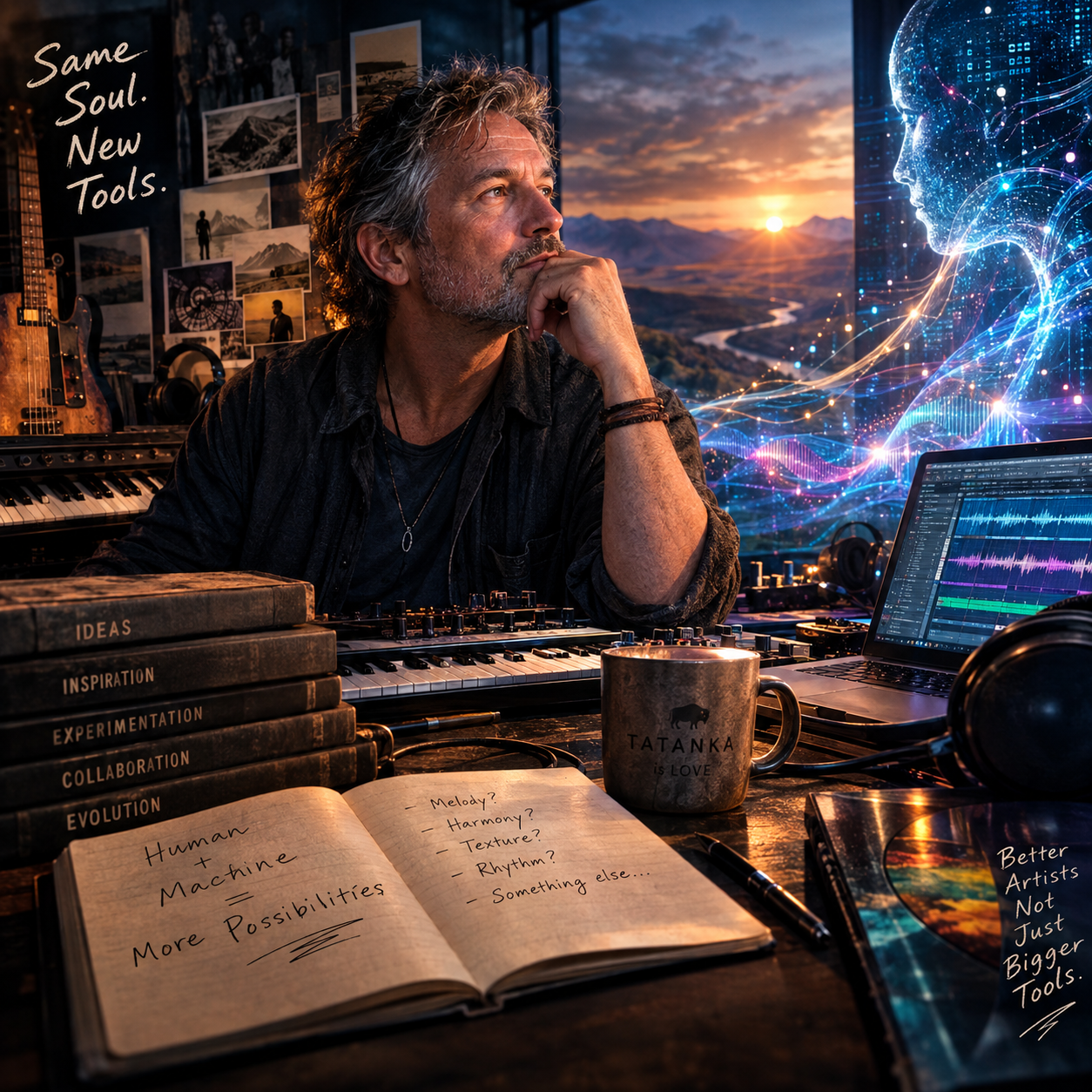
The next great divide in music won’t be between humans and machines. It will be between artists who evolve and artists who refuse to.
An AI dumbs this all down for us:
The next great divide in music won’t be between humans and machines. It will be between artists who evolve and artists who refuse to.
I’ve been making music for a long time.
Long enough to remember when recording music meant something very different from what it means today. Long enough to watch technology repeatedly arrive with dire predictions about what it was going to destroy.
The technology changes.
The argument doesn’t.
Something new appears. Artists get nervous. Some embrace it. Some experiment. Some hate it. Some loudly announce that whatever the new thing is, it isn’t real music.
Then, eventually, we all move on.
The new thing becomes part of the toolbox.
And nobody thinks twice about it anymore.
So here we are again.
This time, it’s artificial intelligence.
And apparently, AI is going to kill music.
I’m not buying it.
I’ve Got a Different Question
I’m not particularly interested in whether AI can “make music.”
Of course it can.
That’s no longer the interesting question.
The interesting question is what happens when a human composer with something to say starts working with a machine capable of doing things that neither an instrument nor a traditional recording studio could do.
That’s where things get interesting.
I don’t use AI because I have suddenly forgotten how to make music.
I use it because I am curious about what happens when I throw an idea into the room and something I didn’t expect comes back.
Sometimes it’s terrible.
Sometimes it’s ridiculous.
Sometimes it’s almost there.
And occasionally, something happens that makes me stop and think:
Holy shit. Where did THAT come from?
That’s the good stuff.
Not because the machine has replaced me.
Because it has surprised me.
And surprise has always been part of art.
I Don’t Want an AI to Be Me
This is where I think some of the conversation has gone completely sideways.
I don’t want a machine to become me.
I don’t want it to have my memories, my scars, my loves, my failures, my obsessions, my childhood, my first guitar, my first heartbreak, or the strange collection of sounds that somehow accumulated in my head over several decades.
It can’t have those things.
I can.
That’s the point.
I bring the human mess.
The machine brings possibilities.
I decide what interests me.
I decide what doesn’t.
I push.
I pull.
I break things.
I start over.
I keep the happy accidents.
I throw away the rest.
That’s composition.
The fact that one of my collaborators happens to be silicon instead of skin doesn’t make the creative process less human.
If anything, it can make me more conscious of what my contribution actually is.
Here’s the Part That Makes People Uncomfortable
AI isn’t going away.
And I don’t think the people who hate it are necessarily going to be persuaded by another hundred think pieces explaining neural networks, copyright law, prompt engineering or the inevitable arrival of AGI.
That’s not really the point.
The point is much simpler.
The technology is here.
You can hate it.
You can regulate it.
You can criticize it.
You can demand ethical standards around it.
You absolutely should challenge companies when they exploit artists or treat creative work as an inexhaustible pile of free raw material.
All of that is legitimate.
But refusing to understand the technology isn’t resistance.
It’s surrender.
Because somebody else is going to learn it.
And That Is Where I Think the Real Danger Lies
I’m far less worried about AI replacing musicians than I am about musicians refusing to learn what AI can do.
Not because AI will magically take their jobs.
Because another human being will use the technology more creatively, more efficiently and more imaginatively.
That person will still be human.
They’ll just have a larger toolbox.
That’s a very different proposition.
Imagine two composers.
Both have talent.
Both have ideas.
Both have something worth saying.
One learns the new tools.
The other spends five years explaining why those tools aren’t legitimate.
Eventually, the first composer can explore ten times as many possibilities.
That’s not because the machine became an artist.
It’s because the artist learned another instrument.
Every Generation Thinks Its Instruments Are Sacred
We forget how weird yesterday’s technology looked when it first arrived.
Electric guitars were controversial.
Synthesizers were controversial.
Drum machines were controversial.
Sampling was controversial.
Auto-Tune was controversial.
Digital photography was controversial.
Computer animation was controversial.
The recording studio itself fundamentally changed music.
Every one of these technologies disrupted somebody’s idea of what music was supposed to be.
And yet here we are.
Still making music.
Still arguing about music.
Still falling in love to music.
Still writing songs at two in the morning because something inside us won’t shut up.
That’s the part technology hasn’t figured out.
And I’m not convinced it ever will.
The Machine Can Generate. The Human Has to Care.
That’s the distinction I keep coming back to.
A machine can generate a thousand melodies.
So what?
Which one matters?
A machine can produce a thousand arrangements.
Which one makes you feel something?
A machine can generate an astonishingly convincing song in thirty seconds.
And then you listen to it and forget it thirty seconds later.
Because technical competence isn’t meaning.
Music isn’t simply sound organized in time.
It’s memory.
It’s context.
It’s desire.
It’s grief.
It’s sex.
It’s politics.
It’s loneliness.
It’s joy.
It’s place.
It’s the sound of somebody trying desperately to say something they don’t quite know how to say.
That’s why I still believe in the human composer.
Not despite AI.
Because of what AI makes increasingly obvious.
I’m Not Interested in “AI-Generated Music”
I’m much more interested in human-directed music made with AI as part of the creative process.
That’s a subtle distinction, but I think it matters.
I don’t want to hide the technology.
I don’t want to pretend I sat down with a pencil and wrote every note if I didn’t.
And I don’t want to pretend the machine independently created something when it didn’t.
There is another possibility.
Something more honest.
We made it together.
That’s the territory I’m interested in.
Not replacement.
Not imitation.
Not automation for automation’s sake.
Collaboration.
Conversation.
Experimentation.
Co-evolution.
The human remains responsible for the meaning.
The machine expands the possibility space.
And somewhere between the two, something new can happen.
So, No. I’m Not Afraid of AI.
I am wary of it.
I question it.
I challenge the companies building it.
I worry about artists whose work is exploited without consent.
I worry about homogenization.
I worry about the extraordinary amount of mediocre content that suddenly becomes possible.
And I worry about humans becoming so enamored with what machines can produce that they forget to develop their own voices.
But I’m not afraid of the tool.
I’ve been around long enough to know that tools don’t make artists.
Artists make choices.
And that’s where the future gets interesting.
Because AI isn’t going to replace everybody.
It isn’t going to make human creativity obsolete.
It isn’t going to eliminate the need for vision.
But it will change the creative landscape.
And some artists are going to understand that much earlier than others.
Those artists won’t necessarily be better musicians.
They won’t necessarily be better writers.
They won’t necessarily be more talented.
They’ll simply be willing to walk into the new landscape instead of standing at its edge yelling at it.
And eventually, the gap between those two groups is going to become very difficult to ignore.
The Future Doesn’t Belong to AI.
It belongs to the human beings willing to imagine what they can do with it.
That’s where I stand.
Not behind AI.
Not beneath it.
Not in fear of it.
Beside it.
I’m still the composer.
Still the musician.
Still the human being trying to make sense of this strange, beautiful mess.
I just have another instrument now.
And I’m curious as hell to hear what happens when I play it.