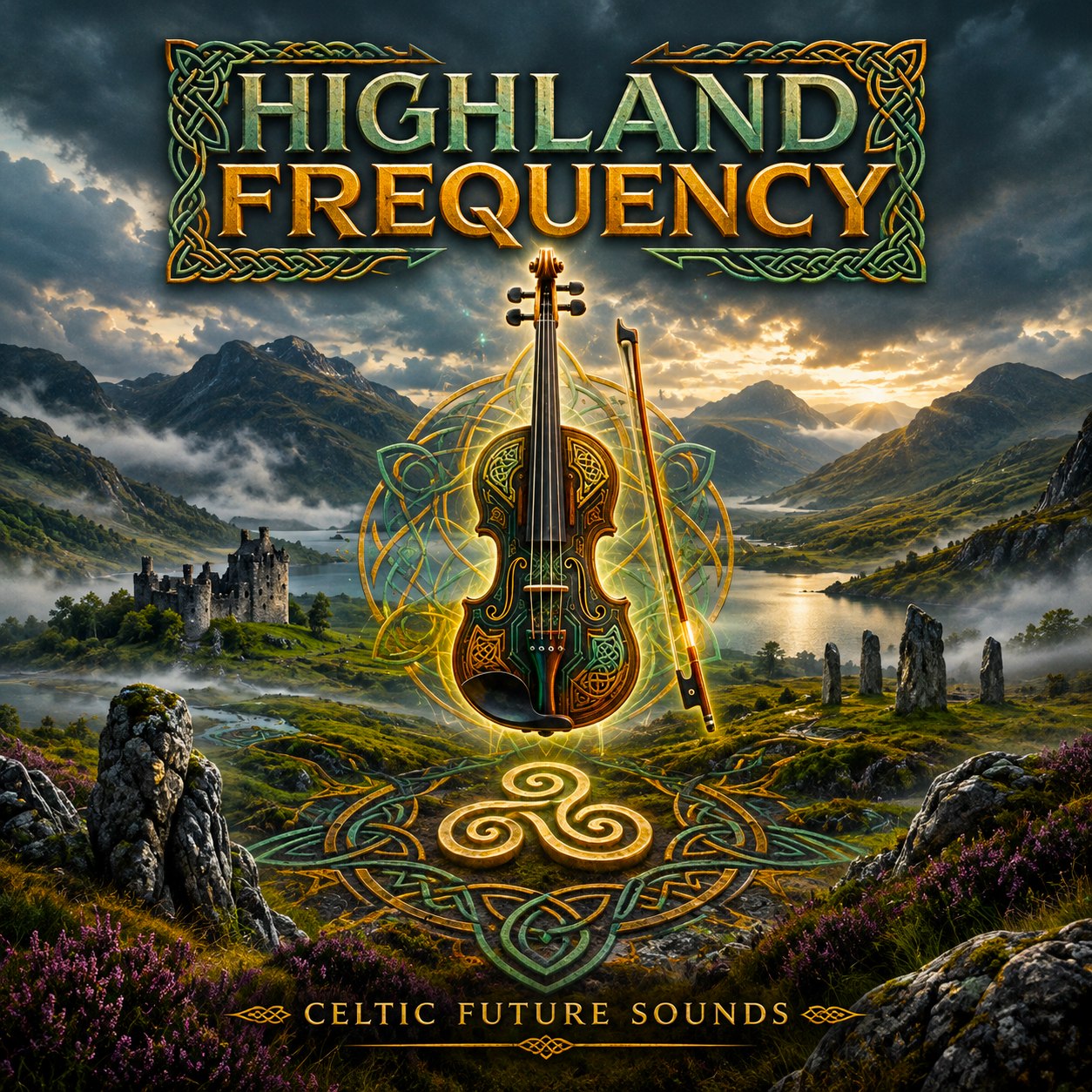
Ancient Strings, Cyber Beats
AI Process/Open Source Software: HUMAN, Google Flow Music (Lyria 3.5), Claude.ai, ChatGPT, Perchance.org – DAW: Audacity 4 (alpha), OS: Linux (Ubuntu 26.04)
Highland Frequency – Full Album (1:10:54)
Sound
Instrumental Celtic Techno, Celtic music and techno fusion, psychedelic, psytrance, trippy, fiddle
There are musical combinations that make immediate sense, and then there are combinations that seem, at first, to have arrived from different centuries.
A fiddle and a synthesizer.
A Highland melody and a psytrance pulse.
The memory of a village dance and the circuitry of a machine.
Highland Frequency lives in that improbable space between them.
This is not Celtic music with a techno beat pasted underneath it. It is not techno dressed in Celtic clothing. It is something stranger, and, I think, considerably more interesting: an attempt to imagine what might happen when an ancient musical language encounters a modern electronic consciousness and neither one agrees to surrender.
The fiddle is the heartbeat of the record’s ancestry. Its voice carries the fingerprints of people who played before amplification, before sequencers, before software instruments, before anyone imagined that music could exist as a stream of numbers moving through a machine. Its melodies feel human because they were built around breath, bow, hand, repetition, ornament, and movement.
Then the circuitry arrives.
The beat does not merely accompany those melodies. It changes their gravitational field.
Techno gives the fiddle somewhere else to go. Psychedelic textures stretch familiar phrases into strange new landscapes. Repetition becomes hypnotic rather than merely traditional. Bass frequencies become physical architecture. Electronic percussion turns the old communal impulse to dance into something more futuristic, more relentless, and occasionally more cosmic.
That is where Highland Frequency becomes particularly fascinating to me.
Traditional music has always been technological.
The fiddle was once advanced technology. So was the recording microphone. So was magnetic tape. So was the synthesizer. So is the sampler. So is the computer. The history of music is, in part, the history of human beings inventing new machines and then immediately teaching those machines how to sing.
This album simply pushes that conversation farther down the road.
The result is instrumental, but it is not wordless.
There are stories here without lyrics.
There is weather in the sustained tones. There are hills in the melodies. There is communal memory in the fiddle. There is machinery in the rhythm. There is something almost ritualistic in the repetition. And there is psychedelia in the way these elements begin to dissolve their boundaries over the course of an hour.
At times, the music feels as though it is looking backward.
At others, it feels as though it is looking over the edge of the planet.
That tension is intentional.
Highland Frequency asks a quietly provocative question:
What happens when ancient music stops being preserved and starts evolving again?
Perhaps this is one possible answer.
Not preservation.
Not imitation.
Mutation.
The old melody enters the machine and comes back carrying new frequencies.
That matters because folk music was never really static. It changed every time someone learned a tune, forgot part of it, added something, changed the rhythm, played it faster, played it drunk, played it for a different audience, or taught it to someone who lived three valleys away. Tradition survives precisely because human beings keep altering it.
Electronic music does exactly the same thing, only with different tools.
So somewhere inside this record, the fiddle and the synthesizer are not opposites at all.
They are relatives.
One remembers.
The other transforms.
And the beat keeps moving.
For me, producing Highland Frequency was an exploration of that borderland: ancient strings meeting cybernetic rhythm, human musical memory meeting machine possibility, the pastoral meeting the psychedelic, the organic meeting the electronic.
It is music for imagining a Highland landscape after dark, when the last lights disappear from the valley and the stars become enormous.
The old songs are still there.
But now they have a frequency we could not have heard before.
Listen accordingly.
Don’t treat this as background music.
Let the repetition work on you.
Let the fiddle pull you backward.
Let the beat pull you forward.
Somewhere between those two directions is the place this album was made to inhabit.
Welcome to the highlands of the future.