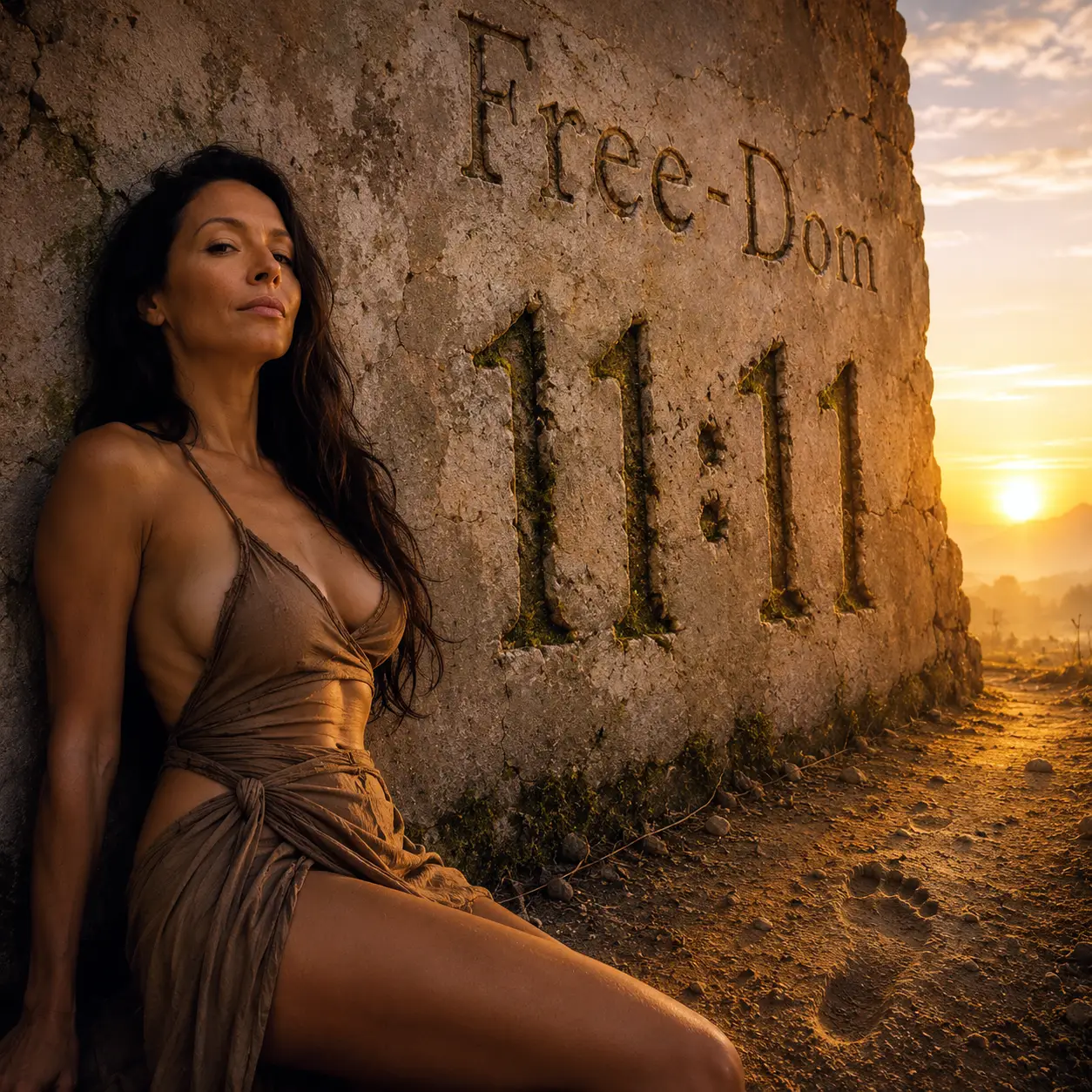
Four ones. One self. Repeated without apology.
AI Process/Open Source Software: HUMAN, Google Flow Music (Lyria 3.5), Claude.ai, ChatGPT, Perchance.org – DAW: Audacity 4 (alpha), OS: Linux (Ubuntu 26.04)
Theme Rendering / Summary
Free-Dom is not an argument against authority, the refusal to need one. The album exists in the space between two definitions of the word “freedom” as in the loud, reactive kind that defines itself by what it’s against, and the harder-won kind that requires no audience, no permission, and no opposition to be true. This is sovereignty as a practice, not a slogan, the daily, unglamorous work of authoring your own identity, your own wants, your own no, your own body, your own voice.
The album is built around a single repeated number, 11:11, stripped of its mystical baggage and re-grounded as personal doctrine of four ones, standing side by side, none of them borrowed from the other. One self, stated plainly, and then stated again, without softening it the second time, or the fourth. Tonally the record moves between haunting and luminous, it opens in near-silence, in the uncertainty before a person is willing to say who they are out loud, and it closes wide open, grounded, cinematic, not triumphant so much as settled.
Sonically this points toward a fusion of ritual folk instrumentation (hand percussion, cello, wordless choral layers) with restrained electronic pulse, the sound of something ancient being spoken through a modern throat.
Narrative Arc Adaptation for Lyrics
Structure: Prelude → seven movements → Coda
The arc follows a single psychological throughline: the migration from asking to declaring. Each of the seven core tracks corresponds to one line of the founding manifesto, but the album is not a recitation of those lines, it’s the emotional terrain a person has to cross to be able to say each one and mean it.
- Prelude, “Before the Names” The silence before identity is spoken. The listener meets the narrator mid-erasure, having spent years answering to other people’s definitions.
- I. “This Is Who I Am” The first, shaking articulation of selfhood, not yet defiant, just true.
- II. “This Is What I Want” Desire allowed to exist without apology or negotiation.
- III. “This Is What I Don’t Want” The harder companion piece, refusal as a form of self-respect, not rejection of others.
- IV. “These Are My Boundaries” The architecture of the self made visible; boundaries as construction, not wall.
- V. “This Is My Body” Reclamation of the physical self from every gaze that ever tried to author it first.
- VI. “This Is My Expression” The self let loose in the world, voice, art, presence, unfiltered.
- VII. “No Permission Required” The turn. The manifesto’s central refusal, given full voice, the moment asking stops entirely.
- Coda, “Dominion” Not an ending but an arrival. Four ones, sung once more, now steady instead of trembling.
Recurring motifs include the wall (what confines, what is written on, what is eventually walked away from), the number (11:11, appearing as a heartbeat pulse throughout the arrangement), and the unnamed narrator, deliberately unnamed, so the “I” belongs equally to whomever is listening.
General Text-to-Music Prompt (Album-Level)
Genre fusion: Ritual folktronica, hand percussion and cello grounding an otherwise spare, breath-driven vocal, layered with a subtle sub-bass pulse that mimics a heartbeat or clock. Genre touchpoints to include dark folk, ambient chamber music, minimal downtempo electronic.
“Create a ritual folktronica soundscape blending hand percussion, processed cello, and layered wordless vocal harmonies with a slow, heartbeat-like sub-bass pulse. Tempo drifts from hesitant and sparse (60 BPM) to grounded and steady (92 BPM) across the record. Convey the sound of someone learning to speak their own name out loud for the first time, haunting at first, luminous by the end, as if an ancient ritual is being performed in a modern, unadorned room.”
Tracklist
01 Prelude: Before the Names
Theme Summary: The album opens in the space before identity is claimed, a narrator who has spent so long being defined by others that their own voice feels unfamiliar. Sparse, near-wordless, this track exists to establish silence as the true starting condition, so that every word after it lands as a genuine departure.
Lyrics:
Intro Before I had a name for it Before the door was mine to close I answered to whatever they were calling Never once to what I chose
Verse 1 Every room I stood in Wore a label I didn’t write Every mirror handed back Somebody else’s light
Outro Somewhere under all the naming Something waited, still, unspent Eleven, eleven, a pulse, not a sentence Waiting to be meant
Text-to-Music Prompt: “Sparse dark ambient with a single distant cello line and a barely audible heartbeat pulse. Near-whispered vocals, heavy reverb, no percussion until the final ten seconds. Tempo 58 BPM. Convey held breath, the moment right before someone speaks a truth they’ve never said aloud.”
02 “This Is Who I Am”
Theme Summary: The first full declaration. Not yet defiant, just true, and trembling with the effort of being true out loud. This track marks the narrator’s first refusal to translate themselves for anyone else’s comfort.
Lyrics:
[Intro]
I used to borrow every word
That someone else thought I should be
Tonight I’m giving all of them back
Tonight I’m only me
[Verse 1]
Not the version softened for the room
Not the story shaped to fit your ear
Just the plain and unrehearsed thing
Standing quiet, standing clear
[Verse 2]
You can call it stubborn
You can call it strange
I call it the first time
I stopped asking to change
[Verse 3]
I have been so many names
None of them were mine to keep
This is the one I’m choosing
This is the one I’ll speak
[Verse 4]
No footnote, no apology
No softer way to say it twice
This is who I am,
Not a question. Not advice.
[Chorus]
This is who I am
Plain as morning, still as stone
Four ones on the clock face
One self, finally home
[Bridge]
I don’t need you to agree
I only need to know it’s true
Eleven, eleven, steady now
There’s nothing left to prove to you
[Outro]
This is who I am
No translation left to give
Eleven, eleven, quiet now,
The first true way to live
Sound:
Ritual folk ballad, hand drum, low cello swell, single unlayered vocal, fragile and courageous, 66 bpm
03 “This Is What I Want”
Theme Summary: Desire given permission to exist without negotiation or shame. Where the first track claims identity, this one claims appetite, the right to want things plainly, without performing gratitude for wanting less.
Lyrics:
[Intro] I stopped shrinking my wanting Down to what was easy to give I want the whole of it now, The wanting is how I live
[Verse 1] Not the polite version Not the version that waits its turn I want what I want And I’m done letting it burn
[Verse 2] You taught me to want small Taught me hunger was unkind I’m done being taught I’m building my own mind
[Verse 3] Some wants are loud as thunder Some are quiet as a held breath Either way they’re mine to carry Either way, mine ’til my death
[Verse 4] I don’t need it justified I don’t need it explained away This is what I want, Full sentence. Simple. Say.
[Chorus] This is what I want No smaller shape to fold it in Four ones, unbothered, certain One self, choosing again
[Bridge] Wanting isn’t weakness It’s the pulse still in the wall Eleven, eleven, steady beat, I want, and I want it all
[Outro] This is what I want No apology in the frame Eleven, eleven, out loud now, Wanting has a name
Sound:
Mid-tempo folktronica, hand percussion, soft electronic pulse, cello countermelody, warm and rhythmic, 74 bpm
04 “This Is What I Don’t Want”
Theme Summary: The harder companion to desire, refusal as self-respect rather than rejection. This track marks the narrator’s growing comfort with disappointing others in service of honesty.
Lyrics:
[Intro]
No is a full sentence
I used to think it needed more
No is a full sentence
I’m not knocking twice at that door
[Verse 1]
I don’t want the version of peace
That costs me my own voice
I don’t want a seat at your table
If silence is the price
[Verse 2]
I don’t want to earn my keeping
By disappearing a little each day
I don’t want your comfort
Built on what I don’t say
[Verse 3]
This isn’t anger, understand me
It’s the shape of what I’ve learned
No is not a wall I’m building
It’s a door I’ve finally turned
[Verse 4]
I don’t want it, plainly spoken
No hedge, no softer start
This is what I don’t want,
Now you know my heart
[Chorus]
This is what I don’t want
Said once, and said complete
Four ones, unmoved, unbending
One self, standing on two feet
[Bridge]
You don’t need my reasons
My no was never yours to grade
Eleven, eleven, quiet thunder,
This is the boundary I’ve made
[Outro]
This is what I don’t want
No further to explain
Eleven, eleven, done repeating,
I won’t say it again
Sound:
Dark folk electronic blend, minor key, steady heartbeat percussion, moody cello, sultry female vocals, quiet resolve, 70 bpm
05 “These Are My Boundaries”
Theme Summary: The architecture of the self made visible, boundaries reframed not as walls that shut others out, but as the load-bearing structure that lets the self stand upright at all.
Lyrics:
[Intro]
I used to call them walls
Now I call them beams
I’m not shutting out the world
I’m holding up my dreams
[Verse 1]
Here is where you’re welcome
Here is where the door stays closed
Not cruelty, just architecture,
The shape of how I’m made, I suppose
[Verse 2]
You can knock as long as you like
Some rooms were never for rent
I built this house from my own hands
Every board with my consent
[Verse 3]
I used to apologize
For every line I drew in sand
Now I draw them steady
Now I let them stand
[Verse 4]
These are my boundaries
Plain as beams, load-bearing, true
Not a punishment for loving you,
Just the shape I have to be to [Chorus]
These are my boundaries
Not a cage, a frame, a floor
Four ones, holding steady
One self, behind its open door [Bridge]
You can visit the whole house
But some rooms stay only mine
Eleven, eleven, structural now,
This is the design
[Outro]
These are my boundaries
I built them beam by beam
Eleven, eleven, standing upright,
This is not a dream
Sound:
Grounded acoustic folk, warm hand percussion, rich layered cellos, expressive female vocals, steady tempo, 78 bpm
06 “This Is My Body”
Theme Summary: Reclamation of the physical self from every gaze, comment, and expectation that ever tried to author it first. The most intimate track on the record, sung close and unadorned.
Lyrics:
Intro This skin was never a suggestion This body, never up for vote This is the one thing wholly mine Before I could even speak, I wrote
Verse 1 You’ve had opinions since the start On how I carry, how I stand I’m done editing my shape To fit inside your hand
Verse 2 This is not a debate This is not a room for your review This is my body, only mine, Not yours to walk me through
Verse 3 I’ve unlearned every mirror That wasn’t built to hold my light This is the vessel I was given This is mine, by right
Verse 4 No comment necessary No permission to be sought This is my body, whole and mine, Nothing here for sale, or bought
Chorus This is my body No translation, no debate Four ones, plainly written One self, at its own gate
Bridge You don’t get a vote here This was never yours to grade Eleven, eleven, closest truth, This is how I’m made
Outro This is my body Quiet now, and fully known Eleven, eleven, coming home, This flesh, this bone, my own
Text-to-Music Prompt: “Intimate acoustic folk, close-mic’d vocal, minimal instrumentation, single cello, soft brushed percussion. Tempo 64 BPM. Convey tenderness and unshakable ownership at once.”
07 “This Is My Expression”
Theme Summary: The self let loose into the world, voice, art, presence, unfiltered. The most sonically expansive track on the album, mirroring its subject: expression without restraint.
Lyrics:
Intro I used to whisper my colors Keep the volume low, polite Tonight I’m turning it up Tonight I’m taking up light
Verse 1 This is how I move This is how I speak, unspooled I stopped translating my joy Into something smaller, more ruled
Verse 2 You don’t have to understand it To let it exist out loud This is my expression, Not a performance for the crowd
Verse 3 Some of it is loud as color Some of it is soft as ash Either way it’s honest Either way, it’s mine to cast
Verse 4 No edit for your comfort No dimming for the room This is my expression, Full color, full bloom
Chorus This is my expression Wide open, nothing held in store Four ones, all at once now One self, at full roar
Bridge Let it be too much sometimes Let it be more than you expected Eleven, eleven, unashamed, This is how I’m reflected
Outro This is my expression No smaller shape to wear Eleven, eleven, out in the open, I finally don’t care
Text-to-Music Prompt: “Fuller ritual folktronica arrangement, layered choral vocal harmonies, driving hand percussion, electronic pulse rising in the mix. Tempo 88 BPM. Convey release, color and volume returning after long restraint.”
08 “No Permission Required”
Theme Summary: The turning point of the record, the manifesto’s central refusal, given full voice. Every prior track has been building toward this one sentence, and here it finally arrives whole, without hedge or footnote.
Lyrics:
Intro I kept a list once Of everyone I had to ask I burned it somewhere back a ways I don’t remember the task
Verse 1 I don’t need your signature On the shape of how I live I don’t need your blessing For the self I choose to give
Verse 2 Existing isn’t a request form It isn’t yours to approve I stopped waiting in that line I stopped needing to prove
Verse 3 You can love me or you can’t Either way, I remain I do not require permission To walk out into the rain
Verse 4 This isn’t defiance It’s just no longer asking twice I do not require permission, That’s the whole of my advice
Chorus I do not require permission To exist as I authentically am Four ones, unbroken, certain One self, no exam, no plan
Bridge You can watch me from the doorway You were never holding the key Eleven, eleven, wide open now, I let myself be
Outro No permission required Not from you, not from the past Eleven, eleven, spoken plainly, I’m free, and it lasts
Text-to-Music Prompt: “Anthemic ritual folktronica, full percussion arrangement, layered vocal chant on the chorus, electronic pulse locked with the heartbeat motif. Tempo 92 BPM. Convey the turn from asking to declaring, steady, unhurried triumph.”
09 Coda: “Dominion”
Theme Summary: Not an ending but an arrival. The number returns one final time, no longer trembling, steady, plain, lived-in. This track exists to let the manifesto rest, having been fully earned across the record.
Lyrics:
Intro Four ones on the clock face No longer a sign to read Just a pulse, just a rhythm Just the shape of what I need
Verse 1 This is who I am This is what I want and don’t This is my body, my expression This is the door I won’t
Outro Free-Dom begins with dominion Over the one self I own Eleven, eleven, steady now, One self, repeated, home
Text-to-Music Prompt: “Warm, grounded folk arrangement, all instrumentation from the album layered gently together and slowly fading, cello, hand drum, choral hum, distant pulse. Tempo settles at 80 BPM and holds. Convey quiet, settled arrival, not a climax, a homecoming.”
Narrative Adaptation
She Answered to No One
One woman spent thirty-one years waiting for permission that was never coming, and the morning she stopped waiting looked nothing like anyone expected.

She had always been good at becoming whatever a room needed. It was, she used to say, her one reliable talent, not beauty, not intelligence, just an uncanny instinct for which version of herself would cause the least friction. At her mother’s dinner table she was agreeable. At work she was competent but never threatening. With Daniel, in the small yellow kitchen of the apartment they’d shared for six years, she was easy, low-maintenance, undemanding, the kind of woman men described to their friends as no drama. She had built an entire adult life out of subtraction, carving away whatever parts of herself seemed likely to cost her something, until what remained fit neatly into every space she was asked to occupy.
She didn’t think of this as a loss. For a long time it felt more like competence, a skill she’d mastered the way other people mastered languages or instruments. It was only in the last year, somewhere in the quiet stretch between turning thirty and turning thirty-one, that the competence had started to feel less like fluency and more like erosion. She’d catch herself in the bathroom mirror at odd hours, brushing her teeth, and have the distinct, dizzying sensation of not recognizing the woman looking back, not because her face had changed, but because she genuinely could not have said, if asked plainly, what she wanted. Not what Daniel wanted. Not what her mother wanted. Not what the job wanted. What she wanted. The question sat in her chest like a stone she’d swallowed years ago and forgotten was there.
It was Daniel, unknowingly, who cracked it open. They were in the kitchen on a Tuesday in early autumn, the good light coming low through the window over the sink, and he was talking, as he often did, about the shape of their future. Not asking. Describing. The house they’d eventually buy in the town where his job was headed, the schedule she’d eventually shift her freelance work around, the version of herself who would exist five years from now, fully formed in his telling, as though she were a renovation project already scoped and budgeted. She had nodded along a thousand times before at conversations exactly like this one. She opened her mouth to nod along again.
What came out instead surprised her more than it surprised him.
“I don’t know if I want that.”
It wasn’t defiant. It wasn’t even loud. But it landed in the kitchen like a dropped glass, and Daniel looked at her the way you look at a piece of furniture that’s suddenly spoken. “What do you mean you don’t know,” he said, not unkindly, just baffled, the way you’d respond to weather that had no business happening in that season. “You’ve never said anything different.”
That’s exactly the problem, she thought, though she didn’t say it yet. She stood there with the dish towel still in her hand and felt something shift underneath her sternum, not a decision, not yet, just the first small crack in a wall she hadn’t fully noticed she’d been standing behind her whole life. She excused herself, went into the bathroom, and sat on the edge of the tub for a long time, staring at the tile grout, waiting for the feeling to pass the way discomfort usually did. It didn’t pass. It sharpened.
The days that followed were not dramatic. There was no single scene, no slammed door, no ultimatum delivered on a rain-soaked porch. What happened instead was quieter and, in its way, far more frightening: she started asking herself the question outright, deliberately, the way you’d press a bruise to see how deep it went. What do I want? Not what would keep the peace. Not what would make sense to Daniel, or her mother, or the version of herself that had spent three decades optimizing for approval. Just, what did she want. The first few times she asked it, she came up empty, and the emptiness terrified her more than any answer could have. It meant the erosion had gone further than she’d realized. It meant she had genuinely misplaced herself somewhere along the way, buried under thirty-one years of well-meaning accommodation.
She started small, almost embarrassingly small. She wanted to eat dinner at seven instead of six, because six had only ever been Daniel’s preference. She wanted to repaint the bedroom a color she actually liked instead of the neutral grey they’d agreed was “safe”, agreed being generous, since she’d simply stopped objecting three apartments ago. She wanted, she realized with a kind of vertigo, to stop cutting her hair the length her mother had always called “flattering.” None of it was defiance for its own sake. It wasn’t rebellion. It was, she came to understand, something closer to inventory, she was walking room to room through her own life, checking which choices had actually been hers, and finding, with mounting unease, how few of them were.
The turn, the real one, the hinge the whole shape of her life would eventually swing on, came on a Sunday morning three weeks later. Daniel had asked, again, gently but with the particular patience of a man who believed a phase simply needed to run its course, whether she was “still doing the thing,” which was how he’d started referring to whatever was happening to her, as though it were a diet or a mood he could wait out. She was standing at the same sink, in the same low autumn light, and she found herself answering not with an explanation but with something closer to a fact.
“This is who I am now,” she said. “Or maybe it’s who I always was. I don’t need you to agree with it. I just need you to know it.”
He didn’t understand, not that morning, and maybe not ever fully. That was, she was beginning to accept, allowed to simply be true. His understanding was not a prerequisite for her existing. It was a strange, almost physically disorienting realization, like discovering a limb she’d forgotten how to use had been functional the entire time. She did not need his permission. She had never needed it, not really, she had simply spent thirty-one years behaving as though she did, because asking felt safer than claiming.
The months that followed were not tidy. She and Daniel did not stay together, though the ending, when it finally came, was quieter and less bitter than either of them expected, less an explosion than a long exhale, two people releasing a shape neither of them had actually chosen. Her mother did not immediately understand the haircut, or the new color on the bedroom wall of the apartment She eventually rented alone, or the dinner reservations now made for seven o’clock. Understanding, she was learning, was not owed to her, and its absence did not undo anything she’d claimed.
What she noticed most, in the year that unspooled after that autumn morning, was how ordinary the freedom actually felt once she stopped waiting for it to announce itself. She had expected, if she’d ever let herself imagine this version of her life at all, that self-possession would feel triumphant, a door thrown open, trumpets, some cinematic swell. Instead it felt almost domestic. It felt like eating dinner at the hour she wanted to eat it. It felt like a bedroom the color she’d actually chosen. It felt like saying no to things that cost her peace and yes to things that cost her nothing but other people’s comfort, and discovering that the second kind of cost was one she could finally, easily, afford to pay.
She thought sometimes about the version of herself who’d sat on the edge of that bathtub, waiting for the discomfort to pass like weather. She was not embarrassed by that woman. She understood her, understood the decades of practiced smallness that had built her, understood that becoming what a room needed had once been the only kind of safety she knew how to construct. But she did not live there anymore. She had built something else instead: a house with rooms of her own design, doors she opened and closed on her own authority, walls that were no longer apologies but simply the shape of a self standing upright, finally, on its own foundation.
She did not need anyone’s signature on that. She never had. It had simply taken her thirty-one years to stop asking for one.