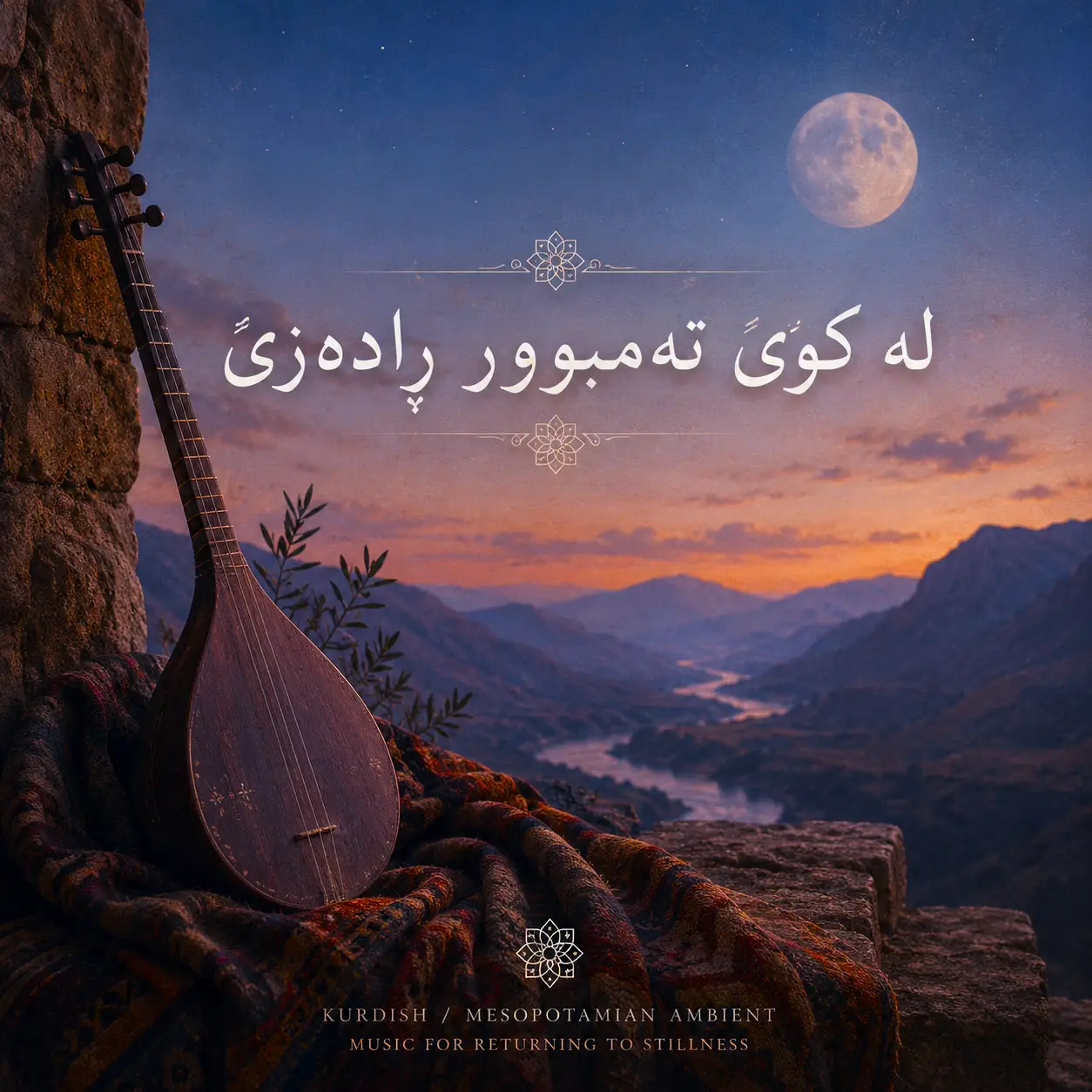
Where the Tembûr Sleeps
AI Process/Open Source Software: HUMAN, Google Flow Music (Lyria 3.5), Claude.ai, ChatGPT, Perchance.org – DAW: Audacity 4 (alpha), OS: Linux (Ubuntu 26.04)
Download Free Full Album Mix (320 kbps MP3 – 92.8 MB)
Text to Music Prompt (Google Flow Music)
KURDISH / MESOPOTAMIAN AMBIENT, deeply atmospheric instrumental relaxation music rooted in the ancient musical traditions of Mesopotamia and Kurdistan, reimagined as a contemporary cinematic ambient composition with Lo-Fi production.
Very slow tempo, approximately 52–58 BPM, with an almost suspended sense of time. No conventional verse/chorus structure. No dramatic climax. No obvious beat-driven groove. The music should feel like slowly breathing in an immense, quiet landscape at dusk.
PRIMARY INSTRUMENTS:
A warm, intimate Kurdish tembûr carries the central melodic voice, playing sparse, expressive modal phrases with long pauses between them. The melody should feel ancient and contemplative rather than theatrical. Use subtle microtonal inflections and ornamentation characteristic of Middle Eastern/Kurdish melodic traditions, but keep the performance restrained and natural.
A soft santur appears occasionally as delicate isolated notes and slowly unfolding patterns, never becoming busy or rhythmic. Let individual notes resonate into enormous spaces.
A breathy ney flute enters very sparingly, with long sustained tones, gentle breath noise, subtle pitch movement, and phrases that seem to emerge from silence and disappear back into it. The ney should feel intimate, human, and vulnerable rather than virtuosic.
Use a daf extremely sparingly, if at all: perhaps one soft, distant frame-drum pulse every several measures, more like a heartbeat heard through a wall than percussion. No driving rhythm, no dance groove, no hand-drum performance.
ATMOSPHERIC FOUNDATION:
Surround the acoustic instruments with extremely soft contemporary ambient textures: warm analog synthesizer drones, deep but gentle low-frequency resonance, faint granular textures, distant harmonic overtones, and very subtle organic field-recording textures suggesting wind moving across an open landscape.
The electronic layers should never dominate or sound overtly futuristic. They should feel like an invisible atmosphere surrounding ancient acoustic instruments.
HARMONY AND MELODY:
Use a contemplative Kurdish/Mesopotamian modal language, with a minor or ambiguous tonal center. Avoid conventional Western major/minor chord progressions. Favor sustained modal harmony, drones, open fifths, unresolved intervals, subtle dissonance, and extremely slow harmonic movement.
The melody should be simple enough to become almost subconscious after several minutes. No catchy hooks. No sentimental Hollywood-style chord changes. No emotional manipulation.
SPATIAL DESIGN:
Huge, natural-sounding acoustic space. Very long reverb tails, but preserve intimacy in the tembûr and ney. Create the sensation of sitting alone inside an ancient stone chamber opening onto an enormous night landscape.
Wide stereo field. Deep front-to-back dimension. Instruments should appear at different distances rather than simply being panned left and right.
EMOTIONAL CHARACTER:
Quiet, ancient, introspective, compassionate, grounded, mysterious, warm, safe, spacious, healing, nocturnal.
The emotional journey should move subtly from solitude toward peace without ever becoming overtly triumphant. It should feel like the nervous system gradually releasing its grip after a long and difficult day.
IMPORTANT INSTRUCTION:
This is music for someone who spends their life listening to difficult human stories and carrying emotional weight. Do not make the music tragic, mournful, dramatic, or psychologically heavy. Do not evoke war, grief, danger, or cinematic suffering. Instead, create a sense of refuge, stillness, cultural memory, breath, and return.
NO VOCALS.
NO SPOKEN WORDS.
NO POP STRUCTURE.
NO EDM.
NO PERCUSSION-DRIVEN RHYTHM.
NO DRAMATIC CRESCENDO.
NO TRAILER MUSIC.
NO SYNTHWAVE.
NO NEW-AGE CHEESE.
NO GENERIC SPA MUSIC.
The final result should sound like:
“…an ancient Kurdish melody remembered by someone dreaming beside a quiet fire beneath the Mesopotamian night sky, surrounded by modern ambient silence.”