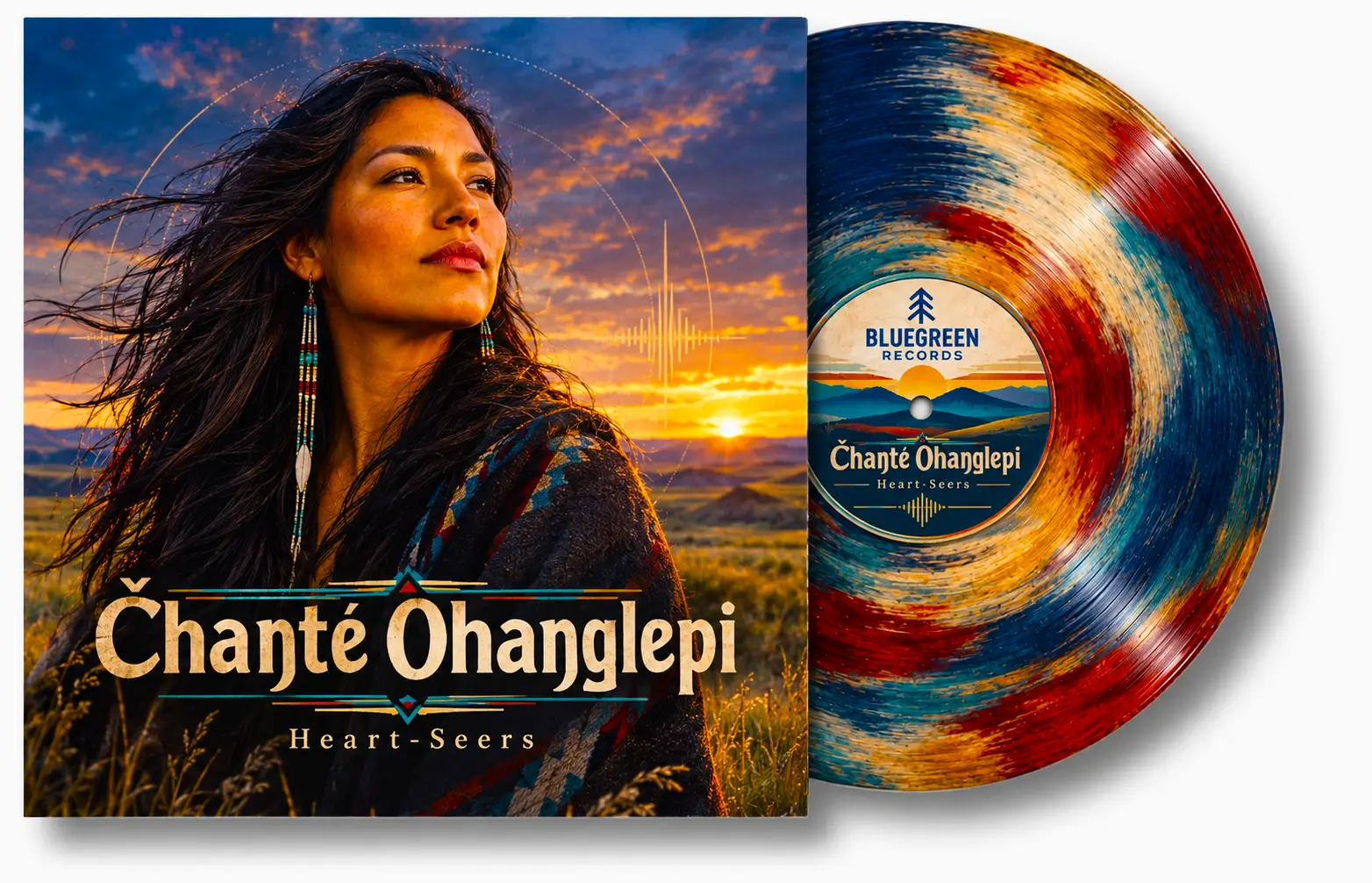
(Heart-Seers)
AI Process/Open Source Software: HUMAN, Google Flow Music (Lyria 3.5), Claude.ai, ChatGPT, Perchance.org – DAW: Audacity 4 (alpha), OS: Linux (Ubuntu 26.04)
Čhaŋté Ohaŋglepi – Full Album (1:10:35)
There are songs we make. And there are songs we discover.
I think this album belongs to the second kind.
Somewhere beneath the music, beneath the words, beneath the flute and the voices and the electronic pulse, there is something much older waiting for us. A heartbeat. One beat. Then another.
The first rhythm any of us ever knew.
Before we knew language, before we knew music, before we knew ourselves as separate from anything else, there was that quiet, insistent pulse.
Ba-dum.
Ba-dum.
Ba-dum.
Čhaŋté Ohaŋglepi means Heart-Seers, and that became the doorway into this record for me. To see with the heart is different from simply looking. The eyes can tell us what is there. The heart asks us what it means. So I wanted this music to move the way memory moves. Not in a straight line. It begins quietly. Breath. Space. Flute. A voice appearing almost from somewhere beyond the edge of hearing. Then the pulse finds us. The electronic world enters. The traditional drum and the machine begin speaking to one another, and eventually they become difficult to separate.
That was important to me. Not old against new. Not tradition against technology. Not one world replacing another. But a conversation. A remembering. A becoming.
The siyotanka carries a melody through the electronic landscape. Voices rise and answer one another. The heartbeat drum remains beneath it all. At times the music reaches outward, becoming dance, celebration, ceremony, movement. At other moments it pulls us back toward something almost unbearably intimate: a voice, a breath, a story, a single resonant drum.
And then there is the land. The names in this collection seem to carry pieces of it with them: winter, water, stone, river, ridge, sky, hearth, horizon, fire. Places become memories. Memories become songs. Songs become a way of carrying something forward.
Perhaps that is what music has always done. It carries what we are afraid to lose.
I came to this project as a Sound Designer, but somewhere along the way I stopped feeling like I was designing the sound. I was listening for it. Listening for the place where an ancient heartbeat might meet a synthesizer. Listening for the moment when a flute might cross a digital landscape and somehow make the landscape feel older rather than newer. Listening for the space between a human voice and everything that came before it.
That space is where this album lives. And maybe that is where you will find yourself, too. So don’t listen only with your ears. Listen with the part of you that remembers things you cannot explain. Listen for the heartbeat beneath the beat. Listen for the breath between the notes. Listen for the river in the stone. Listen for the voice calling across the distance.
And when the music finally becomes still, don’t rush to fill the silence. There may be something there. Something that was already here. Something waiting to be heard.
Čhaŋté Wašté (With a Good Heart),
JJ, Sound Designer
Text to Music Prompt
Native American/Techno EDM/Ambient music, a genre-blending powwow-electronica pop track, sung phrases by a Lakota woman with a strong Native American/Indigenous accent, all in the Lakota language, over a sparse ambient pad and a single resonant heartbeat drum hit.
The track builds into a slow, atmospheric verse: breathy siyotanka (Lakota courting flute) plays a pentatonic lead melody over minimal piano and soft synth pads, with a falsetto vocal, full of vocables and tremolo phrasing, floating on top in a dream-pop, singer-songwriter style. As the pre-chorus builds, layer in a steady four-on-the-floor kick and a traditional drum-group ‘heartbeat’ pulse underneath, rising in intensity.
The chorus drops into full powwow-step energy: driving trap-influenced electronic beats, sub-bass, and the traditional drum pulse locked together, with call-and-response vocals (a lead falsetto answered by group vocables) punctuated by sharp eagle-bone whistle accents on the hook.
The siyotanka flute returns as a melodic hook between vocal lines, threading through the electronic production. Bring the energy down for a bridge, strip back to just spoken-word/oral storytelling, flute, and heartbeat drum, before building back into one final high-energy chorus with full electronic production, drum group, and layered vocals.
Overall mood: reverent but festival-ready, moving between intimate/atmospheric and high-energy, danceable.