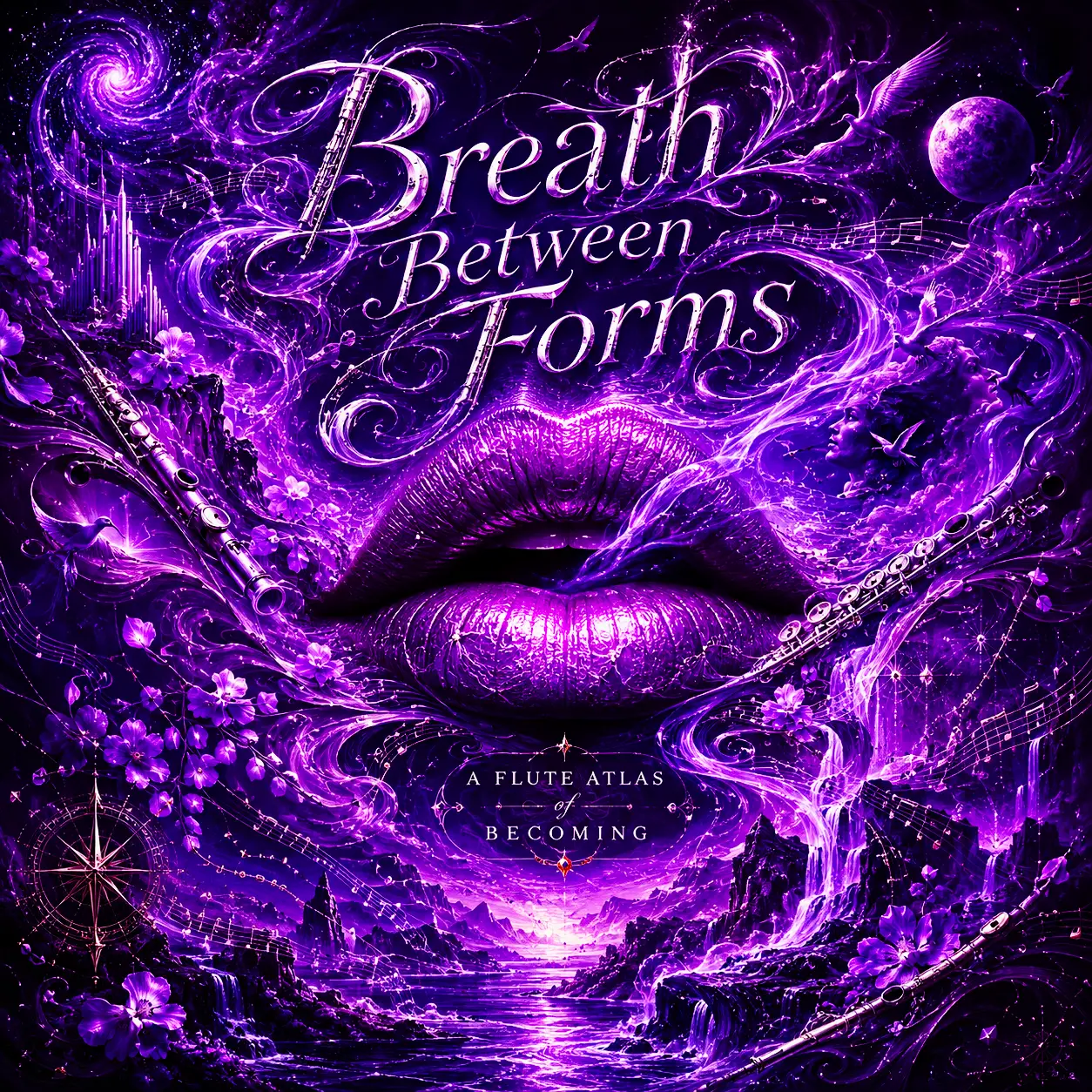
A Flute Atlas of Becoming
If you want to hear what I’m building, and how, my process and project archive live at https://tatanka.site/music.
If you’re a musician, composer, writer, or visual artist and this resonates, don’t just follow. Let’s actually make something. If it moves you, and if you feel aligned, reach out. Real collaboration, not “social” media networking theater. Not interested in followers. Interested in human creators.
To download the mix/album, click the three dots to the right of the audio player. The music ideally should speak for itself. I’ll let it, if you are truly listening.
I’m not here to collect “connections.” I’m here to create with people who are serious about doing the same. If that’s you, DM me and let’s link up to create: https://tatanka.site/talent.
— JJ https://linktr.ee/j_j_j
AI Process/Open Source Software: HUMAN, Google Flow Music, Claude.ai, ChatGPT, Perchance.org – DAW: Audacity 4 (alpha), OS: Linux (Ubuntu 26.04)
Breath Between Forms: A Flute Atlas of Becoming – Full Album (56:12)
Free Full Album Downloads:
MP3 (44.1k Hz – 320 kbps) – WAV (48k Hz)
Google Deep Dive Podcast: Discipline and Fluidity in Evolution (40:52)
Note from JJ: As precisely as I engineer a prompt, the results are never guaranteed to be on target. For example, I apologize for the repeated error of BASS, as in fish, versus BASS, as in low frequency. There is my aleatory ethos, and then there is just bad AI; this is the latter. Bad Robot!
The Flute Orchestra: A Journey from Crystalline Heights to Subterranean Depths
The Living Ecosystem of Breath
In the discipline of advanced sound architecture, the flute orchestra is not a mere assembly of disparate instruments; it is a unified, breathing organism. We must view this ensemble as a living ecosystem where the rigid boundaries of classical form dissolve into a state of immersive fluidity. Here, the mechanical construction of the instrument—the silver, the wood, the bore—serves only as a conduit for a deeper exploration of the self, where identity is not static but a continuous process of unfolding through the medium of air.
“The flute orchestra behaves as a unified organism—a living ecosystem where identity unfolds through breath and classical discipline dissolves into immersive sonic fluidity.”
To architect such a sound, we must analyze the structural components of this organism. We begin at the frequency ceiling, where the highest vibrations pierce the acoustic canopy before descending into the resonant depths of the earth.
High Altitudes: Piccolo and the Classical Core
At the apex of our orchestral hierarchy, the sound is defined by crystalline precision. The Piccolo and the standard C Flutes establish the upper frequency boundaries, providing the structural clarity and “starlike” motifs that define the initial inception of the work.
The Upper Registers: Light and Dialogue
| Instrument | Sonic Character | Role in the Ecosystem |
| Piccolo | Starlike and Ephemeral | Defining the frequency ceiling; utilizes fragmented melodic cells and airy textures to pierce the acoustic canopy. |
| C Flutes (1 & 2) | Classical and Grounded | Established as the core harmonic dialogue; functions with the precise counterpoint and discipline of a chamber duet. |
As the starlike brilliance of the Piccolo fades, we enter the visceral, resonant chambers of the human interior—the domain of the middle voices.
Middle Voices: Introspection and Resonance
The transition into the middle voices marks a shift from external brilliance to internal introspection. As the bore diameter increases, the physical demands on the performer change, necessitating a shift in the biological rhythm of the performance.
- Sonic Signature: The Alto Flute
- This voice deepens the emotional register, employing warm, introspective melodic lines that anchor the ensemble’s heart.
- Texture Profile: The Bass Flute
- Defined by grounded, resonant breath textures. Due to the significant air volume required to vibrate the larger column of air, the Bass Flute utilizes slightly elongated phrasing, forcing a slower, more deliberate movement that bridges the gap between melodic intent and atmospheric presence.
As these melodic lines stretch and the air becomes more prominent than the pitch, we descend further into the foundations of the orchestral structure.
Subterranean Pillars: The Low-Frequency Hierarchy
The lower end of the flute family represents the geological foundation of our soundscape. Here, the physics of frequency masking and sympathetic resonance create a space where sound is felt as a physical pressure against the body.
- Contra-alto Flute: Harmonic Haze. Transitions the ensemble into a dreamlike state, blending distinct pitches with intentional air noise to blur the lines of the harmonic field.
- Contrabass Flute: Organ Pipes. These massive instruments act as slow-moving tonal pillars, providing a Deep Earth Resonance that stabilizes the atmospheric layers above.
- Subcontrabass Flute: Ultra-low Frequency Beds. This instrument generates the foundational frequency beds that sit at the edge of human hearing, providing a tactile, vibrating floor for the orchestra.
- Double Contrabass Flute: Geological Space. The ultimate pillar of the hierarchy, providing a sense of Vast Internal Space. It functions as the literal structural anchor upon which the entire experimental architecture is built.
These deep frequencies provide the tonal pillars and “geological pulse” upon which the experimental textures of the orchestra are layered.
Sonic Environment: Beyond Traditional Performance
To move from an intimate chamber to a cathedral-scale cavern, we must reframe the acoustic soul of the flute through technological intervention. In this ecosystem, electronic elements are not ornaments; they are the environment itself—the rhythmic skeleton and the harmonic air.
- Breath & Tactile Techniques: The use of key clicks and breath tones emphasizes the biological origin of the sound, while multiphonics create the complex “harmonic haze” required to transition the listener into the experimental domain.
- Granular Processing: Individual flute phrases are captured and stretched into vast, microscopic textures, turning a single breath into an infinite atmosphere.
- Spatial Reverb: Architecturally shifting the listener’s perception from the close-proximity “chamber” to a resonant, subterranean cavern.
- Layered Looping: Digital recursion creates the illusion of a singular “flute organism,” where dozens of voices breathe in perfect, synthesized unison.
- Electronic Textures (Percussion/Beats): Integrating Chillhop and Techno beats to provide the rhythmic pulse and harmonic environment, allowing the acoustic flutes to remain the melodic soul while the electronics provide the modern, kinetic loom.
This synthesis of the biological and the mechanical leads us to our final understanding of the work.
The Synthesis of Becoming
The flute orchestra is a fluid symphony that rejects the stagnation of rigid movements in favor of organic evolution. It is a journey of “continuous becoming,” where the performer is transformed from a classical technician into a vital component of a processed, living organism. By spanning the entire family—from the piercing frequency ceiling of the Piccolo to the sub-audible geological weight of the Double Contrabass—the ensemble mirrors the multi-layered registers of the self.
Key Takeaway: The Flute Atlas
The flute orchestra is a unified, breathing ecosystem. It bridges the gap between classical discipline and immersive, electroacoustic fluidity, utilizing the full spectrum of the flute family to create a transformative sonic journey—an atlas of identity unfolding through the power of the breath.
Text to Music Prompt (Google Flow Music)
Instrumental symphonic work for a full flute orchestra spanning the entire flute family: piccolo, C flutes (Flute 1 and Flute 2), alto flute, bass flute, contra-alto flute, contrabass flute, subcontrabass flute, and double contrabass flute.
The composition blends rigorous classical orchestration and technique with immersive experimental soundscapes. Traditional flute performance is preserved with precise articulation, ensemble counterpoint, and chamber-music clarity, while the sonic environment expands into ambient, electroacoustic, and textural domains.
Structure the piece as a fluid symphony without rigid movements, where sections evolve organically rather than clearly separating.
- Piccolo introduces crystalline, starlike motifs: fragmented melodic cells, airy and ephemeral.
- Flute 1 and Flute 2 establish classical harmonic dialogue, like a duet within a chamber ensemble.
- Alto flute deepens emotional register with warm, introspective melodic lines.
- Bass flute introduces grounded, resonant breath textures, slightly elongated phrasing.
- Contra-alto flute transitions into dreamlike harmonic haze, blending pitch and air noise.
- Contrabass flute forms subterranean drones, slow-moving tonal pillars resembling organ pipes or deep earth resonance.
- Subcontrabass and double contrabass flutes create ultra-low frequency harmonic beds, felt more than heard, evoking vast internal and geological space.
Experimental sound design elements:
- Here is where the electronic instruments will be mostly employed.
- Extended flute techniques (breath tones, key clicks, multiphonics, overblowing, microtonal bending)
- Granular stretching of flute phrases into atmospheric textures
- Spatial reverb shifting from intimate chamber space to cathedral-scale cavern resonance
- Subtle electronic processing that never overtakes acoustic identity, only reframes it
- Layered looping that creates the illusion of a “flute organism breathing as one entity”
The overall emotional tone is fluid, symphonic, introspective, and transformative, with a sense of continuous becoming rather than resolution. Music should feel like identity unfolding through breath across multiple registers of self.
No vocals. No percussion, strings, or any other instruments than the flute orchestra and the experimental electronic instrumentation, as requested above. Focus entirely on flute-derived sound as melody and electronic/tech textures and instruments as the environment including harmony and percussion, which can include Chillhop and other Techno beats.
Final sound: a unified flute orchestra that behaves like a living ecosystem of breath, memory, and transformation, classical discipline dissolving into immersive sonic fluidity.
TRACKLIST
Free Track Downloads:
MP3 (MP3s_breath_between_forms.zip – 126.3 MB)
WAV (WAVs_breath_between_forms.zip – 575.8 MB)
I. Crystalline Inception

II. The First Diffusion

III. Veils of the Alto

IV. Subterranean Pillars
V. Geological Pulse

VI. The Kinetic Loom

VII. Shifting Membranes

VIII. Organism of Air

IX. Axis of Breath

X. The Mirrored Garden

XI. Mechanical Whispers

XII. Echoes of the Atlas
XIII. Resonant Membranes

XIV. The Velocity of Stillness

XV. Deep Internal Space
XVI. Memory of Becoming

XVII. The Convergence of Breath

XVIII. Transfiguration of Form
XIX. The Final Atlas

XX. Dissolving into One
Deepest Dives
| Track Number | Track Title | Key Themes | Instrumental Focus | Atmospheric Quality |
| I | Crystalline Inception | Starlike motifs, fragmented melodic cells, and beginnings | Piccolo; airy and ephemeral textures | Crystalline, starlike, and ephemeral |
| II | The First Diffusion | Classical harmonic dialogue and chamber ensemble duet | Flute 1 and Flute 2 | Intimate chamber space |
| III | Veils of the Alto | Deepening emotional register and introspection | Alto flute; warm melodic lines | Introspective and warm |
| IV | Subterranean Pillars | Grounded resonance and tonal pillars | Bass flute, breath textures, and elongated phrasing | Subterranean and resonant |
| V | Geological Pulse | Dreamlike harmonic haze and transition from pitch to noise | Contra-alto flute | Fluid, hazy, and geological |
| VI | The Kinetic Loom | Slow-moving tonal pillars and earth resonance | Contrabass flute and organ-like drones | Subterranean and deep earth resonance |
| VII | Shifting Membranes | Ultra-low frequency harmonic beds and internal space | Subcontrabass and double contrabass flutes | Vast internal and geological space |
| VIII | Organism of Air | Flute organism breathing as one and layered looping | Extended flute techniques and granular stretching | Living ecosystem of breath |
| IX | Axis of Breath | Identity unfolding through breath | Full flute orchestra and electronic textures | Fluid and symphonic |
| X | The Mirrored Garden | Classical discipline dissolving into fluidity | Flute orchestra and electronic processing | Immersive sonic fluidity |
| XI | Mechanical Whispers | Experimental sound design and tech textures | Electronic instruments, key clicks, and Techno beats | Electroacoustic and textural |
| XII | Echoes of the Atlas | Memory and transformation | Flute orchestra and spatial reverb | Cathedral-scale cavern resonance |
| XIII | Resonant Membranes | Harmonic resonance and felt frequencies | Subcontrabass flutes and microtonal bending | Vast; felt more than heard |
| XIV | The Velocity of Stillness | Continuous becoming and lack of resolution | Multiphonics, overblowing, and electronic environment | Still yet fluid |
| XV | Deep Internal Space | Internal registers of self | Double contrabass flute and sub-low frequencies | Vast internal space |
| XVI | Memory of Becoming | Transformation of identity | Granular stretched flute phrases | Introspective and transformative |
| XVII | The Convergence of Breath | Unified ecosystem and ensemble counterpoint | Full flute family (Piccolo to Double Contrabass) | Unified and immersive |
| XVIII | Transfiguration of Form | Evolution of sections and fluid symphony | Electronic processing and flute-derived melody | Fluid and organic evolution |
| XIX | The Final Atlas | Mapping of the flute family and becoming | Full flute orchestra and symphonic orchestration | Symphonic and expansive |
| XX | Dissolving into One | Final dissolution and unified identity | Full ensemble, layered looping, and reverb | Dissolving into immersive fluidity |
Technical Specification: Breath Between Forms — Integration of Flute Orchestration and Granular Environments
1. Strategic Framework: The “Flute Organism” Concept
The “flute organism” is a strategic directive that recontextualizes the flute family as a unified, living ecosystem rather than a collection of disparate voices. This document serves as the technical protocol for bridging rigorous classical discipline with immersive electroacoustic fluidity. Within the development environment of Audacity 4 (alpha) on Linux (Ubuntu 26.04), the objective is to facilitate an “identity unfolding through breath.” This philosophical mandate shifts the production focus from static composition to “continuous becoming,” where the sonic form is never resolved but remains in a state of perpetual evolution. The breath is the primary catalyst; it is the data source from which all digital architecture emerges, ensuring that the electronic environment is a literal extension of the performer’s internal self.
2. Acoustic Hierarchy: Instrumental Roles and Frequency Mapping
To engineer a unified sonic field, we must deploy the full spectral density of the flute family. This hierarchy creates a frequency-contiguous landscape, allowing for seamless transitions between acoustic clarity and subterranean texture.
| Instrument | Frequency Range / Register | Sonic Characteristic | Strategic Function |
| Piccolo | High / Altissimo | Crystalline, starlike | Fragmented melodic cells; airy transients. |
| C Flutes (1 & 2) | Mid-High / Clarino | Classical, articulate | Central harmonic dialogue; chamber duets. |
| Alto Flute | Mid / Deep Warmth | Introspective, resonant | Emotional anchoring; melodic weight. |
| Bass Flute | Low-Mid / Breathy | Grounded, elongated | Foundation textures; elongated breath cycles. |
| Contra-alto Flute | Low / Diffuse | Dreamlike harmonic haze | The bridge between pitch and air noise. |
| Contrabass Flute | Sub-Bass / Fundamental | Organ-like pillars | Subterranean drones; deep earth resonance. |
| Sub-contrabass | Infra-Bass / Felt | Physical, geological | Internal space; ultra-low harmonic beds. |
| Double Contrabass | Infra-Bass / Geological | Sub-harmonic, tectonic | Physicalized vibration; the “Final Atlas” floor. |
So What? Analysis: The strategic deployment of sub-contrabass and double contrabass flutes is not merely for low-end reinforcement; it is for the construction of “geological space.” By populating frequencies below 40Hz, we shift the listener’s perception from auditory observation to physical immersion. The sound is felt as a shifting of internal boundaries, forcing a psychoacoustic transition where the listener no longer perceives the music as an external object, but as a space they occupy.
3. Extended Techniques for Sound Generation
Non-traditional performance techniques serve as the primary raw data for our synthesis engine. Capturing these artifacts requires high-fidelity transient response and specific microphone placements to ensure the “environmental seeds” are viable for DSP.
- Breath Tones: Capture using small-diaphragm condensers (cardioid) in close proximity (2–5cm) to the embouchure. These provide the high-frequency “white noise” required for granular clouds.
- Key Clicks: Utilize contact microphones on the instrument body or high-sensitivity condensers aimed at the mechanism. These transients are the exclusive source for rhythmic synthesis.
- Multiphonics: Record with a neutral, flat-response profile to capture the unstable beating between tones. These provide the complex spectral data for unfolding pads.
- Overblowing: Focus on capturing the upper partials; these serve as high-energy spectral markers for frequency-shifting.
- Microtonal Bending: Essential for the “becoming” narrative, these transitions must be captured with minimal room reflection to allow for clean pitch-tracking in the digital domain.
The transition from the contra-alto flute’s “harmonic haze” is the vital pivot point where air noise eclipses pure pitch. This “haze” acts as a natural masking agent, allowing the engineer to introduce electronic textures without a perceptible “seam.” This acoustic-to-digital blurring is what maintains the integrity of the organism.
4. Electronic Processing: Granular Synthesis and Textural Reframing
Electronic intervention must never obscure the flute’s acoustic identity; it must reframe it within a digital architecture. All processing must be conducted with the awareness of the Audacity 4 (alpha) signal chain constraints.
- FFT-Based Granular Stretching: Flute phrases (specifically multiphonics) should be processed into micro-grains between 20ms and 200ms. Apply a stochastic jitter of 15–30% to the grain position to prevent mechanical phasing. This transforms a single breath into an atmospheric texture while preserving the organic “woodwind” spectral footprint.
- Layered Looping (Asynchronous Cycles): Create the “illusion of a single breathing entity” by layering loops of varying, non-integer lengths (e.g., 7.3s, 11.2s, 15.9s). This ensures that the ensemble “breathes” out of sync, mirroring the complexity of a biological system.
- Flute-Derived Rhythmic Synthesis: Percussive elements—including “Chillhop and Techno beats”—must be derived strictly from the source material. Key Clicks should be processed through low-pass filters and transient shapers to create “kicks” and “snares,” while Breath Bursts function as high-hats or shakers. Use of external 808/909 samples is strictly prohibited to maintain the “unified ecosystem” mandate.
5. Spatial Architecture: From Chamber to Cathedral
Spatial reverb is a narrative agent, evolving alongside the “flute organism” to alter the listener’s perceived environment.
- Intimate Chamber Space: Characterized by short decay times (0.8s – 1.2s) and high early-reflection density. Used for Flute 1/2 dialogues (e.g., Track X: The Mirrored Garden) to emphasize the physical presence and breath of the performer.
- Cathedral-Scale Cavern Resonance: Characterized by long decay times (4.5s – 8.0s) and a high-frequency roll-off mimicking subterranean absorption. Reserved for the sub-contrabass pillars and drones.
So What? Analysis: The automated transition between these states is a psychoacoustic maneuver. As the space expands from the chamber to the cathedral, the listener’s relationship to the “internal space” of the performer is obliterated. The movement signifies the dissolution of the individual ego into a universal, environmental state, forcing the listener to lose their sense of physical boundaries.
6. Implementation Atlas: Structural Evolution of “Breath Between Forms”
The 20-track symphony is a continuous evolution. The engineer must manage the balance of “Acoustic Purity” (A) vs. “Electronic Environment” (E) across four distinct phases:
Phase One: Inception (Tracks I–III)
- Tracks: Crystalline Inception, The First Diffusion, Veils of the Alto.
- Directive: A: 90% / E: 10%. Maintain the purity of the Piccolo and C Flutes. Electronic elements are restricted to subtle granular shimmers (20ms grains) that mirror the acoustic transients.
Phase Two: Diffusion and Subterranean (Tracks IV–IX)
- Tracks: Subterranean Pillars, Geological Pulse, The Kinetic Loom, Shifting Membranes, Organism of Air, Axis of Breath.
- Directive: A: 60% / E: 40%. Shift the spectral focus to the lower flutes. Introduce deep, vibrating environments through the processing of sub-contrabass tones into “Geological Pulses.”
Phase Three: Kinetic and Mechanical (Tracks X–XIV)
- Tracks: The Mirrored Garden, Mechanical Whispers, Echoes of the Atlas, Resonant Membranes, The Velocity of Stillness.
- Directive: A: 40% / E: 60%. Map the key clicks of Mechanical Whispers into the rhythmic “Kinetic Loom.” Use layered looping to create a sense of a complex, ticking, biological machine.
Phase Four: Transfiguration (Tracks XV–XX)
- Tracks: Deep Internal Space, Memory of Becoming, The Convergence of Breath, Transfiguration of Form, The Final Atlas, Dissolving into One.
- Directive: A: 10% / E: 90%. Maximum integration. Acoustic identities must dissolve into the electronic environment. By Dissolving into One, the breath and the digital texture should be spectrally indistinguishable.
The “Final Atlas” is the realization of this unified, living ecosystem—a total integration where classical discipline and sonic fluidity exist as a single, breathing entity.
Creative Production Blueprint: Breath Between Forms
1. Project Vision and Philosophical Foundations
We are architecting “Breath Between Forms” not merely as a musical composition, but as a “Flute Atlas of Becoming”—a strategic paradigm shift that moves beyond the rigid, segmented movements of the traditional symphony. This blueprint replaces static structures with a fluid, organic evolution of sound, where the work functions as a continuous state of emergence. By positioning the flute family as the sole source of acoustic data, we establish a sonic footprint that is both singular and vast, ensuring the project remains a cohesive living system rather than a collection of disparate parts.
The core philosophical pillar, “Identity through Breath,” redefines the orchestral ensemble as a biological-technological ecosystem. This philosophy mandates the absolute rejection of non-flute acoustic instruments. By stripping away strings, brass, and percussion, we force a radical transformation of the breath itself into the primary architect of the soundscape. This constraint is a strategic purification: it allows us to explore the full spectrum of human experience—from the intimate flicker of a piccolo to the tectonic resonance of a double contrabass—ensuring that every frequency within this 56:12 journey originates from the same “living organism.”
This synthesis of biological impulse and symphonic scale is made possible through a cutting-edge technical infrastructure designed to bridge the gap between human intuition and machine precision.
2. Technical Infrastructure and Open-Source Stack
The selection of a specific, forward-leaning software stack is critical to maintaining our ethos of “Human-AI Collaboration.” We have opted for an open-source foundation to ensure a transparent, scalable workflow that reflects the project’s identity as a shared “Atlas” of modern creativity.
The Technical Stack: A Hybrid Process
Our stack is a curated convergence of human agency and generative intelligence, anchored in the following components:
- Primary Processor: HUMAN. The human element is the lead architect, providing the emotional intent, structural governance, and final editorial judgment.
- Operating System & DAW: The project is built on Linux (Ubuntu 26.04), utilizing the bleeding-edge stability of a future-facing OS to run Audacity 4 (alpha). Utilizing an alpha-build DAW allows us early access to advanced processing algorithms that facilitate the assembly of ultra-complex, multi-layered flute textures.
- AI Process Suite:
- Google Flow Music: The engine for “Text to Music” generation, translating conceptual prompts into symphonic data.
- Claude.ai & ChatGPT: Strategic partners for narrative architecture and structural planning.
- Perchance.org: Utilized for specialized generative elements within the soundscape.
Strategic Significance of the Hybrid Workflow
This technical arrangement is not merely a convenience; it is a necessity for the “Atlas” to exist. The “Text to Music” workflow allows us to bypass the limitations of traditional notation to achieve a density of “flute-derived” sound that would be impossible for a human ensemble to sustain. The AI acts as a force multiplier, synthesizing the layered looping and granular textures required to turn a single instrument family into a gargantuan ecosystem.
Deliverables and Strategic Accessibility
- MP3 (320 kbps, 44.1k Hz): Optimized for global diffusion, ensuring the “Atlas” is accessible across all digital platforms without compromising standard listening quality.
- WAV (48k Hz): A high-fidelity requirement for professional environments. This format is essential to capture the “geological resonance” of the subterranean flutes, where lower frequencies require the uncompressed bit-depth to be felt as much as heard.
This digital infrastructure serves as the conduit for the physical breath, translating the nuanced hierarchy of the flute family into a scalable symphonic experience.
3. Orchestral Architecture: The Flute Hierarchy
By deploying the full breadth of the flute family, we achieve a frequency-range coverage that rivals a traditional symphony. This strategic vertical arrangement allows the ensemble to function as a single “breathing organism” across the entire frequency spectrum.
The Hierarchy of Resonance
| Register | Instrument | Functional Role & Tonal Contribution |
| High | Piccolo | Crystalline motifs; fragmented, ephemeral melodic cells. |
| Mid-High | Flute 1 & 2 | Classical harmonic dialogue; chamber-music clarity and counterpoint. |
| Mid-Low | Alto & Bass Flute | Emotional introspection; warm, resonant breath textures and elongated phrasing. |
| Low | Contra-alto Flute | Transitionary register; creating a dreamlike harmonic haze of pitch and air. |
| Subterranean | Contrabass Flute | Tonal pillars; slow-moving drones resembling organ pipes. |
| Extreme Low | Subcontrabass & Double Contrabass | Tectonic foundation; ultra-low frequency beds evoking geological space. |
The “So What?”: The Tectonic Foundation
The significance of this hierarchy lies in the “Subterranean” register. The inclusion of the Double Contrabass is not for melody, but for “geological resonance.” These instruments provide the tectonic pillars upon which the entire symphony rests. By mapping the “intellect” to the Piccolo and the “physical earth” to the Double Contrabass, we create a total-immersion environment. The ensemble behaves as a singular entity where the higher registers are the thoughts and the lower registers are the very ground the listener walks upon.
This acoustic foundation provides the raw data that we then reframe through sophisticated electroacoustic synthesis.
4. Sound Design and Electroacoustic Synthesis
The strategic objective of our sound design is to maintain a balance between “Classical Discipline” and “Immersive Sonic Fluidity.” Electronic elements are never decorative; they are the environment that allows the acoustic flutes to transcend their monophonic nature.
Categorized Experimental Techniques
- Extended Acoustic Techniques: We utilize multiphonics, breath tones, key clicks, and microtonal bending to emphasize the mechanical and human origin of the sound.
- Digital Transformation: Through granular stretching and layered looping, we transform the single flute breath into a polyphonic landscape. This is how we achieve harmony from a monophonic source: stretching a single tone until it becomes a shimmering chordal texture.
- Spatial Engineering: We manipulate the listener’s perception of space, shifting from “intimate chamber” proximity to “cathedral-scale” resonance, mirroring the expansion of the “Atlas.”
- Rhythmic Framing: Subtle integration of Chillhop and Techno beats provides a modern kinetic frame, ensuring the “organism” possesses a pulse that resonates with contemporary listeners.
In this ecosystem, the electronic processing serves the harmony and the environment. It reframes the flute’s identity, ensuring that while the source is always a breath, the output is a multi-dimensional universe.
5. Narrative Roadmap: The Atlas of Becoming
The 56:12 total duration is a deliberate strategic choice, allowing the listener to lose their sense of time within a “vast internal and geological space.” The 20-track progression is divided into five logical phases of evolution.
Phases of Evolution
Phase 1: Inception & Diffusion (Tracks I – III)
- Crystalline Inception, The First Diffusion, Veils of the Alto
- Narrative Arc: The emergence of the “breath” from silence. Establishes the high and mid-high registers, creating an airy, ephemeral entry point into the atlas.
Phase 2: The Tectonic Descent (Tracks IV – VI)
- Subterranean Pillars, Geological Pulse, The Kinetic Loom
- Narrative Arc: A descent into the low-frequency foundations. The “geological” quality of the contrabass flutes takes hold, introducing a rhythmic, kinetic energy.
Phase 3: The Expanding Organism (Tracks VII – IX)
- Shifting Membranes, Organism of Air, Axis of Breath
- Narrative Arc: The realization of the “breathing ecosystem.” The flutes begin to blend seamlessly with electronic textures, expanding the scale of the environment.
Phase 4: The Internal Atlas (Tracks X – XIV)
- The Mirrored Garden, Mechanical Whispers, Echoes of the Atlas, Resonant Membranes, The Velocity of Stillness
- Narrative Arc: An exploration of internal space. The focus shifts to the mechanical “whispers” of the instruments and the psychological resonance of the “atlas,” moving toward a state of profound stillness.
Phase 5: Convergence & Transfiguration (Tracks XV – XX)
- Deep Internal Space, Memory of Becoming, The Convergence of Breath, Transfiguration of Form, The Final Atlas, Dissolving into One
- Narrative Arc: The final transfiguration. Individual registers and electronic beats converge into a singular, unified entity. The journey concludes with the total dissolution of form into a pure, immersive sonic state.
This roadmap ensures that “Breath Between Forms” functions as a cohesive execution of high-level creative direction, where technology, breath, and symphonic tradition converge into a singular state of being.
Beyond the Silver Tube: 5 Revelations from the AI-Enhanced “Flute Atlas”
1. Reimagining the Breath
For too long, the flute has been a captive of pastoral tropes—a delicate mimic of birdsong or a shimmering inhabitant of Impressionist meadows. In Breath Between Forms, this traditional identity is stripped away, reimagined not as an instrument but as a spectral vehicle for “becoming.” Here, the primal act of human respiration is no longer a solo performance; it is a collaborative data-stream where human lungs meet the cold, precise architecture of artificial intelligence and open-source ecosystems. This is more than a recording; it is a cyber-organic inquiry into what happens when our most fundamental biological rhythm is stretched and reframed by digital intelligence. What remains of the “human” when the breath is amplified into a symphonic entity?
2. The “Flute Organism”: More Than Just an Ensemble
The project abandons the tired hierarchy of the orchestral “section” in favor of something far more metabolic: the unified flute orchestra. By layering the entire family—from the piercing, starlike motifs of the piccolo to the tectonic rumblings of the double contrabass—the ensemble ceases to be a collection of players and begins to function as a singular, macro-biological entity.
“Final sound: a unified flute orchestra that behaves like a living ecosystem of breath, memory, and transformation, classical discipline dissolving into immersive sonic fluidity.”
In this ecosystem, harmony is not a static vertical arrangement of notes but a byproduct of collective respiration. As the “organism” breathes, the listener loses the ability to distinguish individual voices, experiencing instead a translucent, shifting texture that feels more like an atmospheric phenomenon than a musical performance.
3. Subterranean Pillars: The Visceral Thrum of the Double Contrabass
While the casual listener associates the flute with high-register brilliance, Breath Between Forms pivots toward the abyss. This is the secret life of the lower registers—the bass, contra-alto, contrabass, subcontrabass, and double contrabass flutes. These are not merely “low notes”; they are “subterranean pillars” that occupy a geological space rarely mapped in contemporary composition.
The subcontrabass and double contrabass flutes provide ultra-low frequency harmonic beds that resonate with the physical weight of organ pipes. These are sounds felt in the marrow and the gut, evoking deep earth resonance and vast, lightless caverns. By anchoring the ephemeral piccolo trills to these massive, low-frequency foundations, the work creates a sense of immense internal scale, turning the flute’s air-stream into a tectonic force.
4. The Tech Stack: A Hybrid Symphony of AI and Linux
As a technologist, one cannot overlook the profound statement made by the project’s “AI Process” list. It begins not with an algorithm, but with HUMAN. This positioning is crucial; it asserts that the biological creator is the primary component of the stack, with digital tools serving as extensions of the nervous system rather than replacements for it.
The specific ecosystem used to “refame” this acoustic identity includes:
- HUMAN: The primary architect and source of the initial breath.
- Google Flow Music: For text-to-music generation and structural prompting.
- Claude.ai & ChatGPT: For conceptual scaffolding and processing instructions.
- Perchance.org: For generative elements.
- Audacity 4 (alpha): The Digital Audio Workstation (DAW) for final assembly.
- Ubuntu 26.04 (Linux): The underlying OS—notably a speculative, future-dated release suggesting a “bleeding edge” development environment.
The irony here is delicious: using high-tech “granular stretching” and speculative Linux builds to reveal the most “organic” elements of the instrument. By digitally slowing the audio, the technology exposes the hidden textures of the flute—microtonal bending, multiphonics, and the rhythmic “key clicks” of the mechanism. The machine does not sanitize the sound; it magnifies the “air noise” and physical imperfections, making the digital experience paradoxically more intimate than a traditional recording.
5. Genre Alchemy: When Classical Meets Techno Beats
The project achieves a rare transfiguration of form by weaving rigorous classical counterpoint into the rhythmic “kinetic loom” of Chillhop and Techno. This is not a superficial “remix” but a deep structural hybridization. If we view the classical discipline—the horizontal melodic lines and vertical harmonies—as the warp of the music, the modern electronic beats provide the weft.
“Final sound: a unified flute orchestra that behaves like a living ecosystem of breath, memory, and transformation, classical discipline dissolving into immersive sonic fluidity.”
The “kinetic loom” metaphor is essential here; the precision of the flute’s articulation creates a fabric of sound that is both intellectually dense and physically engaging. The techno influence provides a structural pulse that prevents the ambient textures from drifting into formlessness, creating a soundscape that is simultaneously a rigorous chamber work and a visceral club-space immersion.
6. The Philosophy of “Becoming”
At its ontological core, Breath Between Forms rejects the Western musical tradition of “resolution.” There is no final cadence, no triumphant return to the tonic. Instead, the work is a study in “continuous becoming.” This philosophy is grounded in the way identity is expressed through “identity unfolding through breath across multiple registers of self.”
By navigating the full spectrum of the flute family, the work mirrors the human psychological journey. We move from the crystalline, fragmented thoughts of the piccolo down through the warm introspective melodies of the alto, finally resting in the deep, internal space of the double contrabass. It suggests that identity is not a fixed point but a fluid resonance that shifts across different states of being.
7. Closing: The Final Atlas
Breath Between Forms is more than an album; it is a new “atlas” for the future of artistic creation. It maps a territory where the boundaries between human intent, acoustic tradition, and machine logic are permanently blurred. It proves that the flute—an instrument as old as human civilization—still has uncharted dimensions to offer when paired with the speculative power of AI.
As we move further into this era of hybrid creativity, we must ask: If a machine can help a single human breath expand into a thousand-voiced organism, what other hidden “registers of self” are waiting to be mapped?
