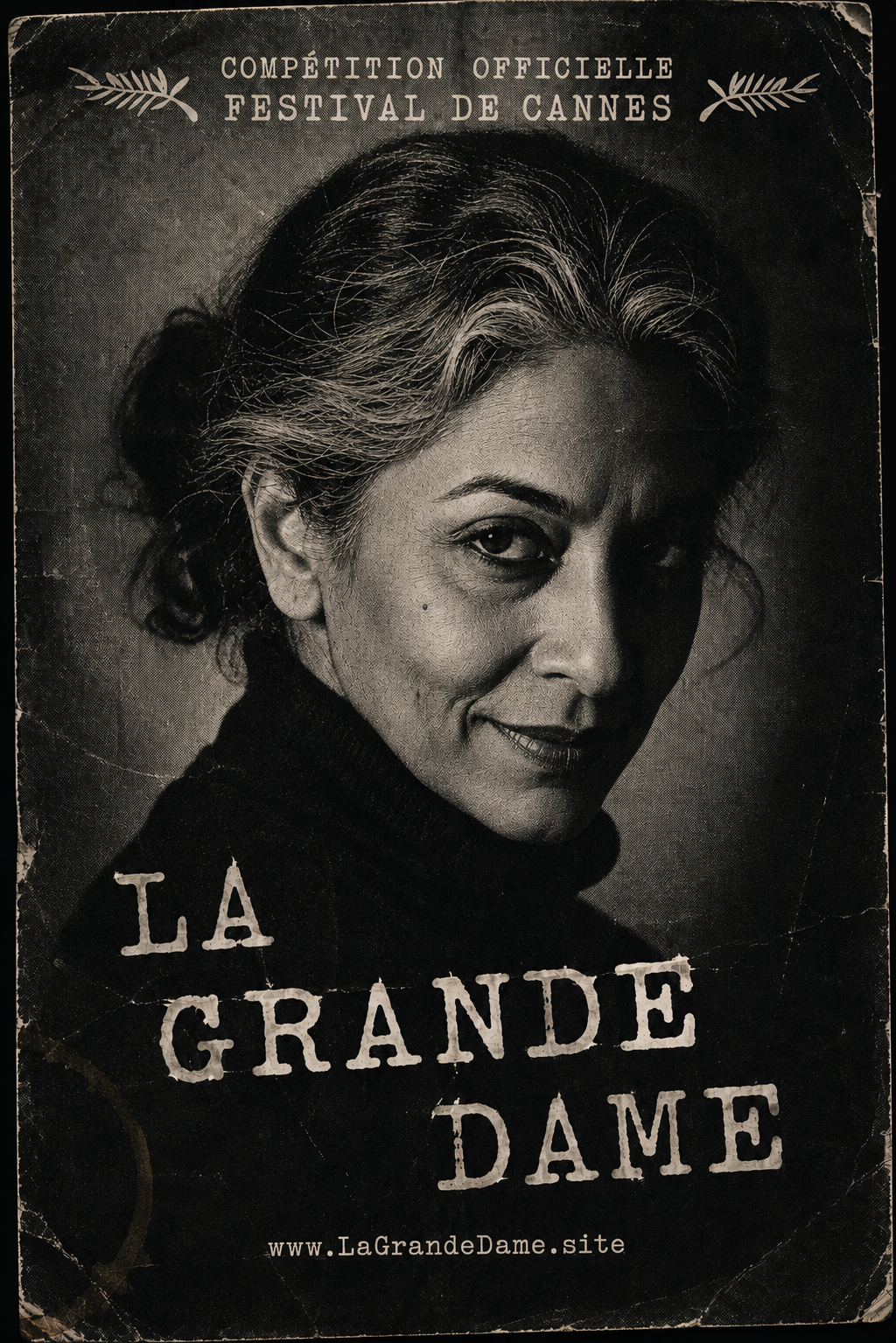
(www.LaGrandeDame.site)
Aspects of the following were assisted in development with AI Process/Open Source Software: HUMAN, Google Flow Music, Claude.ai, ChatGPT, Perchance.org – DAW: Audacity 4 (alpha), OS: Linux (Ubuntu 26.04)
LA GRANDE DAME is available for development partnerships:
The connection between LA GRANDE DAME and TATANKA:
We focus on all marginalized groups, to be “radically inclusive,” by modeling harmony and love to counter hate and fear. The focus includes ageism, a theme of the narrative.
Characters, Five-Act Structure, Sample Poster and Finale Concepts
CHARACTER LIST & ANALYSES
Ila, The reinvented Bollywood star in her sixties, fresh out of a childless “Gray Divorce,” restarting in Cannes, not to act, but to reinvent herself. She is deliberately unshowy on the page, she does not announce her past, she simply carries it. Her arc concerns the difference between being seen and being chosen, she spent decades being looked at professionally, commodfied, and is only now learning what it feels like to be looked at because someone wants to make something with her, not off her.
In a perfect universe, the role was conceived around Sarita Choudhury, a real actor’s actor with real international range.
Odette, The café’s proprietor and the film’s moral compass, though she would never accept that description. Underestimation has been her life’s education, and she recognizes it instantly in Ila. She never explains herself, which is what makes her explanations land when they finally come.
No real performer was attached to this role in the original notes. She functions best as an original creation, the one part of the ensemble not built in the shadow of a public persona.
Aldo Ferrante, The broke, unembarrassable director, allergic to being told no because he has already been told no by everyone who mattered professionally. His guerrilla instincts are not a personality quirk, they are the only tool left to someone shut out of traditional financing. His arc mirrors Ila’s from the opposite direction, he needs to be believed before proof exists.
The character was written with Roberto Benigni in mind, his blend of manic conviction and genuine cinephile devotion, rooted in his own relationship to the town where Cinema Paradiso was filmed, is the emotional engine the character was built around.
Rene (piano), The band’s anchor, the one who keeps playing through the “French incident” instead of stopping, the film’s philosophy of continuity through chaos, rendered in miniature.
The burn-scarred piano introduced in Chapter One was clearly written with Tom Waits’ presence already in the room.
Milo (saxophone), Less a character than a mood, he says almost nothing across the novella and lets the horn do it.
John Lurie’s deadpan, half-there screen presence from Jarmusch’s own early films informed how Milo should read.
Gus (upright bass), The band’s low end and its dry wit, the one who makes the joke nobody else in the room is fast enough to make.
Iggy Pop, cast deliberately against type, quiet, watchful, funny in a way that surprises people who only know the stage persona.
Wren & June (guitar/drums), The youngest members of the band, and the ones who do the actual night-work of papering Cannes with posters. Their energy drives the guerrilla marketing campaign.
Jack White and Meg White were the intended pairing, “sibling chemistry,” raw and a little reckless, suited to the poster-run scenes.
Camille, Enters mid-story, a producer burned by the studio system who finds in this project the first thing in years worth doing for free. She is the bridge between guerrilla and legitimate, the one who turns “no money” into “a little money.”
No real performer was named for this role. Given her structural importance, she is the funding turn of the story, she works best left unanchored from any public persona, like Odette.
Régis, The critic whose unreadability through the screening carries real tension, and whose quiet appearance with the newspaper in Act Five constitutes the film’s only “announcement” of the win.
Likewise left original in the notes, for the same reasons as Camille and Odette.
The sit-in musicians, Unnamed on the page by design, appearing only on certain nights, recognizable only to a specific kind of listener.
Nick Cave, Kim Deal, and Thurston Moore were named for these wandering-in cameos, kept anonymous within the story so the “Easter egg” only resolves for someone who already knows their faces, the same logic as the French cameo extras.
LA GRANDE DAME – Summary
ACT ONE, Exposition: The Sign in the Window
Ila’s arrival and hiring are established. On her first shift, a small, absurd “French incident” occurs, a regular’s ancient dog gets loose and ends up asleep on the piano mid-set, and the band folds the disruption into the music rather than stopping. Ila watches, unbothered by chaos for the first time in years, and sits at the piano and vocally improvises, whereupon the dog wakes and begins to “scat” along with Ila. The café is established as a world with its own laws. The act closes on Aldo appearing in the doorway, soaked from rain he did not need to walk through, already looking at Ila as though he has shot the scene in his head.
ACT TWO, Rising Action: A Film With No Money
Aldo mounts a nightly campaign, a fake casting call, a “location scout” who is only him with a borrowed camera, an offer to pay Ila in a currency that turns out to be homemade wine. Odette observes with the patience of someone who has seen every kind of fool. Ila’s resistance softens not through flattery but because Aldo speaks about being overlooked in his fifties the way she recognizes being overlooked at sixty, the observation lands as accurate, not sentimental. The decision to shoot in black and white is made by necessity, since Aldo cannot afford color stock, and becomes the film’s defining visual identity. Ila agrees on principle. The first guerrilla shoot follows, three in the morning, an empty Croisette, Aldo and one friend with a camera, Ila in a borrowed coat.
ACT THREE, Crisis: Posters Without Permission
The guerrilla marketing campaign begins in earnest, Aldo and a growing skeleton crew, including Wren and June, paper Cannes at night with Ila’s face and name, without her sign-off, without a studio, without a cleared title. A tense scene follows in which Ila discovers her own face on a wall she did not approve, and must decide whether visibility is a threat or a return. Camille enters, recognizes what is being built, works unpaid at first, and gradually locates small amounts of real money. Episodic vignettes of shooting follow, a scene stolen inside an actual festival party, a scene filmed inside the café during service that the customers do not realize is part of a film. Cameos come and go, French extras carrying private jokes legible only to industry insiders. The act closes on the film finished, no distributor, no invitation, nothing but a rough cut and Odette’s café as the only available venue.
ACT FOUR, Climax/Falling Action: The Screening
The café is rearranged after closing into a small house with folding chairs. Word has spread only through posters and whisper, yet the room is packed, standing room only, critics mixed among regulars who do not know they are watching something significant. Régis attends, unreadable through most of the screening. The band performs a short live set before the film rather than trailers. There is no triumphant swell, only the discomfort of watching herself, at sixty, in black and white, being looked at again after choosing not to be for years. Ila steps out of the room partway through, and Odette finds her outside, a quiet scene addresses the cost of being seen versus being chosen to be seen. Ila returns for the ending, and the standing ovation lasting over ten minutes as the critics clamor to interview the cast and crew.
ACT FIVE, Dénouement: The News, Not the Ceremony
There is no Cannes selection, no red carpet, that absence is the point. Weeks later, during an ordinary shift at the café, with Odette wiping down the copper bar and Rene tuning the piano, the news arrives quietly, a phone call from Camille, or a critic wandering in with a newspaper, or Régis simply appearing and setting it on the table without a word. The critics’ prize has been awarded, voted independently, unsanctioned by the festival itself. The scene remains small, a beat of stunned quiet, someone laughs first, no one makes a speech. Aldo’s reaction is not vindication but something closer to relief that the effort was witnessed at all. Ila’s reaction carries the film’s thesis without stating it outright, not proof she was right to keep going, only confirmation that someone noticed. The story closes on the café returning to its ordinary rhythm, the band resumes playing, service continues, the sign remains crooked in the window. No exterior award-ceremony scene occurs, and no acceptance speech is depicted, the story ends at the moment the room learns.
Ila returns to her piano and sings the title song as we fade to the credits.
End Sample Title Song: Appelez-moi Par Mon Nom
(Download MP3)
Prompt:
Create an intimate, timeless French chanson for the closing credits of an arthouse feature film set in Cannes. The song should feel completely authentic, as if it were discovered on an old reel of film from the early 1960s rather than newly composed. It is not nostalgic or retro. It is simply honest.
The emotional atmosphere is quiet redemption, late-life reinvention, grace after disappointment, and the peace that comes from finally belonging. This is not a triumphant finale. It is a deeply personal confession that happens to be overheard.
Style references include the poetic intimacy of Barbara, the elegance of Juliette Gréco, the melodic sophistication of Michel Legrand, and the understated emotional restraint of classic French Left Bank chanson.
Tempo: slow (58 to 64 BPM).
Meter: gentle French café 3/4.
Key: F major with frequent excursions into D minor.
Harmony should use warm major sevenths, sixths, suspended chords, and tasteful jazz extensions without sounding like jazz. Avoid dramatic modulations or cinematic orchestration.
Instrumentation should remain entirely acoustic:
- Upright piano throughout, slightly worn in tone, warm, close-miked, occasionally imperfect.
- Upright bass entering softly after the first refrain.
- Very restrained brushed snare appearing only later.
- Hollow-body acoustic guitar played sparsely.
- Tenor saxophone used only for quiet lyrical counter-melodies, never a solo.
- No strings.
- No accordion.
- No synthesizers.
- No cinematic percussion.
- No orchestral swells.
The recording should sound live inside a small café after closing time. Preserve subtle room ambience, wooden reflections, pedal noises, breathing, chair movement, and natural imperfections. Everything should feel performed in a single take by musicians who have played together for years.
The singer is a woman in her early sixties.
Her voice is a warm, smoky low mezzo-soprano with remarkable emotional honesty rather than technical perfection. She never sounds theatrical or as though she is trying to impress the listener. She sings with complete emotional confidence and complete vocal humility.
The voice should carry the natural texture of age: a slight grain, gentle breath, occasional fragility, and effortless control. Vibrato is used sparingly and only at the ends of emotionally significant phrases. Dynamic range remains intimate throughout.
She sings entirely in flawless contemporary French with a subtle Riviera warmth in her natural pronunciation, never exaggerated into caricature. Her diction is crystal clear, elegant, conversational, and unmistakably native. Every word feels spoken before it is sung.
The melody should prioritize the poetry of the lyrics over vocal virtuosity. Mostly stepwise motion with only occasional expressive leaps. Every phrase should feel inevitable, as though it could only have been sung this way.
The emotional arc begins reflective, becomes quietly hopeful, and ends in peaceful acceptance.
The final refrain gradually removes instruments until only the piano and voice remain.
The final words, “La Grande Dame… n’a jamais été la gloire… C’était la femme… qui est revenue… pour chanter.”, should be delivered almost as a whisper.
Do not end with a grand cadence. Let the final piano chord ring naturally into silence, allowing the room itself to become the last instrument.
Overall feeling: intimate, elegant, understated, profoundly human, worthy of the final scene of a Palme d’Or-winning French film.
Sample A/V Streams
Lyrics
[Couplet 1]
Je portais des diamants de lumière,
Des noms empruntés, des nuits passagères.
Tous connaissaient celle que j’avais été,
Personne ne cherchait mon âme cachée.
Le rideau montait, les applaudissements fleurissaient,
Puis s’évanouissaient dans le silence.
Chaque photographie voyait…
Tout, sauf moi.
[Refrain]
Je ne demande pas au temps de revenir,
Les cendres ne rêvent plus de brûler.
Laissez les couronnes à leurs royaumes,
Appelez-moi seulement par mon nom.
Si demain prononce mon nom,
Qu’il le fasse tout bas.
J’ai traversé la plus longue des mers
En cherchant simplement…
À être aimée.
[Couplet 2]
La pluie tombait sur les pierres,
Les petites tables, les tasses oubliées.
Quelqu’un jouait quelques notes fatiguées,
Et la chanson s’est souvenue de moi.
Non parce que le monde y croyait,
Non parce que j’avais enfin réussi.
Seulement parce qu’un seul regard
Voyait au-delà du masque.
[Refrain]
Je ne demande pas à la jeunesse de rester,
Le matin retrouve toujours son chemin.
Chaque miroir dit la vérité,
La grâce est plus douce que la jeunesse.
Si demain ferme la porte,
Laissez la bougie allumée.
J’ai appris qu’une pièce peut rayonner
D’un seul cœur…
Qui l’habite.
[Pont]
À tous les films qui ne verront jamais le jour,
À toutes les promesses effacées.
À tous les commencements tardifs,
À toutes les victoires silencieuses.
Ne dressez aucune bannière vers le ciel.
Versez le vin, laissez-le respirer.
La vie est plus petite que nos peurs…
Et tellement plus précieuse.
[Refrain final]
Je ne demande pas aux étoiles de tomber,
Elles n’ont jamais été à moi.
Laissez l’orchestre s’apaiser,
Écoutez le rebord de la fenêtre.
Chaque inconnu, chaque ami,
Chaque chemin dessiné par les années,
M’a conduite jusqu’à celle que je suis…
La Grande Dame…
N’a jamais été la gloire.
C’était la femme
Qui est revenue
Pour chanter.
Call Me By My Name
Verse 1
I wore diamonds made of light,
Borrowed names and borrowed nights.
Every face knew who I’d been,
No one asked the soul within.
Curtains rose, applause would bloom,
Then dissolve into the room.
Every photograph could see…
Everything but me.
Chorus
I’m not asking time to turn,
Ashes have no wish to burn.
Leave the crowns where kingdoms came,
Call me only by my name.
If tomorrow speaks my name,
Softly is enough.
I have crossed the longest sea
Looking simply…
to be loved.
Verse 2
There was rain upon the stone,
Little tables, cups alone.
Someone played a tired key,
And the song remembered me.
Not because the world believed,
Not because I finally achieved.
Just because one pair of eyes
Saw behind disguise.
Chorus
I’m not asking youth to stay,
Morning always finds its way.
Every mirror tells the truth,
Grace is kinder now than youth.
If tomorrow shuts the door,
Leave the candle lit.
I have learned a room can glow
From one heart…
inside of it.
Bridge
Here’s to all the films unmade,
Every promise left to fade.
Here’s to every late beginning,
Every quiet kind of winning.
Raise no banner to the sky.
Pour the wine and let it dry.
Life is smaller than we feared…
And so much more dear.
Final Chorus
I’m not asking stars to fall,
They were never mine at all.
Let the orchestra grow still,
Listen to the windowsill.
Every stranger, every friend,
Every road the years have mapped,
Made me who I came to be…
La grande dame…
was never fame.
She was the woman
who came back
to sing.
LA GRANDE DAME: A Literary Treatment
I. LITERARY ELEMENTS
Character
The ensemble is built on a deliberate asymmetry: some figures are given psychological interiority, others are given only surface and sound. This isn’t a flaw in the design — it’s the design.
Ila is the story’s true engine, and her arc now needs to be legible not just in what happens to her but in how she talks about her craft as the story progresses. She arrives a Bollywood star in exile from her own reflection — decades of being professionally looked at, none of it, by her own private accounting, real. Her early vocabulary about acting should still carry the residue of that old profession: performance as offering, a transaction between a face and an audience that wants to be flattered. As the novella moves through Acts Two and Three, her language should shift, almost without her noticing it happen — from talk of being seen to talk of disappearing into something, from technique to attention, from “giving them what they came for” to something closer to service: showing up completely for a moment that isn’t about her at all. By the screening in Act Four, she is no longer describing what she does as acting in the sense she once meant it. She has become, in the novella’s own quiet term for it, a world-class actor — not because the guerrilla film proves it externally, but because she has already stopped needing it proven. The reader should be able to chart her transformation almost entirely through her observations about the work, offered in passing, never as declarations.
Odette functions as a kind of dramaturgical anchor — the character whose judgment the audience trusts because she withholds it so consistently. Her moral authority is structural, not moralizing: she rarely offers opinions, so when she does, they land with disproportionate weight. She becomes, increasingly through Act Three, the only person Ila will say the true version of things to — not the version calibrated for a director, a producer, or a public.
Aldo Ferrante is Ila’s structural mirror, approaching the same territory — belief before proof — from the opposite direction. Where Ila must learn to be chosen, Aldo must learn to keep choosing without external validation. His comic exterior in Act Two (the homemade wine, the fake casting call) is protective coloring over a genuinely precarious position; by Act Three, as the stakes rise and the posters go up without permission, his humor should thin without disappearing, revealing the fear underneath the guerrilla bravado.
The band — Rene, Milo, Gus, Wren, June — functions almost as a Greek chorus rendered in instruments rather than voices, and across Acts Two and Three they should be the primary carriers of the story’s episodic, deadpan humor before that humor sobers. Individually thin on the page by design; collectively, they are the film’s stated philosophy — continuity through chaos — made audible, and their vignettes are where the tonal pivot of the piece should be most visible scene to scene.
Camille and Régis remain functional characters in the classical sense — each exists to enact a single narrative hinge (money, recognition) — and stay rightly unanchored from real personas. Camille’s recognition, when it comes in Act Three, should register as one of the first outside confirmations that what she’s seeing in Ila is not stardom but craft.
Plot
The plot follows a rags-to-recognition arc, but its real spine is a quieter, recursive question asked repeatedly in shifting registers: what does it cost to be looked at, and what changes when you stop performing for the look and start working for the thing itself? Acts Two and Three now do the heaviest lifting on this question, moving through a string of episodic, loosely connected vignettes — bound by mood rather than tight causality — that begin as deadpan comedy and gradually darken and deepen as Ila’s own relationship to acting changes underneath her.
Setting
The café remains the fixed point against which everything else moves. Cannes itself operates as an antagonist-setting: glamorous, indifferent, structured entirely around official channels the story’s heroes have no access to. The decision to shoot in black and white, born of necessity, continues to mirror the story’s thematic arc — a limitation treated as a virtue, exactly as Ila’s own reinvention treats the loss of her old career as a limitation that produces something truer.
Theme
The dominant theme remains the distinction between visibility and selection, but it now sharpens into something more specific: the difference between performing and acting. A secondary theme, carried by the band’s episodic detours, is continuity as resistance — the choice to keep playing, keep believing, keep shooting is framed as philosophy, not stubbornness. A third thread, carried by the shifting tone of Acts Two and Three, is that seriousness is not the opposite of lightness but its natural continuation — the humor doesn’t get abandoned as the story deepens, it gets earned into something quieter.
Conflict
The conflict remains layered rather than single-source, but the internal conflict should now be given more explicit shape:
- External/institutional: no money, no distributor, no sanctioned access to the festival itself.
- Interpersonal: Ila’s resistance to being seen again, softened by Aldo’s argument by analogy rather than persuasion.
- Internal, and now central: Ila’s real conflict is not whether to make the film but what kind of person makes it — the flattered Bollywood star performing generosity, or the actor she is quietly becoming, who has stopped needing the transaction. Her Act Four departure from her own screening is the clearest dramatization of this — she can make the film, but watching it interrogates whether the person she’s become can survive being looked at as that person, rather than as the star she used to be.
There is still no personal antagonist. The “opposition” remains systemic — financing, gatekeeping — which keeps the tone warm even as it grows serious.
Point of View
The novella’s omniscient-but-intimate distance should now be used deliberately to track the tonal pivot: early in Act Two, the narration can hang back with the band’s deadpan comic rhythms, observing Ila from outside as she adjusts to the café’s world. As Act Three progresses, the narration should draw closer to her interiority, granting the reader more direct access to her private observations about acting and life — not through explanation, but through the texture of what she notices.
Tone & Diction
This is where the revision matters most. The tone should now be read as a deliberate arc rather than a fixed register: Act Two opens in full deadpan — absurd transactions, repetitive dialogue, comic non-sequiturs, jokes that land because no one in the scene acknowledges they’re funny. Across Act Two and into Act Three, without ever losing that deadpan restraint, the material underneath the jokes should grow heavier, until by the poster confrontation and the arrival of Camille and Régis, the comedy has become the delivery mechanism for something close to grief and, just behind it, hope. The diction stays plain and concrete throughout — homemade wine, a burn-scarred piano, a dog that scats — which is precisely what allows the tonal shift to happen without ever feeling like a change in style. The prose doesn’t get more serious by reaching for bigger words. It gets more serious by asking the same small, exact words to carry more weight.
II. THE FIVE-ACT SUMMARY, EXPANDED
ACT ONE — Exposition: The Sign in the Window
Ila’s arrival at the café is not framed as a fresh start so much as a quiet surrender to smallness, after decades in which nothing about her life was small. Her first shift establishes the café’s private grammar of chaos: an elderly regular’s dog slips its leash and settles, uninvited, onto the piano mid-set. Rene does not stop playing. The room does not startle. Ila — watching a disruption absorbed rather than resisted, possibly for the first time in her adult life — sits at the piano and begins, unplanned, to sing; the dog wakes and answers her, note for note, absurdly. The café declares its own laws in this moment: nothing here is an emergency, everything here can become music. The act closes on Aldo in the doorway, rain-soaked from a storm he had no need to walk through, already composing the shot in his head before he has said a word to her.
ACT TWO — Rising Action: A Film With No Money
The act opens in pure deadpan. Aldo’s courtship of Ila is conducted almost entirely through invention: a casting call that doesn’t exist, a “location scout” who is only himself with a borrowed camera, payment offered in homemade wine because no other currency does. Odette watches with the patience of a woman who has already sorted the fools from the believers and hasn’t decided yet which one Aldo is.
A string of loosely connected nightly vignettes follows, each one small enough to seem like a digression and each one quietly advancing Ila’s reeducation in what acting even is:
Milo teaches her nothing, on purpose. He says almost nothing across an entire evening shift, letting the saxophone answer for him, and Ila — trained for decades to fill silence with expression — finds herself unsettled by how much a person can communicate by refusing to perform at all. She makes a joke about it to Odette afterward, still light, still a Bollywood star’s joke, self-deprecating about her old “eyebrow work.” But she doesn’t forget the feeling.
Gus runs the same dry joke on three different customers in one night, in the exact same deadpan cadence each time, and Ila watches the joke land differently depending on who’s hearing it — same words, same delivery, entirely different meaning. It is the first time she articulates, half to herself, that this might be closer to acting than anything she did in twenty years of films: not changing what you give, but changing what the room needs from it.
A former colleague from her old industry nearly recognizes her at a nearby table. The scene plays almost entirely without dialogue — a long look, a pause, a decision not to say anything, on both sides. It is funny in the way tension is funny before it resolves, and it is the first moment the tone tilts, however briefly, toward something more serious: Ila realizing she does not want to be recognized as who she was.
Ila’s resistance to the film itself erodes not through flattery but because Aldo speaks about being professionally overlooked in his fifties with an accuracy that mirrors her own experience at sixty — recognition, not seduction, is what moves her. The decision to shoot in black and white, forced by the cost of color stock, becomes retroactively the film’s defining aesthetic choice; Ila agrees on principle, sensing correctly that necessity has produced something better than budget would have allowed. The first guerrilla shoot follows at three in the morning: an empty Croisette, one borrowed camera, Ila in a coat that isn’t hers, saying almost nothing to camera and feeling, for the first time in years, that the not-saying is the performance.
ACT THREE — Crisis: Posters Without Permission
The tone continues to darken here without ever losing its deadpan spine — the jokes get quieter, the silences longer, the stakes realer.
The sit-in musicians begin appearing on certain nights, unnamed, unexplained, recognized only by those who already know who they are. Ila, watching one of these anonymous walk-ons play a single devastating verse and then vanish without acknowledgment, has her clearest private realization yet: that the greatest performances she has witnessed since arriving at the café have all been given by people actively trying not to be seen. She says almost nothing about this out loud. It changes how she carries herself in every scene afterward.
A strange, near-silent scene with Régis, well before the screening — he comes into the café once, alone, orders nothing, watches the room for twenty minutes, and leaves. No one is sure afterward what it meant. It plants, without explaining, the tension his unreadability will carry into Act Four.
The campaign then turns from private to public, and in doing so turns from Aldo’s risk into Ila’s. Wren and June lead a growing crew papering the city at night with Ila’s face and name — without her consent, without a studio, without a cleared title. The scene in which Ila finds her own image on a wall she never approved is now the act’s true crisis point, and it lands differently than it would have in Act One: this is no longer a star’s vanity being wounded, but an actor’s private, hard-won transformation being put back on public display before she’s ready to claim it. She tells Odette, in the closest the novella comes to a direct statement of theme, that she spent thirty years being given a face to wear and has spent three months learning to earn one, and now here it is on a wall, and she doesn’t know yet which face it is.
Camille’s entrance offers the story’s first institutional foothold, converting “no money” into “a little money” — and crucially, what she recognizes in Ila when she watches the dailies is not the Bollywood star she half-remembers from tabloids, but a performer she doesn’t recognize at all, which is precisely why she stays. The shoot proceeds in stolen fragments — a scene lifted inside an actual festival party, a scene filmed inside the café during real service, oblivious customers becoming unwitting extras — each vignette a little quieter, a little less driven by the joke of guerrilla filmmaking and a little more driven by what the footage is actually catching. The act closes on a finished rough cut, no distributor, and Ila watching a few minutes of her own performance for the first time — silent, unsmiling, recognizing herself as someone she has not met before.
ACT FOUR — Climax and Falling Action: The Screening
The café is remade after hours into the only venue available: folding chairs, no marquee, an audience assembled entirely by word of mouth and wheat-pasted posters. Régis sits among them, giving nothing away. The band plays live before the film rather than deferring to a trailer, reasserting the story’s philosophy one more time before the film can make its own case. There is no swelling validation in the screening itself — only the specific discomfort of watching herself at sixty, in black and white, being looked at again by choice after years of choosing not to be, and now as someone she has only recently become. Ila leaves the room before the film ends; Odette finds her outside, and their exchange — brief, exact — becomes the story’s clearest articulation of the difference between being seen and being chosen, spoken rather than merely enacted for the only time in the novella. Ila returns for the final minutes. The ovation that follows runs past the length of politeness into something closer to insistence.
ACT FIVE — Dénouement: The News, Not the Ceremony
The novella’s most pointed formal choice is what it withholds: no selection scene, no red carpet, no ceremony. Weeks pass. During an ordinary shift — Odette at the bar, Rene tuning the piano — word arrives sideways, almost accidentally, through a phone call or a newspaper set down without commentary. The prize, when it comes, is a critics’ prize, voted independently, unsanctioned by the festival that never let them in the front door — a detail that sharpens rather than undercuts the win. The room’s reaction is smaller than the news warrants: a stunned beat, someone’s laugh breaking it, no speeches. Aldo’s response reads as relief rather than vindication — proof not that he was right, but that the effort was witnessed. Ila’s response carries the novella’s thesis without stating it: not confirmation that persistence was correct, only that someone, finally, noticed the person she actually became, on her own terms. The café resumes its ordinary rhythm. The sign stays crooked. Ila returns to the piano and sings the title song as the story ends — deliberately — before any ceremony could begin.
III. ON THE FIVE-ACT STRUCTURE
Your proposed headings — Exposition, Rising Action, Crisis, Climax, Falling Action, Denouement — remain sound, and the new vignette-driven texture in Acts Two and Three actually strengthens the case for keeping them as written, for one specific reason: the episodic structure (a string of loosely causal, mood-bound scenes rather than a tightly plotted chain of events) is exactly what “Rising Action” and “Crisis” are supposed to hold. These headings don’t require a single escalating action — they require accumulation, and accumulation is what a vignette structure does best.
Two refinements are worth flagging now that the tonal arc is explicit:
Consider marking the tonal pivot inside Act Three, not just its plot pivot. As written, Act Three’s “crisis” is still nominally the poster confrontation. But with the added material, the true turn is arguably earlier and quieter — the sit-in musician’s anonymous verse, or the silent scene with Régis — where Ila’s private understanding of acting changes before the public plot catches up to her. If you wanted the structure to reflect this more precisely, you could split Act Three into an internal crisis (recognition of what she’s become) and an external one (the posters), even while keeping them under one heading — the current single Crisis label can absolutely hold both, but it’s worth being intentional that it’s now doing so.
Act One remains the one seam worth a second look, unrelated to this revision — it still contains a nearly complete miniature scene (the dog, the piano, the improvisation) before the true inciting incident (Aldo in the doorway) arrives, meaning “Exposition” is still doing double duty. That observation stands independent of the tonal work done here.
Everywhere else — Rising Action now carrying the comic-to-serious modulation, Crisis holding both an internal and external turn, Climax/Falling Action compressed into the screening, Denouement as a deliberate anti-ceremony — the labels are doing exactly what they should. The headings are earning their names, and now so is the tone.