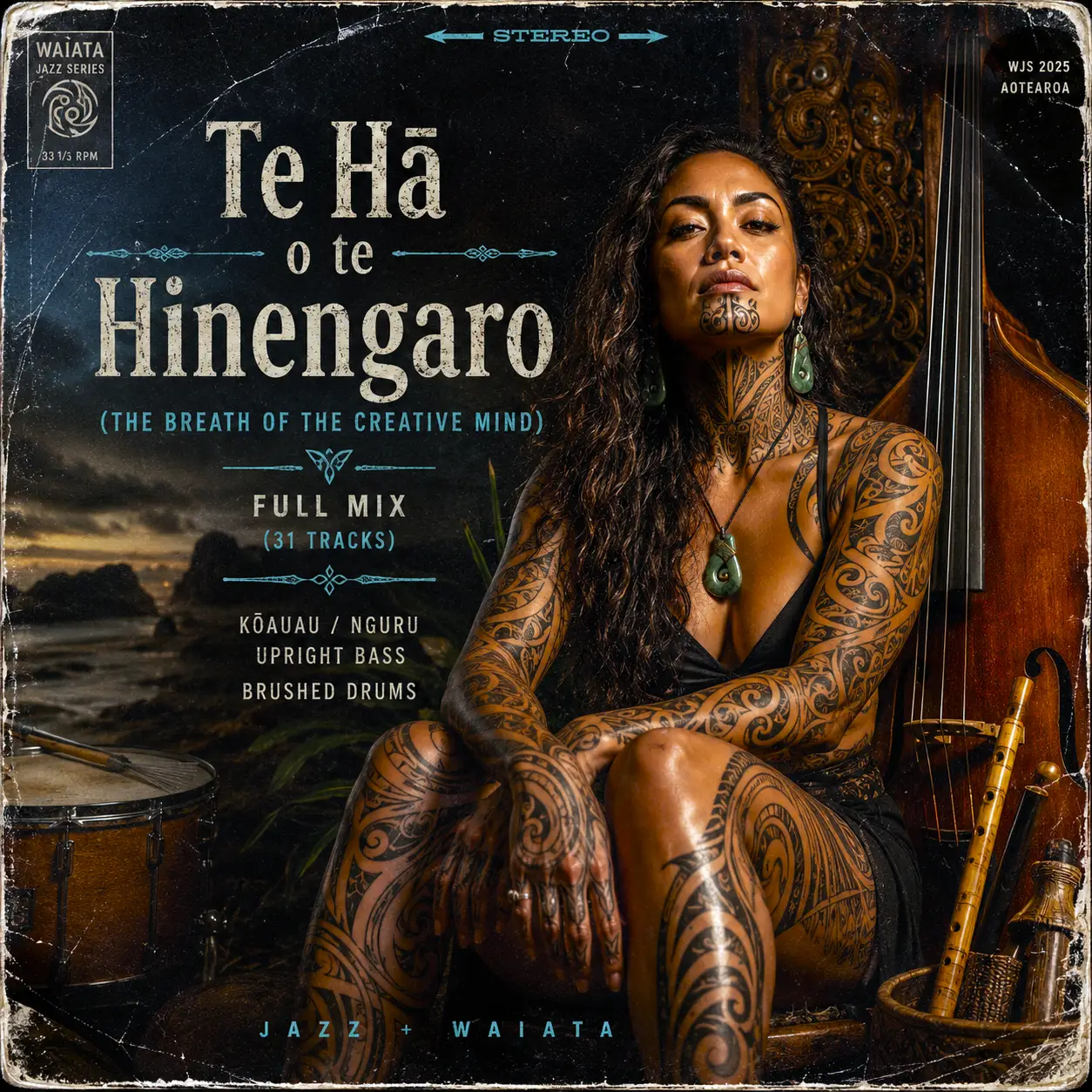
(The Breath of the Creative Mind)
AI Process/Open Source Software: HUMAN, Google Flow Music, Claude.ai, ChatGPT, Perchance.org – DAW: Audacity 4 (alpha), OS: Linux (Ubuntu 26.04)
Te Hā o te Hinengaro – Full Mix (31 Tracks – 1:29:18)
Download/Stream Free Mix MP3
The title is Maori. The word Hā refers to both the physical breath used to play taonga puoro and the essence of life itself, while Hinengaro captures the intellectual and improvisational depth that defines jazz. Together, it honors the oral tradition of waiata while celebrating the spirit of modern jazz discovery.
I wanted to explore the space where the breath of our ancestors meets the improvisational “now” of jazz. On the surface, traditional Māori waiata and modern jazz might seem like distant worlds, but they share a profound DNA, both rooted in oral tradition, adaptive by nature, and relying on a deep, intuitive communication between performers.
To me, the melodic flexibility of Māori music isn’t a structure to be flattened into a standard arrangement; it’s a living, breathing invitation for jazz improvisation to open up new dialogues. For this album, I wanted to strip things back to a quartet setting. You’ll hear the kōauau (bone or wood flute) and the nguru (nose flute) taking the lead, instruments that carry a unique, human-like vocal quality. By pairing them with the grounded, earthy resonance of an upright bass and the subtle, rhythmic “shhh” of brushed drums, we create a crossover similar to the Sami joik-jazz experiments of the North, a sound that is both ancient and avant-garde.
In these tracks, the nguru doesn’t just play a melody. It engages in a call-and-response with the bass, honoring the traditional exchange of whai kōrero. There is no sheet music here, only the spirit of the Wairua guiding the quartet through these ten movements. This is music of the breath, for the mind.
– JJ, Creator
Google Deep Dive Podcast: The Nguru Dialogue
Text To Music Prompt:
Think fusion of traditional Maori music and jazz! Jazz + Waiata has a lot of melodic flexibility and call-and-response phrasing that jazz improvisation could really open up. A quartet built around koauau or nguru alongside upright bass and brushed drums could work beautifully , there’s precedent for this kind of thing in other indigenous-jazz crossovers (Sami joik-jazz, for instance), and the improvisational space would honor the oral, adaptive nature of waiata rather than flattening it.