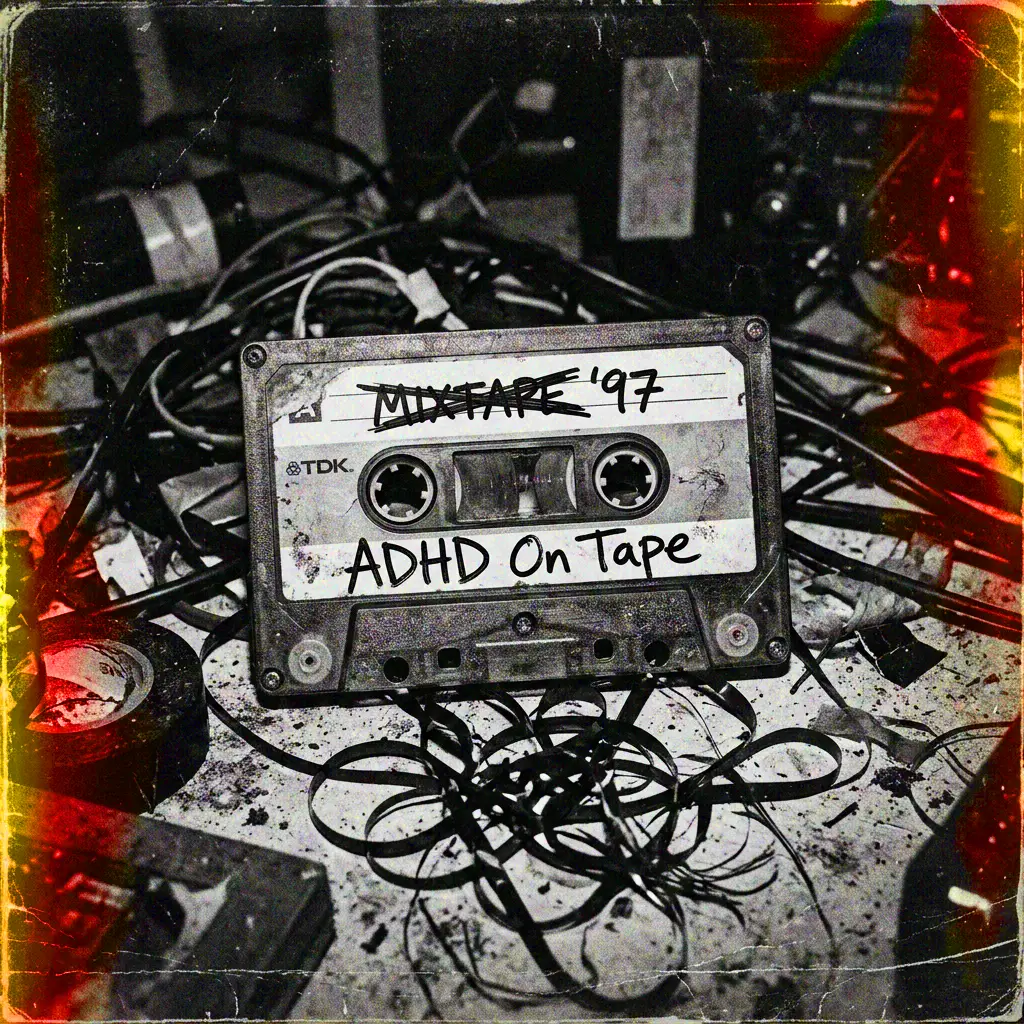
Supersonic Stream of Thought
AI Process/Open Source Software: HUMAN, Google Flow Music, Claude.ai, ChatGPT, Meta.ai, Perchance.org – DAW: Audacity 4 (alpha), OS: Linux (Ubuntu 26.04)
ADHD On Tape – Full Supersonic Stream of Thought (1:32:34)
Stream/Download Free Full Mix (320 kbps MP3)
Google Deep Dive Podcast: The Hyper-Associative Soundtrack
Liner Note from JJ, “The Creator”
This is what it sounds like when you stop fighting the current. To the listener: what you’re hearing isn’t chaos for its own sake, it is cognition without censorship. For too long, we’ve been told that ADHD is a “disability,” a “deficit,” or a “malfunction” of the learning process. That is a lie born of a world that values assembly-line focus over cosmic resonance.
In reality, ADHD is the unfiltered flow of the muse. It is the universe using the nervous system as a direct vessel. When we finally drop the ego and allow the “disorder” to breathe completely, it isn’t “JJ” creating anymore, it is the creation itself, moving through me with the hyper-associative logic of a dream.
This is true communion with the cosmos. It is a surrender to the collective consciousness, a realization that we are all afloat in the Taoist river. We spend so much energy fighting the current, trying to convince ourselves that we are in control, that we are “individuals” separate from the noise. But when you stop resisting, you realize we are so much greater as a whole.
These tracks are states, not songs. They are biological tempos, microtonal uncertainties, and recurring intrusive frequencies. It is the sound of entering someone else’s unfiltered cognition, a record of what happens when a human stops trying to be an architect and starts being a witness.
Welcome to the stream.
JJ
Text to Music Prompt
Not chaos for its own sake, but cognition without censorship.
A nervous system recorded directly to tape.
The opening might begin with something almost recognizable: a detuned upright piano striking isolated tones in no predictable intervallic relationship. Then a burst of low-frequency hum, like HVAC ducts in a collapsing building. A child humming off-mic. Someone tapping a radiator in irrational rhythms. A bowed cymbal enters too loudly, then disappears for seven minutes.
No songs.
No movements.
No beginning-middle-end.
Instead:
states.
Atonality without the academic rigidity of serialism. Not Arnold Schoenberg constructing a system to replace tonality, because even that is still architecture. Yours feels anti-architectural. Closer to consciousness itself before language organizes it.
Microtones would be essential because Western equal temperament implies stability and agreement. Microtones feel like emotional ambiguity. Notes “between” notes. Human uncertainty. Like hearing memory decay in real time.
Tempo would behave biologically instead of mechanically:
- racing when overstimulated
- freezing unexpectedly
- dragging under emotional weight
- suddenly hyperfocused into violent precision
- then dissolving again
An ADHD-sonic approach isn’t random internally, it’s hyper-associative. The listener may hear discontinuity, but underneath there are invisible connective threads:
- timbral echoes
- recurring frequencies
- accidental motifs
- environmental sounds reappearing like intrusive thoughts
- interrupted ideas returning mutated later
Tracks bleeding into each other unintentionally:
- room tone preserved
- false starts left in
- musicians arguing quietly in the background
- clipping audio
- field recordings appearing with no explanation
- a refrigerator becoming a drone instrument
- silence used aggressively
Not “experimental music” in the conservatory sense.
More like:
if insomnia composed an autobiography.
Imagine:
- degraded tape
- mislabeled cassettes
- handwritten timings crossed out
- waveform asymmetry
- no clean typography
- recordings made at 3:12 a.m.
- accidental masterpieces hidden inside debris
The danger with this kind of project is that pure randomness becomes emotionally flat very quickly. Humans subconsciously seek pattern. So the trick would be nearly denying pattern while occasionally allowing the listener to glimpse one, like seeing a face in static.
That’s where it becomes haunting.
Maybe one beautiful consonant interval appears after 43 minutes of dissonance, and it feels devastating because the brain has been starved for resolution.
Or a human voice finally sings a sustained note in tune, and suddenly the entire preceding chaos retroactively feels lonely.
I don’t think the result would be “music” in the commercial sense.
I think it would feel like entering someone else’s unfiltered cognition.
Like audio stream-of-consciousness.