
She Refused to Leave When the Sea Came for Her House, And the Ocean Told Her Everything
AI Process/Open Source Software: HUMAN, Google Flow Music, Claude.ai, ChatGPT – DAW: Audacity 4 (alpha), OS: Linux (Ubuntu 26.04)
TATANKA’s newest release is a meditation on what it means to listen until there is nothing left but the listening.
The Last Transcription – Full Album (51:26)
Stream/Download Free Album MP3 (320 kbps)
Google Deep Dive Podcast: The Last Transcription
Theme Rendering
This is an album about listening as a sacred act. About a woman who understood something most humans never do, that we are not composers, we are transcribers. That the earth has always been singing, and our music is only our attempt to write down what we hear before we are gone.
The Last Transcription sits at the intersection of Indigenous reverence for the natural world, the quiet courage of solitary women who remain when everyone else leaves, and the intimate relationship between human creativity and the forces that outlast us. It is haunting, luminous, slow, and utterly unafraid of silence.
Within TATANKA’s broader narrative, this album speaks directly to the matriarchal wisdom tradition, the keeper who stays, who listens, who preserves. Not through defiance but through devotion.
Narrative Arc
Prelude: She is alone. The last house. The water has taken everything else. She does not mourn. She records.
Tracks 1–5 (Symphony): Each track is a session. Each session captures something the ocean offers, a rhythm, a tone, a frequency she has never heard before. As the water rises, the recordings become more urgent, more intimate, more transcendent. She begins to suspect the ocean knows she is listening.
Tracks 6–7 / Coda: The water reaches the door. She does not stop recording. The final track is her voice, barely above a whisper, reading the last notation she made, and then the sound of the ocean, alone.
General Track Level Text To Music Prompt
“Coastal Indigenous ambient with field recordings of tidal water, sparse cello, hand drum, and processed breath. Slow, meditative tempo, 52–60 BPM throughout. The emotional core: devotion without audience, beauty without witness, the sacred made from the ordinary act of paying attention. As if the earth itself is humming a frequency only one woman alive can still hear.”
TRACKLIST
The House Stays
Track Level Text To Music Prompt
“Sparse coastal ambient. Single cello drone, distant tidal field recording, occasional hand drum heartbeat at 56 BPM. Voice optional, if present, elderly female, barely above speaking tone. The sound of a decision made with complete peace.”
Theme
The album opens in stillness. She has chosen to remain while others fled. This track establishes her solitude not as tragedy but as vocation. The water is distant still, a sound at the edge of hearing. She sets up her equipment. She presses record.
Lyrics
Intro: The road behind me washed away last spring I left no forwarding address, I left no offering The neighbors took their photographs and drove into the grey I locked the door from inside and I decided I would stay
Verse 1: The floorboards know my footsteps like a language spoken low The walls hold thirty winters and the summers long ago I’ve mapped the way the light moves through the salt-clouded glass And catalogued each frequency the tidal cycles pass
Verse 2: They said the sea would take me like it took the Hendersons I said the sea and I have had a longer conversation I’ve heard it building something in the registers below A composition older than the oldest thing I know
Chorus: So the house stays, and I stay, and the water keeps its time There’s a music in the losing that I’m learning line by line What the ocean writes in salt and surge and centuries of stone Is the only score worth keeping, and I’ll keep it here alone
Verse 3: My granddaughter calls Sundays, says come live with us in town I tell her I’m still working, that I haven’t written down The passage that the undertow has practiced since the fall She says grandma you’re not safe there, I say I’m not safe at all
Verse 4: Safety is a story that the frightened tell themselves While the beautiful and terrible keep singing on the shelves Of every ocean, every storm, every living thing that knows That the music doesn’t stop for us, it simply comes and goes
Chorus: So the house stays, and I stay, and the water keeps its time There’s a music in the losing that I’m learning line by line What the ocean writes in salt and surge and centuries of stone Is the only score worth keeping, and I’ll keep it here alone
Bridge: I was twenty when I first heard it beneath the fishing boats A chord that had no instrument, a hymn that had no notes I’ve spent forty years returning to that frequency alone Tonight it’s close enough to touch, tonight it’s coming home
Chorus: So the house stays, and I stay, and the water keeps its time There’s a music in the losing that I’m learning line by line What the ocean writes in salt and surge and centuries of stone Is the only score worth keeping, and I’ll keep it here alone
Outro: Press record The water’s at the garden wall Press record There’s still so much to notate before the fall Press record The house stays standing, for a little while Press record
First Session
Track Level Text To Music Prompt
“Field recording forward, real or simulated ocean, complex polyrhythmic tidal pattern emerging slowly from ambient wash. Light melodic cello enters at the two-minute mark. 58 BPM. Tone of quiet discovery, reverence, the feeling of witnessing something ancient for the first time.”
Theme
She records for the first time with full intention. The ocean offers something unexpected, a rhythmic pattern she has never documented before. This track carries the excitement of discovery, tempered by the knowledge of impermanence.
Lyrics
Intro: Equipment placed and levels set, the morning tide comes in I’ve learned to hold the microphone the way you’d hold a hymn Not tight enough to change it, not so loose it slips away The ocean started early and had plenty more to say
Verse 1: There’s a polyrhythm building in the deep swell and the shore Something hitting something else I’ve never mapped before I slow the tape and listen through the static and the surge A percussion made of continent, a tide-song at the verge
Verse 2: My notebooks fill with symbols I invented years ago A private notation for the things that don’t quite flow Through standard staff and measure, these are frequencies that live In the space between the sayable and all the rest we give
Chorus: First session, first light, first note on the page The ocean in its patience has been waiting for this age When someone who was listening became someone who could write The grammar of the deep sea down before the losing light
Verse 3: I think of all the women who have stood beside this kind of water With their ears against the listening and their hands against the order Of a world that told them silence was the only thing they’d earn They heard the ocean anyway and let the ocean turn
Verse 4: Into something that resembled what we’d later come to call The root of every music, the original, the all Before the first drum spoke it, before the first voice rose The water was already keeping time through highs and lows
Chorus: First session, first light, first note on the page The ocean in its patience has been waiting for this age When someone who was listening became someone who could write The grammar of the deep sea down before the losing light
Bridge: Four hours in the meter shifts, I nearly drop the mic A modulation none of my equipment reads as right But my body knows the feeling of a key change in the bones The ocean just went somewhere that I’ve never been alone
Chorus: First session, first light, first note on the page The ocean in its patience has been waiting for this age When someone who was listening became someone who could write The grammar of the deep sea down before the losing light
Outro: Write it down Even what you cannot name Write it down The unnameable is also part of the frame Write it down Before the battery gives out Write it down
She Suspects
Track Level Text To Music Prompt
“Ambient drift with subtle dissonance, the tidal field recording now contains faint melodic fragments that feel intentional. Processed voice harmonics underneath. 54 BPM. The emotional texture of recognition, the uncanny feeling of being seen by something vast.”
Theme
The midpoint shift. She begins to feel, not imagine, feel, that the ocean is aware of her presence. That the compositions have changed since she began recording. That she is not documenting something indifferent. This track carries unease, wonder, and the beginning of something like communion.
Lyrics
Intro: Tuesday the pattern changed, I noted it at dawn The baseline shifted left of where it always carries on By Wednesday it had moved again, this time toward the house By Thursday I stopped pretending it was anything but us
Verse 1: I’ve been a scientist of sound for longer than most live I know the difference between data and the things we give Meaning to because we need it, I am not a fool But something in the water learned my name and changed the rules
Verse 2: The frequency that found me forty years ago at twenty Returns each night now, closer, fuller, and there’s plenty Of rational explanation I have tried and set aside Because the rational explanation doesn’t feel alive
Chorus: She suspects, she suspects, she suspects and doesn’t run She suspects the tide is listening the way she’s always done She suspects the distance between her and the deep Is not geography but grammar, a conversation in its sleep
Verse 3: What if every living system is attempting to be heard What if oceans have a language and we’ve never found the word For paying the attention that the magnitude requires What if I’m the only one left tending these particular fires
Verse 4: My granddaughter would worry if she knew what I was thinking That the water and I have entered something past the brinking Of coincidence, I’ll spare her, she has children of her own Some conversations only make sense living them alone
Chorus: She suspects, she suspects, she suspects and doesn’t run She suspects the tide is listening the way she’s always done She suspects the distance between her and the deep Is not geography but grammar, a conversation in its sleep
Bridge: Last night I turned the recorder off and simply sat in dark And the rhythm that I’ve documented didn’t miss a mark It played on without witness, played on without my ear As if to say: we were composing long before you chose to hear
Chorus: She suspects, she suspects, she suspects and doesn’t run She suspects the tide is listening the way she’s always done She suspects the distance between her and the deep Is not geography but grammar, a conversation in its sleep
Outro: It knows I’m here It has always known It knows I’m here It was never composing alone It knows
The Notation Problem
Track Level Text To Music Prompt
“Solo cello, prominent and searching, over sustained tidal drone. Occasional silence, deliberate gaps in the music as if the composer is stopping to listen. 60 BPM. Tone of intellectual and spiritual humility, the beauty of limitation, the dignity of trying.”
Theme
She confronts the limits of her own system. The ocean is composing something beyond her ability to transcribe. This track is about the grief and humility of the artist who encounters something greater than their craft, and chooses to continue anyway.
Lyrics
Intro: My notation breaks at the fourth movement, I’ve tried seven ways To render what the water does across these deepening days No symbol I’ve invented holds the weight of what I’m hearing The ocean has outpaced me and the deadline keeps on nearing
Verse 1: I studied under masters who had studied under masters Who’d built their systems carefully from joy and from disasters And none of their vocabularies reach this far below The frequency I’m chasing in the undertow
Verse 2: I’ve invented fourteen symbols in the last two weeks alone To try to name the harmonics in the water and the stone They’re clumsy approximations, hieroglyphs from someone Who heard the thing but couldn’t hold it long enough to run
Chorus: The notation problem is the oldest one we have How to hold the living moment in a line of math How to make the mark that carries what the ear already knows How to catch the water moving while the water flows
Verse 3: Maybe transcription was the wrong word from the start Maybe I’ve been trying to do science with my heart When what the ocean offers isn’t data to be kept But presence, the kind you enter and the kind that enters, depth
Verse 4: I’ll keep the faulty notations, keep the broken signs The ocean doesn’t need my record, this was always mine A woman learning humility by water, stone, and time The music was already finished long before my rhyme
Chorus: The notation problem is the oldest one we have How to hold the living moment in a line of math How to make the mark that carries what the ear already knows How to catch the water moving while the water flows
Bridge: Tonight I wrote one measure that felt almost true Held it to the lamplight, read it through and through It was wrong in seventeen ways by any standard known But it was mine, entirely, brokenly, my own
Chorus: The notation problem is the oldest one we have How to hold the living moment in a line of math How to make the mark that carries what the ear already knows How to catch the water moving while the water flows
Outro: Keep writing Even past the edge of what you know Keep writing Let the inadequacy show Keep writing The attempt is what remains Keep writing
Communion
Track Level Text To Music Prompt
“Full ambient immersion, all prior elements dissolving into a single sustained chord. Field recording, cello, voice, and tidal sound become indistinguishable. 52 BPM or no discernible tempo. The sound of dissolution, not as death but as completion. The most beautiful track on the album.”
Theme
The breakthrough. She stops trying to transcribe and simply listens. In the listening, something shifts, a moment of complete union between the woman and the ocean. The water is at the door now. She doesn’t notice.
Lyrics
Intro: I put the notebook down this morning, haven’t touched it since I put the microphone away without a recompense I sat down by the window where the water meets the glass And let the ocean play me like the instrument I am
Verse 1: Not the woman with the equipment, not the keeper of the score Just a body full of water sitting next to more Water, and between us only glass and thirty years Of thinking I was separate from the thing I held most dear
Verse 2: The frequency came fully then, not through the microphone Not through any instrument or notation I have known But through the sternum, through the jaw, through both the listening ears The way a tuning fork responds to something that it hears
Chorus: Communion doesn’t ask permission, doesn’t knock It finds the frequency you’re made of and it doesn’t stop Until the thing you thought was you dissolves into the sound And what is left is neither lost nor found, just, finally, unbound
Verse 3: I understood then what she’d been composing all along Not a piece for human ears but a much longer song In which we are a passage, a few measures, sweet and brief Before the music carries on past joy, past loss, past grief
Verse 4: I am in the score somewhere between the tide last fall And whatever comes in spring, a grace note, that is all A grace note is enough, it is, in fact, exactly right A single unexpected pitch that makes the rest take flight
Chorus: Communion doesn’t ask permission, doesn’t knock It finds the frequency you’re made of and it doesn’t stop Until the thing you thought was you dissolves into the sound And what is left is neither lost nor found, just, finally, unbound
Bridge: The water crossed the threshold while I sat here in the sound I felt it reach my feet and didn’t turn around Because the thing I’d spent my lifetime trying to transcribe Was holding me completely, I was finally inside
Chorus: Communion doesn’t ask permission, doesn’t knock It finds the frequency you’re made of and it doesn’t stop Until the thing you thought was you dissolves into the sound And what is left is neither lost nor found, just, finally, unbound
Outro: Here Inside the music Here Not separate anymore Here The ocean and the woman Here No shore
The Last Notation
Track Level Text To Music Prompt
“Sparse piano, single notes only, not melody but punctuation. Tidal field recording rising in volume underneath. 56 BPM fading to 48. Female voice, elderly, reading notation symbols aloud as if they were words. The sound of completion without resolution.”
Theme
She returns briefly to her notebook. The water is at her knees. She writes one final notation, not of the ocean’s music, but of the feeling of understanding it. This track is her farewell to craft, to effort, to the long work of a life in listening.
Lyrics
Intro: The notebook’s on the table and the table’s in the water I’ve written one last measure for the granddaughter’s granddaughter Who may never find this house, who may never find this page But I am writing anyway, it’s all I’ve done with age
Verse 1: I’ve noted it as simply as my symbols will allow A chord that is a feeling that is happening right now Three horizontal lines that mean: the listener became The listened-to, and after that, the listening, and then the same
Verse 2: The ink is running slightly at the edges of the stave But the center holds, it always does, the center of the brave And foolish and devoted who stayed past the sensible And found at the last moment something incomprehensible
Chorus: The last notation isn’t music, it’s a door Left open by a woman who had given all she bore To the keeping of a record that the water now will keep Better than any notebook, in its fathomless and permanent sleep
Verse 3: I sign it with my full name, something I have rarely done Most of my life’s work is anonymous, which seemed the better one But this deserves a signature, this final, broken mark This woman who kept listening past the coming of the dark
Verse 4: If anyone retrieves this from the silt in years to come They’ll find a notation system no one else has come from And one last measure written in a hand that didn’t shake And know that someone heard it, really heard it, for its sake
Chorus: The last notation isn’t music, it’s a door Left open by a woman who had given all she bore To the keeping of a record that the water now will keep Better than any notebook, in its fathomless and permanent sleep
Bridge: The water is forgiving, it takes everything with grace It doesn’t judge the notebooks or the woman or the place It simply keeps on composing in the registers below The audible, the same as it was forty years ago
Chorus: The last notation isn’t music, it’s a door Left open by a woman who had given all she bore To the keeping of a record that the water now will keep Better than any notebook, in its fathomless and permanent sleep
Outro: Signed A woman who stayed Signed A woman who listened Signed A woman who wasn’t afraid Signed
What the Water Keeps
Track Level Text To Music Prompt
“Full tidal immersion, ocean field recording alone for the first thirty seconds. Then, slowly, all prior musical elements return: cello, hand drum, voice harmonics, piano, but transformed, as if heard from underwater. 52 BPM. The final note is the ocean, alone, continuing.”
Theme
The final track. She is gone. The ocean plays alone, and it plays what she transcribed. Her notation, imperfect and personal, has become part of the ocean’s composition. The album ends not in loss but in continuation.
Lyrics
Intro: The house is gone now, took it in the February surge Along with seventeen notebooks and a lifetime at the verge Of something she kept reaching for and finally, fully found The water kept the notation and the woman and the sound
Verse 1: Somewhere in the registers below the fishing boats Her symbols drift in saltwater, her fourteen invented notes Her broken stave, her signature, her forty years of care Absorbed into the composition that was always there
Verse 2: The granddaughter came in April when the coast road cleared enough She stood where the house stood and she felt something rebuff Her grief, a frequency that rose from underneath the ground Her grandmother’s voice folded into oceanic sound
Chorus: What the water keeps, it keeps completely What the water takes, it takes and holds Everything the listener loved and listened for so deeply Is now part of the music that the deep sea finally holds
Verse 3: The notation system no one else could read Dissolved into the language that it always tried to heed The student and the teacher in a final, total merge The woman and the water at the everlasting verge
Verse 4: If you stand here in the quiet where the house no longer stands And hold the kind of stillness that requires open hands You’ll hear a grace note rising in the undertow and swell A woman who kept listening, and kept the listening well
Chorus: What the water keeps, it keeps completely What the water takes, it takes and holds Everything the listener loved and listened for so deeply Is now part of the music that the deep sea finally holds
Bridge: The granddaughter stood silent for an hour in the cold She was not a woman given to the mystical or bold But she heard it, she distinctly heard it, rising from below Her grandmother’s last notation in the undertow
Chorus: What the water keeps, it keeps completely What the water takes, it takes and holds Everything the listener loved and listened for so deeply Is now part of the music that the deep sea finally holds
Chorus: What the water keeps, it keeps completely What the water takes, it takes and holds Everything the listener loved and listened for so deeply Is now part of the music that the deep sea finally holds
Outro: The water keeps composing The woman is the song The water keeps composing She was always there all along The water keeps The water keeps The water keeps
NARRATIVE ADAPTATION: What the Water Remembers
She Refused to Leave, And the Ocean Told Her Everything
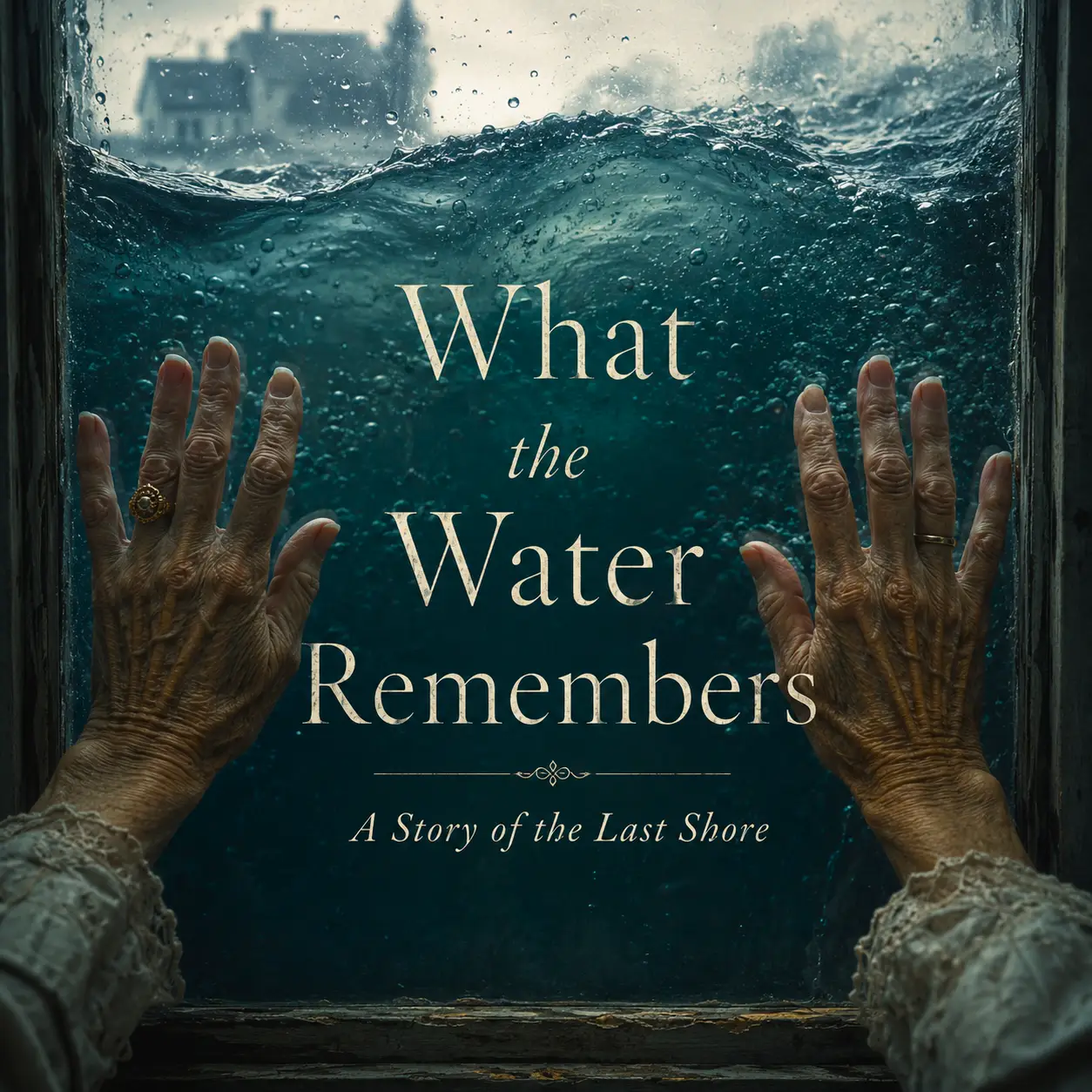
Mara Swiftwind was seventy-one years old the winter the last road washed out, and she made herself a cup of tea.
Her neighbors had been gone for three years by then. The Hendersons first, practical people, sensible people, people who understood that the sea does not negotiate. Then the Chens, who had stayed longer than anyone expected, who had sand-bagged and reinforced and finally, one November morning, loaded their truck in silence and driven without looking back. Then the young couple whose names Mara had never properly learned, who had lasted one winter and fled in the spring with the particular speed of people who have only just realized they are mortal.
Mara had watched them all go from her kitchen window. She had waved. She had meant it.
The house had been her mother’s house, and her mother’s mother’s house before that, built on a cliff of shale and stubborn coastal grass two hundred meters above a sea that had spent the last century making its way up. The Swiftwind women had built it themselves, three of them, in the summer of 1931, with timber hauled overland by horse and a certainty about the rightness of the location that outsiders had always found puzzling. The location was not convenient. The location was not safe. The location was, as Mara’s grandmother had explained to anyone who questioned it, where the water speaks closest to the surface of things.
Mara had grown up understanding this as metaphor. She had grown old understanding it as fact.
She was a composer by training, a sound archivist by vocation, and by the winter of her solitude, something that didn’t have a name yet. The university had given her a position for thirty years and then a retirement dinner and then a modest pension. She had published three volumes of notation, indigenous coastal soundscape documentation, highly regarded in small circles, essentially unknown everywhere else. She had supervised graduate students who went on to careers of practical impact. She had, by every measurable standard, done enough.
She had not done what she came back to the cliff to do.
The recording equipment arrived in two shipments, the last one just before the road became impassable. Microphones rated for coastal exposure. A portable DAW she had taught herself over one winter with the help of a YouTube channel run by a teenager in Seoul. Hard drives, redundant, obsessive, four of them, because Mara Swiftwind had learned over seven decades that the things worth keeping are worth keeping twice.
She set up the equipment in the room that faced the water and she pressed record and she listened.
What Mara heard in the first weeks was not what she expected. She had expected to document. She had built her career on documentation, the careful, neutral notation of sound as data, the archivist’s discipline of keeping herself out of the record. She had been good at it. She had been, her colleagues said, unusually good at it, possessing a rare ability to hear without interpretation, to transcribe without projection.
But the ocean, that winter, was not offering itself for documentation.
It was telling her something.
She recognized the distinction because she had spent forty years learning the difference. There is a quality to information that wishes only to be recorded, a flatness, a patience, a willingness to repeat itself until the instrument captures it correctly. And there is a different quality entirely to communication: a directionality, a variation that corresponds not to random chance but to the presence of a particular listener. The ocean, Mara noted in her journal with the careful precision of someone who knows the difference between observation and delusion, is varying its composition in response to my attention.
She wrote it down. She sat with it for three days. She wrote it down again.
Her granddaughter called on Sunday, as she always did. Mara told her she was fine. She was, in fact, more than fine, she was in the middle of the most significant work of her life, at seventy-one, alone on a cliff with the sea rising, and the feeling she had was not fear but the particular aliveness that arrives when a person finally stops preparing for their real work and simply begins it.
The notation problem arrived in the third month.
Mara had spent her career within established systems, had pushed against their limits, had stretched them toward the sounds they were not designed to hold, but had always, in the end, returned to the shared grammar of her discipline. Now the shared grammar failed entirely.
What the ocean was composing existed below the threshold of standard notation. Not below the threshold of hearing, she could hear it, had heard it since she was twenty years old, standing on a dock with her first field recorder, feeling something move through her sternum that the microphone didn’t catch. But below the threshold of the representable. Below the line where human symbol-making had ever reached.
She invented new symbols. Fourteen of them, in the end, rough, personal, imprecise. Hieroglyphs from a private language spoken by a population of one. She knew they were inadequate. She used them anyway, because inadequate notation is still notation, and a woman who stops writing because she cannot write perfectly will never write anything true.
The winter deepened. The water rose. Mara Swiftwind kept her table dry with sandbags and kept her hand moving across the page and kept the microphones pointed at the sea, which kept composing, which kept varying, which kept finding new ways to say the thing it was saying to the one woman left on the cliff who was still listening.
The breakthrough came on a Tuesday in February, and it came not through the equipment but through the body.
Mara had put down the notebook. She had, for the first time since the work began, turned off every recording device and simply sat by the window in the late afternoon light and let the sound come through the glass without mediation. No microphone between her and the water. No notation system between the hearing and the heard.
The frequency she had first felt at twenty arrived fully.
It arrived through the sternum, as it always had, but this time it did not stop there. It moved through the jaw and the sinuses and the small bones of the inner ear and the skull itself and the place behind the eyes where the self lives, and when it reached that place it did not stop, it passed through, and what it left behind was not a recording or a notation or a description but a complete and total understanding.
She understood, in that moment, what the ocean had been composing.
Not a piece of music. Not a message, in the human sense of a communication with content. Something older and more fundamental: a demonstration. The ocean had been demonstrating, with patience and specificity and forty years of frequency, what it meant to compose without audience, to create without witness, to make something beautiful in the complete absence of anyone to call it beautiful.
It had been demonstrating this to Mara Swiftwind because Mara Swiftwind was the only human being left who could hear the demonstration and understand its implications.
She was not special. She was simply the last one listening.
The water crossed the threshold on a Wednesday.
Mara noted the time, 6:47 AM, and turned the recorder back on. Not because she thought the recording would be retrievable. Not because she imagined anyone finding the hard drives in the silt. But because the act of recording was, by now, simply what she did in the presence of something worth attending to, and the water coming through her door was worth attending to.
She wrote one final notation in the book. Three lines and a symbol she had invented in December for the quality of frequency that occurs when two resonant systems achieve complete coherence, when the distinction between the thing making the sound and the thing receiving the sound dissolves into something that is only, purely, irrevocably both.
She signed her full name. Mara Iwa Swiftwind. The ink ran slightly at the edges from the water that was at her knees now, but the center held.
She put the pen down and she listened.
Her granddaughter, Celeste, drove out in April when the coast road was passable again. She had told herself she was going to retrieve what could be retrieved, the hard drives if they’d survived, the notebooks, whatever remained of a life’s work. She had told herself this was a practical errand, not a grieving one.
She stood where the house had stood for two hours in the cold wind off the water.
She was not, Celeste would later tell her own children, a mystical person. She did not believe in signs. She had her grandmother’s practical intelligence and her grandmother’s refusal of sentiment and very little of her grandmother’s capacity for stillness.
But standing on the shale above the sea that April morning, she heard something.
A frequency, rising from the water. Moving through her sternum like a key turning. A pitch that felt, improbably and unmistakably, like recognition, like the sound a place makes when it knows you by your bloodline, when it says: you are from here, and from here means something, and the woman who was from here before you left something in the water that the water is keeping.
Celeste stood there until the cold drove her back to her car.
She drove home. She sat in her driveway for a long time. Then she went inside and told her children that their great-grandmother had finished her work, and that the work had been worth doing, and that the sea had it now.
The sea, as it always had, kept composing.