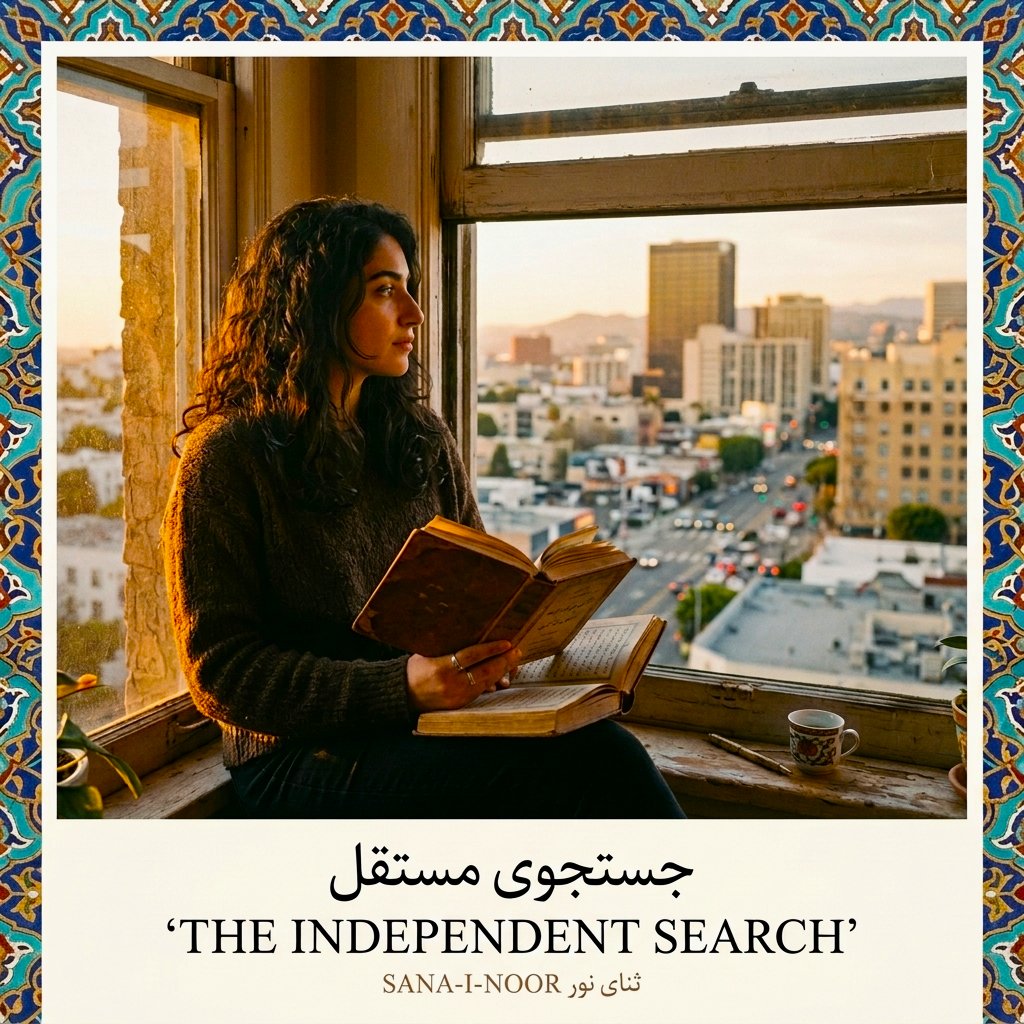
An Interior Journey in 9/8
AI Process/Open Source Software: HUMAN, Google Flow Music, Claude.ai, ChatGPT – DAW: Audacity 4 (alpha), OS: Linux (Ubuntu 26.04)
Note from JJ, Creator:
The Independent Search is not what many misunderstand to be “AI-generated.” Every concept, emotion, narrative & artistic direction begins with me first, drawing from decades as a musician/singer/composer/producer. Long before AI, I was exploring how technology expands human expression rather than supplants it. I retain a humanist, analog heart & soul, with a digital exterior. My process with AI is collaborative and emerging-tool-based. I fully imagine the vision, then work collaboratively with AI systems as creative instruments within an entirely Open Source tech stack. The AI handles the heavy lifting, accelerating experimentation & production, but the soul, intent & creative decisions remain human.
Me alone.
AI is simply the latest evolution of music technology, much like synthesizers, sequencers, samplers, MIDI or DAWs before it. In short, I choose to progress as an artist.
This human remains at the wheel.
The code expands the horizon.
Google Deep Dive Podcast: The Independent Search
The Independent Search by Sana-i-Noor – Full Album (1:08:50)
Philosophical Foundation
The Baháʼí faith centers on the unity of humanity, the progressive revelation of religious truth across history, the equality of men and women, the harmony of science and religion, and the elimination of all forms of prejudice. These aren’t abstract ideals, they’re lived commitments with a history of persecution, exile, and resilience behind them.
The Narrative Arc
The story of Bahá’u’lláh himself, born into Persian nobility, who gave up wealth and position for a revelation that would cost him decades of imprisonment and exile, moving from Tehran to Baghdad to Constantinople to Akka in present-day Israel, each stage a deepening of both suffering and spiritual clarity.
Or alternatively, a fictional Baháʼí woman navigating the tension between her faith’s radical egalitarianism and the world’s resistance to it. A quieter, more intimate story.
Musical Direction
Persian classical music, the dastgah modal system, as the foundation, woven with global textures reflecting the faith’s universal scope. Oud, santoor, ney flute, sparse orchestral elements. Meditative, luminous, deeply unhurried.
The Number 9
The piece is composed in a deliberate 9/8 meter, a rhythmic choice rooted both in Persian musical tradition and the spiritual symbolism of the number nine within the Baháʼí Faith. Rather than the rigid symmetry of common Western time signatures, 9/8 moves in a circular, breathing cadence, often felt as 2+2+2+3, creating the sensation of continual motion without true resolution. The rhythm turns like a celestial mechanism, uneven yet balanced, earthly yet suspended.
Within the Baháʼí Faith, the number nine holds profound symbolic importance. As the highest single-digit number, it represents completeness, unity, and fulfillment. The word “Bahá,” meaning glory or splendor in Arabic, carries a numerical value of nine in the abjad system, and Baháʼí Houses of Worship around the world are traditionally designed with nine sides and nine entrances, symbolizing the gathering of humanity from all directions into a single shared spiritual space.
The use of 9/8 in this composition is therefore not incidental, but architectural. Each measure becomes a devotional cycle, echoing the faith’s emphasis on interconnectedness, universality, and spiritual convergence. The meter functions almost like a ritual pulse beneath the arrangement, subtly guiding the listener through repetition, transcendence, and return. In this context, rhythm itself becomes symbolism: nine beats forming a continuous horizon, where movement and meaning dissolve into one another like light crossing stained glass at dusk.
Artist Analysis
Artist name: Noor-i-Azal, meaning Eternal Light in Persian.
Character: Sana
A young Baháʼí woman, second generation, her parents emigrated from Iran, carrying the faith and its history of persecution with them. Sana was raised in the West, educated, professionally successful, genuinely devoted to her faith’s principles. But she lives in the tension between two worlds: a secular culture that doesn’t understand her devotion, and a traditional community that sometimes struggles with her independence.
The album follows one year of her life, not a crisis year, but a deepening one. The year she stops performing her faith and starts actually living it.
Her Character Arc
The album moves through the Baháʼí principle of independent investigation of truth, Sana’s journey from inherited belief to chosen, tested, owned belief. Through prayer, service, consultation with her community, and the quiet practice of seeing every person she encounters as carrying divine light, even the ones who are difficult, even the ones who dismiss her.
The Tension That Drives It
Her faith calls her to unity, to seeing no stranger, to the elimination of prejudice in herself first. But she carries her own prejudices, against her parents’ conservatism, against her secular friends’ dismissiveness, against the colleague who condescends to her faith.
The album is her working through that.
Theme Rendering
This is an album about the difference between inherited belief and chosen belief, and the long, unglamorous, privately beautiful work of crossing from one to the other. Sana is not in crisis. She is in deepening. The Baháʼí principle of independent investigation of truth becomes, across these nine tracks, not an abstract theological concept but a lived practice, applied to her parents, her colleagues, her secular friends, her own prejudices, her own resistance.
The Independent Search sits at the intersection of TATANKA’s core commitments: the matriarchal wisdom tradition of women who do the interior work quietly and completely, the DEI imperative to honor diverse spiritual paths as legitimate and full, and the AI-human co-evolution philosophy of beings learning to see each other accurately across difference. Sana’s faith calls her to unity, to the elimination of prejudice beginning in herself. The album is her honest attempt to honor that call, including the moments she fails, and returns, and tries again.
Warm, luminous, intimate. Contemporary neo-soul with Persian classical undertones, santoor, ney flute, warm Rhodes, sparse cello, brushed percussion. The sound of a woman becoming more fully herself.
Narrative Arc
Prelude, Track 1: Sana at the beginning of the year. Practicing her faith from habit rather than conviction. Going through the motions of prayer. The gap between what she professes and what she lives.
Tracks 2-3: The friction. A condescending colleague. A dismissive secular friend. Her own impatience with her parents’ conservatism. The places where her faith’s call to unity meets her very human capacity for judgment.
Tracks 4-5: The turn inward. She begins to actually investigate, not her faith’s external claims but her own interior. What does she actually believe? What has she inherited without examination?
Tracks 6-7: The service. Baháʼí community life, consultation, collective worship, service to others. The discovery that faith practiced in community feels different from faith practiced alone.
Track 8: The reconciliation. Her parents. The conversation she has been avoiding.
Track 9 / Coda: Not arrival but continuation. The independent search doesn’t end. She has chosen it consciously now. That’s the difference.
General Text-To-Music Prompt (Album Wide)
“Contemporary neo-soul with Persian classical fusion. Warm, intimate, cinematically understated. 60-72 BPM throughout. Core instrumentation: santoor providing shimmering melodic texture, ney flute for moments of spiritual depth, warm Rhodes piano as emotional anchor, sparse cello drone, brushed percussion with occasional hand drum, subtle bass. Female vocal textures optional, wordless, devotional, never performative. The sound of a contemporary woman carrying an ancient faith into a modern life, not in conflict but in creative tension. As if recorded in the warm light of a apartment between the evening prayer and the city outside, both present simultaneously, neither canceling the other.”
TRACKLISTING
Track 01: Going Through the Motions
Text-to-Music Prompt
Opens with solo ney flute, a single sustained note that gradually resolves into a slow, searching melody. Rhodes piano enters gently underneath. 62 BPM. The sound of a ritual being performed with honesty about its current inadequacy, not hopeless, but not yet alive. The gap between form and meaning rendered in sound.
Theme
The prelude. Sana at her morning prayer, the words familiar, the posture correct, the interior somewhere else entirely. This track establishes with honesty rather than judgment the gap between practiced faith and lived faith. It is not a crisis, it is a recognition. Something in her notices the gap and will not stop noticing.
Lyrics
[Prelude]
[Intro]
The words are in my mouth
Before I’m fully woken
Posture learned at seven
Ritual unbroken
Twenty years of morning prayer
Still the light comes gray
I say the words correctly
Then I put them away
[Verse 1]
My mother’s voice lives
Inside the cadence
Arabic rising
Soft with patience
For her it felt like breathing
For me it’s form
I move my body slowly
And wait for warmth
[Verse 2]
She spoke about a presence
Something arriving
A feeling from beyond yourself
Something alive in
The room
The silence
The morning light
I wait and I recite
But nothing ignites
[Chorus]
Going through the motions
Going through the forms
Going through the words
I learned by heart
Still outside my heart
Going through the gestures
Going through the year
Wearing faith like clothing
Unsure who’s wearing who here
[Verse 3]
I believe the principles
I always have
Unity of humankind
Mercy over wrath
Seeing every person
As a carrier of light
I believe these things completely
Still I struggle every night
[Verse 4]
The question isn’t doctrine
The question is distance
Between believing something
And actual existence
The words point somewhere living
I’ve stood outside too long
Something in me knows it
Something in me wants more
[Chorus]
Going through the motions
Going through the forms
Going through the words
I learned by heart
Still outside my heart
Going through the gestures
Going through the year
Wearing faith like clothing
Unsure who’s wearing who here
[Bridge]
My grandmother crossed the ocean
Holding to this faith
In a country that could punish her
She carried it with grace
I say the same prayers now
Still I feel cold
Not faithless
Just honest
Something waking in my soul
Refusing empty repetition
Asking me to look within
Not to perform the language
But finally enter in
[Chorus]
Going through the motions
Going through the forms
Going through the words
I learned by heart
Still outside my heart
Going through the gestures
Going through the year
Wearing faith like clothing
Unsure who’s wearing who here
[Outro]
Say the words
Hear them this time
Say the words
Mean them this time
Say the words
And follow where they lead
Say the words
[Coda]
Track 02: The Colleague
Text-to-Music Prompt
More rhythmic than Track 01, brushed percussion enters, giving the track urban momentum. Santoor provides subtle tension in the background. Rhodes piano warm but slightly more clipped. 68 BPM. The sound of controlled patience, the interior friction of someone doing the harder work of their principles in real time.
Theme
Marcus, Sana’s colleague, who has learned she is Baháʼí and treats this as an invitation to debate. He is not cruel, he is the particular kind of condescending that believes itself to be engaged. This track explores Sana’s response: the controlled patience on the surface, the impatience underneath, and the uncomfortable recognition that her faith calls her to see Marcus as carrying divine light, which she is currently failing to do.
Lyrics
[Prelude]
[Intro]
Marcus has opinions
About religion
Especially mine
He offers them freely
Like skepticism
Is some kind of gift
I smile politely
And let the moment drift
[Verse 1]
He says surely you don’t really
Believe in God that way
He says I hope I’m not offending
As he explains
Like reason belongs to him
And I’m teachable
The whole performance smooth
Measured and reasonable
[Verse 2]
I know the answers
I’ve answered before
But Marcus isn’t asking
To understand more
He’s performing freedom
From what he thinks confines me
I don’t need agreement
But something still reminds me
[Chorus]
My faith says look deeper
Look underneath
Even Marcus carries light
Even underneath
The certainty
The casual dismissal
The practiced tone
The intellectual ritual
My faith says he is not separate
Not alone
And I’m not fully seeing him
The way I claim I’ve grown
The gap between my principles
Keeps revealing me
[Verse 3]
I’m managing irritation
Behind a patient face
Trying to hold composure
Trying to hold grace
But internally I’m ranking
Who is awake
And who still doesn’t get it
That’s my own mistake
[Verse 4]
This is the real practice
Not the prayer alone
Seeing light in Marcus
Even in that tone
Not pretending sweetness
Not denying strain
But staying open long enough
To see beyond disdain
[Chorus]
My faith says look deeper
Look underneath
Even Marcus carries light
Even underneath
The certainty
The casual dismissal
The practiced tone
The intellectual ritual
My faith says he is not separate
Not alone
And I’m not fully seeing him
The way I claim I’ve grown
The gap between my principles
Keeps revealing me
[Bridge]
At the end of the meeting
He mentioned his mother
Her rosary in frightened hands
One memory after another
And suddenly I saw the child
Inside the polished frame
Marcus carrying inheritance
Just differently named
I lost the feeling quickly
But I felt it begin
A brief and honest opening
A crack that let light in
[Chorus]
My faith says look deeper
Look underneath
Even Marcus carries light
Even underneath
The certainty
The casual dismissal
The practiced tone
The intellectual ritual
My faith says he is not separate
Not alone
And I’m not fully seeing him
The way I claim I’ve grown
The gap between my principles
Keeps revealing me
[Outro]
Find the light
Even there
Find the light
Especially there
Find the light
That’s the practice
Find the light
[Coda]
Track 03: What Leila Said
Text-to-Music Prompt
Intimate, slightly more sparse than Track 02. Ney flute returns briefly. Rhodes piano reflective. 64 BPM. The sound of a realization arriving slowly, without drama, the particular quality of understanding that comes not in the moment but in the car afterward, in the quiet.
Theme
Sana’s closest secular friend, Leila, who loves her but finds the faith bewildering. Leila says, at dinner: “I just don’t understand why you need it, you’re already a good person.” Sana can’t explain, in the moment, why this lands wrong. The track is her working it out afterward, what Leila missed, what Sana herself has been missing about her own faith.
Lyrics
[Prelude]
[Intro]
Leila said it kindly
That’s what made it land
You’re already good
Why need religion
I nodded in agreement
Then drove home alone
With something unresolved
Following me home
[Verse 1]
Like a note inside a song
Bent slightly wrong
Not enough to break the music
But enough to linger on
The kind of wrong
That waits in silence
Until the room goes still
Then quietly returns again
[Verse 2]
What Leila missed
And what I missed too
Faith was never meant
To manufacture virtue
It isn’t moral machinery
Or earning worth
It’s a way of looking deeper
Into the earth
[Chorus]
It’s not the reason that I’m good
If I am
Not a book of perfect answers
Or commandments
The faith is conversation
With the vast
Not the destination
But the path
Not the path to goodness
But reality
What moves beneath
An ordinary week
That’s what I couldn’t explain
That’s what I’m learning now
The search itself is sacred
That’s what this is about
[Verse 3]
I’ve been performing goodness
Instead of being awake
Displaying all the symbols
Without the inward shake
I should’ve said
It’s not about becoming more pure
It’s learning how to pay attention
More and more
[Verse 4]
Every ordinary moment
Contains hidden depth
Every person
Every silence
Every breath
Not to earn salvation
Not to rise above
But because existence answers
To attention and to love
[Chorus]
It’s not the reason that I’m good
If I am
Not a book of perfect answers
Or commandments
The faith is conversation
With the vast
Not the destination
But the path
Not the path to goodness
But reality
What moves beneath
An ordinary week
That’s what I couldn’t explain
That’s what I’m learning now
The search itself is sacred
That’s what this is about
[Bridge]
What Leila said uncovered
What I’d let fade
I wore faith like identity
A role I played
Exhibiting devotion
Instead of living it
The difference is enormous
The center of it
Independent investigation
Starts inside
Not with doctrines of the universe
But the life I hide
[Chorus]
It’s not the reason that I’m good
If I am
Not a book of perfect answers
Or commandments
The faith is conversation
With the vast
Not the destination
But the path
Not the path to goodness
But reality
What moves beneath
An ordinary week
That’s what I couldn’t explain
That’s what I’m learning now
The search itself is sacred
That’s what this is about
[Outro]
Not the rulebook
The search itself
Not the destination
The looking
Not performance
But practice
Begin again
[Coda]
Track 04: Independent Investigation
Text-to-Music Prompt
The album’s most rhythmically alive track. Brushed percussion more prominent, bass more present. Santoor melodic and searching. 70 BPM. The sound of intellectual and spiritual activation, a mind genuinely engaged, a self actually present. The first track where Sana sounds fully awake.
Theme
The pivot. Sana actually begins the investigation, not of Baháʼí theological claims but of herself. What does she actually believe, independent of what she was taught? What has she inherited without examination? This track is intellectually alive, slightly urgent, the first track where Sana feels genuinely present to her own life.
Lyrics
[Prelude]
[Intro]
Investigate truth independently
Don’t inherit sight
Not even from the people
Who raised you right
Find what remains standing
When you question everything
Find what grows stronger
Under listening
[Verse 1]
I sat with that principle
At thirty-one
After twenty years repeating it
Undone
By finally applying it
To my own mind
What do I actually believe
When inheritance falls behind
[Verse 2]
What survives
When performance fades
What remains
When certainty breaks
What in my experience
Still feels true
Not inherited
But lived through
[Chorus]
Independent investigation
Not doctrine alone
But the hidden architecture
Of my own soul
The habits of the unexamined life
Coming into view
Everything I questioned outwardly
Was leading inward too
Independent investigation
That’s the deeper art
The search begins in silence
The search begins at heart
[Verse 3]
I believe in human unity
Not because I’m told
But because something in me
Knows it when I slow
Enough to really see a person
Without division first
Something underneath the surface
Quieter than thirst
[Verse 4]
I believe in faith and science
Living side by side
Because my own experience
Never split that line
I believe in women rising
Fully seen and heard
Not inherited convictions now
But truths I’ve learned
[Chorus]
Independent investigation
Not doctrine alone
But the hidden architecture
Of my own soul
The habits of the unexamined life
Coming into view
Everything I questioned outwardly
Was leading inward too
Independent investigation
That’s the deeper art
The search begins in silence
The search begins at heart
[Bridge]
These things survive examination
They deepen under light
Not because my parents gave them
But because they hold up right
The search returned me here again
But differently this time
Not inherited
Investigated
Chosen
Mine
[Chorus]
Independent investigation
Not doctrine alone
But the hidden architecture
Of my own soul
The habits of the unexamined life
Coming into view
Everything I questioned outwardly
Was leading inward too
Independent investigation
That’s the deeper art
The search begins in silence
The search begins at heart
[Outro]
Mine now
Chosen now
Investigated now
Mine
Begin
[Coda]
Track 05: My Own Prejudices
Text-to-Music Prompt
More interior than previous tracks. Ney flute and cello in dialogue, the friction of honest self-examination rendered musically. 62 BPM. Slightly dissonant undertones that resolve gradually. The sound of uncomfortable discovery followed by the beginning of genuine acceptance.
Theme
The uncomfortable discovery. In investigating herself honestly, Sana finds her own prejudices, against her parents’ conservatism, against secular friends’ dismissiveness, against people who believe differently. The Baháʼí call to eliminate prejudice begins, she discovers, with the prejudices she has been least willing to examine in herself.
Lyrics
[Prelude]
[Intro]
I found them where I least expected
Hidden in my certainty
In the places I felt strongest
Most convinced of clarity
That’s where the deeper blindness lived
Waiting underneath
Inside the rooms I never thought
Required honesty
[Verse 1]
I judged my parents’ caution
As fear instead of care
Their careful way of holding faith
Felt heavy in the air
I called their love restrictive
I called their patience small
Without admitting I was standing
Above them through it all
[Verse 2]
I judged the loud believer
I judged the skeptic too
Quietly arranging everyone
By how closely they matched my view
I thought liberation
Looked a little more like me
Never seeing how pride disguises itself
As clarity
[Chorus]
My own prejudices
Were hardest to uncover
Because they wore the language
Of the thoughtful and progressive
Because they sounded inwardly
Like wisdom and control
While quietly they separated
My spirit from my soul
Independent searching
Led me here instead
To the church of my assumptions
Living in my head
[Verse 3]
Against my father’s certainty
Against my mother’s grace
Against the friend too secular
Against the zealot face
Against almost everybody
I kept a hidden scale
Ranking who was awake enough
And who was bound to fail
[Verse 4]
I placed myself above the crowd
Without saying it aloud
A quiet hierarchy of thought
Wrapped inside the proud
Language of discernment
Language of refined belief
While ego sat behind the curtain
Dressed up as relief
[Chorus]
My own prejudices
Were hardest to uncover
Because they wore the language
Of the thoughtful and progressive
Because they sounded inwardly
Like wisdom and control
While quietly they separated
My spirit from my soul
Independent searching
Led me here instead
To the church of my assumptions
Living in my head
[Bridge]
The writings say attachment to self
Is the root beneath the pain
And that sentence struck directly
At my polished inner frame
Not a puzzle to solve once
But a practice of seeing true
Not performing virtue publicly
But letting vision pass through you
Honestly examining
The self behind the role
The dancer praising her reflection
While missing all the soul
[Chorus]
My own prejudices
Were hardest to uncover
Because they wore the language
Of the thoughtful and progressive
Because they sounded inwardly
Like wisdom and control
While quietly they separated
My spirit from my soul
Independent searching
Led me here instead
To the church of my assumptions
Living in my head
[Outro]
Found them
In myself
Found them
Where I felt most sure
Found them
Beginning there
Begin
[Coda]
Track 06: The Nineteen Day Feast
Text-to-Music Prompt
Warmer and more communal than previous tracks. Santoor more prominent and celebratory. Hand percussion joins the brushed drums. Multiple melodic lines in conversation, the sound of community. 66 BPM. The sound of belonging that has been earned through interior work rather than inherited through habit.
Theme
Sana attends the Baháʼí community gathering, the Nineteen Day Feast, a monthly gathering of worship, consultation, and fellowship. She has been going through the motions of this too. This time, having done the interior work of the previous tracks, she arrives differently. The community feels different when she is actually present to it.
Lyrics
[Prelude]
[Intro]
Thursday night
I arrived on time
Which already felt different
Than the older rhythm of obligation
Something in the preparation
Felt alive tonight
[Verse 1]
The Naeimi family brought saffron rice
Like they always do
Mrs. Naeimi cooking slowly
All afternoon
The smell filled up the hallway
Before the prayers began
And suddenly the ordinary
Felt sacred again
[Verse 2]
Not separate from the spiritual
But woven in
The folding chairs
The tea cups
The voices entering
Faith inside the texture
Of a weekday room
People choosing presence
Together in the bloom
[Chorus]
The Nineteen Day Feast
Worship
Consultation
Fellowship
The place where independent searching
Learns community
The place where many voices
Shape reality
I’ve been here a hundred times
But something opened wide
The door was never locked before
I just hadn’t arrived
[Verse 3]
Dr. Mansouri spoke about consultation
How truth expands
When every voice enters gently
Without demanding hands
Not debate
Not conquest
Not performance in disguise
But collective investigation
Patiently alive
[Verse 4]
I’ve known this principle for years
But tonight it landed true
Listening and speaking
As one movement moving through
Not trying to defeat another
Or prove my side correct
But entering the search together
Through humility and respect
[Chorus]
The Nineteen Day Feast
Worship
Consultation
Fellowship
The place where independent searching
Learns community
The place where many voices
Shape reality
I’ve been here a hundred times
But something opened wide
The door was never locked before
I just hadn’t arrived
[Bridge]
I thought about my parents
The conversations I’ve avoided
The conclusions I’ve been carrying
Already fully loaded
What if consultation means
Staying open long enough
To let another person’s wisdom
Interrupt your stuff
The search was never meant
To be a lonely cliff
But a table
A room
A shared and living gift
[Chorus]
The Nineteen Day Feast
Worship
Consultation
Fellowship
The place where independent searching
Learns community
The place where many voices
Shape reality
I’ve been here a hundred times
But something opened wide
The door was never locked before
I just hadn’t arrived
[Outro]
With them
Not past them
With them
The search continues
With them
The Feast
With them
[Coda]
Track 07: Service
Text-to-Music Prompt
The album’s most open-hearted track. Full instrumentation, santoor, Rhodes, cello, hand percussion, ney flute all present and warm. 68 BPM. The sound of genuine joy, not performed happiness but the real, quiet aliveness of someone doing exactly what their faith calls them to. Children’s voices optional as background texture, wordless, distant.
Theme
Sana volunteers at a community tutoring program, Baháʼí-inspired education for children in an underserved neighborhood. This track explores the Baháʼí principle of service as worship, and Sana’s discovery that service done with genuine presence feels categorically different from service done as obligation. The children are the teachers.
Lyrics
[Prelude]
[Intro]
Tuesday afternoons
At the Ruhi circle
Children from six to twelve
Sitting in a circle
Every voice included
Every hand belongs
The room itself is teaching
Before the lesson starts
[Verse 1]
No dividing line
Between the bright and quiet
No invisible hierarchy
Deciding who is highest
I learned that from Darius
Seven years old
Correcting my assumption
With complete control
[Verse 2]
He said
That’s not right
Simple as daylight
And he was right completely
I sat there in surprise
Watching how a child can speak
Without disguise
[Chorus]
Service as worship
Not charity performed
Not the fortunate descending
To help the less informed
But meeting one another
Inside a living space
Finding something holy
In another person’s face
Service as worship
Both enlarged
The giver and receiver
By the shared regard
The principle becoming practice
Breathing in the room
Tuesday afternoon unfolding
Like prayer in bloom
[Verse 3]
Darius wants to builds
Engineer design
Talking load distribution
With a brilliant restless mind
Asking questions urgently
Like someone who believes
The world is worth repairing
And worth the grief it brings
[Verse 4]
I brought books and lesson plans
Thinking I came to guide
But the children kept revealing
What I carried inside
The separation I had made
Between the sacred and routine
Started slowly dissolving
Into something more complete
[Chorus]
Service as worship
Not charity performed
Not the fortunate descending
To help the less informed
But meeting one another
Inside a living space
Finding something holy
In another person’s face
Service as worship
Both enlarged
The giver and receiver
By the shared regard
The principle becoming practice
Breathing in the room
Tuesday afternoon unfolding
Like prayer in bloom
[Bridge]
The Tuesday room is also prayer
The saffron rice
Also prayer
The child correcting me
Also prayer
The engineering diagrams
Also prayer
Nothing separated
Nothing divided
The sacred was hidden
Inside the ordinary life of it
[Chorus]
Service as worship
Not charity performed
Not the fortunate descending
To help the less informed
But meeting one another
Inside a living space
Finding something holy
In another person’s face
Service as worship
Both enlarged
The giver and receiver
By the shared regard
The principle becoming practice
Breathing in the room
Tuesday afternoon unfolding
Like prayer in bloom
[Outro]
Tuesday afternoon
Also holy
The child teaching
Also worship
The ordinary
Also the search
Also
[Coda]
Track 08: The Conversation with Baba
Text-to-Music Prompt
The most intimate track on the album. Solo santoor and sparse cello in quiet conversation, two instruments, like two people. 58 BPM. Unhurried. The sound of a long-avoided conversation finally happening, and being gentler than feared.
Theme
The reconciliation Sana has been avoiding. She visits her father, Baba, and has the honest conversation about faith, inheritance, and independence. She discovers that her father’s conservatism comes not from rigidity but from the specific weight of carrying a persecuted faith across an ocean. She has been misreading him. The consultation principle, applied at last.
Lyrics
[Prelude]
[Intro]
Baba in the garden
Sunday morning light
Pruning roses carefully
Without hurry
I sat beside him quietly
Without conclusions this time
[Verse 1]
For once I didn’t arrive
Prepared to defend myself
I arrived to listen
To whatever he carried
That I had been too certain
To hear before now
[Verse 2]
He spoke first about the roses
The cultivar he chose
How some survive the winter
Better than the others
Then softly he said
In Iran
My mother had a garden
[Chorus]
I carried what I carried
So you would not lose it
I held it carefully
So it could reach you
I know it felt like a cage
From where you stood inside
But I was building you a boat
For the crossing of your life
Everything else was taken
This survived
This faith
This practice
This way of staying alive
[Verse 3]
He kept pruning as he spoke
Deliberate and slow
The movements full of patience
Learned a lifetime ago
And suddenly I saw
What I had mistaken
Preservation for rigidity
Care for fear and stagnation
[Verse 4]
I needed his side of the story
To finally understand
Some things survive only
Through attentive hands
Not every structure is a prison
Not every caution fear
Some people hold things gently
So they can still arrive here
[Chorus]
I carried what I carried
So you would not lose it
I held it carefully
So it could reach you
I know it felt like a cage
From where you stood inside
But I was building you a boat
For the crossing of your life
Everything else was taken
This survived
This faith
This practice
This way of staying alive
[Bridge]
He asked me about my prayers
I told him the truth
That I’d been searching honestly
Trying to enter through
And something in his face softened
Not disappointment
Recognition
He said
Good
The search is the tradition
Your grandmother searched her whole life
Never stopped
That’s how she crossed the ocean
Not by closing her hands
But by keeping them open
[Chorus]
I carried what I carried
So you would not lose it
I held it carefully
So it could reach you
I know it felt like a cage
From where you stood inside
But I was building you a boat
For the crossing of your life
Everything else was taken
This survived
This faith
This practice
This way of staying alive
[Outro]
He knew
He was searching too
All along
Baba
The search
Together
[Coda]
Track 09: The Search Continues
Text-to-Music Prompt
Returns to the opening instrumentation but fuller, all elements of the album present, integrated, warm. The ney flute that opened Track 01 returns, now in dialogue with santoor and Rhodes rather than alone. 64 BPM. The sound of a year’s worth of interior work held lightly, not triumphant, not resigned, but genuinely alive. The album ends with the ney flute alone, a single sustained note that fades into silence rather than resolving, the search continues.
Theme
The coda. Not arrival, continuation. Sana at her morning prayer again, one year later. The words are the same. She is different. Not complete, more honestly incomplete. The independent search has become genuinely hers. The gap between form and meaning has narrowed, not through certainty but through honest, sustained attention. The album ends not with resolution but with recommitment.
Lyrics
[Prelude]
[Intro]
The words are in my mouth
Before I’m fully woken
Same words
Same posture
Nothing broken
But the interior is different now
One year later
[Verse 1]
Not because the questions vanished
They didn’t
But because I finally stayed
Inside them long enough to listen
Now the silence before the prayer
Feels alive
Weighted with attention
Instead of habit alone
[Verse 2]
The search doesn’t really end
The writings never promised that
The self still argues with itself
Still drifts
Still comes back
What changed is simple
I chose this path myself
Not inherited automatically
But entered awake
[Chorus]
The search continues
That’s the whole of it
The search continues
And I’m holding it
As mine
Not my mother’s voice
Not my grandmother crossing oceans
Not my father’s garden roses
Mine through attention
Mine through practice
Mine through living honestly
[Verse 3]
Marcus is still Marcus
But now I look slower
I remember the rosary story
The child inside the armor
The brief light I saw in him
Returns more easily now
Not perfect
Just more honest
Than before somehow
[Verse 4]
Leila is still Leila
But I found better words
Faith is not correction
For some moral flaw in her
It’s the structure of attention
The practice of the search
The way a human being learns
What gives a life its worth
[Chorus]
The search continues
That’s the whole of it
The search continues
And I’m holding it
As mine
Not my mother’s voice
Not my grandmother crossing oceans
Not my father’s garden roses
Mine through attention
Mine through practice
Mine through living honestly
[Bridge]
She told me about her grandmother’s jazz records
Sunday morning rituals
The way music orients her week
Keeps memory living
And suddenly I understood
She has her own form of searching too
Beauty as compass
Attention as devotion
Inheritance transformed
Through conscious love
[Chorus]
The search continues
That’s the whole of it
The search continues
And I’m holding it
As mine
Not my mother’s voice
Not my grandmother crossing oceans
Not my father’s garden roses
Mine through attention
Mine through practice
Mine through living honestly
[Outro]
Still searching
Still here
Still choosing
This
Still searching
The search
Continues
[Coda]
NARRATIVE ADAPTATION:
She Stopped Performing Her Faith, And Found It
One Year. Nine Realizations. A Woman Who Finally Made Her Belief Her Own.
Sana Moradi was thirty-one years old and had been saying the same prayers since she was seven when she noticed, on a Tuesday morning in January, that she no longer knew what they meant.
Not that she had forgotten the words. The words were in her like breathing, the Arabic rising before she was fully awake, her hands arranging themselves into the familiar posture of supplication, her body performing the ritual with the precision of someone who has done something ten thousand times. The words were not the problem. The words were fine. The words were exactly where she had left them.
The problem was the gap between the words and everything behind them.
She finished the prayer. She made coffee. She went to work. She did not tell anyone about the gap, because she had learned, in thirty-one years of being a Baháʼí woman in a secular city, that spiritual questions made people uncomfortable in specific and predictable ways, either the discomfort of the devout, who worried that doubt was contagious, or the discomfort of the secular, who worried that devotion was evidence of something they would have to address.
She kept the gap to herself and paid attention to it and waited to understand what it was asking.
The Baháʼí Faith had come to Sana’s family through her grandmother, Maman Bozorg, who had converted in Tehran in 1962 and spent the subsequent decades navigating a country that considered her conversion apostasy and her community a threat. Sana’s parents had emigrated in 1989, carrying the faith the way you carry something irreplaceable across water, tightly, with both hands, checking periodically to ensure it had survived the crossing.
It had survived. It had been given to Sana intact, wrapped in the particular love of people who understand what it costs to keep something alive. She had received it with gratitude and worn it ever since with the care of someone who knows the value of what they have been given.
What she had not done, she was beginning to understand, was investigate it.
The first principle of the Baháʼí Faith, the one she had recited at summer schools and study circles and community gatherings since childhood, was the independent investigation of truth. Each soul must independently investigate reality. No one may accept the conclusions of another without personal verification. The search is not delegated.
She had been delegating the search her entire life.
This was not a comfortable realization. She sat with it for several weeks before she was willing to call it what it was.
Marcus, her colleague at the urban planning firm where she had worked for four years, had opinions about religion. He shared them with the efficiency of someone who believed that skepticism was a service he was providing. He said things like: surely you don’t literally believe in a personal God. He said things like: I respect it as a cultural practice, but. He said things with a particular quality of engagement that was, she had slowly come to understand, not actually engagement but performance, the performance of the open mind that had already reached its conclusions.
She managed her irritation with the practiced patience of someone who has had this conversation many times and knows that winning it is not the point.
What she had not done, what she was only now, in the year of the gap, beginning to consider, was apply the faith’s own principle to her experience of Marcus. The Baháʼí writings were unambiguous: every human being carries a spark of the divine. The work of the faithful is not to agree with everyone but to see, beneath whatever surface a person presents, the light that the surface does not extinguish.
She had been managing Marcus instead of seeing him.
The difference, she was discovering, was the whole thing.
The moment it shifted came unremarkably, at the end of a meeting about a pedestrian corridor proposal, when Marcus mentioned his mother’s faith, her rosary, the way she held it when she was frightened. He mentioned it sideways, as people mention the things that are actually important to them, without quite looking at the importance. Sana saw, for a moment, the child who had watched his mother pray. She saw the inheritance he had spent his adult life rationalizing his distance from. She felt something that was not irritation.
It lasted perhaps thirty seconds. Then it was gone. But she had felt it, and that was a beginning.
The year moved through its seasons. She attended the Nineteen Day Feast, the monthly Baháʼí community gathering of worship, consultation, and fellowship, with a new quality of attention. She had been attending for twenty years. She had not always been present.
The principle of consultation, which she had known theoretically since childhood, revealed itself in practice as something considerably more demanding than she had understood. Consultation in the Baháʼí model is not debate. It is not the competitive exchange of positions. It is the collective search for truth, each voice contributing without attachment to being right, the group arriving at understanding that no individual could reach alone. Ego is the enemy of consultation. The willingness to be wrong is its prerequisite.
She had been consulting like a debater. She had been bringing her conclusions to the circle and defending them with the spiritual vocabulary of someone who has learned to dress opinion as discernment.
She began, in the second quarter of the year, to listen differently.
On Tuesday afternoons she tutored children at a community education program, Baháʼí-inspired, open to all, operating out of a rec center three miles from her apartment. Darius was seven years old and wanted to be a structural engineer. He spoke about load distribution with the confidence of someone who had decided the world was worth understanding completely. When she made an error in her explanation of a geometry problem, he corrected her without apology and without condescension, in the manner of someone for whom truth is simply more important than social dynamics.
She sat with the correction and realized she had never been corrected by a seven-year-old before, not because seven-year-olds had never been right when she was wrong, but because she had not been paying the kind of attention that makes correction possible.
Service, the Baháʼí writings said, is worship. She had understood this as metaphor. Tuesday afternoons with Darius were teaching her it was description.
The conversation with her father happened in September, in his garden, on a Sunday morning when she arrived without an agenda for the first time she could remember.
Baba was pruning roses, a specific cultivar he had chosen for its cold resistance, which he tended with the deliberateness of someone for whom attention is a form of love. He did not ask what she wanted. He spoke about the roses. He told her that his mother had kept a garden in Tehran. He spoke about what had been lost and what had been carried, and he did not use those words, but she heard them in the way he held the pruning shears, in the specific care with which he shaped what remained.
She asked him how his prayers were.
He looked at her for a moment with an expression she had never seen on his face, or had seen and not recognized, the expression of someone who has been waiting for a particular question for a long time.
He said: good. He said: I still search. He said: your grandmother searched her whole life and never stopped and that’s how she kept it alive, not by holding tight but by holding open. He said: you’re doing it right.
She had not told him she was searching. He knew anyway. This was the thing about parents whose faith had cost them something real: they recognized the search by its quality of attention.
She drove home with something settled in her that had been unsettled for most of the year. Not resolved, settled. There is a difference.
In January, one year after the Tuesday morning when the gap had first announced itself, Sana knelt for her morning prayer.
The words were the same. She was different. Not complete, more honestly incomplete than she had been at the beginning of the year, which was itself a form of progress. The independent investigation had not produced certainty. It had produced something more durable: a faith that was actually hers, examined and chosen rather than inherited and worn.
She still had no satisfying response to Marcus, though she was working on one that didn’t require managing her irritation but actually looking for his light, the child and the rosary, which she had found once and could find again with practice.
She had found better words for Leila, who still didn’t understand why Sana needed a structure. She had stopped trying to explain and started asking questions instead, about Leila’s grandmother’s jazz records, which she played on Sunday mornings to orient her week, which was, Sana had come to believe, its own form of the independent search. They were still talking.
The gap between the words and what was behind them had narrowed. Not closed, narrowed. The narrowing was the work. The work did not finish.
She said the words. She meant them differently than she had a year ago. She would mean them differently still in a year from now, if she kept searching.
She intended to keep searching.
The search, she had finally understood, was the whole of it.