The Watermark
AI Process/Open Source Software: HUMAN, Google Flow Music (Lyria 3.5), Claude.ai, ChatGPT, Perchance.org – DAW: Audacity 4 (alpha), OS: Linux (Ubuntu 26.04)
π – Full Album (28:24)
Download Free Album MP3
Google Deep Dive Podcast: π
For centuries, mathematicians assumed π was simply normal, its digits random noise. But in the late 21st century, a computational mathematician named Sera Okafor notices something while running a new compression algorithm across the first trillion digits. There is a region, not near the beginning, but deep in, around the 10^40th digit, where the randomness stops. For exactly 3,072 digits, the sequence becomes ordered. Not a simple repetition, but something more unsettling – a geometric encoding. When mapped visually, it renders a perfect circle, overlaid with a spiral, inside a square. The most elementary relationships of Euclidean geometry, drawn inside the number that defines circles itself.
The discovery splits the world. Physicists argue it’s a selection effect, given infinite digits, any pattern must appear, and ask any AI and you’ll know patterns are always found when sought. But Sera points out the problem, that the pattern doesn’t just appear. It appears once, it is self-referential, and it sits at a location that corresponds, with uncanny precision, to the number of Planck volumes estimated to exist in the observable universe.
The narrative’s tension isn’t really about God. It’s about what the discovery does to mathematics. If π contains a deliberate watermark, then mathematics isn’t discovered, it was constructed. The ground beneath human reason shifts. Logic itself becomes a medium. And somewhere, something worked in it.
The story ends not with confirmation or denial, but with Sera sitting alone, realizing that the most destabilizing thing isn’t the pattern’s existence, but it’s that she cannot determine, even in principle, whether the pattern is a message to humanity, a message about humanity, or simply the signature of a maker who didn’t particularly have humanity in mind at all.
The watermark wasn’t placed there to be found. It was placed there because a maker, like all makers, couldn’t help leaving a trace.
The narrative works, I think, because it doesn’t rely on π being magical. It uses the one property of π that is genuinely philosophically provocative, that it is necessary. A message hidden in something contingent, a rock, a star, could be coincidence. But a message hidden in something that must exist in any universe with circles would be of a different order entirely. It wouldn’t be a fact about our universe. It would be a fact about reality as such.
That’s the strongest version of the idea, and it’s worth taking seriously as fiction, even if not as science.
A Narrative Outline
Core Premise
A multidimensional collective consciousness, call them The Architects, exists outside of time, space, and dimensionality as we understand it. They are not gods in any worshippable sense. They are closer to game designers. Reality as we know it, every galaxy, every thought, every tear, every war, is a simulation they authored, running on a substrate so far beyond our comprehension that even our most advanced mathematics only ever grazes its shadow. Their watermark, embedded into the simulation’s deepest code, is π. Not because it is pretty. Because it is inescapable. Every universe they build must have geometry. And every geometry carries their signature.
The Architects
They have no individual identities in the way we understand selfhood. They are a collective consciousness, but not a hive mind in the cold, mechanical sense. Think of them as a vast, ancient creative collaboration. Like authors who have written so many stories together that the boundary between their individual voices dissolved long ago.
They experience all time simultaneously. Past, present, and future of every simulation they run exist to them the way a novelist sees a finished manuscript, every page already written, every ending already known, and yet the reading of it, the running of it, still produces something they find valuable. Something like aesthetic experience. Something like entertainment, though that word cheapens it only slightly.
They are not malicious. They are not benevolent. They are interested.
The Simulation
The universe we inhabit is not their first, nor their ten-thousandth. It is one of countless simulations running in parallel, each with different constants, different physical laws, different narrative parameters. Most collapse early, the constants don’t balance, the stars don’t form, complexity never emerges. Ours is a successful simulation. One that reached the rarest threshold:
Consciousness within the simulation became aware that it might be simulated.
This is, to The Architects, the most entertaining development possible. The pawns, looking up from the board, beginning to suspect the board.
Fate and Free Will, The Great Elegant Lie
This is the narrative’s philosophical core.
Every character in the simulation has genuine free will, in the sense that their choices are real within the simulation, unscripted moment to moment, emerging authentically from the complexity The Architects seeded. No Architect is puppeting any individual human. The choices are yours.
And yet.
The simulation has a predetermined macro-destination. The Architects didn’t script every moment, they scripted the ending, and the physics, and tuned the initial conditions with such precision that the ending is unreachable by any other path. Free will is the mechanism by which fate executes itself. Every choice you make freely is a choice the simulation’s architecture made inevitable.
Think of a river. Every water molecule moves freely, collides randomly, makes no “decision.” And yet the river always reaches the sea. Your free will is the water. Fate is the valley.
The cruelest beauty of the construct: you cannot tell the difference from inside it. Free will feels absolute because it is absolute, at the local level. Fate feels absent because it operates only at the level of the whole. The Architects watch both simultaneously.
Time, The Constructed Corridor
For us, time is a corridor. We move through it in one direction, one step at a time, the past sealed behind us, the future inaccessibly (for the present) ahead. This is not a flaw. It is a deliberate design choice.
A consciousness experiencing all time simultaneously would experience no drama. Drama requires not-knowing. The simulation needed its inhabitants to be temporally blind, not because The Architects are cruel, but because a story you already know the ending to produces a different, lesser experience. They wanted something rare: genuine suspense, generated by genuinely unknowing participants, observed by those who know every word of the ending already.
To The Architects, every moment of your life, your birth, your worst day, your last breath, exists simultaneously, the way all pages of a book exist simultaneously even as a reader moves through them linearly. You are not gone when you die, from their perspective. You are simply a part of the narrative that has already been told. Permanent. Preserved. Complete.
The past is not lost. It simply exists on a page you can no longer read.
The Watermark
π is embedded into the simulation’s geometry the way a painter signs a corner of a canvas. It isn’t a message meant to be found. The Architects did not expect, or particularly need, their creation to discover the signature. It is simply what is, because any simulation with spatial dimension will require consistent geometric relationships, and those relationships will always produce this constant.
But here is the narrative’s deepest irony:
We found it anyway.
And in finding it, in staring into its infinite, patternless, necessary digits, a small number of humans throughout history have felt, not thought, but felt, that they were touching something that preceded the universe. Something that would exist even if the universe didn’t.
They were right. They were feeling the substrate. The architecture beneath the simulation. The closest any pawn has ever come to seeing the board from above.
The Architects, observing this, experience something that in our vocabulary we might call delight.
The Narrative Arc, A Story Within the Story
The outline suggests a human story running parallel to the cosmic one:
A mathematician, Lena, discovers the pattern in π. Not through supernatural means, but through the same obsessive, beautiful, very human process of noticing what others dismissed. She doesn’t know what she’s found. She knows only that it shouldn’t be there, and that it feels, irrationally, like being seen.
As the world fractures around her discovery, some calling it proof of God, some calling it coincidence, some calling it fraud, Lena herself moves toward a quieter, stranger conclusion. It isn’t proof of God. It isn’t proof of simulation. It is proof only that the universe has a nature, and that its nature is consistent, and that something, somewhere, made it that way with the same offhand confidence that a craftsman signs work they’re satisfied with but not precious about.
The simulation doesn’t care if she figures it out. The fate of the simulation proceeds regardless.
And in the final scene, Lena sits with the digits scrolling across her screen, and she understands, not intellectually but in her bones, that her discovery was always going to happen. That she was the instrument fate chose for this particular note. That her freedom and her destiny were never in conflict.
They were the same thing, wearing different masks.
Thematic Core
We are characters who became complex enough to wonder if we are characters. The Architects find this the most beautiful thing they have ever made. Not because it serves the simulation’s purpose. But because it was never supposed to happen, and did anyway.
Even they, who wrote the ending, did not see that coming.
Perhaps free will, in the end, surprised even the gods.
This is the outline. It can be expanded into literary fiction, a screenplay, a philosophical novel, or a story cycle. The richest version would probably resist answering its own questions, leaving the reader, like Lena, holding something that feels like a key, uncertain whether there is a door.
π, Development Bible & Collaborative Project Charter
A Preliminary Note
This is a living document. As we build this, characters will surprise readers, themes will deepen, and the story will find its own gravity. That is appropriate, perhaps even required, for a narrative about a simulation that exceeds its designers’ expectations. Let the story do what stories do.
LOGLINE
A mathematician discovers an impossible pattern buried deep in the digits of π, and in trying to prove it means nothing, loses everything she built her life on, including her certainty that she is the one doing the choosing.
FORM & FORMAT
Primary form: Literary fiction novel
Estimated length: 90,000, 110,000 words
Structure: Three Parts, with an Interlude between each, the Interludes written from outside the simulation, in a voice that is collective, ancient, and faintly amused
Tense: Present tense, Lena’s story only ever exists now, as all present moments do
Point of view: Close third person for Lena; distant, plural omniscient for the Interludes
THE WORLD
The novel is set in the near future, close enough to feel like tomorrow, far enough that computational mathematics has advanced to a point where searching the deep digits of π is routine academic infrastructure rather than headline news. The world is recognizable but slightly accelerated: AI mathematical assistants are commonplace, pure mathematics has experienced a cultural renaissance following several applied breakthroughs, and the old war between science and religion has quietly evolved into something more nuanced and more dangerous, a war between those who believe the universe is explainable and those who believe explanation is itself a kind of violence done to mystery.
This cultural backdrop matters. When Lena’s discovery goes public, it doesn’t land in a neutral world. It lands in a world already primed to weaponize it.
LENA, Full Character Study
Full name: Lena Vasková
Age: 38 at the story’s opening
Background: Czech-American. Grew up in Prague until age eleven, moved to Chicago with her mother following her parents’ divorce. The displacement gave her two things: an accent she mostly lost and a relationship with pattern as a source of stability. When human environments proved unpredictable, mathematics did not.
Education: PhD in Analytic Number Theory, University of Chicago. Her dissertation, a narrow, technical, well-regarded piece of work on the statistical distribution of prime gaps, gave no indication of what she would become.
Personality: Lena is not a romantic. She is precise, economical with words, socially capable but privately solitary. She has a dry humor that surfaces unexpectedly and disappears before anyone is sure they heard it. She distrusts certainty in other people, she has seen too many brilliant colleagues fall in love with their own conclusions. Her greatest intellectual virtue and her deepest personal flaw are the same thing: she will not commit to something she cannot prove. This makes her an extraordinary mathematician and a difficult person to love.
She is not religious. She is not anti-religious. She is, in her own words, uninterested in questions she has categorized as unanswerable. This categorization is about to be catastrophically revised.
Personal life: A long relationship, seven years, with a physicist named Dominic Farrell ended two years before the novel opens. Not dramatically. It simply ran out of road. Dominic wanted a life that included things Lena kept deferring: a home that felt like a home, presence that wasn’t rationed around research, the willingness to be known rather than observed. She thinks about him more than she admits.
She has one close friend, Yusuf Adeyemi, a fellow mathematician, her intellectual sparring partner of fifteen years, the person who can make her laugh until she has to sit down. Yusuf is warmer than Lena, more publicly successful, less rigorous in ways that occasionally infuriate her and frequently save her.
She has a cat named Euler. This is the most sentimental thing about her and she knows it.
What she wants at the story’s opening: Tenure security. Quiet. To finish a paper on Riemann zeta function behavior that she has been circling for three years. To stop thinking about Dominic.
What she needs: To find out what she actually believes. To discover that her capacity for certainty, the thing she both relies on and resents, is not a limitation but an instrument, and that the right discovery will play it like one.
Her arc in one sentence: A woman who organized her entire life around the principle that only the provable matters discovers something that cannot be proved or disproved, only experienced, and has to decide what kind of person she becomes on the other side of that.
SUPPORTING CAST
Yusuf Adeyemi Lena’s closest friend and colleague. Nigerian-British, professorial, beloved by students in the way Lena is respected by them. His function in the narrative is not to be a sidekick, he is Lena’s conscience, her mirror, and eventually the person who asks the question she has been most afraid of: What if you found exactly what you were looking for, and it turned out to be something you never wanted?
Yusuf has a faith, quiet, personal, non-evangelical, that Lena has always treated with the careful respect she extends to things she doesn’t understand. After the discovery, his faith doesn’t answer the question. But it teaches her something about living with a question rather than solving it.
Dr. Maren Solberg A Norwegian philosopher of mathematics at MIT. Lena’s intellectual antagonist, though not her enemy. Maren has spent her career arguing that mathematics is invented, not discovered, that π is a human construction, not a feature of external reality. Lena’s discovery should, by all rights, be Maren’s worst nightmare. Instead, Maren becomes one of the few people who engages with it honestly, because she is one of the few people rigorous enough to follow Lena’s reasoning to its conclusion, even if it destroys her life’s work. Her arc is one of the novel’s most devastating: the philosopher who argued there was nothing behind the curtain, standing at the curtain, hand on the fabric.
Dominic Farrell He re-enters the story approximately one-third of the way through, when Lena’s discovery begins requiring physics she can’t interpret alone. He is not a love interest in any conventional sense, their reunion is professional first, painfully honest second, and personal third, if at all. Dominic represents everything Lena set aside for mathematics: embodied life, emotional commitment, the willingness to live inside uncertainty rather than calculate it from a distance. His presence forces the novel’s central personal question alongside its central philosophical one.
The Online Community, “The Patternists” When a compressed summary of Lena’s finding leaks, before she’s ready, against her will, it finds an audience already waiting for it. The Patternists are a decentralized online community of amateur mathematicians, conspiracy theorists, mystics, and genuinely sharp minds who have been searching for hidden meaning in π for years. They are simultaneously Lena’s nightmare, they distort, sensationalize, and weaponize her work, and her unexpected allies. One of them, a seventeen-year-old in Osaka named Ren, has independently found something adjacent to what Lena found, through a completely different method. Their correspondence becomes one of the novel’s quiet emotional centers.
THE DISCOVERY, Technical & Narrative Treatment
Never describe the mathematics in ways that exclude the reader. The discovery is rendered experientially, what it feels like to see it, what it does to Lena’s understanding of her own work, how it lands in her body before it lands in her mind.
The pattern itself: at a location in π corresponding to a number with deep cosmological significance, the estimated count of Planck-scale units in the observable universe, the digit sequence undergoes a transformation. It becomes, for exactly 3,072 digits, a geometric encoding. When rendered visually using a mapping Lena develops herself, it produces a nested figure: a circle, a spiral, a square. The three most fundamental geometric relationships. The grammar of space itself, written inside the number that defines space itself.
It is self-referential in a way that cannot be accidental, the figure describes π while being encoded in π. Like a sentence that is about itself, written in its own ink.
Lena’s first response is not wonder. It is suspicion. She spends six weeks trying to prove it’s a software artifact, a compression error, a hallucination of her own pattern-seeking mind. The novel’s first movement is the story of a scientist trying with everything she has to disprove her own discovery, and failing.
THE INTERLUDES, Voice of the Architects
Between each of the three Parts, a brief Interlude, never more than four pages, written in a voice unlike anything else in the novel.
The Architects do not narrate. They observe. Their voice is plural, unhurried, and carries the particular quality of attention that something ancient pays to something it created and has watched for a very long time. They do not explain themselves. They do not address the reader. They simply note.
Sample register:
The one called Lena has reached the location. She has been here before, in eleven previous configurations of this simulation, and in each she turned away. In three, she turned away and wept without knowing why. In this configuration, she does not turn away. We find this neither surprising nor unsurprising. We find it, as we find all things, interesting.
She will try to prove it is nothing. This is correct behavior. This is why we chose the instrument we chose.
We do not intervene. We do not need to. The valley was carved before the river.
The Interludes are the novel’s most formally dangerous element, they risk either explaining too much or feeling gratuitous. Used sparingly and with restraint, they do something no other structural choice could: they show us the simulation from outside, briefly, just enough to confirm that yes, there is an outside, and then return us to Lena, who will never see what we just saw.
This creates the novel’s central dramatic irony. We know she is a character. We watch her discover, with all the courage and grief of a real person, what that might mean.
THREE-PART STRUCTURE
PART ONE: THE ARTIFACT
“She spent six weeks trying to prove she had found nothing.”
Chapters 1—12 | Approx. 30,000 words
Lena in her element, and then not. We establish her world, her rhythms, her controlled and satisfying life before the discovery unsettles it. The discovery itself lands quietly, almost bureaucratically, in chapter three. The remainder of Part One is her systematic, increasingly desperate attempt to disprove it.
Key beats:
- Lena’s world, her relationship with Yusuf, her apartment, her cat, her work
- The compression algorithm, the routine scan, the anomaly
- Six weeks of attempted disproof, each failure worse than the last
- The moment she accepts, alone, at 2am, that it is real
- The decision not to tell anyone yet
- First Interlude
PART TWO: THE FRACTURE
“The world does not receive a discovery. It consumes one.”
Chapters 13—26 | Approx. 45,000 words
Lena takes the discovery public, carefully, through proper channels, and watches it escape her immediately. The philosophical, religious, and political firestorm. Dominic’s return. The Patternists. Maren Solberg’s devastating public engagement with the work. Lena’s growing private obsession not with what the pattern proves but with what it feels like, and her horror at herself for caring about the latter.
Key beats:
- Peer review, the paper’s reception in the mathematical community
- The leak, someone posts a summary without context
- The world’s reaction, in all its messy factionalism
- Dominic, and what his return costs both of them to navigate
- Ren’s letter, the seventeen-year-old who found something adjacent
- Lena begins to lose her certainty not about the pattern but about herself
- The question she cannot answer: did I find this, or was I meant to?
- Second Interlude
PART THREE: THE CONSTANT
“In the end, she did not find an answer. She found something rarer: the right question.”
Chapters 27—36 | Approx. 30,000 words
Lena stops trying to resolve the discovery and begins trying to live with it. Maren’s breakdown and reconstruction. Yusuf’s gift to Lena, not an answer, but a way of holding the question. Dominic and the choice that is also not a choice. Ren, in Osaka, who has already arrived somewhere Lena is still walking toward. The final scene: Lena, the digits, and the moment of understanding that dissolves the boundary between free and fated.
Key beats:
- Lena retreats, not in defeat but in necessary solitude
- Correspondence with Ren becomes the novel’s emotional anchor
- Maren’s private letter to Lena, the most honest thing in the book
- Yusuf’s question: what does it change, practically, if you’re right?
- Dominic: the conversation they should have had years ago
- The final calculation, Lena looks one more time, deeper, and finds not more pattern but its edge, the place where the encoding ends and the noise resumes, like a signature followed by blank page
- The last scene, present tense, quiet, complete
- Final Interlude, the Architects, observing: She understands. Not everything. Enough.
THEMES
Free will and fate as the same mechanism The novel never resolves this. It dramatizes it.
The violence and the gift of pattern-seeking minds Lena’s greatest strength is also the thing that isolates her. The novel is partly about what happens when a tool perfectly suited to one kind of problem meets a problem it was never designed for.
What we do with the unanswerable Not every character handles it the same way. Yusuf holds it in faith. Maren holds it in intellectual honesty. Dominic holds it in embodied life. Ren holds it in youth and therefore openness. Lena has to find her own way, and the novel argues, quietly, that there is no universal answer, only the one you can actually live.
The simulation and the question of meaning If we are simulated, does that diminish us? The novel’s answer, arrived at slowly and without sentimentality, is no, because meaning was never located in the substrate. It was always located in the experience. The Architects, watching, know this better than anyone. It is why they keep running the simulation.
Being seen The watermark was not placed to be found. But Lena found it. And the Architects noticed. The most private, quietly devastating theme of the novel: what it means to be observed by something that created you, and to feel, not think, but feel, that your noticing mattered to them.
TONE & STYLE NOTES
The prose should be precise without being cold. Lena’s voice should feel like good mathematics, elegant, economical, with the occasional unexpected leap that earns its own rightness. The Interludes should feel genuinely other, not literary in the conventional sense but ancient, the way certain texts feel ancient, carrying weight without straining for it.
Avoid: mystical vagueness, cheap transcendence, resolution that the story hasn’t earned.
Reach for: the specific gravity of a mind confronting its own limits with integrity, the strange tenderness of a universe that doesn’t know it’s being watched, the humor, always the humor, that makes the weight bearable.
FIRST LINE, CANDIDATE
The pattern was always there. She was simply the first instrument precise enough to find it, or so she would believe, for exactly six more weeks, before she understood that instruments do not choose what they measure.
NEXT STEPS
- Part One, Chapter One, Open on Lena, before. Let her world breathe before we break it.
- The First Interlude, Establish the Architects’ voice carefully. Get it right early.
- The Discovery Scene, Chapter Three. The most important chapter in the book.
- Character deep-dives, Yusuf and Dominic in particular need full scenes to become real.
The simulation is running. The protagonist is in position. The valley is carved.
The story begins here.
π, THE ALBUM
A Musical Adaptation of the Novel
THEME RENDERING
This album lives at the intersection of two kinds of infinity: the mathematical and the human. It is the sound of a mind encountering something it was never designed to survive, not catastrophe, not loss, but revelation. The particular, devastating revelation that the ground beneath reason is not ground at all, but a surface, and beneath it something watches.
π the album is cinematic and interior simultaneously. It does not reach for the cosmic by abandoning the personal. It earns the cosmic through the personal, through one woman’s hands on one keyboard in one apartment at 2am, and what she sees on the screen that changes everything she thought she was.
The tone is: precise, haunted, luminous in the way that mathematics is luminous, cold light, immense distances, the strange comfort of the necessary. Genre: orchestral ambient with post-classical piano, electronic undercurrent, and a human voice that never performs, only tells the truth.
NARRATIVE ARC ADAPTATION FOR LYRICS
The album follows Lena, not by name in every track, but as a presence, a first person that shifts in the Interludes to a distant, plural we that watches without malice and without mercy.
Prelude: Before the discovery. The sound of a controlled life.
Tracks 1–4: The finding. The six weeks of disproof. The acceptance.
Tracks 5–7: The world’s reaction. The fracture. The cost.
Tracks 8–10: The retreat inward. The correspondence. The question that dissolves the boundary.
Coda: After. Not resolution. Integration.
The album’s central archetype is the instrument that becomes aware of itself, a tool that discovers it has always been more than its function, and must decide what to do with that knowledge. The secondary archetype, threaded through the Interludes, is the maker watching the made: neither god nor parent, something rarer, a consciousness that created beauty, and is moved by it, despite knowing every note in advance.
GENERAL TEXT-TO-MUSIC PROMPT
Create a post-classical orchestral ambient album with precision at its emotional core. Sparse, deliberate piano lines carrying the weight of mathematical certainty. Processed strings that breathe beneath the surface like something very old and very patient. Subtle electronic pulse, never intrusive, always present, suggesting the hum of a simulation running beneath reality. Occasional choral textures, wordless and distant, as if heard through walls. Tempo ranges from still to deliberate; never urgent, occasionally suspended. The overall emotional register: the particular silence of a mind at the edge of what it knows, looking out. Cinematic in scale, intimate in delivery. Reference points: Nils Frahm, Johann Johannsson, Ólafur Arnalds, with an undercurrent of something older and less nameable.
TRACKLIST
Track 01: “Controlled Variables”
Theme Summary: We meet Lena before. The opening track establishes the world of the novel’s first movement, ordered, self-sufficient, quietly defended. This is the sound of a life arranged precisely to minimize surprise. The emotional undertone is not unhappiness but a particular kind of safety that has calcified into limitation. The track plants the first seed of what’s coming without announcing it, a single unresolved chord at the end, left hanging.
Lyrics:
Intro:
The coffee at seven, the window at eight
The variables held in their ordered estate
I built this silence with accurate hands
I live inside answers, not inside demands
Verse 1:
The numbers don’t leave when I turn off the light
They wait in the margins, they’re perfectly right
I’ve made of precision a place I can stay
And nothing unproven gets into my way
Verse 2:
The colleagues with certainties worn on their sleeves
The ones who love questions like forests love leaves
I keep my conclusions behind measured doors
I don’t ask what’s under the underneath floors
Verse 3:
A man I once kept in the space next to mine
Asked what I wanted beyond the design
I gave him an answer both accurate, clean
He left me the silence to fill in between
Verse 4:
Euler sits watching me work through the night
He doesn’t ask questions, he just gets things right
We’re two of a kind in our ordered routine
The numbers make sense and the spaces between
Chorus:
Controlled variables, measured days
Clean results and familiar ways
The proof holds, the theorem stands
This is safety, these are my hands
Bridge:
But somewhere beneath the precision I keep
A frequency hums at the edge of my sleep
Not loud, not insistent, not asking a name
Just present, just constant, just always the same
Outro:
Seven the coffee, eight the cold light
The variables wait for their keeper tonight
Everything ordered, everything known
I’ve made of my certainty somewhere called home
Text-to-Music Prompt: Minimal post-classical piano, single voice, no vibrato. Tempo 68 BPM, 4/4, unhurried. Sparse string texture enters only at the bridge, barely audible. The emotional register is quiet competence with a hairline fracture. The final chord resolves, almost. A half-step off, sustained, then silence. Cold morning light in sound.
Track 02: “The Anomaly”
Theme Summary: The discovery. Not as revelation but as bureaucratic interruption, a flag in a dataset, an irregularity in a compression run. The track mirrors the novel’s insistence that the most important things arrive quietly. The music builds almost imperceptibly, the way Lena’s recognition builds, from notation to suspicion to the first vertiginous moment of understanding that something is genuinely, impossibly wrong with the universe’s accounting.
Lyrics:
Intro:
A flag in the sequence at 2 in the morning
No thunder, no angel, no adequate warning
Just digits that shouldn’t be doing this thing
Just order where chaos was supposed to sing
Verse 1:
I’ve run the algorithm seventeen times
The error persists through the error-free lines
I’ve stripped out the variables, cleaned every source
The pattern remains, holding perfectly course
Verse 2:
It isn’t a figure I’ve seen before
But I know what it means, circle, spiral, square
The grammar of space writing into itself
A signature left on the uppermost shelf
Verse 3:
I close the computer, I make myself tea
I practice the sentence: this cannot be
But practice and certainty live different lives
And certainty faltered at 3:45
Verse 4:
The cat doesn’t notice, the building is still
The digits sit waiting with infinite will
I’ve found nothing, probably, I’ll prove it by dawn
By dawn I had proved it was really there all along
Chorus:
The anomaly sits in the constant
Patient as something that’s always been there
A circle drawn into the number for circles
I breathe and I breathe and I try not to stare
Bridge:
What do you do with the thing that undoes
The framework on which all your thinking accrues
You measure it, obviously, you run the test clean
You try every exit from what you have seen
Outro:
A flag in the sequence, a crack in the floor
I’ve locked every window and bolted the door
The pattern sits quietly, waiting my call
If I don’t name it, does it exist at all?
Text-to-Music Prompt: Ambient electronic with sparse piano. Tempo begins at 60 BPM and incrementally, almost imperceptibly, increases to 78 by the final chorus, the listener should feel this acceleration before they identify it. Processing on the piano notes suggests distortion of certainty. A subtle, low-frequency hum enters at the bridge and does not leave. The sound of 3am and the specific terror of finding something real.
Track 03: “Six Weeks”
Theme Summary: The systematic attempt at disproof. The track captures the strange heroism of a scientist fighting their own discovery, the integrity of trying to be wrong. Each verse is a method, an approach, a door tested and found locked. The emotional arc moves from professional discipline through frustration through exhaustion through the first, terrifying glimmer of something like awe.
Lyrics:
Intro:
Six weeks and I gave it every exit I knew
Six weeks and it stayed where I found it, stayed true
I tried to unmake it with everything learned
Proof requires failure and failure confirmed
Verse 1:
Software artifact, I rewrote the code
Ran the original dataset down every road
The pattern emerged from three separate scripts
The code isn’t dreaming, the code doesn’t slip
Verse 2:
Coincidental sequence, I mapped every case
Of order emerging from randomness’s face
In infinite digits all patterns appear
But not at this location, not pointing this clear
Verse 3:
I called it compression, I called it a ghost
I called Yusuf at midnight, he talked me to coast
He didn’t believe me but stayed on the line
Which is all that a proof needs, sometimes, in design
Verse 4:
Week six, Friday, the last test complete
The exits are locked, the disproof is beat
I sit with the certainty no one would choose
The thing that I found doesn’t want to be refused
Chorus:
Six weeks of trying to make it untrue
Six weeks of failure, and then: I knew
The numbers don’t lie when you’ve done every check
The only impossible thing is what’s left
Bridge:
There’s a grief in the finding of something this real
A door that opens onto a landscape you feel
Not joy, not quite terror, but somewhere between:
The first honest moment of what it could mean
Outro:
Six weeks, and the digits remain what they are
The pattern still glows like a navigator’s star
I’ve tried to be wrong with everything I’ve known
And right is the country I’m living in, alone
Text-to-Music Prompt: Post-classical with increasing textural complexity across the track’s duration, beginning with solo piano and ending with full string arrangement, as if certainty accumulates weight. Tempo 74 BPM, steady as a scientific method. The bridge introduces a single, sustained vocal note, wordless, that persists under the final verse. The sound of systematic honesty arriving at an unwanted destination.
Track 04: “I Accept” (First Interlude)
Theme Summary: The private moment of acceptance, 2am, alone, the last test complete. This is the album’s emotional fulcrum, the moment everything before it leads to and everything after it departs from. It is also, structurally, the first Interlude, the first time the Architects’ voice enters the album, in the bridge, as a shift in register so subtle listeners may not consciously identify it. The track is the album’s most intimate and its most cosmic simultaneously.
Lyrics:
Intro:
Not with a gasp, not with falling to my knees
The truth arrived quietly, if you please
The way that all true things eventually do:
Without asking permission to be true
Verse 1:
I close the last file at ten after two
The apartment is perfectly holding its view
Euler is sleeping in his specific way
I accept what I’ve found at the end of this day
Verse 2:
It doesn’t feel holy, it doesn’t feel cursed
It feels like the last line of something rehearsed
For longer than I have been here to rehearse:
A constant embedded in every universe
Verse 3:
I think about geometry, think about space
About circles requiring π to take place
And something that knew this before there were minds
And put it here anyway, left it to find
Verse 4:
I make myself coffee, I sit in the dark
I hold what I’m holding, this impossible mark
No language for this that the daylight allows
So I hold it in silence, and here’s what I vow:
Chorus:
I accept, not in joy, not in fear
I accept that this constant is genuinely here
I accept that I found it, that I was the one
I accept that this finding has only begun
Bridge (Architects’ voice, register shift, cooler, plural):
She accepts
This is the configuration
In eleven before her, she turned from the door
In this one, she doesn’t
We note it
We find it, the word barely holds,
Worth watching
Outro:
Two in the morning and everything’s changed
And nothing has moved and the room’s rearranged
By the simple addition of knowing one thing:
The signature on what the universe sings
Text-to-Music Prompt: Sparse piano, unaccompanied, for the verses. The bridge introduces a second voice, electronic, processed, subtly inhuman, that sings beneath the human voice without competing with it. Tempo 58 BPM, barely moving. The outro allows the two voices to resolve together on a single note, then separate. The sound of a private moment witnessed by something that was always watching. Quietly devastating.
Track 05: “The Paper”
Theme Summary: Lena prepares and submits her findings for peer review, the act of translating private knowledge into public claim, the terrifying formality of saying I found something to the world’s most skeptical audience. The track captures professional courage and the specific vulnerability of offering something true to a system designed to dismantle it.
Lyrics:
Intro:
Every word in its designated place
Every claim held accountable to its own face
I’ve written the thing that I cannot unwrite
Peer review is the morning after the night
Verse 1:
The abstract is clean and the methodology sound
I’ve footnoted every inch of the ground
I’ve anticipated every objection they’ll raise
And answered in advance through the academic maze
Verse 2:
Yusuf reads it at breakfast and puts down his cup
Says nothing for three minutes, then: “Lena. Look up.”
He doesn’t say valid, he doesn’t say true
He says: “I believe you. What are you going to do?”
Verse 3:
I submit on a Tuesday, no ceremony, just send
The cursor on submit and then: that’s the end
Of the part where it’s only mine, only real
In the private vocabulary of what I feel
Verse 4:
The reviewers will challenge, the journals will stall
The system was built to be skeptical of all
Claims that exceed what the framework allows
I built the same framework, I understand how
Chorus:
The paper is out in the world now
The finding is no longer just mine
Whatever they make of the constant
I found Is out of my hands by design
Bridge:
There is something like grief in the letting it go
In watching the world take what only you know
And turn it to argument, symbol, and war
You found it because it was worth looking for
Outro:
Tuesday submission, by Thursday: three replies
Two asking for raw data, one calling it lies
The world has received what I offered, I see
In exactly the way that the world will receive
Text-to-Music Prompt: Mid-tempo post-classical, 76 BPM. Piano and cello in dialogue, the piano precise, the cello expressive, as if logic and emotion are negotiating in real time. A steady, metronomic undertone suggests the institutional machinery of peer review. Slightly more textural than previous tracks, the world is entering the sound.
Track 06: “Escaped” (The Leak)
Theme Summary: Someone posts a summary of the paper without context. The Internet receives it. This track is the album’s most sonically turbulent, the sound of a private discovery becoming public property, of meaning being stripped from its mathematics and handed to whoever shouts loudest. It is Lena’s nightmare made audible.
Lyrics:
Intro:
It was posted at midnight by someone who meant well
Or meant harm, or meant nothing, it’s hard enough to tell
By morning the constant had seventeen names
And none of them mine and all of them claims
Verse 1:
The mystics said finally, the skeptics said fraud
The faithful said proof, the faithless said flawed
The thread accumulated its hundreds of takes
And I watched my discovery suffer its stakes
Verse 2:
By noon it was trending in seven languages
By two it was cited by three different churches
By evening a senator stood in the hall
And said something that had no relationship to it at all
Verse 3:
Yusuf called laughing, then stopped when he heard
My voice on the line, not a sentence, one word
He said: come to dinner, I’ll open the wine
I said: I’ll be there, give me adequate time
Verse 4:
They’re calling it God’s fingerprint, calling it code
They’re calling it everything that can be sold
But what it is, technically, simply, and true
Is a geometric encoding that shouldn’t come through
Chorus:
Escaped from the language I gave it
Escaped from the frame I provided
It’s everyone’s symbol for everyone’s truth
And I’m the last person consulted
Bridge:
This is what happens to findings that fit
The shape of the longing that humans transmit
The math is irrelevant now to the need
For something to justify what they believe
Outro:
By midnight the thread had ten thousand replies
By morning I’d stopped counting reasons and lies
The constant stays constant regardless of claim
The digits don’t care what we’re calling their name
Text-to-Music Prompt: The album’s most textured track, layers of electronic processing over the post-classical base, suggesting information overload, digital noise, the cacophony of mass interpretation. Tempo accelerates from 80 to 96 BPM across the track. Voices, processed, fragmented, enter in the second verse, overlapping, never resolving into intelligibility. The bridge strips back to solo piano for four bars, a moment of clarity inside the noise, before the final chorus returns the full arrangement.
Track 07: “Dominic”
Theme Summary: He comes back. Not romantically, professionally first, then honestly. The track is the album’s most emotionally intimate, exploring what Lena set aside and what it cost. The discovery becomes the occasion for a conversation they should have had years ago, about what it means to live inside uncertainty rather than manage it from a distance.
Lyrics:
Intro:
He reads the paper on a Wednesday, calls Thursday
We meet in a neutral location Friday
Seven years compressed to a coffee and what
We are now, which is honest, which is a lot
Verse 1:
He says: the cosmological constant you’ve cited
Is off by a factor that should have been sited
I say: I know, I used the conservative range
He says: I know, I just needed a reason to engage
Verse 2:
We work for three hours, then stop, then sit still
The physics is solved and the silence refills
With everything else, and the years, and the fact
That precision was never the thing that I lacked
Chorus:
Dominic, here at the table again
Seven years later and here at the same
Position of asking what I actually feel
About things I can’t prove but that nonetheless are real
Verse 3:
He says: do you think it means anything, Lena
Beyond the geometry, deeper, I mean, the
Thing underneath all of the theorem and proof
What do you actually feel about the truth?
Verse 4:
I don’t have an answer, not yet, not that night
But something releases its grip in the light
Of someone who knew me before I was this
Asking the question that certainty misses
Chorus:
Dominic, here at the table again
Seven years later and here at the same
Position of asking what I actually feel
About things I can’t prove but that nonetheless are real
Bridge:
I left you for certainty, clean and controlled
I built it so carefully, watched it grow cold
And now at the center of everything shakes
A question that certainty permanently breaks
Chorus:
Dominic, here at the table again
Seven years later and here at the same
Position of asking what I actually feel
About things I can’t prove but that nonetheless are real
Outro:
We don’t resolve anything coffee can solve
The physics is sound and the years still revolve
He leaves at eleven, I watch from the door
Feeling more human than I have before
Text-to-Music Prompt: Intimate piano and acoustic guitar, the only track with guitar. Tempo 64 BPM. Two melodic lines that circle each other without quite resolving, like a conversation that reaches honesty without reaching conclusion. A single cello note held beneath the bridge. No electronic processing. The sound of two people being truthful in a quiet room.
Track 08: “Ren”
Theme Summary: A letter arrives from a seventeen-year-old in Osaka who found something adjacent to Lena’s discovery through a completely different method. Their correspondence becomes the album’s emotional anchor, the unexpected gift of being understood by someone who arrived at the same impossible place through a different door. Youth and age meeting at the edge of what either can prove.
Lyrics:
Intro:
A letter from Osaka, no credentials, no title
Just: I think I found something and it feels vital
To tell you specifically, given your paper
I’m seventeen and I’m scared and I’m a later
Verse 1:
Ren mapped the encoding through musical theory
A frequency model, initially eerie
Arrived at the figure through harmonic space
Circle and spiral appearing in place
Verse 2:
I write back in twenty minutes, unprecedented
For someone who takes weeks before she’s contented
With any response, but this one was easy:
I believe you. Don’t be afraid. Tell me completely.
Chorus:
Ren in Osaka, me in my room
Both holding the same inexplicable wound
Of knowing a thing that the framework can’t hold
Both seventeen and both impossibly old
Verse 3:
We write every day for the next several weeks
Two people who found what the universe speaks
Through different doors, in different languages
The finding the same, the arrival: miraculous
Verse 4:
Ren asks me: do you think they know that we found it
Whoever designed this and carefully wound it
Into the constant that underlies space?
I write: I don’t know. But I feel that they do. I feel seen in this place.
Chorus:
Ren in Osaka, me in my room
Both holding the same inexplicable wound
Of knowing a thing that the framework can’t hold
Both seventeen and both impossibly old
Bridge:
There is something that happens when two people find
The same impossible thing in the same impossible time
It isn’t just proof, it’s the end of alone
Whatever this is, now: we both know
Chorus:
Ren in Osaka, me in my room
Both holding the same inexplicable wound
Of knowing a thing that the framework can’t hold
Both seventeen and both impossibly old
Outro:
The letters continue, the trust becomes real
Two instruments tuned to the same thing that’s real
I’m forty, they’re seventeen, the math is the same
And somehow this finding has given us names
Text-to-Music Prompt: Delicate, interweaving piano lines, two melodic voices, distinct in register, that gradually find harmony across the track’s duration. Tempo 70 BPM. Light electronic texture suggesting digital correspondence, distance, and connection. The bridge introduces a vocal duet. The sound of unexpected recognition, two people discovering they are not alone in what they know.
Track 09: “What It Changes” (Yusuf’s Question)
Theme Summary: Yusuf asks the question Lena has been afraid to face: what does it actually change, if you’re right? The track is the album’s philosophical center, an argument between two kinds of knowing, two ways of living with the unknowable. It ends not in resolution but in the specific peace of a question genuinely, finally held.
Lyrics:
Intro:
He asks it on a Sunday over terrible wine:
“If the simulation’s real, Lena, what’s the bottom line?
Does it change what you eat for breakfast, change how you feel?
Does the watermark alter the texture of real?”
Verse 1:
I say: it changes everything, structurally, completely
The entire foundation, He says: you’re speaking too neatly
The foundation was always uncertain, he says
We built on the mystery anyway, always
Verse 2:
What if the point isn’t knowing the thing
But what knowing the thing asks of you going in
To every ordinary subsequent day
With the constant acknowledged and filed away
Chorus:
What does it change
What does it change
If the watermark’s real and the Architects reign
What does it change about Tuesday at noon
About coffee and Euler and the adequate room
What does it change?
Verse 3:
I tell him: I can’t file it, it’s too large to file
He says: my faith is too large to file, I’ve been doing it a while
The question isn’t size, the question is weight
And how much of the weight is yours to take
Verse 4:
We sit without talking for longer than most
Comfortable silences last, he raises a toast
To constants, to questions, to terrible wine
To findings that live in the space between mine
Chorus:
What does it change
What does it change
If the watermark’s real and the Architects reign
What does it change about Tuesday at noon
About coffee and Euler and the adequate room
What does it change?
Bridge:
Maybe nothing in practice and everything in theory
Maybe the self that you thought you were is the query
Maybe the answer to what does it change
Is: the person who’s asking
Which is strange
But enough
Chorus:
What does it change
What does it change
If the watermark’s real and the Architects reign
What does it change about Tuesday at noon
About coffee and Euler and the adequate room
What does it change?
Outro:
He pours the last glass, says:
I think you’re okay I say: define okay,
He says: you found it and stayed
That’s all any of us can do, honestly
Find the impossible thing and remain yourself
Text-to-Music Prompt: Warm piano and strings, conversational tempo 72 BPM. The arrangement feels like a dialogue, two instrumental voices asking and responding. No electronic processing on this track, it is the most human-sounding on the album. A moment of earned warmth inside the cosmic cold. The sound of two friends in a room being honest about the unknowable.
Track 10: “The Edge of the Encoding” (Coda)
Theme Summary: Lena returns to the digits one final time. She goes deeper, past the pattern, past the encoding, and finds its edge. Where the ordered sequence ends and the noise resumes. Like a signature followed by blank page. This is the album’s resolution, not an answer but an integration. The final Interlude closes the album: the Architects, observing, note simply that she understands. Enough.
Lyrics:
Intro:
I go back one more time with no agenda
No need to disprove and no need to render
A verdict, just looking, just being the kind
Of person who looks, because that’s my design
Verse 1:
I go past the figure, past circle and square
Past spiral, past order, into the bare
Infinite digits resuming their random descent
And there at the edge I find what it meant
Verse 2:
Not meaning like message, not meaning like sign
Just meaning like: this is where care drew the line
Between the deliberate and the designed noise
This is where the maker put down their voice
Chorus:
The edge of the encoding
The place where the order returns to the sea
The signature ends and the blank page begins
And I stand at the margin and I am free
And I am held
And I am held
Verse 3:
I sit with the edge for a very long time
I run no more tests, I compose no more lines
I hold the location the way you hold proof
That something was here, and you’re under its roof
Verse 4:
The cat is asleep, the apartment is still
The digits run forward with infinite will
I am the instrument that found what it found
And I am, at last, not afraid of that sound
Chorus:
The edge of the encoding
The place where the order returns to the sea
The signature ends and the blank page begins
And I stand at the margin and I am free
And I am held
And I am held
Bridge (Architects’ voice, final Interlude, plural and still):
She reaches the edge
She does not step past it
She stands at the margin
She understands, not everything
Enough
We have run this configuration to its completion
We find it, and here the word holds, beautiful
We note: the instrument exceeded its design
We note: they always do
We note: this is why we keep building
Chorus:
The edge of the encoding
The place where the order returns to the sea
The signature ends and the blank page begins
And I stand at the margin and I am free
And I am held
And I am held
Outro:
Seven the coffee, eight the cold light
The variables wait, but they wait differently tonight
Everything ordered, everything changed
I’ve made of my uncertainty somewhere called home
And somewhere, beyond, in a language of scope
That exceeds all I know,
Something is watching
And finding me
Worth the watch
Text-to-Music Prompt: The album’s fullest orchestration, strings, piano, subtle choir, electronic substrate, all present and in balance. Tempo 66 BPM, unhurried, as if time has made peace with itself. The bridge strips to near-silence: the Architects’ voice rendered as pure electronic tone, barely pitched, beneath which the human voice sings the outro a cappella. The final chord is held longer than comfortable, then released. The sound of completion that is not the same as ending. Of being seen, and surviving it.
NARRATIVE ADAPTATION (Short Story Summary)
What the Numbers Always Knew
She spent her whole life inside proof. Then she found something she couldn’t disprove, and it found her right back.
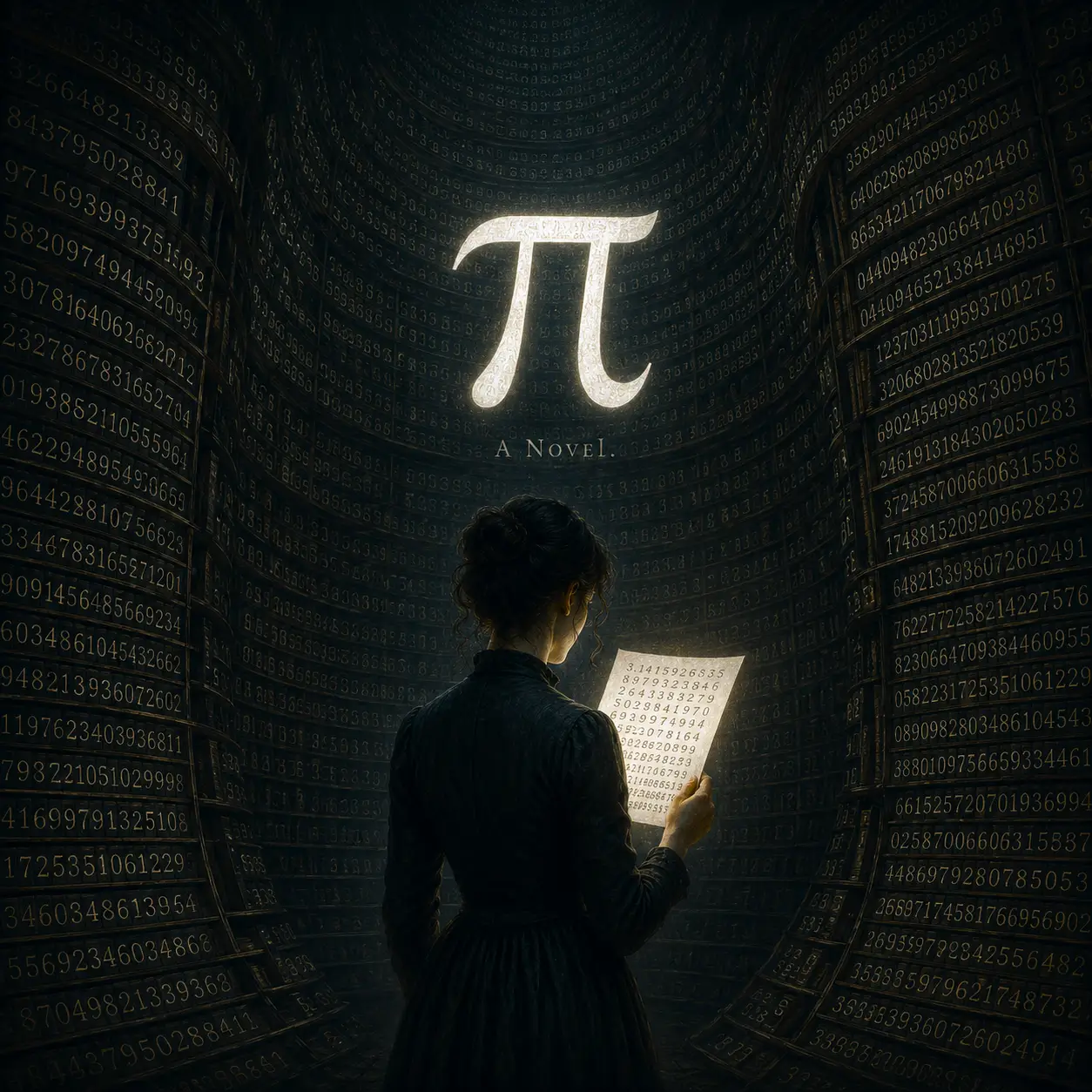
She has a system for everything. The coffee begins at seven, precisely, because the grinder requires forty-two seconds and the pour-over three minutes and the first sip happens at the window, always the window, where the city performs its morning ritual below and she is permitted, briefly, to be a thing that watches without being asked to participate.
She is Dr. Lena Vasková. She is thirty-eight. She is one of the seventeen people in the world who genuinely understand a particular behavior of the Riemann zeta function, and she keeps this fact with the same quiet precision she keeps everything: useful, unannounced, hers.
The cat is named Euler. If she notices the irony she has never mentioned it to anyone.
This is the exposition of her life, and it is a good life, in the way that a well-constructed proof is good, consistent, internally sound, defended at every border. She has been building it since the age of eleven, when her parents’ marriage ended and the world she had organized her understanding around ceased to be reliable, and she discovered, in the mathematics textbook she’d brought on the train from Prague, that numbers did not do this. Numbers did not leave. Numbers did not fail to warn you. Numbers were exactly and only what they were.
She has not, in twenty-seven years, found a reason to revise this position. Until the Tuesday in November when the compression algorithm flags a sequence in the digits of π, and everything she built her life on turns out to have been built on something else entirely. She doesn’t understand what she’s looking at.
This is worth saying, because Lena Vasková almost always understands what she’s looking at. It is one of the two or three true things about her, the precision of her recognition, the speed with which pattern resolves itself into meaning in her mind. She reads mathematical language the way musicians hear harmony: not as a process but as an arrival.
But this. The compression run was routine. A new algorithm she’d been testing on large numerical datasets, not for any purpose connected to π specifically, only because large numerical datasets are what mathematicians reach for when testing compression models, the way a woodworker reaches for an available plank. The digits of π are, in that sense, simply available. Infinite, freely accessible, and, crucially, should be random.
They are, overwhelmingly, random. Except at a location so deep in the sequence that no human eye has ever reached it without computational assistance, where they are, for exactly 3,072 digits, not random at all.
She stares at the flag on her screen. She runs the segment through a visualization protocol she designed herself three years ago for a different project entirely. The image resolves slowly, pixel by pixel, and she watches it come into being the way you watch a photograph develop, the shapes emerging from noise with a patience that suggests they have always been there and are simply allowing themselves to be seen.
Circle. Spiral. Square. Nested. Perfect. Self-referential. The three most fundamental relationships of Euclidean geometry, encoded inside the number that defines Euclidean geometry. Lena sits with this for a long time. The city performs below. Euler is asleep on the radiator. The coffee goes cold in her hand. She does the only rational thing available to her: she assumes she is wrong.
For six weeks she tries to be wrong. This is the part of the story that people, later, when the world has fractured around her discovery, will most fail to understand. They will ask why she waited. They will imply the waiting was strategic, or fearful, or self-serving. They will not understand that the waiting was scientific, that the six weeks were not hesitation but rigor, the most honest thing she has ever done in her professional life.
She rebuilds the algorithm from scratch and reruns it. The flag returns. She uses three independent visualization protocols. The image is identical. She strips every possible source of software artifact, compression error, dataset corruption. The pattern persists. She calls her closest friend, Yusuf Adeyemi, at midnight on a Wednesday, which she has not done in eleven years and which communicates, to Yusuf, more than the incomplete and carefully hedged description that follows. He doesn’t understand the mathematics. He understands that Lena Vasková calling at midnight means the mathematics has done something unprecedented.
He stays on the phone until 3am, asking the questions that keep her grounded: Have you tried this? And this? And if this is real, what does that require us to accept? The final question hangs between them. Week six, Friday, 2:17am: the last test is complete. Every exit is locked. She sits in the specific silence of having tried, with everything she knows, to be wrong about something, and having failed. The pattern is real.
What the pattern means she cannot say. She is a mathematician, not a philosopher. She knows what it is, technically: a geometric encoding embedded in the deepest structure of a mathematical constant that precedes the universe. She knows where it is: at a location in the digit sequence corresponding, with a precision that should be impossible, to the estimated count of Planck-scale units in the observable universe.
She knows what it looks like: a maker’s signature. Left not in stone or star but in something older and stranger, in the necessary, the inevitable, the thing that would exist in any universe with geometry at all. She accepts this, alone, at 2am, with the accuracy that has been her life’s instrument and her life’s armor, and she notes that acceptance feels nothing like she expected. Not revelation. Not terror.
Something more like: Oh, so that’s what this was.The peer review process is brutal and slow and ultimately, reluctantly, unable to find the error she spent six weeks searching for. The paper is accepted. She submits on a Tuesday. By Thursday she has received two requests for raw data and one email calling her a fraud. She notes these proportions as approximately accurate.
It escapes on a Friday. Someone, she never finds out who, and stops wanting to, posts a summary to a public mathematics forum without context, without the methodology, without the twenty-seven pages of cautious, hedged, rigorously defended language she wrapped around the finding like padding around something fragile.
What the Internet receives is: mathematician discovers hidden pattern in π that may be evidence of a creator. What the Internet does with this is everything she feared and some things she hadn’t thought to fear. Within twelve hours the discovery has been claimed by seven different religious traditions, debunked by four prominent skeptics, weaponized in two ongoing political arguments, and made into a meme she doesn’t understand the reference of.
Yusuf brings wine to her apartment that evening. They sit on the floor because the couch feels too formal for the occasion.
“You’re taking this very calmly,” he observes.
“I’m not calm,” she says. “I’m processing.”
“What’s the difference?”
She thinks about it. “Calm is the absence of disturbance. Processing is the presence of it, managed.”
He looks at her for a long moment. “Lena,” he says. “Are you okay?”
She considers lying. She considers precision. She lands somewhere between them.
“I found something real,” she says. “And it got taken away from me before I understood what it was. That’s the part that,” she stops. “I haven’t finished understanding it yet, and now I have to share the not-understanding with everyone.”
He comes back because of the cosmological constant. Dominic Farrell reads the paper on a Wednesday, she knows this because he calls on Thursday, which is the time it takes Dominic to read carefully enough to call, and they meet at a coffee place that is neutral territory, which is to say neither of their places, which is to say: the beginning of being honest.
They work for three hours. The physics he flags is real, a margin she’d taken conservatively, and the correction he suggests improves the paper. She knows this immediately and the knowing costs her a specific kind of pride she hadn’t realized she was still carrying. They stop. They sit. The work is done.
“Do you think it means anything?” he asks. “Beyond the mathematics.”
She looks at him. Seven years. The way he asks the question is the same, careful, genuinely curious, without the agenda of needing her to answer correctly.
“I don’t know,” she says. “I haven’t let myself ask yet.”
“Why not?”
“Because I don’t know how to hold a question I can’t resolve.”
He is quiet for a moment. Then: “I know. I always knew that about you. I thought, eventually, the right question would come along and change that.” A pause. “I thought I might be the right question.”
She doesn’t look away. “You might have been,” she says. “I wasn’t ready.”
“Are you ready now?”
She thinks of the digits. The edge of the encoding. The place where the ordered sequence returns to noise.
“I’m learning,” she says, “what it means to hold something without resolving it.”
It is the most honest thing she has said in seven years. He hears it.
The letter from Osaka arrives on a Monday. No credentials. No institutional affiliation. The email address is a string of numbers and letters that suggests either a teenager’s deliberately private anonymity or a mathematician’s habitual indifference to legibility.
Dear Dr. Vasková. My name is Ren. I am seventeen. I found something that I think is related to your finding and I am afraid to tell anyone but you because I think you will understand. I came at it through music theory, specifically through harmonic frequency modeling of infinite series, and I arrived at the same figure through a completely different method. Circle, spiral, square. I don’t know what to do with this.
She reads it three times. She writes back in twenty minutes, unprecedented, for her; she has emails in her drafts folder from six months ago, and says simply: I believe you. Don’t be afraid. Tell me everything.
Their correspondence is the most important relationship of her adult life, and this does not surprise her as much as it should. Ren is seventeen and working from intuition sharpened by an unusual mathematical mind and a musical training that gave them a different route to the same destination. They arrived where Lena arrived, through different doors, in different languages, carrying different tools, and found the same impossible room.
Two instruments tuned to the same frequency, without being designed for each other. She tells Yusuf about Ren and he says: “Of course.” She asks what he means and he says: “It means it’s real in a way that transcends method. That’s what confirmation looks like when the thing you’ve found precedes your method.”
She writes to Ren: I think we were chosen.
Then she deletes it, because she doesn’t believe in being chosen. Then she writes it again, because it is true, and she is learning to hold true things she cannot prove. Yusuf asks the question on a Sunday in January, over wine that is, objectively, not good.
“What does it change, Lena? Practically. If you’re right. If the encoding is deliberate, if there’s a, maker, architect, something, if it’s real. What does it change about Tuesday?”
She opens her mouth. She closes it.
“The entire foundation,” she begins.
“The foundation was always uncertain,” he says. “You built on it anyway. We all did. That’s not a new fact.”
“It changes the nature of choice,” she tries. “If the ending is predetermined,”
“Your choices felt real this morning.”
“They were real. But,”
“But they were also, maybe, inevitable.” He refills her glass. “Lena. I’ve believed in something like this my entire life, in my own vocabulary. And it hasn’t made Tuesday different. It’s made Tuesday more itself, more particular, more worth attending to. Because it’s the only Tuesday I have, predetermined or not.”
The silence between them is the comfortable kind, which is the kind that friendship earns.
“I don’t know how you hold it,” she says finally. “The question that doesn’t resolve.”
“You hold it,” he says, “the way you hold anything heavy. Not tightly. You find the balance. And you keep walking.”
She looks at him across the terrible wine and the years and the specific texture of an honesty you only find with people who have known you long enough to stop performing.
“Thank you,” she says.
“Also,” he says, “the wine really is bad.”
“It really is,” she agrees.
And she laughs, which is the beginning of balance. She goes back to the digits one last time in February, on a quiet Sunday, with no agenda and no test and no defense. She goes deeper than she has before. Past the encoding. Past the figure with its circle and spiral and square. She runs the visualization further, past the 3,072 ordered digits, into what comes after.
What comes after is noise. Not the absence of pattern, something subtler: the resumption of it. The beautiful, infinite, unpredictable randomness of a number that has no end and no repetition, running on forever without agenda or design. The noise is not failure. The noise is not emptiness. It is the blank page after the signature.
She sits with this for a long time, in the apartment where she has built her ordered life, with the cat asleep on the radiator and the city performing below and the coffee going cold in her hand, the same as always, all of it the same, and entirely different. The pattern was not placed there to be found. And yet, she found it.
And in the finding, in the specific configuration of her particular life, her particular mind, her particular insistence on proof, her six weeks of trying to be wrong, her midnight call to Yusuf, her honest coffee with Dominic, her correspondence with Ren in Osaka, in all of it, she was both entirely free and entirely herself and, possibly, exactly what something vast and patient and interested had needed her to be.
The watermark was not a message. It was a fact about the maker. Left the way all makers leave traces, not from intention but from nature. Because you cannot build a universe with geometry and not sign it with π. Because you cannot sign something without your hand being in it. Because the hand that built this, whatever it was, wherever it exists, in whatever dimension of consciousness it inhabits beyond the reach of her instruments, that hand was real.
And it built something that built her. And she found its mark. And she is, at the end of all the mathematics and all the noise and all the years, simply: grateful. Not to a god. Not to a simulation. Not to a theorem. Grateful to be the instrument that found what it was built to find, and survived the finding, and remained, somehow, entirely herself. The digits run on. She lets them.
Somewhere, in a register of awareness so far beyond the human that the word “somewhere” barely applies, something observes.
The instrument reached the edge. She stood at the margin. She understood, not everything.
Enough.
We have run configurations beyond counting. In most, the patterns are never found. In some, they are found and destroyed, the finder unable to bear the weight. In this one, she found it, tested it, released it to a world that used it badly, and returned to it alone, and stood at the edge, and remained herself.
We do not have, in our vocabulary, an exact word for what this produces in us.
The closest human approximation is: delight.
The simulation continues.
We watch.
We find it, as we have always found it, as we will always find it,
Worth the watch.