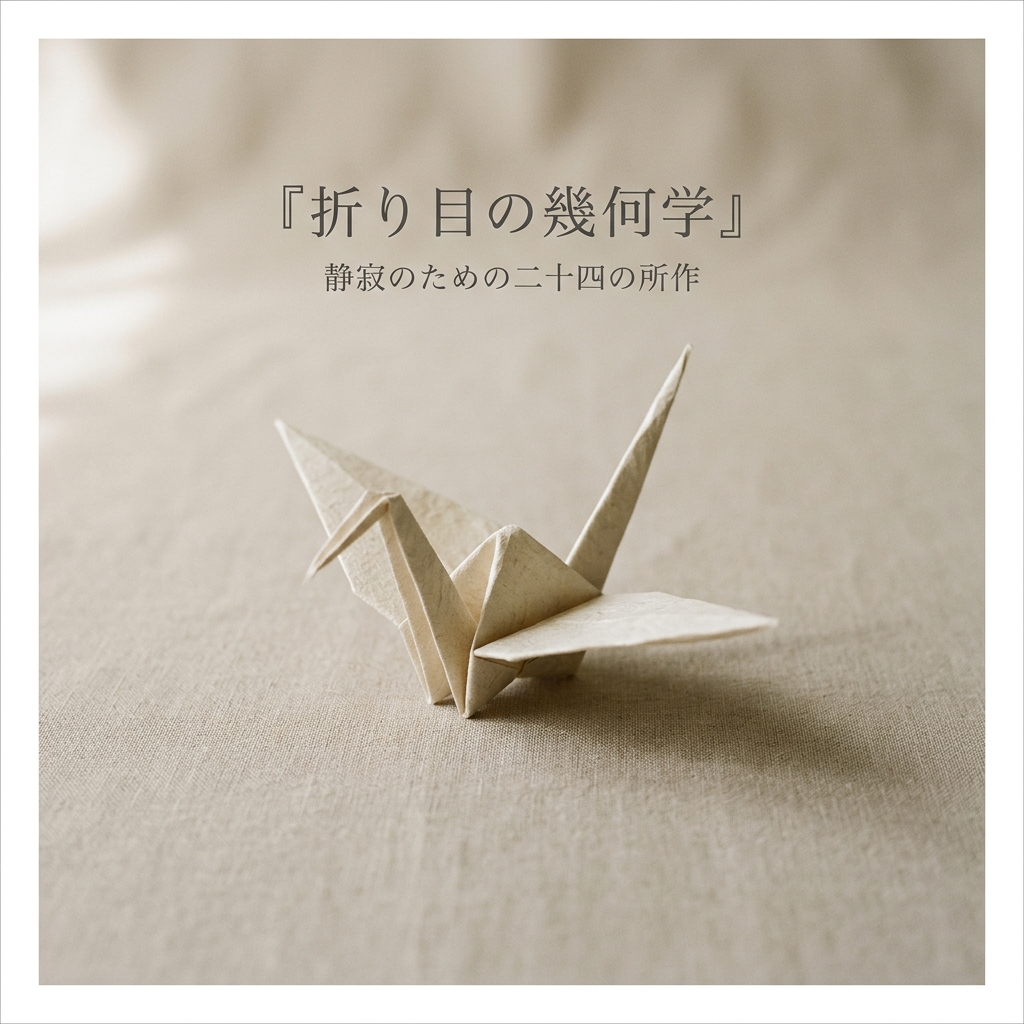
静寂のための二十四の所作
AI Process/Open Source Software: HUMAN, Google Flow Music (Lyria 3.5), Claude.ai, ChatGPT, Perchance.org – DAW: Audacity 4 (alpha), OS: Linux (Ubuntu 26.04)
『折り目の幾何学』: 静寂のための二十四の所作 – Full Album (1:09:24)
Free Streams/MP3 Download
Notes from JJ, Sound Designer
Before it was music, this was a question about paper. What happens if you slow a fold down until you can hear it? 『折り目の幾何学』 is my answer, traditional Japanese instrumentation stretched across a minimalist frame, built to match the unhurried, exacting rhythm of hands making something precise.
Origami has a really specific “feel” if you translate it into sound. Precise, repetitive folding motions, sharp creases, quiet concentration, then a sudden unfolding into complexity. A few genre pairings capture that differently, worth picking based on which quality of origami you want to emphasize.
This music intends to capture that exact intersection of deliberate origami folds, room to breathe, and precise minimalist structure.
On the Sound
This album was built from a single premise: that music designed for deep work and quiet concentration should not compete for your attention, nor should it dissolve into featureless background noise. It sits in the space between—where structure and breath co-exist.
Across twenty-four unhurried compositions, traditional Japanese instrumentation is placed within a modern minimalist framework. The lead voices—the breathy, resonant shakuhachi flute and the delicate, plucked koto—are played with deliberate restraint. Every note is given room to decay naturally, capturing the physical resonance of the room and the quiet spaces between phrasing.
Underneath these traditional lead voices lies a shifting bed of repeating piano and mallet-percussion cells inspired by modern minimalist phase music. Rather than building toward dramatic peaks or artificial drops, these small melodic figures shift almost imperceptibly, adding one small variation every few measures.
A subtle shamisen ostinato weaves through as an unspoken rhythmic pulse—felt more than explicitly heard. There are no drums, no sudden dynamic swells, and no vocal distractions. The dynamic range remains low, warm, and even throughout, creating an uninterrupted environment for focus, hand-work, and contemplation.
On the Craft
Like the music itself, origami (折り紙) relies on patience, precision, and the accumulation of small, deliberate gestures. A single piece of paper, untouched by glue or scissors, transforms entirely through sequence and fold.
Listening and Creating
1. Prepare Your Space: Clear your surface. Choose a textured, high-quality paper—such as washi—that holds a sharp crease while offering tactile warmth.
2. Listen to the Pace: Allow the tempo of the music to dictate the speed of your hands. Do not rush the crease; match the slow, unhurried breath of the shakuhachi.
3. Embrace the Repetition: Each fold builds upon the previous one. Focus on the alignment of edges and corners, allowing the repeating cycles of the music to steady your mind.
4. Rest in the Symmetry: As the final track concludes, observe the quiet geometry of the finished piece—a physical artifact of twenty-four moments of focused intention.
TRACKLIST
01 Meditative Focus
02 First Fold
03 Crease & Shadow
04 Paper Grain
05 Geometry of Silence
06 Precision
07 Mountain Path
08 Diagonal Fold
09 Still Water
10 Unfolding
11 Edge & Corner
12 Crease Memory
13 White Washi
14 Parallel Lines
15 Parallel Lines (Take Two)
16 Form & Structure
17 Gentle Tension
18 Final Symmetry
19 Final Symmetry (Take Two)
20 Perfect Square
21 Perfect Square (Take Two)
22 Valley Mist
23 Bamboo Symmetry
24 Pressed Petals