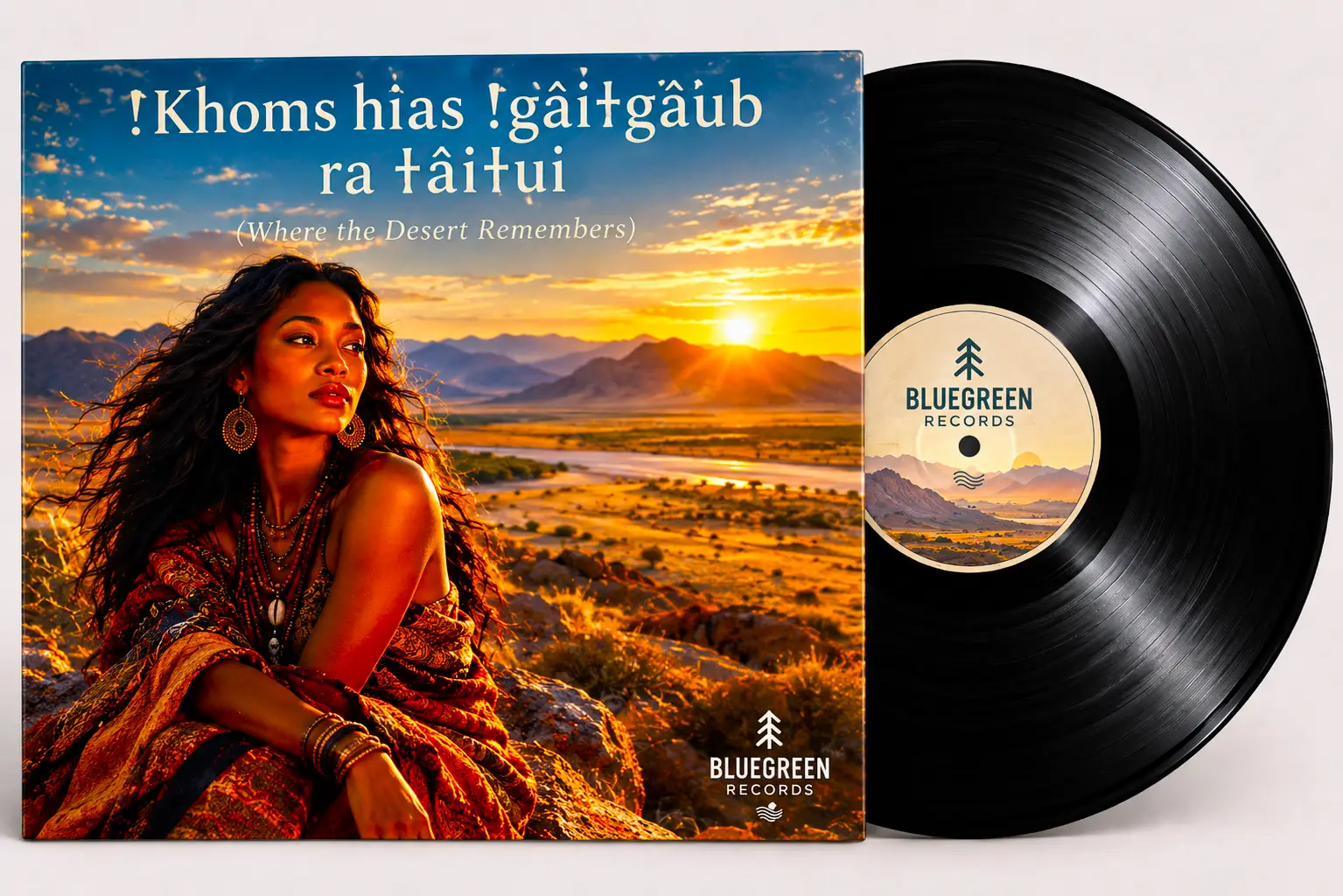
(Where the Desert Remembers)
AI Process/Open Source Software: HUMAN, Google Flow Music (Lyria 3.5), Claude.ai, ChatGPT, Perchance.org – DAW: Audacity 4 (alpha), OS: Linux (Ubuntu 26.04)
!Khoms hîas ǃgâiǂgâub ra ǂâiǂui – Full Album (58:06)
Click to Stream or Download FREE Full Album MP3 (320 kbps – 133 MB)
🇳🇦 Namibian Folk + Ambient Electronica
Traditional Namibian vocal/instrumental traditions + ambient + cinematic electronica, sung by a Namibian woman in Khoekhoegowab.
Sound: Namibian Folk + Ambient Electronica
Namibia’s enormous landscapes practically invite spacious production: dry percussion, voices, acoustic strings, atmospheric drones, environmental recordings, and restrained electronic pulses.
Lyrical themes: land, memory, ancestors, water, desert, stars.
TRACKLIST
01 ǀAms ǃNa
02 ǃGâub ǂÂis
03 ǂAoa ǀHai
04 ǃNami ǀGâas
05 ǂAob !Ami
06 ǂAbras ǁGams
07 Daureb ǀAib
08 Haitsi Aibeb
09 Aas-i ǀâi
10 Gams ǂAos
11 Daureb ǀÂron
12 ǃAmi ǁGau
13 ǃGâb ǂNû
14 ǂAmi ǃGâb
15 ǁGami ǂAob
16 ǃGâa-Aob
17 ǁSaos ǀAib
18 ǃKhāgu ǂÂi-re
19 ǁHurib !Ams
20 ǂHâb ǀAogu
21 ǂAos ǀAi
Narrative Adaptation:
!Khoms hîas ǃgâiǂgâub ra ǂâiǂui
(Where the Desert Remembers)
Chapter Two: The Road That Remembers
Nangula did not plan the trip.
That was the strange part.
She had gone home that evening, made tea, sat with her laptop open to the same unfinished proposal she had been avoiding for weeks. The cursor blinked at her. The spreadsheet waited, patient and unmoved, the way spreadsheets always are.
She closed the laptop.
She looked, instead, for her grandmother’s photographs.
They were kept in an old biscuit tin at the bottom of a cupboard, curling at the edges, smelling faintly of dust and paraffin. Nangula had not opened it in years. But something about the morning’s drive, the little girl in the yellow dress, the question that would not leave her, how does a place inhabit a person?, had sent her looking for an answer in the only place she thought she might find one.
Her grandmother, Ouma Katrina, had grown up near Sesfontein, where the mountains broke apart into gravel plains and the Hoanib River remembered water more often than it carried it. She used to say that the desert was not empty. She used to say the desert was listening.
Nangula had thought, as a child, that this was simply the kind of thing grandmothers said.
Now, at thirty years old, holding a photograph of a young woman standing beside a ǃnara melon patch with the light behind her like a held breath, she was no longer sure.
She packed the car the next morning before she had fully decided to go.
The road out of Windhoek unspooled westward, past the last flowering jacarandas, past the industrial edges of the city, out into the gravel plains where the Khomas Highlands folded down into something older and flatter and far less interested in her opinion of it.
She did not put the roof up.
The wind took her hair the way it had the morning before, but the air had changed character entirely. It no longer smelled of gardens and cut grass. It smelled of stone that had been warming since sunrise, of thornbush, of distances.
The Afrobeat had been left behind in Windhoek, somehow. She did not put on music at all. She let the tires do the talking, that low continuous hum against tar, and later against gravel, and later still against a silence so complete it had its own kind of sound.
Somewhere past the Us Pass, the mountains began.
They rose without announcement, copper-colored, folded like fabric dropped from a great height, their shadows moving slowly across the plains as the sun climbed. Nangula had designed buildings meant to withstand this light. She had never designed anything that could compete with it.
She stopped the car on the side of the road, for no reason she could name, and got out.
The silence startled her.
Not an absence of sound. A presence of it. Wind moving through grass that was mostly the memory of grass. A bird she couldn’t name calling once, twice, then giving up. Her own breathing, suddenly very loud.
She thought of her father’s voice. You cannot hurry the horizon.
She thought she finally understood what he meant, not patience as a virtue to be practiced, but patience as a fact of geography. Out here, the horizon set the terms. You either learned to move at its pace or you spent your whole life arguing with a mountain range that had never once lost an argument.
By late afternoon she reached a small guesthouse on the edge of the Namib, run by a woman named Ai-!Nanseb who remembered her grandmother’s family without needing to be told the surname, only the village, only the river.
“Katrina’s granddaughter,” the woman said, not as a question. “You have her eyes. Also her stubbornness, I think, if you drove all this way without calling first.”
Nangula laughed, surprised by how much the words loosened something in her chest.
That night, Ai-!Nanseb made a fire outside, small and efficient against the enormous dark, and the two women sat beside it while the stars arrived, not gradually, the way they did in Windhoek, dimmed by streetlight and distance, but all at once, as if a curtain had simply been removed from the sky.
“Your grandmother used to say the desert remembers everything,” Ai-!Nanseb said. “Every footstep. Every name. Every song sung to keep the walking easier. She said the reason it looks empty is that it is full, just not in a way city eyes know how to read.”
“She told me that too,” Nangula said. “I thought she meant it as a story.”
“Everything out here is a story,” the older woman said. “That does not make it untrue.”
They sat with that for a while.
“I have been trying to decide something,” Nangula admitted, watching sparks rise and vanish. “Whether to leave my job. Start something smaller. Something that actually looks at the people it is meant to serve.”
Ai-!Nanseb considered this with the unhurried attention of someone who had spent a lifetime letting silence do half the work of conversation.
“The desert does not rush the rain,” she said eventually. “But when the rain comes, everything that was only waiting suddenly blooms. You cannot see the seeds from the road. You have to know they are there.”
Nangula looked out at the dark shapes of the dunes, invisible now except where starlight caught their curves.
“I think I have been trying to be the road,” she said slowly, working it out as she spoke. “Straight. Efficient. Leading somewhere obvious. But maybe I am supposed to be the seed instead. Waiting for the right season. Not wasted, just not blooming yet.”
Ai-!Nanseb smiled, the firelight catching the lines around her eyes.
“Now you sound like your grandmother.”
Nangula did not sleep well that night, but it was not the restlessness of worry. It was the restlessness of a mind finally given room to move.
She woke before dawn and walked out alone toward the dunes, her footprints the only mark on ground that had likely not held a footprint in weeks. The sky ahead was beginning to lighten from black to the deep, bruised blue that comes just before color returns to the world.
She thought about the little girl in the yellow dress.
She thought about the development plans that had no children in them, no grandmothers, no fires, no songs sung to keep the walking easier.
She understood, standing there, that she had been asking the wrong question all along. The question was never how does a place inhabit a person.
The question was what a person owed to the place that had shaped them, and whether a building, done right, could be one way of repaying that debt.
The sun came up over the dune line like something remembering how to exist.
Nangula stood very still and let it happen to her.
Then she turned and walked back toward the guesthouse, toward the car, toward Windhoek, toward the conversation she now knew she was finally ready to have with her firm, not about leaving in anger, but about building something new; something that listened the way the desert listened, and remembered the way her grandmother had always insisted it did.
Behind her, the Namib settled back into its long, patient quiet.
It had heard this story before.
It would hear it again.
That was, after all, what it was for.