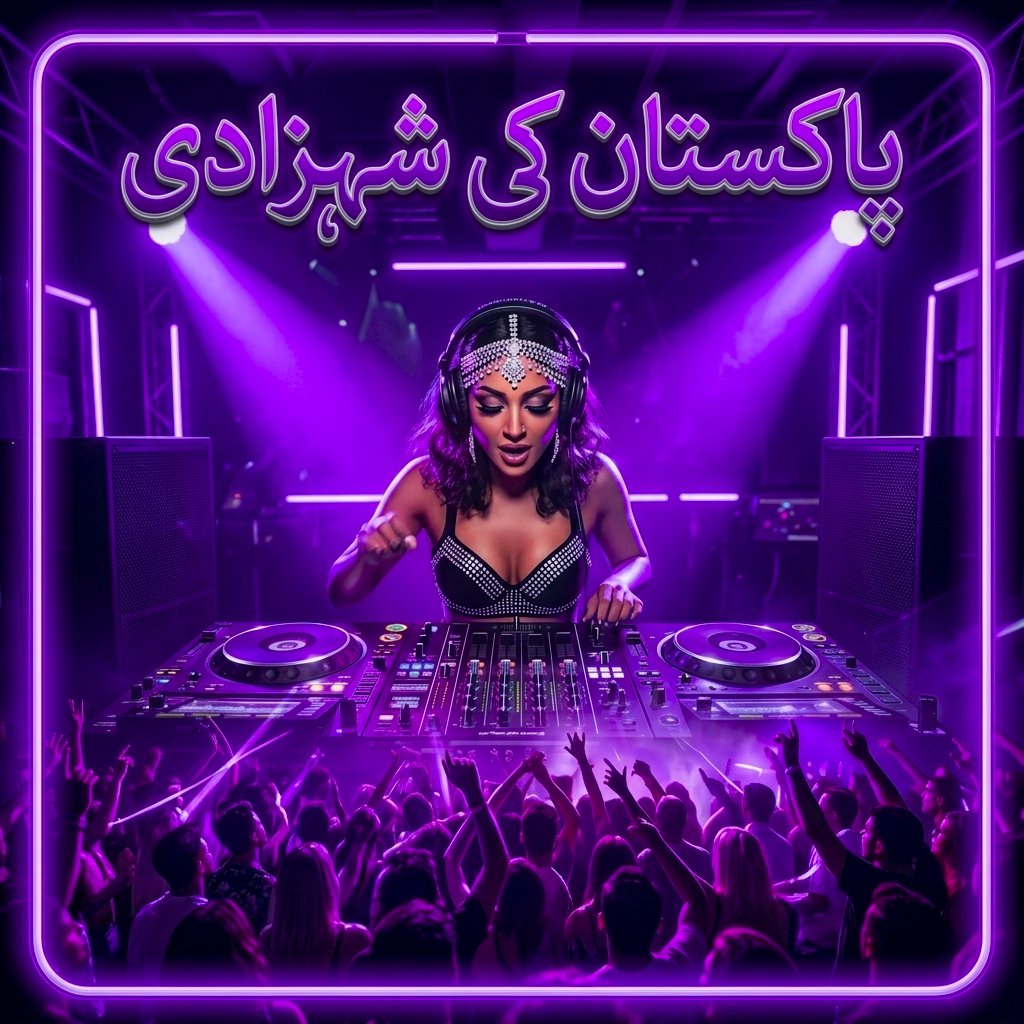
Full Mix (40 Tracks – 1:49:55)
AI Process/Open Source Software: HUMAN, Google Flow Music (Lyria 3.5), Claude.ai, ChatGPT, Perchance.org – DAW: Audacity 4 (alpha), OS: Linux (Ubuntu 26.04)
Before you press play, a few things I want you to know.
This mix didn’t start as a genre exercise. It started as a question. What happens when you let tabla and techno sit at the same table and refuse to translate for each other? Nobody in this mix is a guest. Bhangra isn’t seasoning on top of afrobeat, and afrobeat isn’t a backdrop for bhangra, they’re two rhythmic languages that grew up an ocean apart and, it turns out, have a lot to say to each other. Soca horns lean into reggaeton’s dembow. Bollywood strings find a pocket next to Punjabi folk percussion. Dancehall’s swagger walks straight into a qawwali-adjacent vocal line and doesn’t flinch. None of it is fused so much as “introduced,” like putting old friends in the same room for the first time and watching them realize they already speak the same rhythm.
The voice at the center of all of it belongs to Shehzadi-e-Pakistan, the “Princess of Pakistan,” a Pakistani woman singing in her own language, with her own accent, unapologetically. She’s not performing an exotic register for anyone’s benefit. She sounds like she sounds. That was non-negotiable for me as the person building the sound around her. The accent stays, the language stays, the phrasing stays true to how it’s actually spoken and sung at home, not smoothed out for an international market.
What you’re about to hear, technically: all 40 tracks sit exactly at 132.5 BPM, in a minor key hovering between D♯ and E♭, which gives the whole record a club/live tension underneath its energy. It’s not a sad record, but it’s not a naive one either. The 4/4 pulse is strong and dance-floor-built, the rhythmic density runs high, and the top end stays bright and present, so this is a record that wants low-end movement in your chest and clarity in your ears at the same time. Play it loud if you can. It was mixed to be danced to, not just listened to politely.
Thematically, the whole arc bends toward one idea, that music doesn’t need a passport. Every genre stitched into this record came from somewhere specific and survived being carried somewhere else. That’s the whole point. If a dance floor can hold tabla and dancehall in the same four bars without either one apologizing for being there, perhaps that’s a small, loud argument for what peace between cultures could actually sound like, not flattened into sameness, but standing shoulder to shoulder, still fully itself.
That’s the vision. The rest is just groove.
— JJ, sound designer
P.S. Why 40 tracks? 40 is a significant number in Islamic and South Asian religious culture. Forty appears in traditions concerning spiritual development, periods of retreat, mourning, and religious maturation. Its exact significance varies considerably by tradition.
Core Specs
| Element | Analysis |
|---|---|
| Tempo | ≈132.5 BPM |
| Likely key | D♯ minor / E♭ minor |
| Time feel | Strong 4/4, dance-oriented pulse |
| Energy | Medium-high, propulsive |
| Tonal character | Minor, somewhat dark but energetic |
| Rhythmic density | High |
| Spectral character | Bright upper-mid/high-frequency presence |
| Overall feel | Modern, groove-driven, electronic/urban |
Text to Sound Prompt (Google Flow Music)
Please generate a track by a fictitious artist named پاکستان کی شہزادی (Shehzadi-e-Pakistan), meaning “Princess of Pakistan.”
The music is an organic fusion of Desi roots, Pakistani music, with global rhythms, mixing tabla with techno and bhangra with afrobeat. It also blends elements and textures of soca, dancehall, reggaeton, bollywood and punjabi music.
The lyrics are sung by a Pakistani woman, in Urdu, and she sings with a strong, pronounced Pakistani accent.
Lyrical themes can include any of the following: music is a universal language, it can teach us about one another and bring peace, turn dance floors into spaces of connection and harmony, world music for world peace is the thematic arc, the vision and the vibe.