From Ground To Flight
AI Process/Open Source Software: HUMAN, Google Flow Music, Claude.ai, ChatGPT, Perchance.org – DAW: Audacity 4 (alpha), OS: Linux (Ubuntu 26.04)
MONARCH: From Ground To Flight – Full EP (24:14)
Download Free MP3
MONARCH: From Ground to Flight
7 Songs · 4 Stages · One Woman’s Becoming
The Monarch as a throughline for a woman’s transformation, not just metaphor but architecture for an album, is genuinely powerful. The stages map almost too perfectly: larva, chrysalis, emergence, flight.
The four-stage arc follows the biological truth of the Monarch, egg, larva, chrysalis, imago, but the album lives in the middle three. The egg is before the story (her girlhood, what was planted in her). The larva is her early life: survival mode, hunger without name, crawling toward things she can’t yet identify. The chrysalis is the hardest part and the most interior, dissolution, the dark night, what looks like death from the outside. Emergence is the crack and the pain and the first unfamiliar glimpse of wings. And aloft is not triumphant so much as true, she was always this, always capable of this, and now she simply is.
A few things that make this concept especially strong:
The Monarch doesn’t choose its migration. It is called. That’s a profound detail, she doesn’t decide to transform; something in her recognizes the season and moves. That’s a very different story than willpower or decision. It’s destiny awakening.
The chrysalis is not a resting place. Inside it, the larval body essentially dissolves, turns to biological soup, before reorganizing into something new. The science is almost spiritual. A track rooted in that biology could be devastating.
The other Monarchs. They migrate in groups. She is not alone. The album could hold other voices, women who went before, women going alongside, women she doesn’t know but who are in the same sky.
Image Prompts
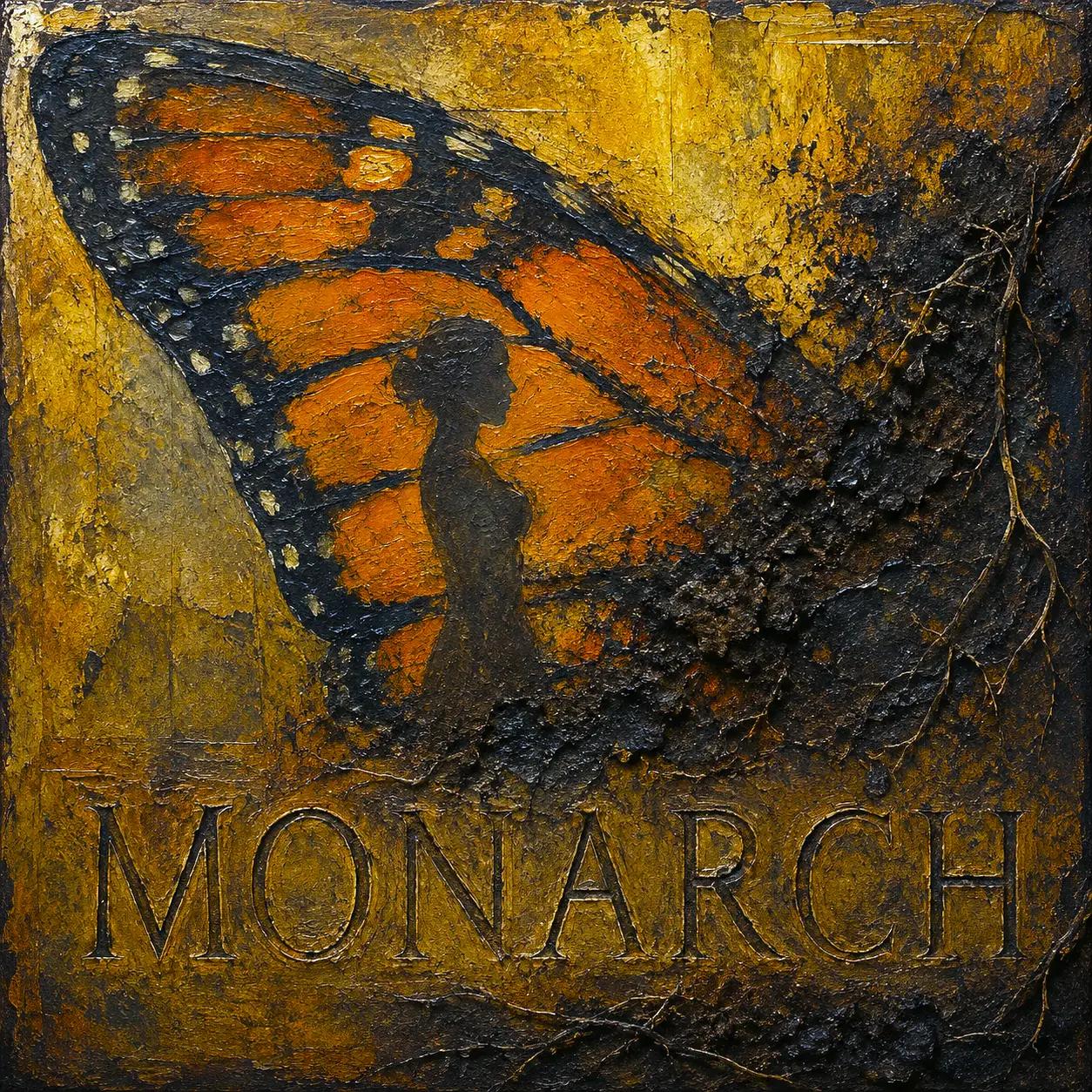
Album Cover (1:1 square)
A close-up oil painting of a Monarch butterfly wing pressed against weathered cardboard, the orange and black veins dissolving at the edges into soil and roots. A single female silhouette, barely visible, is embedded in the wing pattern as negative space. Title: MONARCH in hand-etched serif letterforms across the lower third, as if carved into the surface. Palette: raw amber, charcoal, burnt sienna, ochre. Style: textured, aged, intimate.
YouTube Stream Thumbnail (16:9 widescreen)
A cinematic wide shot: a woman standing alone in a vast golden prairie at dusk, her arms slightly lifted, her back to us. She is mid-transformation, the shadow she casts behind her has wings. The sky is amber-to-deep-violet. No text overlay needed but the title MONARCH could appear in thin white lowercase at top left. Style: painterly realism, emotionally expansive, cinematic aspect ratio.
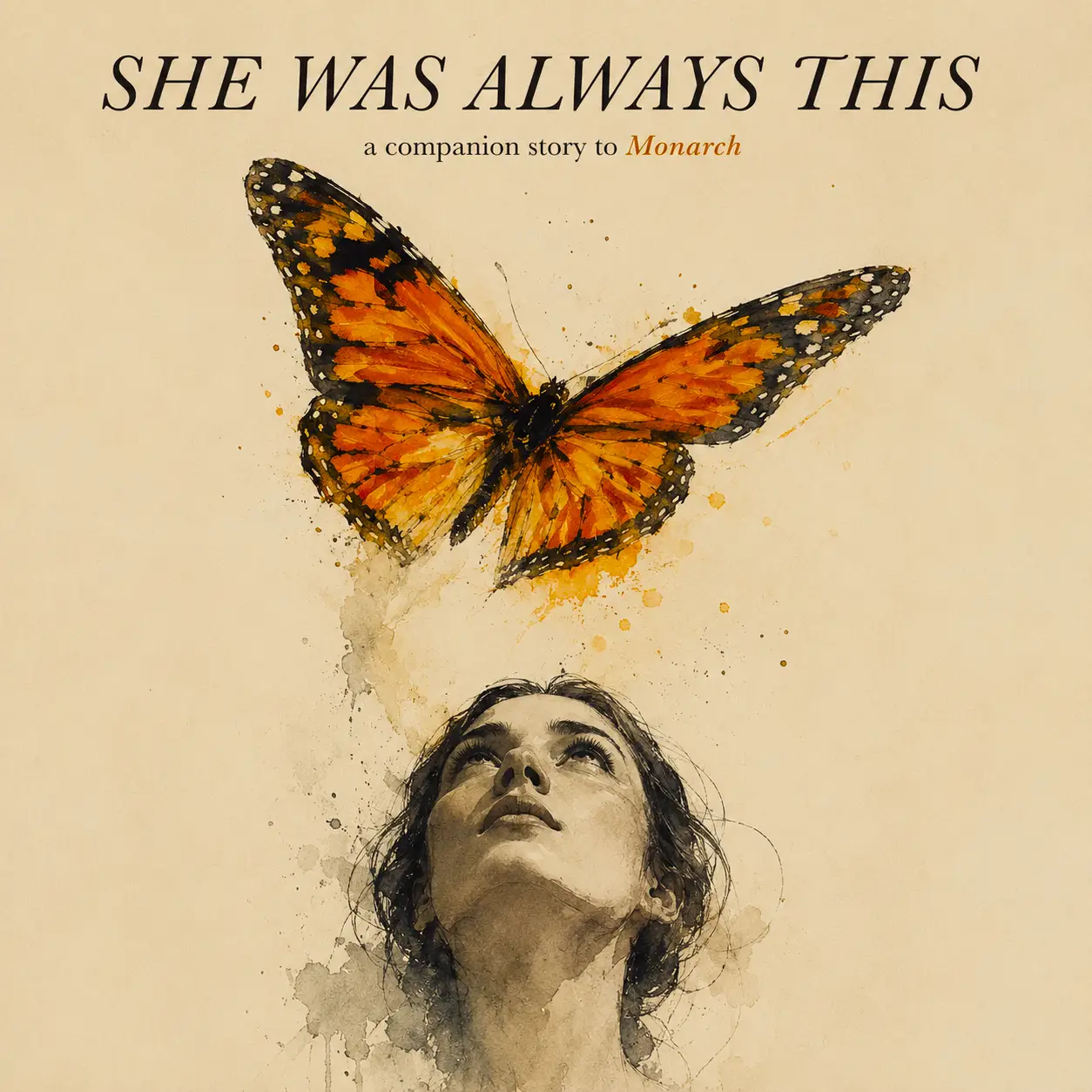
Narrative Adaptation Cover (1:1 square)
A square book cover in the style of literary fiction: a single Monarch butterfly caught mid-flight against a pale cream background, rendered in watercolor and ink. Below the butterfly, a woman’s face gazes upward, fading into the paper as though she is only half-remembered. Title: SHE WAS ALWAYS THIS in bold italic serif at the top. Subtitle: a companion story to Monarch in smaller type below. Palette: soft cream, burnt orange, charcoal ink.
Theme Rendering / Summary
Monarch is a meditation on latency, the long sleep of a woman’s true self inside the life she was handed. It is not a story of triumph over adversity, but something quieter and more devastating: the recognition, arriving late and irrevocable, that she was always capable of more than the world allowed her to imagine.
The album draws its architecture from the biological reality of the Monarch butterfly, the larva that consumes without knowing why, the chrysalis in which the body dissolves before it reforms, the imago that emerges tender and enormous into an unfamiliar sky. The science is spiritual here. She does not choose to transform. The season calls her, and something in her obeys.
Tonally, Monarch moves from earth to air: grounded and drone-like in Stage I, then dissonant and interior in Stage II, then cracked open and raw in Stage III, and finally, in Stage IV, something that sounds like truth. Not victory. Truth. Genre fusion guidance: folk-ambient at the root, with low cello and bowed bass carrying the earth weight; sparse piano and processed voice for the dissolution; acoustic fragility at emergence; and a final track that opens into something wide and uncontained.
This is a TATANKA production in its bones, matriarchal, human, and deeply concerned with the dignity of quiet lives. The protagonist has no name. She is every woman who has ever lived smaller than herself.
Lyrics’ Narrative Arc
The album follows a nameless woman across the four biological stages of the Monarch butterfly, mapped onto the interior life of a woman moving from acquiescence to self-possession. The arc is not linear in the conventional sense, it spirals inward before it opens outward.
Stage I: Earth Bound, the larva (Tracks 1–3)
She lives on the leaf she was given. Her world has edges and she does not question them. She is full, she eats, she persists, she survives, but fullness is not the same as flourishing. Track 1 honors the smallness without irony. Track 2 [Intro]duces the first tremor: hunger without an object, desire with no name. Track 3 brings friction, the weight of inherited identity, the chafe of clothes that almost fit.
Stage II: The Dissolving, the chrysalis (Tracks 4–5)
The chrysalis is not a shelter. Inside it, the larval body dissolves entirely, becomes biological soup, before reorganizing into something new. Track 4 is the moment the body sends its signal: wordless, instinctual, unstoppable. Track 5 is the dissolution itself: the dark interior, the loss of everything she knew herself to be, the terrifying absence of form. The album’s emotional nadir.
Stage III: Emergence, the cracking open (Track 6)
She does not emerge gracefully. She tears. The wings are soft and wet and enormous and nothing works the way she expects. Track 6 holds the contradiction: the emergence is painful and it is the most alive she has ever been. The struggle to push through the chrysalis wall is what pumps fluid into the wings, without the resistance, she cannot fly.
Stage IV: Aloft, the imago (Track 7)
She was always this. She always could have been this. And now, simply, she is. Track 7 is not triumphant, triumph implies a winner and a loser, and she has not defeated anyone. She has become. The final image is not her soaring, but her lifting, one wing-beat, two, and the ground falling slowly away.
Key archetypes woven across the arc: the Sleeper (who does not know she sleeps), the Hunger (desire without object), the Dissolving (necessary death of the old self), the Emergence (the painful gift of becoming), and the Aloft Woman (who was always there, waiting inside the worm).
General Text-To-Music Prompt (Album Wide)
Create a slow-building folk-ambient soundscape for a 7-track concept album about a woman’s interior transformation. Begin with grounded, earth-weighted tones: bowed bass, low cello drones, close-miked hand percussion, and near-dry vocals with no reverb. As the album progresses, [Intro]duce dissonance and dissolution, processed voice, unresolved harmonics, silence used as an instrument. At the emergence point, crack open the sonic world: a single acoustic guitar note that rings longer than expected, a voice that finds its room for the first time. The final track opens into open air, wide stereo field, the first suggestion of wind and altitude, a melody that arrives without apology. Tempo: 58–72 BPM throughout. Emotional core: not sadness, not triumph, recognition. The sound of a woman realizing she was always this.
TRACKLIST
Track 01 · Stage I: Earth Bound
The Leaf She Lived On
THEME SUMMARY
This is the world before the question. She has a leaf and she knows its edges, its veins, its taste, the way the light falls across it at noon. The leaf is real. It fed her. It was her everything, and the song honors that without condescension. To diminish what held her would be to miss the depth of what she must eventually release. The track establishes the emotional gravity that everything else must earn the right to disturb.
SOUND
Slow folk-ambient, middle age Latina woman with a pronounced Spanish accent, open-tuned acoustic guitar fingerpicking, bowed upright bass drone, dry intimate close-miked vocals, soft hand drum enters halfway, 58 bpm

LYRICS
[Intro]
Here is the green world I was given,
here is the edge I’ve never crossed.
I know the weight of every morning,
I’ve never counted what it cost.
[Verse 1]
My mother’s mother knew this leaf,
her hands were shaped to hold it so.
She taught me how to keep my smallness,
how to tend the things I’d never outgrow.
The days came in like water into cupped hands,
I held them till they disappeared.
What is a life but careful tending?
What is a woman but the one who stayed here?
[Verse 2]
I woke before the light most mornings,
laid the table, called the names.
I was useful as a door left open,
I was faithful as the grinding of the days.
There was a kind of grace in ordinary,
a dignity in being small and known.
I swept the same floor in the same light,
and called that life, and called that home.
[Chorus]
The leaf she lived on,
it was enough, it was enough.
The world was small and she was steady,
and what is rough can still be love.
The leaf she lived on,
fed her well, it fed her well.
She did not ask for other heavens,
she could not know what she couldn’t tell.
[Verse 3]
I had a body once that didn’t question,
that moved through rooms like light through glass.
I filled the shape that I was handed,
I didn’t know that shapes could pass.
I was the woman at the edge of photographs,
the one who disappeared in white.
I held the children and I held the evening,
and I never asked to hold the light.
[Verse 4]
In the quiet after everyone was sleeping,
I would listen to the house breathe slow.
Something in me was awake and watching,
though I had no word for what it wanted to know.
I thought it was just tiredness, just the weight of years,
the soft ache of a life worn in.
I pressed it down the way you press a letter
you have written but will never send.
[Bridge]
I was not unhappy,
that is the hardest thing to say.
I was not unhappy, I was ordinary,
and ordinary lasts until one day
it doesn’t.
[Outro]
Here is the green world I was given.
Here is the edge I’ve never crossed.
I am still here. I am still tending.
But something in me woke, and counts the cost.
Track 02 · Stage I: Earth Bound
Hunger Without a Name
THEME SUMMARY
The first tremor. She feels something she has never felt before, or rather, she feels something she has always felt but never let herself name. Desire without an object. A reaching toward something unspecified. This is the Monarch’s instinct before it becomes direction: the pull exists before the destination reveals itself. The track is beautiful and uneasy, like the moment before you remember what you’ve forgotten. Musically, a restless pulse begins to work its way under the stillness.
SOUND
Folk-ambient with growing unease, middle age Latina woman with a pronounced Spanish accent, open guitar with subtle dissonance, restless bowed bass drone, soft electronic pulse enters at [Chorus], dry vocals opening to slight room reverb on chorus, 62 bpm.

LYRICS
[Intro]
There is a thing I carry that I cannot set down,
a weight without a name, a sound without a ground.
I wake and find it waiting in the space beside me,
and I do not know if it’s loss or what I’ve yet to find.
[Verse 1]
I saw a woman once on a train at dusk,
her face turned to the window and the going light.
Something in her jaw, something in her stillness,
she was traveling toward or away from something right.
I wanted to lean over, wanted to say to her:
whatever it is, keep going, don’t look down.
But I was already at my stop.
I was already turning around.
[Verse 2]
There are places I have never been that call to me
in languages I don’t have words to name.
Not places on a map, I mean interior places,
rooms inside myself I’ve never claimed.
I stand at doorways I have never opened,
I press my ear against the wood and wait.
I hear something moving on the other side,
and I am almost never brave enough to step and take.
[Chorus]
Hunger without a name,
appetite without an altar.
Reaching in the dark for something
she has not been taught to find.
Hunger without a name,
a current underneath the water.
She has been fed so long on crumbs
she forgot there was a table, forgot the table’s kind.
[Verse 3]
I used to think it was ambition, that small animal,
the one that keeps its claws inside your throat.
But ambition wants a thing, a name, a prize, a title.
This is older, this is wider, this is a different note.
It’s more like thirst before you know that water exists,
more like light before your eyes have opened to the day.
It doesn’t want a future. It wants something truer.
It wants the part of me I gave and gave and gave away.
[Verse 4]
My grandmother had it, I see it now in photographs,
that look she wore when no one was watching her perform.
A gaze aimed somewhere past the frame of the picture,
something in her that was neither resting nor at war.
She lived eighty years and never said its name aloud.
She took it with her like a folded piece of cloth.
I carry what she carried without knowing she passed it,
and I am done with swallowing what hasn’t been enough.
[Bridge]
Name it.
Name it.
I dare you to name it.
I dare you to sit with it long enough
to hear what it’s saying.
Not the version of it you were taught,
the real one.
The one that woke before you did
and has been waiting.
[Outro]
There is a thing I carry and I choose to set it down
not to lose it, but to finally look it in the eye.
A hunger without a name is still a hunger.
And a woman without a name for her hunger is the first lie.
Track 03 · Stage I: Earth Bound
The Weight of Given Things
THEME SUMMARY
The friction arrives. She is still not angry, the anger belongs to Stage II. But she is beginning to feel, with quiet precision, the cost of what she was handed: the name, the role, the shape, the silence. These are not cruel impositions, that would be easier. They are loving ones. The grief here is that she was given a small life by people who loved her and knew no other way. The track closes Stage I’s first movement before the interlude shifts everything underground.
SOUND
Folk with dark ambient undercurrent, middle age Latina woman with a pronounced Spanish accent, acoustic guitar dropping away mid-track, bowed bass and cello, sparse unresolved piano notes, wordless second female vocal shadow in [Chorus], 65 bpm, ends on an unresolved note.

LYRICS
[Intro]
I was given a name like a key to a room
that I’d live in so long I forgot it was locked.
I was given a shape like a dress in a story,
and I wore it so well that I thought it was cloth.
[Verse 1]
My father handed me quietness like a virtue,
my mother handed me the art of making small.
They handed me a life that fit the hallway
and taught me not to need the larger hall.
They weren’t cruel, I want to say that clearly,
they gave me what they had, the only way they knew.
But what they had was just enough to bind me,
and what I needed was a different kind of true.
[Verse 2]
There’s a word for what I was, it sounds like patience,
it sounds like grace, it sounds like being kind.
But underneath the sounds there was a grammar
that said: stay small, stay soft, stay far behind.
I learned to take up less space in a conversation,
to cede the room before the door was shut.
I learned to need less air than I was using,
and called that generosity, but it was just a cut.
[Chorus]
The weight of given things,
the inherited fit that almost holds.
The weight of given things,
the shapes you live in till you’re old,
till one morning you wake in the body
of a woman you don’t recognize,
wearing the weight of given things
and finally tired of the size.
[Verse 3]
I watched my daughter learning what I’d learned,
the subtle math of how much space to take.
I watched her making herself fit the hallway,
and something in me cracked for both our sakes.
I didn’t want to pass her this inheritance,
this narrowing that looks like being good.
But I had nothing else to hand her,
no other way I knew, no other word I could.
[Verse 4]
The women in my family have beautiful hands.
They were built for holding, built for keeping whole.
But I have started wondering what those hands might carry
if they were freed from holding up the world.
Not freed from love, I want to say that clearly,
love is the only thing worth being bound to at all.
But freed from the kind of love that keeps you
just barely upright in a hall that’s too small.
[Chorus]
The weight of given things,
the inherited fit that almost holds.
The weight of given things,
the shapes you live in till you’re old,
till one morning you wake in the body
of a woman you don’t recognize,
wearing the weight of given things
and finally tired of the size.
[Bridge]
What if the weight isn’t mine to carry?
What if I set it down without betraying her, or her, or her?
What if the shape I was given was a starting place,
not a destination?
What if I am allowed to outgrow
what loved me?
[Chorus]
The weight of given things,
the inherited fit that almost holds.
The weight of given things,
the shapes you live in till you’re old,
till one morning you wake in the body
of a woman you don’t recognize,
wearing the weight of given things
and finally tired of the size.
[Outro]
I was given a name like a key to a room.
I have lived here long enough to know every wall.
Something in me is pressing at the doorframe.
Something in me no longer fits the hall.
Track 04 · Stage II: The Dissolving
Something in the Body Knows
THEME SUMMARY
The signal arrives, not from the mind, not from a decision, but from the body itself. This is the biological truth at the heart of the Monarch: the chrysalis does not form from choice. The larval body recognizes the season and begins to seal itself away. This track is the hinge between earth and dissolution. It is wordless in its knowing, the body understands what the mind hasn’t yet been told. The track was an interlude in the earliest concept; it earns its place as a full song because this moment deserves to be fully inhabited, not passed through.
SOUND
Dark ambient folk. 60 BPM. Sparse piano, single repeated two-note motif that began in Track 3, now foregrounded. Bowed bass becomes more prominent, almost melodic. Voice processed with slight reverb delay, the first suggestion of interior space opening up. Low drone beneath everything like a sustained breath. A field recording of wind in tall grass mixed very low. The track should feel like standing at a threshold in the dark.

LYRICS
[Intro]
Not the mind. Not the calendar. Not the plan.
Something older. Something in the blood and bone.
A current that has been running underneath
longer than I’ve been awake to call it home.
[Verse 1]
I woke one morning and the room was wrong,
not wrong like danger, wrong like outgrown.
The ceiling I had memorized for years
was suddenly a ceiling I had never known.
My hands looked like a stranger’s at the table.
My name, when someone called it, sounded far.
Not illness, I checked. Not grief. Not madness.
Just the season turning where I was.
[Verse 2]
The Monarch doesn’t pack a bag and leave.
It doesn’t plan. It doesn’t make a list.
One morning the light hits different on the leaf
and the body knows: this is what is.
I felt it in my sternum like a key.
I felt it in the small of my back, a pressure, slow.
The way a root feels when the earth above it
is finally ready to let go.
[Chorus]
Something in the body knows
before the mind has found the words.
Something in the body goes
ahead of reason, ahead of hurt.
Something in the body grows
a door in the wall of what you’ve been,
something in the body knows:
the season’s calling. It’s time to begin.
[Verse 3]
I stopped eating things that tasted gray.
I stopped agreeing when I felt the no.
I stopped explaining what I didn’t owe,
stopped making small the things I’d let grow low.
It wasn’t courage, I want to be honest,
it wasn’t a decision, wasn’t brave.
It was the body doing what the body must,
the way the Monarch builds its grave.
[Verse 4]
You can call it breakdown if you need that word.
You can call it crisis, call it loss of form.
But there are deaths that are actually beginnings
and there are storms that are the eye before the storm.
I was sealing. I was softening. I was starting
to dissolve the only self I’d ever known.
And it was terrifying and it was sacred
and I did it absolutely alone.
[Chorus]
Something in the body knows
before the mind has found the words.
Something in the body goes
ahead of reason, ahead of hurt.
Something in the body grows
a door in the wall of what you’ve been,
something in the body knows:
the season’s calling. It’s time to begin.
[Bridge]
Trust the body.
Not the body that was trained to make itself small.
Not the body that learned to apologize for needing.
The original one.
The one underneath.
The one that knows what season this is.
[Chorus]
Something in the body knows
before the mind has found the words.
Something in the body goes
ahead of reason, ahead of hurt.
Something in the body grows
a door in the wall of what you’ve been,
something in the body knows:
the season’s calling. It’s time to begin.
[Outro]
Not the mind. Not the mirror. Not the voice that says: wait.
Something older. Something patient.
Something that has been waiting
for exactly this,
for exactly now.
Track 05 · Stage II / III Hinge, The Dissolving into Emergence
I Have Lived So Small
THEME SUMMARY
The album’s emotional nadir and its most devastating song. Not rage. Not self-pity. Just the recognition, arriving like a stone settling to the bottom of still water: I have lived so small. The chrysalis is at its most complete here, she has dissolved the old self entirely and nothing new has formed yet. She exists in the in-between, the dark interior of becoming. The line ‘I have lived so small’ should land with the weight of a whole life understood in five words.
SOUND
Stripped-back folk ballad, 58 BPM, single sparse unadorned acoustic guitar, vocals often completely alone without accompaniment, very intimate and exposed, second wordless vocal in [Bridge], no hope, ends quietly in darkness.

LYRICS
[Intro]
There is no dramatic moment I can give you.
There is no breaking point I can name.
Just a Tuesday in November
and the knowledge, quiet as a flame.
[Verse 1]
I have been so careful with my wanting,
so precise in how I parceled out my need.
I became an expert in the art of almost,
almost asked, almost reached, almost freed.
I have edited myself in every room I entered.
I have made myself the footnote to the page.
I have held my breath so long in conversations
that I forgot I had a breath to take.
[Verse 2]
I let the best years go like loose change.
Not stolen, surrendered, counted out.
I gave the morning to the ones who needed it
and called whatever was left my amount.
I have apologized for space I had a right to.
I have apologized for needing, wanting, speaking true.
I have apologized to empty rooms for crying
and dressed the wound of myself in someone else’s blue.
[Chorus]
I have lived so small,
I have lived so small.
I have been so careful,
I have kept to the wall.
I have lived so small
and the world let me.
And the years, oh, the years,
they agreed with me.
[Verse 3]
Here is the thing about a quietly diminished life:
it looks, from the outside, like contentment.
No one calls the ambulance for that.
No one brings flowers to that kind of bereavement.
You just go on. You just make the dinner.
You just answer when your name is called.
And somewhere underneath the going on
you feel yourself getting small, and smaller, and small.
[Verse 4]
I am not angry at the people who loved me smaller.
I am not looking for a villain in this scene.
But I am done with being kind to the container
that held me back from what I could have been.
The chrysalis is not a home.
The dissolution is not death.
The thing that’s happening inside me in the darkness
is not an ending, it’s a held and shaking breath.
[Bridge]
What do you do with the years you didn’t live?
You don’t get them back. I know.
You hold them like the seed holds its becoming,
not with grief, but with the readiness to go.
I am not my smallness.
I was never only that.
I was always the wings
inside the worm.
I just didn’t know.
I just. Didn’t. Know.
[Outro]
There is no dramatic moment I can give you.
There is no rescue I can stage.
Just a woman in November
finally turning the page.
Track 06 · Stage III: Emergence
The Cracking Open
THEME SUMMARY
She tears. Not gracefully, with effort and confusion and a kind of terrible joy. The Monarch’s emergence is instructive here: the struggle to push through the chrysalis wall is biologically necessary. It pumps fluid into the wings. A Monarch helped too soon, the wall cut open for it, cannot fly. The resistance is the gift. This track holds both the pain and the exhilaration of becoming, without resolving one into the other. She is not yet aloft. But she is out.
SOUND
Folk-ambient with building momentum, 68 BPM, acoustic guitar returning with confidence, melodic bowed bass, piano resolves the recurring motif, voice in a wide reverb acoustic space, quiet bridge before a large open outro.

LYRICS
[Intro]
Nobody told me it would feel like this,
like tearing, like too much light.
Nobody said that becoming
would look so much like a fight.
[Verse 1]
I came out wrong, that’s the honest accounting.
Not graceful. Not the way they show in the films.
I came out gasping and confused and enormous,
with more of myself than I knew how to fill.
I didn’t know these hands were mine.
I didn’t know this voice, this hunger, this wide.
I stood in the light like something newborn in November
with wet wings and nowhere yet to hide.
[Verse 2]
They say the struggle is the point,
and I believe them now, I believe them now.
The resistance is what fills the wings with flying.
The hard way out is also the only way somehow.
I could have been saved, I could feel the hands nearby,
the ones that wanted to cut the wall and free me fast.
But a mercy that removes the necessary breaking
produces a creature that is beautiful, and last.
[Chorus]
The cracking open,
the terrible release.
The cracking open,
not an ending, not a peace.
But the first breath taken
in the full size of the air.
The cracking open:
I am finally here.
[Verse 3]
My wings are soft. They’re not yet what they’ll be.
I need the morning to dry me into flight.
I am standing at the edge of something uncontained
and learning the new grammar of the light.
I do not know where I am going.
I do not know the name of what I’ll find.
But I am no longer sealed inside the question.
I am no longer only in my mind.
[Verse 4]
The women who came before me and stayed small,
I carry them. I carry them. I do.
I carry the unlived lives inside my wings now,
every grounded dream they never flew.
I am not leaving, I am lifting.
There is a difference, though the view looks much the same.
I am not escaping anything that held me.
I am becoming everything they couldn’t name.
[Chorus]
The cracking open,
the terrible release.
The cracking open,
not an ending, not a peace.
But the first breath taken
in the full size of the air.
The cracking open:
I am finally here.
[Bridge]
You’re allowed to take up room.
You’re allowed to use your voice at full volume.
You’re allowed to need more than what you were given.
You’re allowed to say: this is the woman
I was always going to become.
And she is not a disappointment.
She is not too much.
She is exactly
enough.
[Chorus]
The cracking open,
the terrible release.
The cracking open,
not an ending, not a peace.
But the first breath taken
in the full size of the air.
The cracking open:
I am finally here.
[Outro]
Nobody told me it would feel like this.
Like terrible and right and too bright and true.
Nobody told me that becoming yourself
was the bravest thing a body gets to do.
Track 07 · Stage IV: Aloft
Aloft
THEME SUMMARY
She was always this. She always could have been. And now, simply, she is. The final track is not a victory lap, victory implies an opponent, and she has not defeated anyone. She has become. The Monarch migrates without a map, guided by the position of the sun and a magnetic compass in its body that it was born with and never needed to learn. She always had the compass. She is simply using it now. The album’s last image is not her soaring, it is her lifting: one wingbeat, two, and the ground falling slowly away.
SOUND
Open wide-field folk-ambient, 72 BPM, unhurried full resolved piano motif, warm deep bowed bass anchor, acoustic guitar with room reverb, vocals with full room sound, spacious and free.

LYRICS
[Intro]
I was always going to be this.
The compass was always in me.
I was reading the sun wrong,
or reading only the sun I could see.
[Verse 1]
There are women ahead of me in the air,
and women behind me finding their lift.
We don’t speak, the distances are too large for speaking,
but we share the current, we share the gift.
The world from here is enormous and uncomplicated.
The world from here has room for what I am.
I can see the shape of my whole life below me
and I hold it without shame, without a plan.
[Verse 2]
I do not hate the leaf. I want to say that plainly.
The leaf was real. The leaf was good and true.
I needed it to be the thing that held me
until I had the wings to leave it to.
This is not a story of escape or fury.
This is not a story of a woman wronged.
This is a story of a long and necessary becoming,
of a life that belonged, and then, belonged.
[Chorus]
Aloft.
Not beyond, arrived.
Not saved, alive.
Not flying from,
flying into what I am.
Aloft.
No longer small.
No longer half.
The woman I was always going to become
has finally gone ahead and laughed.
[Verse 3]
I think of her, the one I left inside the chrysalis,
and I am tender with her, tender to the bone.
She did the work. She held the dissolution.
She kept the faith through everything unknown.
She was not weak. She was not failed. She was becoming.
She was doing what the season asked of her.
And I am what she dreamed toward in the darkness,
I am everything she was before the blur.
[Verse 4]
One day a woman will look at my photograph
the way I looked at my grandmother’s far gaze.
She will see something past the frame and feel it,
the unnamed thing that runs through all our days.
I want to leave her something in the current.
I want to leave a line of warmth across the sky.
Not an instruction, just the evidence of passage:
that a woman who was earthbound learned to fly.
[Bridge]
She was always this.
She was always, this.
The worm contained the wings.
The wings were always there.
The only thing that changed
was the season.
The only thing that changed
was her willingness
to meet it.
[Chorus]
Aloft.
Not beyond, arrived.
Not saved, alive.
Not flying from,
flying into what I am.
Aloft.
No longer small.
No longer half.
The woman I was always going to become
has finally gone ahead and laughed.
[Chorus]
Aloft.
Not beyond, arrived.
Not saved, alive.
Not flying from,
flying into what I am.
Aloft.
No longer small.
No longer half.
The woman I was always going to become
has finally gone ahead and laughed.
[Outro]
The ground is falling slowly away.
One wingbeat. Two.
I am not afraid of the air.
The air is what I was always made to move through.
The air is what I was,
the air is what I am.
Aloft.
Finally, aloft.
Narrative Adaptation:
She Was Always This
How a Woman Learns, Too Late and Just in Time, That She Was Never Small, She Was Only Waiting for the Season
The Leaf
Her name, in this story, is not given. She would not want it given. She is the woman in the back of the photograph, the one whose name you don’t know, who is smiling at something just outside the frame. She is your grandmother, or your mother, or the woman you saw once on a train at dusk whose face, turned toward the window, contained a whole unmapped country you never got to visit.
She grew up in a house that smelled of bread and industry. Her mother had good hands and a gift for making something from the particular nothing that women of that generation were handed. Her father was not a bad man, she is careful to say this, even now, he was simply a man of his era, which means he understood the world as a set of fixed positions, and he loved her by placing her in the one that seemed made for her: quiet, careful, useful, good.
She was a bright child. Her teachers said so, the way teachers say such things, with a warmth that doesn’t quite know what to do with itself. She read everything she could reach and some things she couldn’t, standing on chairs in libraries, stretching toward spines on high shelves. She had opinions and enthusiasms and a laugh that was too loud for the rooms she was expected to inhabit. Over years, the laugh got quieter. The opinions learned to arrive as questions. The enthusiasms became hobbies, then pastimes, then the kind of thing you mention once and then don’t mention again.
She does not remember the exact moment she decided to be small. She suspects it was not a decision so much as an accumulation, the way sediment accumulates at the bottom of a slow-moving river, layer by layer, until the river finds it has a new bed and cannot quite remember what the old one felt like.
The Leaf She Knew Too Well
She married a man she loved in the way that is available to a woman who has spent twenty years learning to need very little. He was not a bad man either. This story does not traffic in bad men, it is not that kind of story. He was a man who benefited enormously from her smallness without ever quite knowing it, which is perhaps the most common kind of man there is.
She had children and she loved them with everything she had, which was considerable, despite everything that had been quietly removed. She made a home that worked. She showed up. She held the structure together the way a keystone holds an arch, invisibly, under pressure, without credit, without rest.
There were things she wanted. She is honest about this now, in the telling. She wanted to study linguistics, once. She wanted to travel to places where she didn’t speak the language and have to find her way through gesture and patience and the slow, humbling grammar of being foreign. She wanted to write, not for publication, just for the pure physics of it, the way an idea changes shape when it moves from inside the head to outside on the page. She wanted to take up more space in conversations. She wanted to finish her sentences without modifying them into questions.
None of these things were impossible. That is the detail that will stay with you, if you are a woman reading this, or a woman listening: none of these things required a revolution. They required only a small, consistent permission she was never taught to grant herself.
She gave the best years of her morning to other people’s waking. She gave the good hours of her afternoon to maintenance and management. She gave the last hours of the evening to the particular exhaustion that doesn’t have a name yet but deserves one, the exhaustion of a person who has been fully present for everyone except herself.
In the quiet after the house went to sleep, she would sit at the kitchen table and feel it: a thing without a name, a reach without a direction, a hunger that had no object. She thought it was loneliness. She thought it was ingratitude. She thought, on her worst nights, that there was something wrong with her, that a good woman would not have this ache, that contentment was a skill she simply hadn’t mastered.
She was wrong on all three counts.
The Chrysalis
It did not begin dramatically. That is the first thing to understand about a real transformation: it rarely announces itself.
It began on a Tuesday in late autumn, when she was fifty-one years old, when she woke before the light and lay in the dark and felt, felt with the kind of certainty that lives in the body rather than the mind, that the room she was in did not fit her anymore. Not the room exactly. The life the room was part of. The shape she had been poured into, which had held her perfectly for decades, and now, didn’t.
She did not leave. Not yet, and not in the way you might imagine. Transformation is not always locomotion. She began, simply and terrifyingly, to stop agreeing with things she did not agree with. To stop making herself the footnote to her own story. To stop apologizing to empty rooms for the crime of needing.
This sounds like a small thing. It was not a small thing.
The chrysalis is not a shelter. This is what most people get wrong about metamorphosis, they imagine it as a kind of protected sleep, a safe house where the caterpillar rests until it becomes something else. The biological reality is far stranger and more violent. Inside the chrysalis, the larval body dissolves. It becomes, quite literally, undifferentiated cellular material, a kind of biological soup. There is no caterpillar inside. There is no butterfly yet. There is only the process, and the faith of chemistry that something new will cohere from the dissolution.
She did not know the biology. But she knew the feeling.
She describes it now, when she speaks about it, and she does speak about it, she has stopped keeping it private, as the strangest loneliness she has ever felt. Not the loneliness of being unknown to others, but of being unknown to herself. The self she had maintained for five decades dissolved. The habits, the accommodations, the careful architecture of smallness, all of it went liquid. And she floated in that liquidity, terrified, and waited.
She called no one. There was no one to call. This is not a criticism of the people who loved her, it is simply the truth that some transformations cannot be witnessed, only survived. The chrysalis is opaque for a reason.
The Cracking Open
She came out wrong. That is how she describes the emergence, and she says it with a laugh now, the old loud one, the one that fills rooms without apologizing for itself.
She came out confused and enormous and unsure of the dimensions of herself. She did not know yet what she was capable of. She did not know the wingspan she had been carrying folded inside her all those years. She stood in the new light of the new version of her life and blinked.
There is a fact about the Monarch butterfly’s emergence that she learned later, when she started reading about them, drawn to them with a recognition she couldn’t explain. The struggle to push through the chrysalis wall is not incidental to the butterfly’s formation, it is constitutive of it. The resistance of the wall is what pumps fluid into the wings. A butterfly helped too soon, the wall cut open by a well-meaning hand, cannot fly. Its wings remain soft and collapsed. It lives briefly and never leaves the ground.
She thinks about the hands that might have cut the wall for her, earlier. The therapist she saw briefly at thirty-two who told her she was doing so well. The friend who said you seem happy, and she had agreed, because she had learned to agree. The husband who loved her in the shape he found her, and whose love, gentle as it was, was part of what held the wall in place.
She does not blame them. She has moved through blame and out the other side of it into something more spacious and more true. They were not the antagonists of her story. They were the wall. And the wall was necessary. The wall was what made her strong enough to fly.
The emergence was months, not a morning. It was a series of small irreversible choices. She went back to school at fifty-three, not for a credential, just because there was a subject she had always wanted to learn and she was done waiting for permission that was never going to arrive. She started writing, not for publication, just for the physics of it, just to feel the ideas change shape on their way out of her. She started taking up more space in conversations. She started finishing her sentences.
She lost some things. She is honest about this too. Some relationships could not survive a woman who had stopped being conveniently small. She mourns them, and she mourns them without regret, which is its own kind of complicated grace.
Aloft
She is, at the time of this telling, fifty-three years old. She is standing in her kitchen on a morning in early October, the month of the Monarch migration, and the light is coming in at an angle she has noticed before but is only now fully able to receive.
She is not a different person. That is important. She did not leave her life and build a new one from scratch, the way transformation is sometimes romanticized in the telling. She is the same person she was on the Tuesday in November when she woke and felt the room no longer fit. She is the same person she was at thirty-two, and twenty-four, and nine years old in the library standing on a chair. She was always this. That is the sentence she comes back to, that is the sentence that changes everything: she was always this.
The woman she is now was present in the woman who stayed too small. She was there in the girl who laughed too loud before she learned to soften it. She was there in the hunger without a name, the reaching toward something unspecified, the letters written and not sent. She was always the wings inside the worm. She simply needed the season to arrive.
The Monarch does not migrate to a place it has ever been. It travels thousands of miles to a mountain forest in central Mexico that no individual butterfly has visited before. It navigates by the sun and by a magnetic compass built into its body at birth. It arrives, generation after generation, year after year, at a place it recognizes without having memory of, because the knowing is deeper than memory. It is written in the architecture of what it is.
She understands this now. The life she was always meant to live was not a foreign destination. It was the place her compass had been pointing since the beginning. She wasn’t lost. She was in transit. And there is a difference, she has learned this slowly and completely, between a woman who is lost and a woman who is still on her way.
She thinks sometimes of the women who came before her and stayed grounded all their lives. Her grandmother with the far gaze and the folded piece of cloth she carried. The women in photographs whose names no one remembers. The women whose hunger was never named, whose wings were never pumped full, who lived and died on the leaf and never knew the leaf was not the world.
She carries them. They are in her wings. Every unlived life, every swallowed sentence, every morning given over entirely to someone else’s waking, she carries all of it aloft. She is not flying away from them. She is flying as them, as the part of them that always could have, finally going.
Outside her kitchen window the Monarchs are moving south, orange and black against the pale October sky, in their thousands, in their unhurried urgency. She watches them for a long time. Then she turns back to the table, to the page, to the life that is hers now in the full sense of the word.
She picks up her pen.
She begins.
A TATANKA Production · Monarch