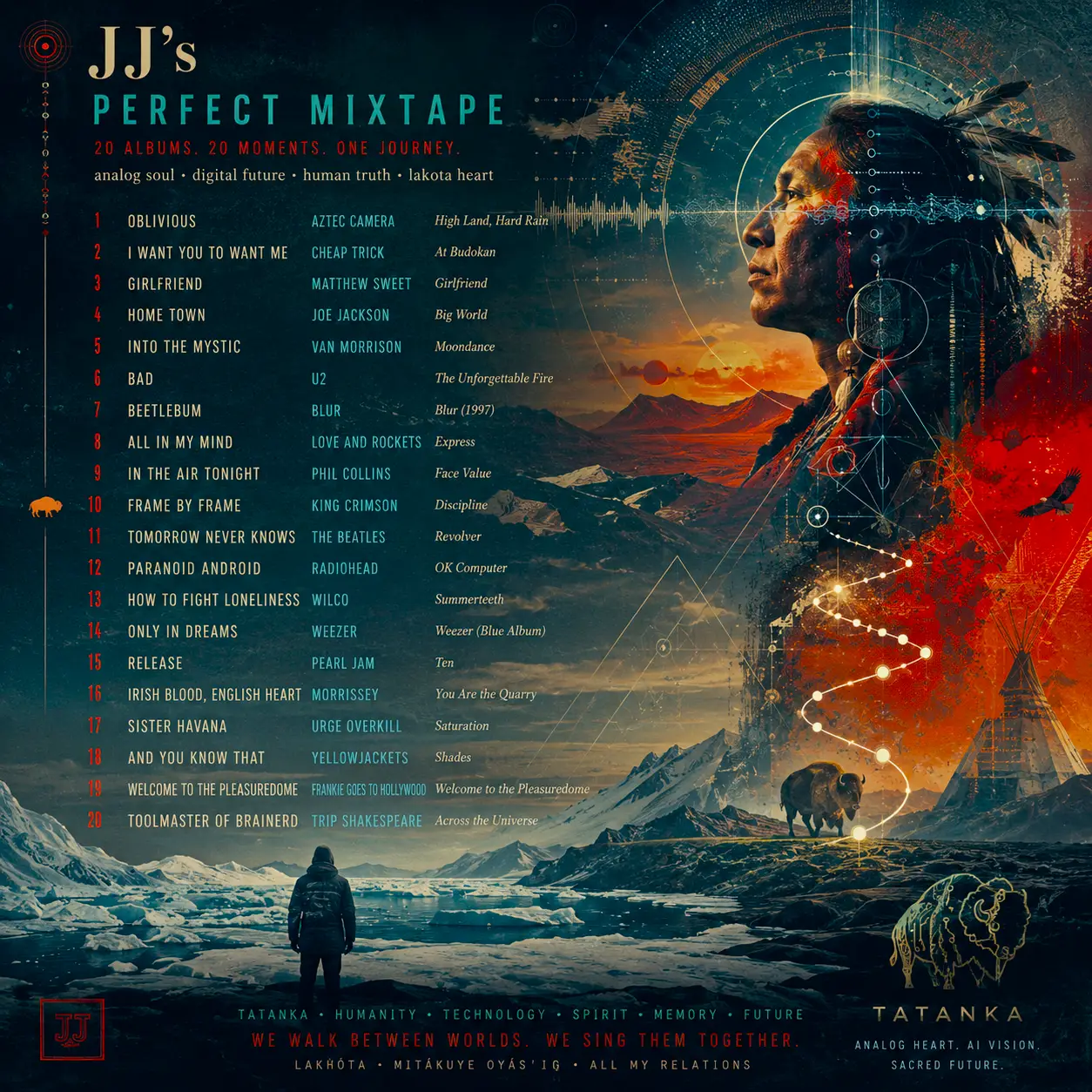
Q: “Whatddya listen to, man?”
A: “This.”
My Perfect is Not Yours
Stream/Download Free Mix MP3
A lot of thought went into this relatively short piece. I have always had a mental list of “Perfect Albums,” the crème de la crème IMHO. Flawless performance, production, concept and cohesive bang for the buck. It takes a lot to make my shortlist, but then again, I am reportedly impossible.
But when I zoom in, album-level, I really have to shift gears as I’m not longer looking at the parts but the album vibe, the flow in that context. I used to put an absurd amount of time into that album flow with my stuff. Then, and now actually, I locked into a less emotional but consistent spacing, aka “pro,” lest I ever be confused with that ilk. But this mix, by nature, deserves much more attention and love.
If you’re not a nerd, you may stop reading now. If you’re still here, once I not select, but KNOW, not which track is most quintessential of that album, to me alone, but something more meta. The one song that always reminds me of that album, and I can’t explain why, a very good, very human thing. Pacing those final twenty-one tracks presents my final challenge, arranging the songs never meant to be in a sequence, to the most organic flow, track to track, all the while across the implied emotion of the mixtape as a whole, beginning to end.
Why, you might ask? Why in God’s name, son?
Because I fondly remember the early art of the mixtape, from the ‘70s, when all I knew to do is convince myself that recording radio music was somehow as good as buying the vinyl, but I digress, again. By the ‘80s, as I woke to being more of a man than boy and girls became a topic of endless discussions, I prided myself not on overall mixtape skillz, yo, but like with my own recordings, those transitions and fades deserved as much attention of the track sequence, an entirely new plot, with shared themes across all iterations.
Yes, I take this shit seriously.
So this mixtape behaves less like a compilation and more like a staged psychological migration. It is not autobiographical. It as always moves with the Muse, directed silently by Her. But it is NOT “my soundtrack,” that makes sense. It arranged itself, period. But forever a writing student, I imagined a framework, possible plot for this exponentially more grand story. I would like to believe I got this one right. You be the judge. Listen to it, all 90 minutes. If you don’t agree that’s the finest mixtape you have ever been lucky to hear, then I will refund all $0.00 you paid for any of these sonic shenanigans.
If somehow you are still reading, the rest is for you:
The mixtape flow begins in a state of suspended awareness, where thought is not yet narrative. From there, it gradually learns structure such as domestic fragility, emotional weather, relational tension. Early songs do not “start the story,” they teach the listener how to perceive time again. By the time Donald Fagen’s crystalline futurism enters, the world briefly believes in its own design. That belief does not last. Instead, it becomes ceremonial under U2, then overheats into Cheap Trick’s communal rupture and Love and Rockets’ kinetic ignition.
At the center of the arc, distortion becomes emotional language rather than aesthetic choice. Blur, Weezer, Pearl Jam, and Matthew Sweet do not resolve feeling, they multiply it until clarity breaks apart into useful fragments. The middle-late section collapses inward. Wilco destabilizes form entirely. Radiohead reduces modern existence to controlled silence. Morrissey introduces philosophical recursion, where even forgiveness becomes structurally ironic.
The final stretch is not resolution but exposure. Brockhampton-era fragmentation refracts identity into overlapping signals. “Revelation” acts as a threshold artifact, something almost understood but not fully translated into language. Then “Two Tribes” arrives not as ending, but as a broadcast from the edge of the system. Conflict is no longer personal. It is architectural. The mixtape closes not in silence, but in pressure held at maximum capacity.
What remains afterward is not a conclusion. It is the sensation that the listener has been moved through several versions of themselves, and none of them are fully finished yet.
TRACKLIST
“I’m Only Sleeping” — The Beatles (1966, Revolver)
“Redwood Tree” — Van Morrison (1972, Saint Dominic’s Preview)
“The Roof is Leaking” — Phil Collins (1981, Face Value)
“Matte Kudasai” — King Crimson (1981, Discipline)
“Walk Out to Winter” — Aztec Camera (1983, High Land, Hard Rain)
“We Can’t Live Together” — Joe Jackson (1979, Look Sharp!)
“I.G.Y. (What a Beautiful World)” — Donald Fagen (1982, The Nightfly)
“The Unforgettable Fire” — U2 (1984, The Unforgettable Fire)
“Surrender” — Cheap Trick (1978, Live at Budokan)
“Kundalini Express” — Love and Rockets (1986, Express)
“Beetlebum” — Blur (1997, Blur)
“Say It Ain’t So” — Weezer (1994, Weezer)
“Oceans” — Pearl Jam (1991, Ten)
“Thought I Knew You” — Matthew Sweet (1991, Girlfriend)
“New Mistake” — Jellyfish (1993, Spilt Milk)
“Via Chicago” — Wilco (1999, Summerteeth)
“No Surprises” — Radiohead (1997, OK Computer)
“I Have Forgiven Jesus” — Morrissey (2004, You Are the Quarry)
“Dropout” — Urge Overkill (1993, Saturation)
“Revelation” — Shades (1986, Shades)
“Two Tribes” — Frankie Goes to Hollywood (1984, Welcome to the Pleasuredome)
So that is the “new” backstory, I hope, to more than a mix, more than a song, more than an album, and more than the genres and styles themselves, always disparate parts of a profoundly greater theme: sound. Frequencies. One of the dark matters. But we’re incapable, yet, of even being physically able to understand the greater narrative, reality. So, why even try? We can still feel its effects in all aspects of our existence, but like AI, we still try to make out those patterns, even when all might seem most chaotic and random. It’s not. So at the end of the day it’s up to to decide if we rock along with the music, go with the flows, or not.
I should mention that I am well aware of copyright infringement and the fact that none of this mix is my original music, but others’ work. If you are actually reading these words, kudos, and know I monetize nothing, ever, anywhere, including this project, which by definition is an educational vehicle, making it additionally fair use, etc. In case you wonder.