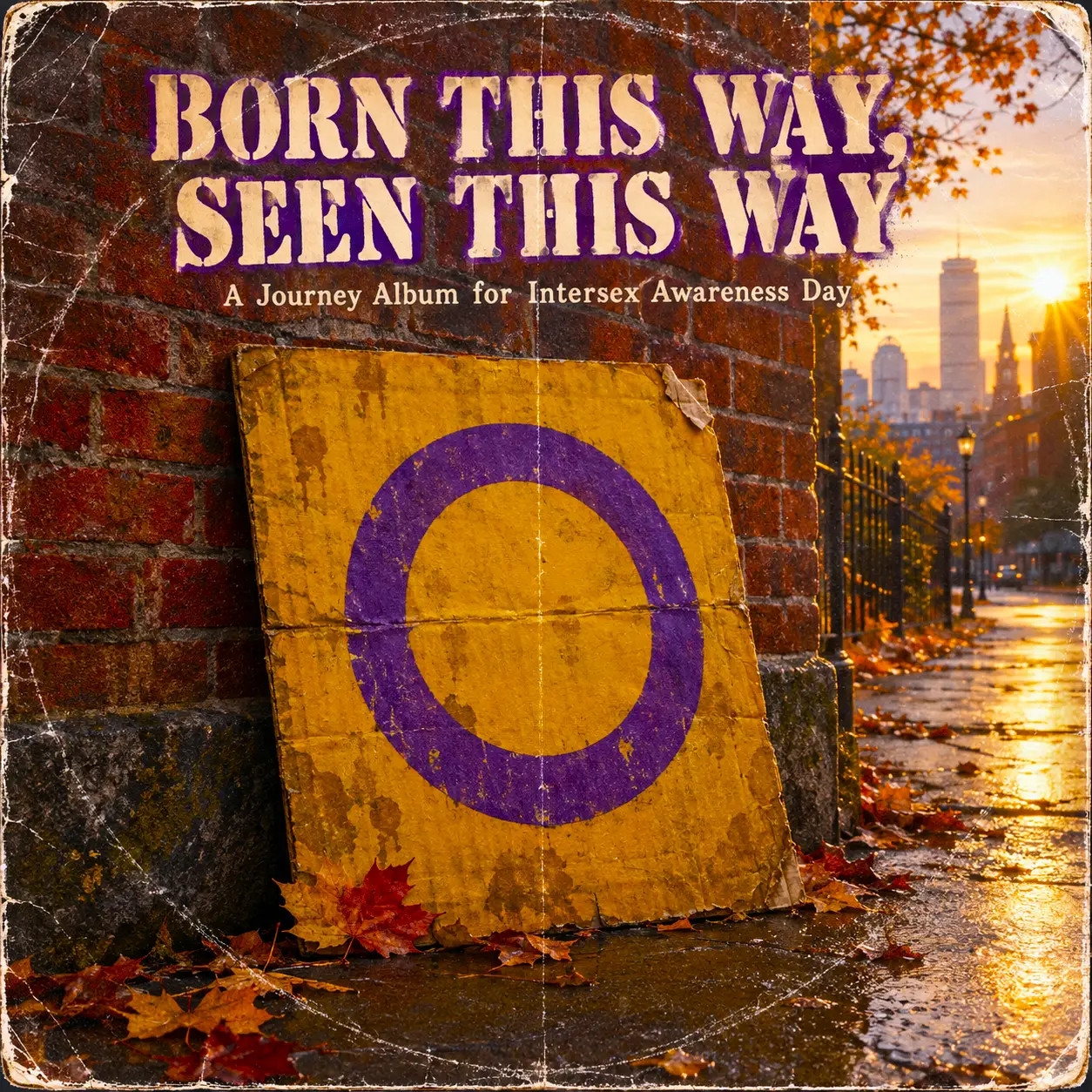
A Journey Album for Intersex Awareness Day, October 26
A ten-track journey album that moves from invisibility and silence, through the 1996 Boston protest and the rise of the movement, to pride and everyday joy, with a short, plain-language spoken fact before every song.
Human-AI Collaboration/Open Source Software: Composer/Sound Designer (Linktr.ee/j_j_j), Google Flow Music (Lyria 3.5), Claude.ai, ChatGPT, Perchance.org – DAW, Audacity4.0.1, OS, Linux (Ubuntu 26.04.5)
Born This Way, Seen This Way – Full Album (28:17)
Click to Download Free Full Album Mix MP3 (44.1 kHz @ 320 kbps – 64.8 MB)
Google Deep Dive Podcast: The History and Harmony of Intersex Advocacy
Liner Note
A Note From JJ, Composer / Sound Designer To The Listener
Before you press play, here is a short guide to what you’re about to hear and how it was made.
What This Is
Born This Way, Seen This Way is a ten-track album with a spoken fact at the start of every song. It is meant to be heard from start to finish, like a journey, though every song also stands on its own. The album moves from silence and invisibility, through the first public intersex demonstration in the United States in 1996, to pride, remembrance, and everyday joy. It was made for Intersex Awareness Day, observed every October 26.
About The Title
“Born this way” is a familiar phrase, and here it carries its plainest meaning: intersex people are born with natural variations in their sex characteristics, and those variations are simply part of who they are. “Seen this way” is the hope the album is built on, that people can be seen as they are: whole, ordinary, dignified, and worth asking before anyone decides anything about them. The comma between the two halves is a pause, a breath, a moment to look up.
The Sound
This is a warm, organic blend of indie folk, soul-pop, and gospel-tinged choir, with cinematic strings and a touch of tape-hiss warmth. The album is sequenced like a good concept record, in three waves: it builds, then breathes, then builds higher. The quiet moments are part of the composition, so please don’t mistake them for gaps. Tempos range from a slow, candlelit 58 BPM up to a driving 128 BPM.
Spoken Interludes
Every track opens with a short spoken passage, about 15 to 20 seconds, giving one plain-language fact: what intersex means, why consent matters, how intersex differs from gender identity, and more. They are there so that anyone, whether they know a lot or nothing at all, can listen and learn along the way. They are spoken by a calm, AI-generated narrator voice.
The Journey, Track By Track
- 01. Nobody Said the Word: The album opens in a hush: a child grows up with no word for who they are, and the silence is what’s missing.
- 02. The Quiet Room: The silence kept out of love and fear, and the gentle idea that a fear handed down can be handed back.
- 03. Finding Each Other: Strangers find each other through letters and phone lines, and discover they were never alone.
- 04. October in Boston: The 1996 Boston protest, told as a driving anthem about courage in numbers.
- 05. My Body, My Yes: The tender heart of the album: consent, time, and the right to take part in decisions about your own body.
- 06. Three Different Questions: A playful explainer: three different questions, about a body, a name, and a heart.
- 07. Open the Door: The movement widens, and allies are invited in: show up, listen, and step back when it’s their call.
- 08. The Circle Stays Whole: The summit: pride, and the intersex flag’s unbroken ring of violet on yellow.
- 09. Names We Carry: A candlelit song of remembrance for those who came before.
- 10. Ordinary Sunlight: Ordinary morning joy, and a warm welcome to anyone still deciding what to say.
Lyrics And Vocalists
Every song has original lyrics, written for this album. The themes include silence and secrecy, finding community, the 1996 protest, consent and bodily autonomy, the difference between sex characteristics, gender identity, and sexual orientation, allyship, pride, remembrance, and ordinary joy. The voices you hear (a warm lead alto, a community choir, and a calm spoken narrator) are AI-generated. They are not recordings of human singers.
How It Was Made: A Human-AI Collaboration
This album was built by one human composer working with several AI tools, with the artist steering at every step. In plain terms:
- Human (the Sound Designer): concept, direction, selection, arrangement, editing, sequencing, and final decisions on everything you hear.
- Google Flow Music (Lyria 3.5): AI music generation, used to produce raw musical material and vocals.
- Claude.ai and ChatGPT: AI assistants used for planning, prompt drafting, lyric and note writing support, and track naming.
- Perchance.org: a free, open web generator used for some album artwork.
- Audacity 4 (alpha): an Open Source audio editor where the material was shaped, trimmed, layered, and mixed.
- Linux (Ubuntu 26.04): the Open Source operating system everything was assembled on.
The AI produced raw material only AFTER the human songwriter decided what the album’s themes and construction would be, what stayed on the record, what was cut, and how it all fits together. Please treat the result as a collaboration, not a push-button product.
A Word On Language And Respect
This album uses the word “intersex,” the term most widely preferred by the community today. The 1996 protest was organized by a group that used an older word for itself; that word is now widely considered outdated, so it is mentioned only as history. This album is educational, not medical advice. If you want to learn more, please start with intersex-led organizations such as interACT, and read works by intersex authors.
Listen And Download
The download is free. It’s the best-sounding version, so it’s worth grabbing for headphones or offline listening.
A Few Listening Suggestions
- Use headphones or decent speakers if you can, since the quiet details and the choir layers are easy to lose on a phone speaker.
- Listen from start to finish at least once, so the journey from silence to joy lands the way it was built to.
- Share it with a friend, a classroom, or a community group. The spoken facts make it a good conversation-starter.
- Let track nine be quiet. It was written for candlelight.
Transparency And Sharing
This album was made with AI assistance, and I’m saying so openly, at the very top of these project notes, as always. I compose with AI assistance because it helps create new artistic pathways with a clear and fresh vision and lets me explore far more sonic ideas than I could alone, while I continue to shape, edit, and decide every detail of the final music, so the result is warm, human-directed, and publicly shared with anyone who wants to listen.
That said, all of my work is free and not monetized in any manner, so please feel free to download this and any of my other musical projects at will, for any use.
Thank You For Listening
Thank you for giving this time out of your day to the music. I hope it helps someone feel truly seen and ideally understood.
JJ, Sound Designer
Project Notes and Specs
| Project at a glance | |
| Format | 10 songs, each opening with a short spoken interlude (a plain-language fact), 10 tracks total |
| Arc | Prelude (Tracks 1-2), Symphony (Tracks 3-8), Coda (Tracks 9-10) |
| Genre fusion | Indie folk, soul-pop, gospel-tinged choir, cinematic chamber strings |
| Tempo range | 58 to 128 BPM, sequenced as three rising-and-falling waves |
| Runtime | 28:17 |
| Release timing | Intersex Awareness Day (October 26); closes toward Intersex Day of Remembrance (November 8) |
| Companion piece | A parallel short story, “The Voice on Reel 14,” written to be read aloud on the podcast (about 10 minutes) |
Contents
- Part 1: Text-to-Image Prompts
- Part 2: The Liner Note (from JJ, Sound Designer)
- Part 3: Theme Rendering / Summary
- Part 4: Narrative Arc Adaptation for Lyrics
- Part 5: General Text-to-Music Prompt (Album-Level) and Pacing Map
- Part 6: Song-by-Song Development (10 tracks)
- Part 7: Narrative Adaptation: “The Voice on Reel 14”
Respect and review guardrails used throughout
- All lyrics, interludes, and notes are original work, written to be dignified rather than pitying.
- Intersex bodies are never used as metaphors, and variations are never framed as “problems” or “disorders.”
- Medical content is kept to plain, non-graphic facts, with no medical advice.
Born This Way, Seen This Way is a journey album about the distance between being silenced and being seen. It begins in a kitchen where something important goes unsaid, and it ends in the same kitchen, filled with ordinary morning light and an open invitation. Between those two rooms it passes through a half-closed door, a living room full of strangers becoming friends, a cold Boston sidewalk in October 1996, a quiet conversation about consent, a bright explainer on three different questions, a growing circle of allies, a golden banner, and a candle in a window. Every step is meant to be educational without being a lecture, respectful without being solemn, and uplifting without pretending the past was easy.
The emotional core is dignity. Intersex people appear here as whole people, never as puzzles, metaphors, or medical cases, and the album’s recurring image is the unbroken ring: a shape with nothing missing. Between songs, a calm spoken voice offers one plain fact at a time, so a listener who knows nothing and a listener who knows everything can both walk the whole road together.
Connection to the TATANKA narrative. The album carries the project’s wider convictions: a matriarchal ethos of care passed down through elders and community (echoed in the companion story’s grandmother, Pilar, whose love and fear shaped a silence that her granddaughter finally breaks); AI-human coexistence, in which the AI is a tool that asks permission and the human makes every final decision (the story’s restoration software, Lantern, and the album’s own collaborative process); and DEI at its most practical, the simple principle that everyone deserves to be asked, heard, and welcomed exactly as they are.
Tone indicators: hushed, warm, luminous, communal, defiant, tender, golden, grounded, celebratory.
Genre fusion guidance: begin in intimate indie folk with felt piano and room tone; widen into folk-pop and gospel-tinged choir; reach full anthemic pop-folk with brass and strings at the peaks; recede to candlelit chamber music for remembrance; finish in sunlit acoustic pop-folk. Keep everything organic, slightly weathered, and handmade.
Narrative Arc Adaptation for Lyrics
The lyrics follow one unfolding story, structured as Prelude, Symphony, Coda, and it is the story of a voice moving from silence to speech to song. The psychological journey runs from invisibility, to shame that was never the speaker’s own, to discovery of community, to collective courage, to self-determination, to pride, to remembrance, and finally to ease. The album never claims a single narrator: the “I” in the verses belongs to many, and the “we” belongs to all.
| Movement | Tracks | Emotional journey |
| Prelude | 01 to 02 | Invisibility and imposed silence. The word is missing, the door is half closed, and a child learns shame that was never theirs. |
| Symphony | 03 to 08 | Discovery, courage, and rising voice: finding each other (03), the 1996 protest (04), consent (05), clarity (06), allies and the widening movement (07), and pride at the summit (08). |
| Coda | 09 to 10 | Remembrance and release. A candlelit pause for those who came before (09), then ordinary sunlit joy and welcome (10). |
Key motifs and archetypes
- The Unspoken Word: the missing word that becomes a window, a door, and finally an everyday part of speech.
- The Door: half-closed (02), propped open (01 outro), thrown wide (07), and finally just a door you walk through into morning (10).
- The Lantern / the Signal: lit windows, a radio voice, a modem tone: the many ways strangers find each other (03, 07).
- The Circle: the unbroken ring of the flag, wholeness without edges (08), echoed in the sun of the final track.
- The Quiet Witness, the Elder, and the Ally: the child who waits, the parent who loved in fear, and the neighbor who learns to listen.
- Sunlight: from a thin line under a door (01) to ordinary morning light on every face (10).
General Text-to-Music Prompt (Album-Level)
Best-fitting genre fusion: the story is communal, hopeful, and rooted in real history, so it calls for indie folk and soul-pop with a gospel-tinged community choir and cinematic chamber strings. Folk carries the storytelling and intimacy, gospel and choir carry the sense of “many voices together,” and strings and brass carry the emotional peaks.
Album-level prompt
Create an anthemic indie-folk and soul-pop concept-album soundscape that grows from hush to joy. Begin with intimate felt piano, room tone, and a single warm alto voice; build through fingerpicked acoustic guitar, upright bass, hand percussion, and brushed drums; open into a gospel-tinged community choir, stomping rhythms, warm brass, and cinematic strings for the protest and pride anthems; dip into a candlelit, nearly silent remembrance; then finish in bright, sunlit pop-folk. Analog tape warmth, slightly weathered, organic and handmade. Dignified rather than pitying, hopeful rather than sentimental. Tempos range from 58 to 128 BPM. Clear, intelligible lead vocals with ensemble and choir backing. Avoid electronic dance sounds and harsh distortion.
Spoken-interlude voice prompt (every track intro)
A calm, warm, unhurried narrator voice, gender-neutral and kind, close-mic’d with a soft touch of room reverb, speaking in plain, clear sentences at a gentle pace. A very quiet sustained piano or string pad underneath, fading out completely by the end. About 15 to 20 seconds. No dramatic inflection, no pity, just clear, friendly information.
Pacing map: the sonic roller-coaster
Intensity (1 to 10) rises and falls in three waves, so the listener is lifted, rested, and lifted again.
| No. | Title | BPM | Intensity | Role in the wave |
| 01 | Nobody Said the Word | 72 | 2 | Wave 1 begins: hush |
| 02 | The Quiet Room | 84 | 4 | Wave 1 rises: tension |
| 03 | Finding Each Other | 96 | 5 | Wave 1 rises: warmth |
| 04 | October in Boston | 128 | 8 | Wave 1 peak: protest anthem |
| 05 | My Body, My Yes | 76 | 3 | Valley: tender consent ballad |
| 06 | Three Different Questions | 112 | 6 | Wave 2 rises: playful clarity |
| 07 | Open the Door | 104 | 8 | Wave 2 climbs: community singalong |
| 08 | The Circle Stays Whole | 120 | 10 | Album summit: pride |
| 09 | Names We Carry | 58 | 1 | Deepest valley: remembrance |
| 10 | Ordinary Sunlight | 108 | 8 | Wave 3: sunlit finale |
Song-by-Song Development
Each track opens with a short spoken interlude, then the song. Lyrics are written in the requested 4-line stanzas: intro, four verses, chorus, bridge, and outro. Order: Intro, Verse 1, Verse 2, Chorus, Verse 3, Verse 4, Chorus (repeat), Bridge, Chorus (final), Outro.
01 Nobody Said the Word
Prelude | Invisibility | 72 BPM | Intensity 2/10
1. Theme Summary
The album opens inside a hush. A child grows up in a world with two boxes on every form and no word for them, learning early which questions make the grown-ups turn away. This track names the invisibility without self-pity: the speaker is whole and present, and the silence is what is missing. It sets the album’s central motif (the unspoken word) and ends with the first small act of courage, the idea that the word itself is not a weight but a window.
Spoken Interlude: What Intersex Means
Script (read before the song)
Intersex is an umbrella term for people born with natural variations in sex characteristics, such as chromosomes, hormones, or anatomy, that don’t fit typical ideas of male or female bodies. Intersex people have always existed, in every culture and every family.
Sound
Intimate, hushed indie-folk opening with spoken intro, felt piano, soft room tone and faint tape hiss, a single warm alto voice close-mic’d and unhurried, and a low cello swell entering in the second half. Tempo 72 bpm, minor key lifting to major at the chorus. No drums until a soft kick, like a heartbeat, enters at the chorus. Convey the sound of a quiet kitchen where something important has gone unsaid, and the first light of being heard.
Lyrics
[Spoken Intro]
Intersex is an umbrella term for people born with natural variations in sex characteristics, such as chromosomes, hormones, or anatomy, that don’t fit typical ideas of male or female bodies. Intersex people have always existed, in every culture and every family.
[Intro]
A kettle hums in a quiet kitchen,
The radio trades in weather and news,
There are words in this house we never mention,
Yet the room keeps leaning toward the truth.
[Verse 1]
I learned the shape of the silence early,
Which questions made the grown-ups turn,
A form with two boxes, a pen that hovered,
And a lesson in how to wait my turn.
[Verse 2]
The schoolyard drew its lines in chalk,
Two doors, two queues, two names to call,
I stood in plain sight, ordinary and whole,
And the map made no room for me at all.
[Chorus]
Nobody said the word out loud,
But I was here, but I was here,
A whole note held beneath the crowd,
Waiting for the room to hear.
[Verse 3]
No book on the shelf had my story in it,
No face on the screen said, I know you,
So I filed my questions in a drawer marked later
And learned to look like I had nothing to prove.
[Verse 4]
But silence is not the same as empty,
It hums like a wire before the song,
Somewhere a stranger is holding the same breath,
Wondering if they’re the only one.
[Chorus]
Nobody said the word out loud,
But I was here, but I was here,
A whole note held beneath the crowd,
Waiting for the room to hear.
[Bridge]
And what if the word is not a weight?
What if it’s a window, open wide?
Say it slow, say it kind, say it plain,
Let the morning come inside.
[Chorus]
Nobody said the word out loud,
But I was here, but I was here,
A whole note held beneath the crowd,
Waiting for the room to hear.
[Outro]
A word like a door, propped open at last,
Light spilling over the floor,
Nobody said it, until someone did,
And now we can say it more.
02 The Quiet Room
Prelude | Silence and secrecy | 84 BPM | Intensity 4/10
1. Theme Summary
The hush deepens into something heavier: the silence kept by people who loved the child and were afraid. This track is about secrecy that was imposed, not chosen, and the shame that was handed down rather than earned. It stays dignified and avoids any medical detail, keeping the focus on the feeling of a half-closed door. Its turning point is a gentle one: a fear that was handed down can be handed back, without blame, and the child inside the quiet room was never the problem.
Spoken Interlude: Variation, Not Illness
Script (read before the song)
Being intersex is a natural variation of the human body, not an illness. Some intersex people do have health needs, and good medical care matters. But care is not the same as surgery done to change how a healthy body looks.
Sound
Tense, restrained chamber-folk opening with spoken intro, muted piano, pizzicato strings, low upright bass, and a distant ticking rim-click like a hallway clock. Tempo 84 bpm, minor key, slow-building. Warm alto vocal, close and slightly breathy, with a hushed double-tracked harmony. At the chorus the room opens up: sustained strings, soft choir oohs, a sense of daylight entering. Convey a hallway of hushed voices slowly becoming an open door.
Lyrics
[Spoken Intro]
Being intersex is a natural variation of the human body, not an illness. Some intersex people do have health needs, and good medical care matters. But care is not the same as surgery done to change how a healthy body looks.
[Intro]
Down the hall, a door that stays half closed,
Soft shoes, soft voices, careful tone,
A clipboard full of words I couldn’t read
About a body that was only my own.
[Verse 1]
They said it was best not to tell me,
Said knowing would only bring me pain,
So the truth took a chair in the corner
And waited, patient as rain.
[Verse 2]
Birthday cards with a careful hush,
A look that passed above my head,
Every kindness carried a locked room in it,
And the key was all the things unsaid.
[Chorus]
Open the door of the quiet room,
Let the daylight cross the floor,
There was nothing wrong with the child inside,
Only the hush at the door.
[Verse 3]
I wasn’t ashamed till I learned that shame
Was the thing I was meant to feel,
Someone else’s fear, pinned to my collar
Like a name tag I could not peel.
[Verse 4]
But a fear that was handed can be handed back,
Gently, with both hands, no blame,
It was never mine to carry in the dark,
It was only ever ours to name.
[Chorus]
Open the door of the quiet room,
Let the daylight cross the floor,
There was nothing wrong with the child inside,
Only the hush at the door.
[Bridge]
To every parent who did what they were told,
Who loved us in the dark and afraid,
There’s a gentler way, and it starts today,
Tell the truth, and let the love stay.
[Chorus]
Open the door of the quiet room,
Let the daylight cross the floor,
There was nothing wrong with the child inside,
Only the hush at the door.
[Outro]
The door swings wide on its old, slow hinge,
And the hallway fills with sun,
No one is whispering anymore,
Just a story, just begun.
03 Finding Each Other
Symphony | Connection and community | 96 BPM | Intensity 5/10
1. Theme Summary
The first real shift in the album’s mood. Strangers find each other through letters, phone calls, and the first crackling dial-up connections of the 1990s, and discover that isolation was a story told by silence, not a fact. The music warms and begins to build in the way a living room fills up. This track introduces the “lantern” motif (every lit window a person who is not alone) and the idea that the people who were spoken about take the pen and begin writing for themselves.
Spoken Interlude: Community-Led Change
Script (read before the song)
For many years, intersex people were told very little about their own bodies, and many believed they were alone. Intersex-led groups changed that, by building communities where people could share their stories in their own words.
Sound
Warm, hopeful folk-pop opening with spoken intro, fingerpicked acoustic guitar, light banjo, hand claps, soft kick drum, and a faint dial-up-modem-like tone woven in as a rhythmic motif at the very start only. Tempo 96 bpm, major key. Warm alto lead with a small group of friendly backing voices that join one at a time, like people arriving at a gathering. Convey strangers finding each other and the glow of a lit living room on a cold night.
Lyrics
[Spoken Intro]
For many years, intersex people were told very little about their own bodies, and many believed they were alone. Intersex-led groups changed that, by building communities where people could share their stories in their own words.
[Intro]
A letter slips through a mail slot,
A modem sings its dial-up tune,
Someone types three honest sentences
And a stranger answers soon.
[Verse 1]
I thought I was the only one
Who’d ever been told to keep it quiet,
Then a voice on a crackling telephone line
Said, I know that room, I’ve been in it.
[Verse 2]
We gathered in borrowed living rooms
With coffee gone cold in the cup,
Told our stories in our own plain words
And one by one we stood up.
[Chorus]
Finding each other, finding our names,
Finding our voices in the open air,
Every window lit like a lantern,
You were never alone out there.
[Verse 3]
No two of us were quite the same,
Different journeys, different names,
Different roads to the same front door,
Nobody asked us to explain.
[Verse 4]
Alone was the story the silence told,
Together is the page we write,
We took the pen from the ones who spoke for us
And wrote it ourselves by lamplight.
[Chorus]
Finding each other, finding our names,
Finding our voices in the open air,
Every window lit like a lantern,
You were never alone out there.
[Bridge]
And if you’re listening in the dark tonight,
Hand on the radio, heart on the line,
Know there’s a table with a chair pulled out,
And a place on the page that’s yours and mine.
[Chorus]
Finding each other, finding our names,
Finding our voices in the open air,
Every window lit like a lantern,
You were never alone out there.
[Outro]
The static fades and the voices rise,
A choir where the crackle was,
Alone was only the sound of waiting
Before the others found us.
04 October in Boston
Symphony | The 1996 protest | 128 BPM | Intensity 8/10
1. Theme Summary
The first peak of the album and its historical heart. On October 26, 1996, a small group of intersex activists stood outside a pediatric conference in Boston with hand-lettered signs and one clear request: ask us before you decide about our bodies. The group organizing the protest used the name “Hermaphrodites With Attitude,” which was their own name for themselves at the time; today that word is widely considered outdated and stigmatizing, so this album uses “intersex” throughout. The track is a driving, joyful anthem about courage in numbers, and about a seed planted in frozen ground.
Spoken Interlude: The 1996 Demonstration
Script (read before the song)
On October 26, 1996, intersex activists held what is recognized as the first public intersex demonstration in the United States, outside a pediatric conference in Boston. That date is now observed every year as Intersex Awareness Day.
Sound
Driving, anthemic folk-rock protest song with spoken intro, stomping floor tom and snare, strummed acoustic guitar with a gritty electric guitar layer, punchy bass, tambourine, and gang-vocal chants on the chorus sung by a crowd of voices together. Tempo 128 bpm, major key, urgent but joyful. Raw, live-in-the-room energy with slightly rough edges. Convey a cold October morning, hand-lettered signs, and the courage of a small crowd.
Lyrics
[Spoken Intro]
On October 26, 1996, intersex activists held what is recognized as the first public intersex demonstration in the United States, outside a pediatric conference in Boston. That date is now observed every year as Intersex Awareness Day.
[Intro]
October twenty-sixth, nineteen ninety-six,
A cold wind coming off the bay,
A handful of us on a city sidewalk
With a few plain words to say.
[Verse 1]
We didn’t have a megaphone,
Just hand-lettered signs and each other’s nerve,
Outside the doors where the doctors gathered,
To ask for the thing we deserved.
[Verse 2]
Not a mob, just people in winter coats,
Standing very still in the cold,
Saying what the files had never said:
We are here, and we are whole.
[Chorus]
Stand in the cold, stand in the light,
Ask us before you decide,
Our bodies are ours, our voices are ours,
And no more hiding inside.
[Verse 3]
A stranger on the sidewalk asked what it was for,
We said, for the ones not yet born,
For the right to be asked, the right to wait,
For a childhood that’s theirs to own.
[Verse 4]
There were no big headlines, no crowd on the news,
Few people knew that the day had come,
But a seed went into the frozen ground
And a movement had begun.
[Chorus]
Stand in the cold, stand in the light,
Ask us before you decide,
Our bodies are ours, our voices are ours,
And no more hiding inside.
[Bridge]
Every movement starts with a handful,
A few brave hearts and a borrowed street,
Every great chorus begins with one voice
And the courage to repeat.
[Chorus]
Stand in the cold, stand in the light,
Ask us before you decide,
Our bodies are ours, our voices are ours,
And no more hiding inside.
[Outro]
The signs came down, the sidewalk cleared,
The bus pulled out at the end of the day,
But the echo stayed on that Boston street
And it never went away.
05 My Body, My Yes
Symphony | Consent and bodily autonomy | 76 BPM | Intensity 3/10
1. Theme Summary
After the anthem comes the tender center of the album. This is the consent song: a slow, warm ballad about honest information, time, and the right to take part in decisions about your own body. It is carefully written to honor parents, nurses, and doctors who act out of love, and to invite them toward a gentler, slower way of caring. It also offers comfort to anyone whose choices were made before they could speak: you are not late, you are not less, and you are still the author of the next word.
Spoken Interlude: Why Consent Matters
Script (read before the song)
Consent means a person gets honest information and a real say over what happens to their own body. Intersex advocates ask that, unless a situation is truly urgent, decisions about medically unnecessary procedures wait until the person can take part in the choice.
Sound
Intimate soul-folk ballad with spoken intro, warm piano, soft electric piano, upright bass, brushed drums, and a close, steady lead vocal, with a gentle gospel-tinged choir arriving only for the final chorus. Tempo 76 bpm, major key with a tender modal color. Plenty of space between phrases. Convey a calm, unhurried conversation where nobody is rushed and one person is given all the time they need.
Lyrics
[Spoken Intro]
Consent means a person gets honest information and a real say over what happens to their own body. Intersex advocates ask that, unless a situation is truly urgent, decisions about medically unnecessary procedures wait until the person can take part in the choice.
[Intro]
Before you decide for me, sit with me,
Before you choose, will you wait?
There is no clock on the kitchen wall
That says tomorrow is too late.
[Verse 1]
A yes is a gift only I can give,
A no is a door I can close,
Nobody else can answer for me
Of the things that only my heart knows.
[Verse 2]
There’s care that comes with honest words,
With time, and questions, and a chair,
A doctor who says, here’s what we know,
And what can wait until you’re there.
[Chorus]
My body, my yes, my body, my no,
My time, my choice, my pace,
Love me enough to let me decide,
That is the shape of grace.
[Verse 3]
I want to be the author of my own story,
Every chapter signed in my own hand,
Not a page torn out before I could read it,
Not a plan I couldn’t understand.
[Verse 4]
So here’s what I’d ask of the ones who love me,
The parents, the healers, the friends,
Slow down, tell the truth, make room for my voice,
And let the story unfold, not end.
[Chorus]
My body, my yes, my body, my no,
My time, my choice, my pace,
Love me enough to let me decide,
That is the shape of grace.
[Bridge]
And if the choice was made before your voice,
There is still a way to be held and heard,
You are not late, you are not less,
You are still the author of the next word.
[Chorus]
My body, my yes, my body, my no,
My time, my choice, my pace,
Love me enough to let me decide,
That is the shape of grace.
[Outro]
Ask me, and I will tell you,
Wait, and I will say,
A yes means the most when it’s mine to give,
And a no is free to stay.
06 Three Different Questions
Symphony | Sex characteristics vs. gender identity vs. orientation | 112 BPM | Intensity 6/10
1. Theme Summary
The mood lifts into a playful, clear-eyed explainer. Using the image of three separate questions (how a body is built, who a person knows themselves to be, and who they love) the track gently untangles three ideas that are often mixed together. Intersex describes physical sex characteristics; gender identity and sexual orientation are separate questions, and intersex people answer them in every possible way. The track closes with a kind reminder about respectful curiosity: learn the word, then meet the person.
Spoken Interlude: Not the Same as Gender or Orientation
Script (read before the song)
Intersex describes a person’s physical sex characteristics. It is not the same as gender identity, who you know yourself to be, or sexual orientation, who you are drawn to. Intersex people can be any gender and have any orientation.
Sound
Playful, bright indie-pop with spoken intro, plucky bass, syncopated hand claps, bouncy electric piano, glockenspiel accents, and a light shuffle drum groove. Call-and-response vocals in three distinct voices that overlap in the chorus. Tempo 112 bpm, major key. Convey curiosity, humor, and clarity: three separate questions, each answered with a smile.
Lyrics
[Spoken Intro]
Intersex describes a person’s physical sex characteristics. It is not the same as gender identity, who you know yourself to be, or sexual orientation, who you are drawn to. Intersex people can be any gender and have any orientation.
[Intro]
Question one is about my body,
Question two is about my name,
Question three is about my heart,
Three different questions, not the same.
[Verse 1]
How was I made? That’s a story of cells,
Of hormones and chromosomes and more,
It’s the way a body can be built,
A fact, and nothing to be sorry for.
[Verse 2]
Who am I? That’s a different thing,
A knowing that begins inside,
Some of us women, some of us men,
Some neither, and none have to hide.
[Chorus]
Three different questions, three different songs,
A body, a name, and a heart,
Don’t let them blur into one long tune,
Let each one play its part.
[Verse 3]
Who do I love? That’s a third one still,
A song only the heart can write,
We fall in love the way everyone does,
With wonder, and with light.
[Verse 4]
So when you meet me, don’t ask for details
Of the things that are private and mine,
Ask me my name, ask me my story,
And I’ll tell you in my own time.
[Chorus]
Three different questions, three different songs,
A body, a name, and a heart,
Don’t let them blur into one long tune,
Let each one play its part.
[Bridge]
Curiosity is welcome when it’s kind,
When it knows to listen, not just to pry,
Learn the word, then meet the person,
That’s how the best friendships fly.
[Chorus]
Three different questions, three different songs,
A body, a name, and a heart,
Don’t let them blur into one long tune,
Let each one play its part.
[Outro]
One, two, three, and each one’s mine,
Each one a verse in the song of me,
A body, a name, a love, a line,
Different questions, and I’m free.
07 Open the Door
Symphony | Allies and the growing movement | 104 BPM | Intensity 8/10
1. Theme Summary
The movement widens. From a cold sidewalk, change travels into classrooms, clinics, families, and online spaces: teachers learn new words, nurses learn to listen first, some doctors pull up a chair and let people lead. This is a gospel-tinged invitation to allies, who do not need to be experts, only willing to show up, listen, and step back when it is the other person’s call. It is the album’s most communal song, built to be sung along with.
Spoken Interlude: How to Be an Ally
Script (read before the song)
Being a good ally can be simple. Listen to intersex people. Use the words they use for themselves. Don’t ask about anyone’s private anatomy or medical history. And support intersex-led organizations doing the work.
Sound
Uplifting gospel-tinged pop-folk with spoken intro, stomping kick, hand claps, driving piano chords, warm brass swells, and a growing community choir that joins in layers. Tempo 104 bpm, major key. Start simple with piano and one voice, then swell into a full, welcoming singalong. Convey a door swinging open and a crowd making room.
Lyrics
[Spoken Intro]
Being a good ally can be simple. Listen to intersex people. Use the words they use for themselves. Don’t ask about anyone’s private anatomy or medical history. And support intersex-led organizations doing the work.
[Intro]
It started on a sidewalk, thin and cold,
Now the story’s traveling wide,
Letters, speeches, brave small gatherings,
And a door that opens from the inside.
[Verse 1]
Teachers learned a few new words,
Nurses learned to listen first,
Somebody’s mother read a pamphlet
And let the old fear burst.
[Verse 2]
Some doctors started asking questions,
Pulling up a chair to hear the whole,
Learning from the people they once talked about
And letting them be in control.
[Chorus]
Open the door, open the door,
There’s a table and a seat for you,
Bring your questions, bring your open heart,
The old silence is through.
[Verse 3]
Young ones started speaking up,
Writing, filming, singing loud,
Telling their own stories first
To a gathering crowd.
[Verse 4]
Allies, you don’t need to be an expert,
You don’t need to know it all,
Show up, listen, say it’s good to meet you,
And step back when it’s their call.
[Chorus]
Open the door, open the door,
There’s a table and a seat for you,
Bring your questions, bring your open heart,
The old silence is through.
[Bridge]
One voice, then ten, then a thousand more,
A string of lights across the plain,
Not a cause to be admired from afar,
But a family, through sun and rain.
[Chorus]
Open the door, open the door,
There’s a table and a seat for you,
Bring your questions, bring your open heart,
The old silence is through.
[Outro]
Come on in, there’s room to spare,
Pull a chair up to the song,
The door was never really locked,
It just needed us, all along.
08 The Circle Stays Whole
Symphony | Pride | 120 BPM | Intensity 10/10
1. Theme Summary
The emotional summit of the album. The intersex flag, a golden-yellow field with an unbroken violet ring, designed by Morgan Carpenter in 2013, becomes the song’s central image. Its colors were chosen to stand apart from gendered pink and blue, and the ring stands for wholeness and possibility. The track is full-throated, golden, and dignified: pride as both a roar and a quiet morning moment of meeting your own eyes. It deliberately treats the symbol with respect and never uses bodies as metaphors.
Spoken Interlude: The Intersex Flag
Script (read before the song)
The intersex flag was designed in 2013 by Morgan Carpenter: a golden-yellow field with a violet circle. The colors were chosen to avoid gendered pink and blue, and the unbroken ring stands for wholeness and the freedom to choose your own path.
Sound
Soaring, anthemic pop-folk celebration with spoken intro, full band, cinematic strings, bright brass fanfares, a big choir, timpani, and shimmering tambourine. Tempo 120 bpm, major key, with a key change lifting into the final chorus. Warm, golden, hopeful, and powerful: the emotional peak of the album. Convey sunlight, a raised banner, wholeness, and dignified pride.
Lyrics
[Spoken Intro]
The intersex flag was designed in 2013 by Morgan Carpenter: a golden-yellow field with a violet circle. The colors were chosen to avoid gendered pink and blue, and the unbroken ring stands for wholeness and the freedom to choose your own path.
[Intro]
A field of yellow, bright as morning,
A ring of violet, drawn with care,
No pink, no blue, no borrowed colors,
A circle simply, simply there.
[Verse 1]
Someone drew it so we’d have a sign
That belonged to no one else but us,
A ring unbroken, a field of sun,
Raised up above the dust.
[Verse 2]
Not a puzzle, not a footnote,
Not a case study on a page,
A whole person, in the whole bright daylight,
Walking out onto the stage.
[Chorus]
The circle stays whole, the circle stays whole,
Yellow like morning, violet like dusk,
No part left out, no piece set apart,
In the light, we are enough.
[Verse 3]
We pin it to our jackets and our bags,
Hang it from the window and the door,
Wave it from the crowd on a sunlit street
Like a small round sun, and more.
[Verse 4]
Pride is not a loud thing only,
Pride can be a quiet thing too,
A morning when you meet your own eyes
And you simply say hello to you.
[Chorus]
The circle stays whole, the circle stays whole,
Yellow like morning, violet like dusk,
No part left out, no piece set apart,
In the light, we are enough.
[Bridge]
Lift it high, lift it high,
Let the whole street see the sun,
Every voice a different color,
And the song belongs to everyone.
[Chorus]
The circle stays whole, the circle stays whole,
Yellow like morning, violet like dusk,
No part left out, no piece set apart,
In the light, we are enough.
[Outro]
Whole as the moon on the river,
Whole as the dawn on the hill,
Whole as the song we are singing,
Whole, and here, and still.
09 Names We Carry
Coda | Remembrance | 58 BPM | Intensity 1/10
1. Theme Summary
After the summit, the album exhales. This is a candlelit song for the Intersex Day of Remembrance on November 8, honoring intersex people who came before: those who left their stories behind, those hurt by silence and shame, and those who carry the memory forward. It is gentle and grateful rather than despairing, and it never dwells on harm. Its closing promise is that remembering is also a commitment, that the people who come next will be heard.
Spoken Interlude: The Day of Remembrance
Script (read before the song)
Every year on November 8, the Intersex Day of Remembrance, also called Intersex Solidarity Day, honors intersex people who came before us, including Herculine Barbin, born on that date in 1838, whose memoir remains a landmark in intersex history.
Sound
Quiet, reverent chamber ballad featuring a warm female voice reciting the spoken intro and singing the song, solo piano, soft solo cello, distant bell-like glockenspiel, and a hushed choir of humming voices, like candlelight in a window. Tempo 58 bpm, gentle minor key resolving to major in the final bars. Intimate, unforced female lead vocal. Almost no percussion, only a soft, distant low-drum heartbeat. Convey gratitude, remembrance, and calm, not despair.
Lyrics
[Spoken Intro]
Every year on November 8, the Intersex Day of Remembrance, also called Intersex Solidarity Day, honors intersex people who came before us, including Herculine Barbin, born on that date in 1838, whose memoir remains a landmark in intersex history.
[Intro]
A candle in the window, early November,
A small and steady light,
We are saying the names that were never said aloud
In the long, unlistening night.
[Verse 1]
Some of them left their stories on paper,
Some in a song, some in a stare,
Some left a quiet, brave example
For anyone who’d care.
[Verse 2]
Some were hurt by a world that wouldn’t listen,
By silence, by shame, by fear,
Some were never asked what they needed
For all of their years.
[Chorus]
We remember, we remember,
Every name and every face,
The ones we lost, the ones who taught us,
And the love that holds the place.
[Verse 3]
We don’t say their names to be sorrowful,
We say them so they’re known,
Each one a whole life, a whole story,
Each one a seed that was sown.
[Verse 4]
And the ones who are here with us tonight,
Holding the flame in their hands,
Carrying forward the work and the memory
Across these quiet lands.
[Chorus]
We remember, we remember,
Every name and every face,
The ones we lost, the ones who taught us,
And the love that holds the place.
[Bridge]
Let the candles burn until the morning,
Let the stillness hold us near,
Remembering is also a promise,
That the ones who come next will be heard.
[Chorus]
We remember, we remember,
Every name and every face,
The ones we lost, the ones who taught us,
And the love that holds the place.
[Outro]
One by one the flames grow steady,
One by one the dark gives way,
Every name is in the morning,
Every name will stay.
10 Ordinary Sunlight
Coda | Everyday joy | 108 BPM | Intensity 8/10
1. Theme Summary
The album ends where most lives actually happen: in the kitchen, on the walk to work, at the dinner table. After protest, pride, and remembrance, this finale celebrates the simple fact that most of the time being intersex is one ordinary part of a full life. It speaks directly to any listener who is still deciding what to say, with permission to take all the time they need, and echoes the album title in its closing lines. It is the sunlit, welcoming “good morning” the whole record has been moving toward.
Spoken Interlude: An Ordinary, Full Life
Script (read before the song)
Intersex people are teachers, farmers, artists, parents, and neighbors. Most of the time, being intersex is simply one ordinary part of a full life. You are welcome here exactly as you are.
Sound
Bright, sunlit pop-folk finale with spoken intro recited by a warm female voice, strummed acoustic guitars, hand claps, a light drum kit, walking bass, mandolin, warm organ, and a joyful full-choir finish led by a warm female lead vocal. Tempo 108 bpm, major key. Open with a gentle kitchen-window acoustic feel, build to a celebratory singalong, then settle into a warm, quiet last chord. Convey ordinary morning joy, belonging, and welcome.
Lyrics
[Spoken Intro]
Intersex people are teachers, farmers, artists, parents, and neighbors. Most of the time, being intersex is simply one ordinary part of a full life. You are welcome here exactly as you are.
[Intro]
Morning comes in through the kitchen window,
Spills like honey on the floor,
Coffee, toast, and a song on the radio,
Nothing special, and so much more.
[Verse 1]
I walk to work past the corner bakery,
Say good morning to the man with the keys,
Nobody asks me to explain myself,
I’m just a neighbor, at ease.
[Verse 2]
We are teachers, bakers, welders,
Poets, nurses, kids at play,
Artists, farmers, engineers,
Making ordinary, beautiful days.
[Chorus]
Ordinary sunlight, falling on us all,
Warm on every shoulder, bright on every face,
Nothing to hide and nothing to prove,
Just the joy of having a place.
[Verse 3]
Maybe you’re still deciding what to say,
Maybe you’re holding it close to your chest,
Take your time, there is no hurry,
You belong here like all the rest.
[Verse 4]
We dance in the kitchen, we argue at dinner,
We cry at weddings, and call our friends,
Birthdays, bills, and burnt-toast mornings,
Ordinary joy that never ends.
[Chorus]
Ordinary sunlight, falling on us all,
Warm on every shoulder, bright on every face,
Nothing to hide and nothing to prove,
Just the joy of having a place.
[Bridge]
So here’s to the ones who stood on the sidewalk,
Here’s to the ones who stood in the cold,
Here’s to the ones who simply walk down the street
Wholly themselves, and bold.
[Chorus]
Ordinary sunlight, falling on us all,
Warm on every shoulder, bright on every face,
Nothing to hide and nothing to prove,
Just the joy of having a place.
[Outro]
Seen this way, and seen this way,
Seen as we are at the start of the day,
The song doesn’t end, it only turns to light,
Good morning, friend. Come in from the night.
Narrative Adaptation
The Voice on Reel 14

How One Dusty Tape and a Small-Town Radio Engineer Broke a Whole Town’s Silence on Intersex Lives
A companion story for Intersex Awareness Day, October 26.
Every radio station has a room where sound goes to be repaired. Ours is a closet behind the weather desk, with a space heater, a cracked leather chair, and forty years of other people’s voices stacked in cardboard boxes. I am the person who fixes those voices. For fifteen years, at KRVB, 91.3 on the dial in the river town of Harlan Bend, I have taken the hiss and the dropout and the dead air out of other people’s lives so they could sound the way they always meant to sound. I am very good at it. And I should tell you plainly, because I could not say it plainly then: I am also intersex, and I had spent thirty-nine years making sure nobody ever had to hear that from me.
It was the last week of October. The cottonwoods along the river had gone the color of old brass, and the station was days away from its fortieth-anniversary broadcast. Hollis Pruitt, our station manager, a man of seventy-four who communicates mostly in sighs, wanted a special: forty years, forty voices, the town’s greatest hits. He set a milk crate on my desk. “Pilar’s things,” he said. “She kept everything. See what’s worth saving.”
Pilar was my grandmother. She founded KRVB with a borrowed transmitter and a stubborn streak, she raised me in the apartment above the studio, and she died in April. I had not opened her boxes. Opening them meant admitting the quiet in the building was permanent.
Reel 14 lay at the bottom of the crate, its cardboard as soft as cloth. Three words in her slanted hand: Boston, October ‘96. And beneath them, smaller, a single letter: J.
That’s me. J for June.
I threaded the tape that night, long after Hollis had gone home, and woke Lantern, the restoration software we use at the station. Lantern isn’t a person and never pretends to be, which is part of why I trust it. It can find a sentence under thirty years of noise and lift it forward like a hand raising a veil. Years ago I wrote one rule into its setup: before it touches any tape marked private, it has to ask. Because a voice belongs to the person who made it. The question appeared on the screen in plain white letters.
This recording may contain personal material. Do you want me to proceed?
I stared at that sentence for a long time. Nobody had ever asked me that about anything that mattered.
Yes, I typed.
The tape hissed, then opened like a window. Wind. A bus braking. Footsteps on cold pavement. Then people, twenty or thirty of them, voices overlapping, nervous laughter, the scrape of cardboard signs against winter coats. And my grandmother’s voice, unmistakable, saying to someone off-microphone, “I flew all this way. I am not standing in the back.”
I put my hand over my mouth.
A young voice came next, steady except at the edges, reading from a page. I never learned the speaker’s name. “We are not asking you to fix us,” the voice said. “We are asking you to ask us.” The crowd answered, not loudly, but together. Then the sound swung close, and Pilar was speaking into the recorder the way you speak into a message you hope someone will hear one day.
“June, you were nine years old when I stood on this sidewalk. When you were small, the doctors wanted to make decisions about your body that did not need making. I said no. I said, she will decide when she is old enough to decide. They looked at me like I was foolish, and I never told you, because I was afraid of what the world would do with the word. But standing here, I understand something. Quiet is not the same as safe. When you are ready, and only when you are ready, this story belongs to you.”
The tape ran out into hiss. I sat in the chair with the space heater ticking and understood that the silence I had lived inside had not been built only by strangers. Some of it had been built by love, which is the hardest kind to be angry at.
For two days I barely slept. I wrote a statement and deleted it. I wrote another and deleted that one too. I am a person who removes noise for a living, and I could not find the signal in my own voice. On the afternoon of the twenty-sixth, Marlene Voss, the chair of our board, found me in the hallway with a clipboard and a polite smile. “The anniversary is a celebration,” she said. “Let’s keep it light. Nothing personal. Nothing divisive. People tune in for comfort.”
“Of course,” I said, which is the phrase I had always used when I meant the opposite. I walked back to the closet with my face hot and my hands shaking, and I sat down in front of the reel, and for the first time I understood that the fight was not with Marlene. It was with the thirty-nine-year-old habit of saying of course.
Hollis was standing in the doorway. I don’t know how long he had been there. “The nine o’clock hour is yours,” he said. “I run this building, not the board chair. And June, it’s the twenty-sixth. Intersex Awareness Day. Your grandmother told me, years ago. She said it wasn’t hers to tell. So I’ve been waiting for you to need me.” Then he sighed, the longest sigh I had ever heard from him, and it sounded like a man setting down something heavy.
At nine o’clock the red light came on. In fifteen years I had never sat on the other side of the glass. The microphone looked smaller than I remembered and my hands were not steady, but the tape was cued, and Lantern, which had asked me one last time whether I wished to proceed, waited with its plain white letters. I played ninety seconds of Reel 14: the wind, the signs, the young voice, my grandmother’s I am not standing in the back. Then I leaned toward the microphone.
“My name is June Alderete,” I said. “I fix voices for a living. I was born intersex, which means my body developed in a way some people don’t expect. It is a natural variation, not an illness and not a secret. For most of my life I believed the safe thing was to stay quiet. The people who loved me believed it too. Tonight is Intersex Awareness Day, and I’m saying it out loud because on a cold sidewalk in Boston, thirty years ago, a few strangers did it first, and my grandmother stood beside them. Everyone deserves to be asked before decisions are made about their own body. That’s all. That’s the whole request.”
Three seconds of silence. On the radio, three seconds is a lifetime. Engineers call it dead air, and we are trained to fear it. I let it ring. Then every line on the phone board lit at once.
The first caller was a long-haul trucker named Teo, with a voice like gravel in a bucket. He said he had a cousin he’d loved his whole life and never had the right word for, and he wanted to say thank you. The second was a woman named Ruth, whispering, her baby four months old, everyone around her hurrying her toward decisions she did not yet understand. I told her I am not a doctor and could not give medical advice. I told her she was allowed to ask every question she had, that she was allowed to ask for time, and that there are intersex-led organizations that have walked this road beside many families, and she should write their names down. “You are not late,” I said. “Nothing about this has to be rushed.” I heard her breathe out. Near eleven, line three belonged to Marlene Voss, who said only, “I was wrong about what comfort sounds like,” and hung up before I could answer.
By midnight the calls thinned. Hollis came in with two paper cups of terrible coffee and sat in the cracked chair without a word, which, for him, was a speech. Just before dawn I went back to the closet. Light came through the high window, thin and ordinary and gold, across the milk crate, the reel, and the boxes of other people’s voices. Lantern’s screen glowed. Archive Reel 14? it asked. I typed yes, and under notes I wrote: For anyone who needs it.
I used to think my work was to remove the noise. I understand now that some of the noise is people standing close together in the cold, saying a thing out loud so it can be true in daylight. Out on the river, the cottonwoods were catching the sun. I switched off the space heater, and for the first time in my life I did not mind how loud the quiet was, because it was only a room, and I was in it, and the door was open.
Literary elements at a glance
| Element | How it appears |
| Character | June Alderete (protagonist, a sound restorer), her late grandmother Pilar (the elder whose love and fear shaped her silence), Hollis Pruitt (the quiet ally), Marlene Voss (the cautious gatekeeper), and Lantern (the AI tool that models consent by asking first). |
| Plot | June discovers a hidden reel from 1996, hears her grandmother’s confession, wrestles with fear, and finally goes on air to tell her own story. |
| Setting | Harlan Bend, a river town in late October: cottonwoods the color of old brass, a cramped radio-repair closet, the glass of the broadcast booth. |
| Theme | Quiet is not the same as safe; people deserve to be asked before decisions are made about their bodies; love and silence can coexist, and love can learn to speak. |
| Conflict | Internal (June versus a lifelong habit of saying “of course”); interpersonal (Marlene’s request to keep things “light”); and the inherited conflict of a grandmother’s loving silence. |
| Point of View | First person, past tense, told by June looking back, which allows plain reflection (“I should tell you plainly, because I could not say it plainly then”). |
| Tone & Diction | Warm, restrained, and luminous. The vocabulary of sound (hiss, dropout, dead air, signal, room tone) doubles as emotional language. |
| Structure | Exposition (the closet, the crate, the reel), rising action (the tape, the two days of struggle), climax (the nine o’clock broadcast), falling action (the phone calls), denouement (dawn, the archive note, the open door). |