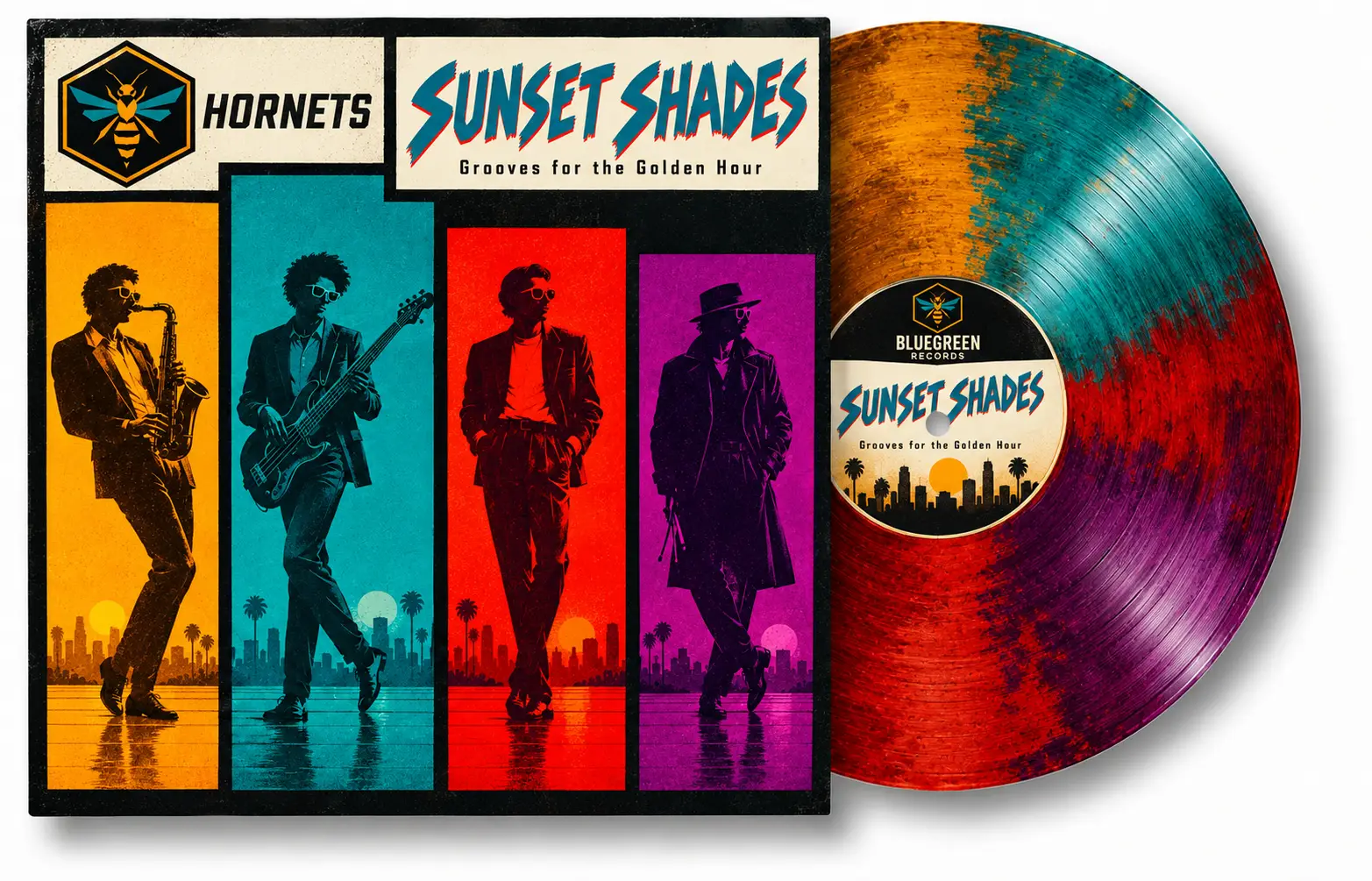
Full Album Mix (38:53)
AI Process/Open Source Software: HUMAN, Google Flow Music (Lyria 3.5), Claude.ai, ChatGPT, Perchance.org – DAW: Audacity 4 (alpha), OS: Linux (Ubuntu 26.04)
HORNETS: SUNSET SHADES (1986) – Full Album Mix (38:53)
Download Free Full Mix MP3 (89.4 MB)
Get Stung
Are you familiar with the 1986 album by Yellowjackets, “Shades?”
This is not that.
This is my attempt to recreate a particular feeling I found in that record, the sleek, sophisticated, impossibly musical world of mid-1980s jazz fusion, where jazz could wear an R&B groove, pop could borrow jazz harmony, and a studio could become an instrument in its own right.
I approached HORNETS: SUNSET SHADES (1986) with nothing but respect and admiration for one of my favorite records of all time. This isn’t an exercise in trying to reproduce someone else’s music note for note. It’s more like walking back into a room I remember vividly and seeing what happens when I turn the lights on again.
The palette is deliberately rooted in 1986, glassy tenor and soprano saxophones carrying melodies you can actually hum, fretless and slap electric bass sitting deep in the pocket while occasionally answering the sax almost like a second voice, warm electric piano, lush synthesizer pads, bright brass accents, and acoustic piano voicings full of sevenths, suspended chords, ninths and elevenths.
Then there are the drums. Tight. Punchy. Funky. A little gated reverb on the snare. Crisp hi-hats. Restrained fills. A shaker or conga appearing just long enough to add some human texture. And, here and there, the unmistakable ghost of an early drum machine quietly reminding us that 1986 was already beginning to blur the boundary between the player and the programmed machine.
That’s part of what I love about this particular musical era. It was polished without necessarily being sterile. Technology was becoming increasingly sophisticated, but the best records still sounded like people making music together.
That tension is important to me.
I’m a “traditional” composer who has increasingly found myself working alongside AI as another instrument in the creative process. I don’t see that as replacing the human musician, any more than a synthesizer replaced the pianist or a drum machine eliminated the drummer. The interesting question has never really been whether the machine can make something. The interesting question is what we choose to make with it.
So I gave the machines a very specific room to play in. A mid-80s Los Angeles studio. A small quartet. A saxophone with something to say. A bass player who refuses to merely keep time. Keyboards glowing somewhere between analog warmth and early digital glass. Drums sitting precisely inside the pocket. Songs that know when to develop an idea and, perhaps more importantly, when to get out of its way.
The result is HORNETS: SUNSET SHADES (1986).
It’s imagined music from an imagined afternoon in that imagined studio, but the musical language is very real. The harmonies, the grooves, the textures, the restraint, the little imperfections we choose to leave intact… those are all part of the conversation.
And perhaps that’s what I really wanted to preserve.
Not Shades itself. The feeling of discovering music like that for the first time. So put it on. Turn it up just enough. Let the saxophone find you. And for a little while, let 1986 happen again.
JJ, Sound Designer
Full Album-Wide Text-To-Music Prompt
Instrumental 1986s jazz fusion with a polished R&B and pop-jazz sheen, in the style of a mid-80s Los Angeles studio quartet. Lead voice is a soulful, glassy-toned tenor/soprano saxophone playing singable, hook-driven melodies with smooth legato phrasing and occasional bluesy bends. The sax is often mirrored almost melodically by the fretless and slap-capable electric bass, fat and melodic, locked into a tight pocket serving as both part of the rhythm section and sax melody. Keyboards are the harmonic centerpiece: warm FM electric piano (DX7-style Rhodes tones), lush analog-style synth pads, bright sampled-sounding brass stabs, and a crisp acoustic piano for solos with sophisticated jazz voicings (major 7ths, suspended chords, 9th/11th extensions). Drums are a punchy, tight R&B-funk groove with a gated-reverb snare, crisp hi-hats, restrained fills, and light shaker/congas for percussion color. Occasional programmed drum-machine layers underneath live drums. Mid-tempo groove, 90-110 BPM, with a few brighter up-tempo moments. Clean, glossy 1986 digital studio production: wide stereo chorus on the keys, short plate reverb, polished but still musical and human. Song structures are compact (about 4 minutes each) with a clear head melody, a bridge, a concise sax or keyboard solo, and a tight return to the theme. Sophisticated but accessible, warm, urbane, and groove-forward, with no vocals.