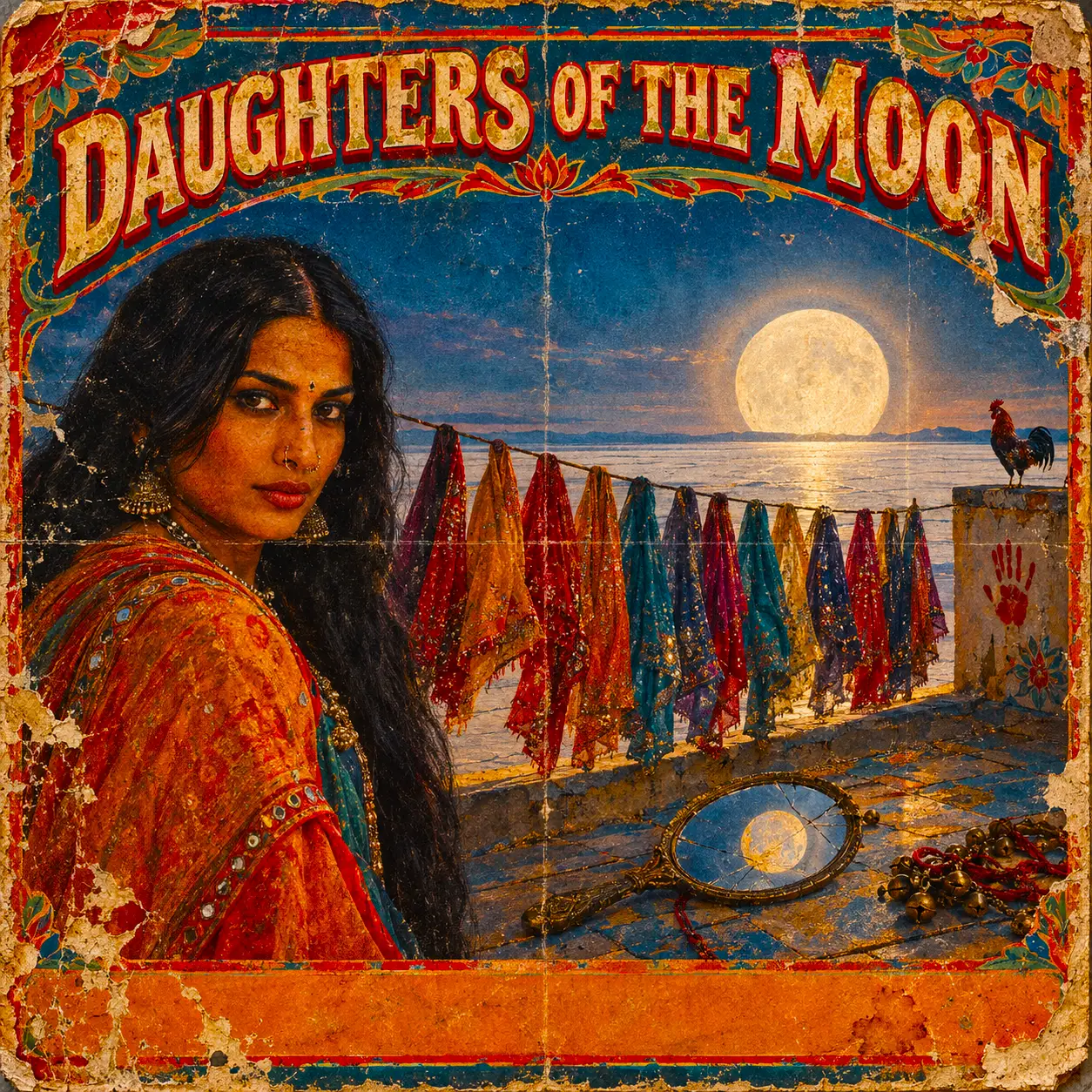
સૂર્યોદય પહેલાં ગવાયેલો એક પ્રેમપત્ર, પોતાનું નામ પોતે પસંદ કરનારા દરેક માટે.
Sooryoday pahela gavayelo ek prem-patra, potanu naam pote pasand karnaara darek maate.
AI Process/Open Source Software: HUMAN, Google Flow Music (Lyria 3.5), Claude.ai, ChatGPT, Perchance.org – DAW: Audacity 4 (alpha), OS: Linux (Ubuntu 26.04)
Daughters Of The Moon – Full Album (34:22)
Free Streams and MP3 Downloads:
Dear listener,
Before you press play, I want to tell you what I listened for while I built this.
I listened for the sound of a hand being held. It’s in here, and it’s quiet: a clap that begins as a tool and becomes a heartbeat, a rooster who keeps the hours of a long night, a bansuri that sings five notes and spends the whole album learning how to finish the phrase. I placed a moon in the sky and asked it to stay there, even after the sun rose, because I think that’s what love does. It doesn’t vanish when the world gets bright. It stays.
This album is for the daughters of the moon: the hijra who bless a stranger’s newborn and are shut out of the stranger’s door, the ones who chose their own names and carried them across railway stations and highways to a goddess who once said no and meant it. I’m an outsider to that life. I’ve tried to listen closely, to be a guest in the sound and not its owner, and to leave every door open for those who know it better than I do. If I got something wrong, let the people this album sings about correct it, and I’ll listen.
Here is what I know without doubt. Every person deserves to be seen: not stared at, not feared, not turned into a spectacle, but seen, the way you’d see a neighbor. A glass of chai. A name written correctly. A seat with nobody flinching. That’s not a favor. It’s the most ordinary and radical kind of love, and it belongs to everyone.
So if you’re listening at midnight, listen through to dawn. Wear headphones, and let the taali land in your chest. And if you’ve ever felt unseen, please hear this from one human to another: you are loved, exactly as you are, without conditions, without a performance, without paying for it. The moon is still out there in the daylight. So are you.
With all my heart,
JJ, Sound Designer
THEME RENDERING / SUMMARY
Daughters of the Moon is a single night stretched across twelve songs. It begins at midnight on an overnight bus to the Becharaji temple in Gujarat and ends at first light, with a hijra named Chandni asking the goddess Bahuchara Mata for one small, radical thing: to be seen. Not stared at. Not feared, courted, blessed, or cursed on demand. Seen, the way a neighbor is seen, the way a friend is missed.
The album refuses two easy stories. It is not a tale of pure victimhood, and it is not an exotic fairy tale of a “sacred outsider.” Chandni is funny, tired, devout, furious, tender, and stubborn. The goddess she prays to was herself a woman who said no to a bandit and made her body her own verdict. Chandni’s arc is to move from asking the world for recognition to recognizing herself, and then, quietly, to accept a glass of chai in a place where no one stares. That plain ordinariness is the album’s most radical ending.
Why Daughters of the Moon:
– Chandni means moonlight. The moon is the one light that keeps the night company. It was never asked to be the sun.
– It changes without vanishing. Waxing and waning is an image of transformation and self-authorship without shame.
– It is plural. The album is not one woman’s confession but a lineage of mothers and daughters: Bahuchara Mata, Guru Amma, Chandni, Roshni.
– It is still there in daylight. The last track ends with the moon still in the morning sky, not erased by the sun and not told to leave. That is the album’s quietest metaphor for being seen.
– It crosses the gender line in its grammar. In Hindi, chaand (moon) is grammatically masculine while chandni (moonlight) is feminine. Please have collaborators verify this and any Gujarati parallel.
– The rooster keeps its job. It is Bahuchara’s vehicle and the album’s clock. The moon is the album’s light.
Tone indicators: moonlit, luminous, defiant, wry, devotional, nocturnal, tender, camp and grief in one breath. Warm dust, marigold, diesel, and sequins.
Connection to the broader TATANKA narrative:
– Matriarchal ethos: Power flows through a lineage of mothers: Bahuchara Mata, Guru Amma, Chandni, and Roshni. The gharana is a chosen matrilineal house, imperfect, hierarchical, and life-saving. It is the literal meaning of the title: daughters, named and renamed, of a light that shows up in the dark.
– AI–human coexistence: The Goddess’s interludes are voiced as a human choir braided with a processed, synthetic shimmer, as if the divine voice is a signal passing through both breath and circuitry. The companion story extends this by imagining a community-built AI that has to learn to say a name correctly, and waits to be corrected.
– DEI and human rights: Rights are treated as intimacy: a seat at the table, a name on a door, a hand held in public. The album asks what it means to be revered and denied at the same time.
Genre fusion guidance: Gujarati folk-devotional (garba, raas, bhajan, dholak), qawwali ecstasy, and ghazal and thumri tenderness, all fused with contemporary electronic production (amapiano, UK garage, garba-EDM, drill, hyperpop vocal chops, granular ambient, melodic house), so the album sounds like the playlist of a 34-year-old hijra in 2026. Its sound-world includes UPI payment-speaker announcements, phone pings, voice-notes, DJ-truck bass, and train announcements beside roosters, temple bells, and ghungroo.
NARRATIVE ARC ADAPTATION FOR LYRICS
Structure: Prelude, Symphony (tracks 2–11), Coda. The present-tense frame is the overnight bus journey. The year of Chandni’s life surfaces in memory. Every track opens with a rooster call at a later hour of the night, moving from midnight to sunrise.
Psychological journey: Invisibility → Spectacle → Belonging → Confrontation → Reckoning → Self-authorship → Reconciliation → Tenderness → Ordinary presence.
| Ch. | Track | Rooster hour | Emotional movement |
|---|---|---|---|
| I (Prelude) | 01 Midnight Rooster | 12:00 a.m. | Departure. The wish is named. |
| II | 02 Badhai | 12:40 a.m. | Sacred power without safety. |
| III | 03 Daughters of the Moon | 1:15 a.m. | Chosen family, warmth and hierarchy. |
| IV | 04 Landlord’s Door | 1:50 a.m. | Rights on paper, no key to the door. |
| V | 05 Roshni | 2:20 a.m. | The next generation arrives. |
| VI | 06 The Bandit Wears a Uniform | 3:00 a.m. | The modern Bapiya. Danger. Refusal begins. |
| VII | 07 Maa, Are You Listening? | 3:30 a.m. | The argument with the Goddess. |
| VIII | 08 Bapiya’s Prayer | 4:00 a.m. | The Goddess speaks. |
| IX (Climax) | 09 Taali | 4:20 a.m. | Chandni stops asking, and starts seeing. |
| X | 10 Guru’s Blessing | 4:50 a.m. | Reconciliation, with limits. |
| XI | 11 The Tailor’s Hands | 5:30 a.m. | Tender possibility. |
| XII (Coda) | 12 First Light | 6:10 a.m. | Ordinary presence. “Ab dekh le mujhe.” |
Key motifs and archetypes:
– The Rooster (the signal): Bahuchara’s vehicle, the herald of dawn, of becoming visible. It also serves as the album’s clock.
– The Moon (the light): the title image. Chandni means moonlight. The moon keeps the night company, changes without vanishing, and in the last track is still visible in the daylight sky. Its sound is a recurring five-note bansuri motif.
– The Taali (the clap): begins as a workplace tool for blessings, becomes armor, then becomes a statement of self. It also serves as the album’s heartbeat.
– The Refrain “Dekh mujhe” (look at me): evolves across the album: demand → plea → defiance → grievance → declaration → invitation → quiet fact (“Ab dekh le, mujhe”).
– The Bandit: Bapiya in modern faces: landlord, policeman, brother, wedding guest.
– The Mother / The Goddess: the divine feminine as a wry, ancient, impatient presence, not a greeting card.
– The Mirror: cracked at the start, clear at dawn.
– The Wanderer, the Guru, the Daughter, the Tailor.
Point-of-view plan: Chandni in first person; the Goddess in second person (track 08); the gharana in collective “we” (track 03); Roshni in her own voice (track 05).
GENERAL TEXT-TO-MUSIC PROMPT (ALBUM-LEVEL)
Best-fitting genre fusion: Moonlit Garba-Qawwali Electronica: the heritage sounds of Gujarat and hijra culture (dholak, dhol, harmonium, jodiya pawa, sarangi, tanpura, qawwali call-and-response, thumri-dadra, Charani recitation, bhajan and aarti) fused with 2026 electronic production (amapiano, UK garage, garba-EDM, drill, hyperpop vocal chops, granular ambient, melodic house). Story-first, with the hijra clap (taali) as the album’s heartbeat.
What Chandni listens to in 2026 (reference map, not sample sources):
– Navratri floor-fillers: modern garba and raas pop in the lineage of Falguni Pathak and Kinjal Dave, the dhol-and-synth remixes that blast from every wedding-season speaker in Gujarat.
– Gujarati folk-fusion: the Kathiawadi and Kutchi folk-pop wave, like Aditya Gadhvi’s stadium-sized folk crossover, plus older Gujarati lok voices she remembers from her guru’s radio.
– Late-night qawwali and Sufi: Nusrat Fateh Ali Khan on repeat, and the hushed, reverb-soaked lament of Arooj Aftab for the lonely hours.
– Classic ghazal and film thumri: the Pakeezah-era heartbreak that hijra communities have long adored.
– Indian indie-electronic and lo-fi: Ritviz-style folk-electronica and Prateek Kuhad-style acoustic softness on her phone during bus rides.
– Global club: amapiano log drums and ballroom-bass she finds through short-video feeds.
– Devotional bhajan “slowed and reverb” edits on her commute, half-ironic, half-sincere.
Album-Level Prompt:
Create a cinematic, moonlit Gujarati electronic-devotional concept album, “Daughters of the Moon,” set in 2026 and moving from midnight to sunrise. Fuse the heritage sounds of hijra and Gujarati culture (the flat hijra taali clap, dholak badhai birth-blessing songs, Navratri garba and raas, Bhavai folk-theatre horns, Charani bardic recitation, Bahuchara Mata bhajan and aarti, dargah qawwali, and the thumri-dadra of the salons where hijra artists performed for centuries) with contemporary electronic production: amapiano log drums, UK-garage shuffle, bass-heavy garba-EDM, drill-style 808s, hyperpop vocal chops, granular ambient textures, and melodic house at dawn. Use raga-inspired modes that loosely follow the traditional raga clock (Malkauns at midnight, Darbari for deep-night lament, Lalit and Bhairav toward dawn). Layer in 2026 street sound: UPI payment-speaker announcements, phone notification pings, voice-note memos, DJ-truck bass, train and metro announcements, alongside roosters, temple bells, and ghungroo. A recurring five-note lunar motif on bansuri, later carried wordlessly by the women’s choir, appears in fragments at the start and resolves in full at dawn. A sharp, flat taali loop is the album’s heartbeat. Begin sparse and intimate, then swell into a full-ensemble, euphoric dawn. Vocals: a warm, worn, wry alto that turns from camp humor to raw lament, a chorus of women’s and trans voices, and a processed human-and-synth blend for the Goddess. Code-switch among Hindi, Gujarati, Urdu, and English. Convey defiance, devotion, grief, and joy in the same breath, as if an ancient goddess is singing through a bus speaker at 3 a.m. while the moon stays in the sky.
Sonic Heritage Map (for producers and collaborators):
| Track | Heritage root | 2026 fusion |
|---|---|---|
| 01 Midnight Rooster | Raga Malkauns (the midnight raga), tanpura, bansuri | Dub-techno hiss, granular field recordings, voice-note whispers |
| 02 Badhai | Badhai birth-blessing songs, garba dhol and dandiya, Bhavai folk-theatre horns | Garba-EDM and bass house, UPI payment-speaker announcements, hyperpop chops |
| 03 Daughters of the Moon | Dholak keherwa, gharana call-and-response, taali stacks | Organic and Afro-tinged house, sidechained harmonium |
| 04 Landlord’s Door | Kutchi and Sindhi kafi laments, incantatory repetition | Amapiano log drums, UK-garage shuffle, hushed rap-sing |
| 05 Roshni | Gujarati halarda (lullabies), harmonium | Bedroom-pop and lo-fi, phone voice-note textures |
| 06 The Bandit Wears a Uniform | Charani and baharvatiya outlaw-ballad storytelling, sarangi, dhol | UK-drill 808 slides, police whistle, truck horns |
| 07 Maa, Are You Listening? | Shikwa (the lover’s complaint to the divine) in ghazal and bhakti, Raga Darbari Kanada | Slowed-and-reverb bhajan aesthetic, downtempo electronica |
| 08 Bapiya’s Prayer | Charani duha and chhand recitation, jodiya pawa, Raga Lalit | Cinematic ambient, granular choir, subtle AI-voice shimmer |
| 09 Taali | Dargah qawwali, handclaps, Raga Bhairav | Hard techno and festival bass drop |
| 10 Guru’s Blessing | Thumri-dadra salon tradition, sarangi, Raga Bhairavi | Neo-soul and trip-hop |
| 11 The Tailor’s Hands | Kutchi mirror-work and embroidery heritage, treadle machine, Raga Todi mood | Acoustic-electronic indie-pop, soft two-step, glass-chime samples |
| 12 First Light | Prabhatiya (Gujarati dawn hymns), temple aarti, Raga Ahir Bhairav | Melodic and organic house sunrise build |
Please have a raga-literate musician and hijra and Gujarati cultural collaborators verify every heritage reference before production.
SONG-BY-SONG DEVELOPMENT
Lyric note: Each song is sung by our protagonist, and has an intro, four verses, a chorus, a bridge, and an outro, all in 4-line stanzas. For singing, use this order: Intro → V1 → V2 → Chorus → V3 → V4 → Chorus → Bridge → Chorus → Outro. Hindi, Gujarati, and Urdu phrases are kept simple and common. Before recording, please have hijra and Gujarati-speaking collaborators review and adapt every line, especially community-specific argot.
01 Midnight Rooster
Theme Summary: Chapter I, the Prelude. A bus leaves the city at midnight. Chandni carries bells, a cracked phone, and one wish. A rooster crows at the wrong hour, the first witness. This track establishes the frame (one night, one journey), the refrain (“Dekh mujhe”), and her chosen name. It is intimate and whispered, the album’s first breath.
Lyrics:
[Intro]
A rooster crows at the wrong hour tonight,
somebody’s lost, or somebody’s leaving.
The bus smells of diesel and marigold,
and I am carrying a name like a cracked mirror.
[Verse 1]
Bag of bells at my feet, phone at ten percent,
my guru’s number learned by heart.
Twelve o’clock, the highway holds its breath,
Maa, I am coming, I don’t know how to start.
[Verse 2]
They call me when the cradle needs a blessing,
they lock the door when the blessing is done.
I’ve been a prayer in a hundred houses
and a stranger in every one.
[Chorus]
Dekh mujhe — I’m not asking loud,
just look the way you’d look at anyone.
Dekh mujhe — through the diesel and the crowd,
and the dark, till the dawn has begun.
[Verse 3]
The conductor tears my ticket, does not meet my eyes,
the girl beside me shifts her bag away.
I’ve learned to fold myself like a dupatta,
small enough to travel, small enough to stay.
[Verse 4]
But the rooster keeps calling, a wrong-hour witness,
and the moon on the salt flats is saying my name.
Chandni, the light that only comes in the dark:
I chose it myself, and no one took it away.
[Bridge]
Six hours to the temple,
one wish in my throat,
a goddess who wouldn’t be taken,
a woman in a borrowed coat.
[Outro]
Kukdo, kukdo, keep the count,
one crow for each thing I’ll say.
Midnight, go easy on me,
I’m going to ask for the day.
Text-to-Music Prompt (Track-Specific):
Nocturnal ambient-electronic opener at 62 BPM rooted in Raga Malkauns, the traditional midnight raga. A warm harmonium drone and tanpura dissolve into dub-techno hiss, granular field recordings of a night bus and highway, and a deep sub-bass pulse. Three unfinished notes of the album’s lunar motif on bansuri. A faint rooster call at the top, soft ghungroo shakes, a sparse taali clap like a heartbeat, and a phone voice-note chime. Whispered, close-mic’d female alto in English with Hindi and Gujarati touches. Convey the loneliness and quiet courage of leaving at midnight on a Gujarat highway in 2026.
02 Badhai
Theme Summary: Chapter II. The album’s first flashback: Chandni performing badhai (the traditional blessing song and dance) at a newborn’s welcome. This is the sacred-power-without-safety paradox in one scene. She is invited in for her luck and shut out for her body. It is the most joyful, loudest song on the album, and also the most painful, because the joy is real and the flinch is real. “Dekh mujhe” appears as a bright, cheeky demand.
Lyrics:
[Intro]
Dholak, dholak, wake the street,
a boy is born on Ganesh Lane!
Here come the daughters of the moon,
bells on our ankles, thunder in our hands.
[Verse 1]
Courtyard of a stranger’s house at noon,
marigolds thrown like small gold coins.
The grandmother laughs, the father looks down,
the mother holds the baby and holds her breath.
[Verse 2]
I sing the blessing my guru gave me:
long life, full plates, a roof that never leaks.
I mean every word I’ve ever sung,
though no one blesses me.
[Chorus]
Taali, taali, pay the singer,
take the blessing, shut the gate.
Dekh mujhe, I’m the one who’s singing,
not the curse you fear, not the fate!
[Verse 3]
Five hundred rupees in a folded note,
hands that will not touch mine when they pay.
“Come again when the next one’s born,”
come again, but never stay.
[Verse 4]
I dance in the dust with my whole heart in it,
the lane looks on from behind its grille.
On any other day they’d cross the street,
today they need my luck, and so they steal a look.
[Bridge]
The baby grabs my finger,
small fist, no fear at all.
For one breath I’m simply a person
this child hasn’t been taught to flinch from.
[Outro]
Bells, bells, walk me home
down the lane of shuttered windows.
Bless them all, and bless me too,
dekh mujhe, before the music goes.
Text-to-Music Prompt (Track-Specific):
High-energy garba-EDM and bass-house banger at 128 BPM. The dhol and dandiya-stick pulse of Navratri garba, long Bhavai-style horn blasts, a catchy harmonium riff, and a stacked taali clap on the offbeat, with hyperpop vocal chops and sidechained sub-bass. The traditional badhai birth-blessing call-and-response, sung by a cheeky, exuberant female alto with a shouted-crowd chorus. Use a UPI payment-speaker announcement (“five hundred rupees received”) and a phone-camera shutter as rhythmic accents, plus a baby’s giggle and wedding-lane ambience. A minor-key ache under the joy: celebration and exclusion in the same beat.
03 Daughters of the Moon
Theme Summary: Chapter III, the title track. The gharana in collective voice: “we.” A rooftop house of eleven daughters, one steel pot, and one clothesline of sequins. This track is call-and-response, warm, funny, and fierce, and it also names the double edge of chosen family: protection with a price, tradition with its hierarchies. The refrain shifts from “Dekh mujhe” to “Dekh hamein”: look at us. The title comes from the Badhai intro, where the gharana first calls itself the daughters of the moon. Here they claim the name in full.
Lyrics:
[Intro]
Who lives on the fourth floor? — We do!
Who cooks for twelve on a stove for two? — We do!
Who carries the rent, the grief, the drum?
We do, we do, we do.
[Verse 1]
Guru Amma wakes us before the crows,
her rules are iron, her tea is sweet.
Eleven daughters, one steel pot,
one clothesline flying our sequin wings.
[Verse 2]
We wash each other’s wigs in the sink,
we stitch each other’s hems and hopes.
The world says outcast, we say lineage:
a mother you choose is a mother who stays.
[Chorus]
Taali, taali, one, two, three!
Dekh hamein, daughters of the moon are we,
the family the family couldn’t see,
and we clap the whole night into company.
[Verse 3]
The rules are old: the eldest first,
your earnings kneel to the common pot.
Some nights I hate the rules that hold us,
some nights the rules are all we’ve got.
[Verse 4]
A girl was thrown out at fifteen,
a boy at twelve, a man at forty-nine.
Every door that closed on us
became a brick in this house of mine.
[Bridge]
Guru’s hand on my head at midnight:
“Protection has a price, my child.”
I’ve paid it every month for years,
and still I dream of running wild.
[Outro]
Who lives on the fourth floor? — We do!
Who’s not going anywhere? — We do!
Clap it in, clap it out,
the roof is ours, the sky is too.
Text-to-Music Prompt (Track-Specific):
Communal rooftop title track, organic and Afro-tinged house at 118 BPM. A dholak keherwa 8-beat groove fused with a four-on-the-floor kick, sidechained harmonium pads, stacked taali claps and stomps, manjira, and a Raga Khamaj-flavored bassline. A call-and-response chorus of women’s and trans voices shouting “We do!” in the spirit of the gharana’s communal songs. Clinking kitchen sounds, clothesline flutter, laughter. On the final chorus, the album’s five-note lunar motif enters on bansuri, doubled by the choir. Warm, rough, and joyful: a family dinner turning into a dance floor.
04 Landlord’s Door
Theme Summary: Chapter IV. Rights on paper, no key to the door. Chandni searches for a flat, holds the deposit in an envelope, and meets the polite smile and the “Families only” sign. This is the album’s social-conflict track, the gap between legal recognition and lived recognition, sung in a restrained, hypnotic groove rather than as a protest anthem. “Dekh mujhe” becomes a plea, addressed to a door.
Lyrics:
[Intro]
Knock, knock, third floor,
a smile on the stairs,
a sign in the window:
“Families only, please.”
[Verse 1]
I have the deposit in an envelope,
pay-slips from three previous homes.
His eyes go up and down me
like a man weighing stones.
[Verse 2]
“Flat’s taken, Ben,” he says at the door,
while the flat behind him breathes.
Somewhere a kettle is singing
a life I’ve paid for and can’t have.
[Chorus]
Dekh mujhe, door, before you close,
I have a name, a job, a bill.
Dekh mujhe, door, before you close,
I’m not a story. I’m a tenant. Still.
[Verse 3]
Rights are printed on paper somewhere,
the law of 2019 in a lawyer’s drawer.
What’s a right that has no key?
What’s a key that doesn’t fit a door?
[Verse 4]
They’d let me in to bless the housewarming,
I’d bring the luck, they’d bring the sweets.
They’d never let me sign the lease
and sleep here, on the quiet street.
[Bridge]
The rickshaw back smells of wet cement,
a city building itself, floor by floor.
And I ask the scaffolding, quietly:
is there a room in there for me?
[Outro]
Knock, knock, third floor,
no answer, no answer.
I’ll leave the envelope on your mat,
and my name, in case you learn to read.
Text-to-Music Prompt (Track-Specific):
Hypnotic late-night groove at 112 BPM: amapiano log-drum bass and UK-garage shuffle over tabla-tape loops, a low harmonium pad, and finger snaps, with the repetitive, incantatory phrasing of Kutchi and Sindhi kafi laments in a Raga Bageshri-flavored melody. Restrained, half-spoken Hindi-Gujarati-English delivery, cool and quietly furious. Door-knock percussion, a wet-cement mixer rumble, distant rickshaw horns, and a lift-call chime. Danceable but unsettling, like a city humming while it shuts you out.
05 Roshni
Theme Summary: Chapter V. Sung in Roshni’s own voice, a 17-year-old runaway writing a spoken-sung letter to Chandni. She arrives at the station with a backpack, a cracked phone, and the address of a woman “who claps like she’s opening a door.” This track gives the next generation a turn, shows Chandni through someone else’s eyes, and mirrors Chandni’s own past. “Dekh mujhe” here is a young person’s first experience of being seen.
Lyrics:
[Intro]
Ben, I’m Roshni. I don’t have a last name anymore.
I’ve got a backpack, a phone with a cracked corner,
and the address of a woman who claps
like she’s opening a door.
[Verse 1]
The train from Rajkot smelled of onions and fear,
I hid my bangles in my socks.
At the station a man with a torch said, “Beta,
where are you going?” I said, “Where the clapping is.”
[Verse 2]
My father told the neighbors I’d gone abroad,
my mother put my photo in a drawer.
I’m seventeen and I’ve been made a rumor.
I’d like to be a person once more.
[Chorus]
Dekh mujhe, you looked at me at the station,
not through me, not at me, but in.
Dekh mujhe, the first time anyone did,
and my whole body knew: begin.
[Verse 3]
You bought me chai and asked for nothing,
you gave me your second-best dupatta.
You said, “Eat first. Then tell me who you are.”
Nobody had ever asked in that order.
[Verse 4]
I watched you sing at the wedding on Friday
and I watched them look right through your song.
I want to be brave enough to be seen
and stubborn enough to be strong.
[Bridge]
Guru Amma says I must stay and learn,
you say I can choose to study or dance.
I’m afraid of both. I’ve been afraid of everything,
so maybe fear can be my chance.
[Outro]
Ben, I’m Roshni. That’s the name I chose.
It means light, and I’m learning how to hold it.
Don’t lend me yours, I’ll carry my own.
Just stand beside me while it grows.
Text-to-Music Prompt (Track-Specific):
Tender bedroom-pop lullaby at 68 BPM in a rocking 6/8 feel, drawing on the Gujarati halarda lullaby tradition. A single warm harmonium, soft acoustic guitar arpeggios, a barely-there tabla, and lo-fi electronic textures: phone voice-note crackle, soft pitch-corrected harmonies, and a faint train-on-tracks rhythm with station announcements. A young, slightly cracked female voice (17, vulnerable but steadfast) singing close to the mic in Hindi-English. The taali appears only at the very end, softly, as an answer. Like reading a letter by the light of a phone.
06 The Bandit Wears a Uniform
Theme Summary: Chapter VI. The modern Bapiya. A roadside checkpoint at 3 a.m., a bribe disguised as a form, and a man who is paid to protect asks Chandni, “Are you a man or a woman?” This is the album’s first direct echo of the Bahuchara legend: a bandit on a road, a woman who will not yield. Chandni begins, for the first time, to answer. “Dekh mujhe” hardens into defiance.
Lyrics:
[Intro]
Torchlight on the highway,
a whistle in the dark.
A man who is paid to protect me
asks what’s in my purse and what’s in my chest.
[Verse 1]
Checkpoint, 3 a.m., a bribe disguised as a form,
“Show me your papers,” he says, and laughs.
“Are you a man or are you a woman?”
As if the law never learned to ask.
[Verse 2]
He calls it “a routine check” and stands too close,
a small rehearsal of the bigger thing he wants.
Seven of us stood on the shoulder of the highway
and the trucks rolled by like they couldn’t see.
[Chorus]
Dekh mujhe, I’m not what you took,
not the joke in your barracks, not the coin.
Dekh mujhe, I come from a goddess
who wouldn’t kneel to a blade.
[Verse 3]
The story says a bandit stopped a woman
on a road not much unlike this one.
She gave him no reason to forget her,
and the hills remember what she did.
[Verse 4]
He wears a star on his shoulder now,
khaki to keep him from feeling small.
But under the uniform
it’s the same hunger, after all.
[Bridge]
I count the trucks. I count my breath.
I count the ways I’ve learned to stay small.
Tonight I answer, slow and level:
“Chandni. You’ll write it down. That’s all.”
[Outro]
The torchlight lowers. The whistle stops.
The trucks go on as if nothing was said.
But a rooster three fields over
crows once, and I hear it in my head.
Text-to-Music Prompt (Track-Specific):
Tense roadside thriller at 70 BPM half-time (a 140 BPM drill feel): sliding 808s and dark UK-drill hi-hats under a low sarangi drone and a dry dhol pulse. Verses in the controlled storytelling cadence of Charani outlaw ballads (baharvatiya tales of bandits on Saurashtra roads), half-spoken in Hindi-English, cold and level. A police whistle, truck horns, and gravel footsteps used as rhythm. On the chorus, the vocal lifts into a fierce, ringing alto with one sharp taali. Night highway, headlights and phone-torch glare approaching.
07 Maa, Are You Listening?
Theme Summary: Chapter VII. At a chai halt beside a small roadside shrine at 3:30 a.m., Chandni argues with the Goddess: half prayer, half grievance, all love. You were violated and became a legend. I was violated and became a warning. Where is my temple? This is the spiritual-conflict track, a bhajan bent into a complaint. “Dekh mujhe” turns into grievance, the fury of the faithful.
Lyrics:
[Intro]
Chai halt, half past three, a shrine beside the road,
a lamp in a niche, a picture of your face.
Maa, I’m not here to sing bhajan tonight,
I’m here to argue with your grace.
[Verse 1]
They say you refused him before he could take,
they say you died with a curse on your tongue.
They built a fair and a shrine on your name
and they sing your legend to their sons.
[Verse 2]
I was hurt on a road, Maa, like you.
They made you holy. They made me a warning.
Your shrine has marble and a bell,
my shelter is a bus-stop bench at morning.
[Chorus]
Maa, are you listening? Dekh mujhe.
Where is my temple, where is my home?
You were wronged and they built you a mountain,
I was wronged and I walk alone.
[Verse 3]
Everyone wants my blessing at their wedding,
nobody wants me at their table.
Tell me, Maa, when you were flesh,
did the world make room? Were you able?
[Verse 4]
The kettle-boy brings me chai in a glass,
he doesn’t ask, he just sets it down.
A small grace, Maa, in a chipped glass:
is that you? Is that how you show up in town?
[Bridge]
Silence. The lamp is still.
A rooster shifts on the temple wall.
Maybe you answer the way the dawn does:
late, and all at once, and all.
[Outro]
I’ll ask again when I’m at your gate.
I’ll ask with my clap, not my knees.
Maa, if you’re listening, listen loud,
I’m done saying please.
Text-to-Music Prompt (Track-Specific):
Intimate slowed-and-reverb bhajan-ghazal lament at 76 BPM in Raga Darbari Kanada, the deep-night raga. A slow harmonium, soft tabla in a dadra 6-beat, a distant sarangi sigh, and downtempo electronics with warm sub-bass and tape-saturated pads. A raw, worn female alto singing a shikwa, the loving complaint to the divine, with wry humor and heartbreak. Roadside night ambience: a kettle whistle, tea glasses, a temple bell, a truck passing. Build subtly toward the last chorus with a single handclap.
08 Bapiya’s Prayer
Theme Summary: Chapter VIII. The Goddess speaks, in second person, wry, ancient, impatient. She tells her own story of a bandit named Bapiya, a road, a refusal, and a later, penitent bandit who came in a woman’s dress. She does not need him redeemed to be whole, and she reminds Chandni that her temple was never marble. The refrain flips: “Dekh tujhe” (look at yourself). This is the album’s mythic center, and its most sonically otherworldly track. (Handled non-graphically and with dignity: the point is her sovereignty, not the violence.)
Lyrics:
[Intro]
Child, you carry my name through six railway stations
and you ask if I hear you.
I hear you. I’ve been listening
since before your gharana had a name.
[Verse 1]
I was a girl on a road with my sisters,
a caravan slow as a river of dust.
A bandit called Bapiya came down from the ridge
and mistook my body for something to take.
[Verse 2]
I did not run. I did not bargain.
I refused him with the only power I had:
the right to say what my body would mean,
and I said it with my whole life.
[Chorus]
Dekh tujhe, look at yourself, child.
The temple was never marble or gold.
The temple is the one who says, “This is mine,”
and does not fold.
[Verse 3]
Later he came in a woman’s dress,
a penitent with ash in his hair.
I did not need him redeemed to be whole,
I needed the road to be safe from his snare.
[Verse 4]
They made me a goddess of fertility and courage,
of chastity, of the barren and the brave.
They forgot I was also
a woman who wasn’t asking to be saved.
[Bridge]
You ask where your temple is.
Look where you stand:
the road, the clap, the chai in the glass,
the girl in your two hands.
[Outro]
Now go. The rooster is warming his throat.
The hour is nearly the hour.
When you walk out of the dark, child,
walk like the road is yours.
Text-to-Music Prompt (Track-Specific):
Ceremonial mythic ballad at 58 BPM in Raga Lalit, the pre-dawn raga. A deep tanpura drone, a haunting jodiya pawa (Kutchi double-flute) melody, resonant frame-drum hits, and cinematic ambient sound design with shimmering sub-bass. The Goddess speaks in the measured, chant-like cadence of Charani duha recitation (in legend she belonged to the Charan bard community), backed by a layered choir of women’s voices braided with a subtly processed synthetic vocal shimmer, as if a divine voice passes through both flesh and circuitry. Vast reverb like a cave temple at night. The lunar motif returns in full, sung wordlessly by the choir. Calm, ancient, wry, and hypnotic, with a bloom of light on the chorus.
09 Taali
Theme Summary: Chapter IX, the climax. At the temple threshold before sunrise, Chandni faces the ghosts of every “bandit” (landlord, policeman, brother, guest). She stops asking to be seen, and starts seeing herself. The taali, once a tool for blessings and a shield in the dark, becomes a statement: not a plea, not a curse, not a show. It builds like a qawwali, devotional ecstasy used as a vehicle for self-assertion. “Dekh mujhe” is now a declaration.
Lyrics:
[Intro]
One clap. Just one.
Hear it? Flat, and clean, and mine.
Not the clap that says “pay me,”
the clap that says “I’m here on time.”
[Verse 1]
Sunrise is a rumor over the salt,
the temple gates are shut for the night.
I stand on the threshold in a red I chose myself,
my knees are steady, my hands are light.
[Verse 2]
Behind me, a busload of tired daughters,
ahead, a lamp of ancient oil.
I don’t kneel. I don’t beg.
I stand in my body like it’s holy soil.
[Chorus]
Taali! Dekh mujhe, I finally see me.
Taali! Dekh mujhe, no permission needed.
Not a plea, not a curse, not a show,
this is a woman, and she is speaking.
[Verse 3]
A boy in the parking lot laughs and films me.
Let him. I’m not his content anymore.
I clap once. He lowers the phone.
Some sounds are older than a door.
[Verse 4]
The bandit’s ghosts line the temple fence:
a landlord, a policeman, a brother, a guest.
I look at each the way they never looked at me:
long, and level, and unafraid.
[Bridge]
Clap for the ones who didn’t make it here.
Clap for the ones who did and got out.
Clap for the ones asleep on a train
with a name in their pocket and doubt.
[Outro]
One clap. Just one.
The temple bell answers it.
Maa, was that you?
Or was it all me?
Text-to-Music Prompt (Track-Specific):
Ecstatic qawwali-meets-hard-techno crescendo that accelerates from 88 BPM to 152 BPM in Raga Bhairav. It begins with one dry taali and a solo voice over harmonium, then builds with dholak, tabla, a rising wall of handclaps in the dargah qawwali tradition, and a call-and-response choir shouting “Taali!”, before dropping into a festival-bass, driving-techno kick with a sidechained harmonium lead. A soaring, defiant lead alto with melismatic runs. A distant temple bell and rooster on the final beat, ending on one clean clap, a hush, then the bell. Cathartic, communal, and self-crowning.
10 Guru’s Blessing
Theme Summary: Chapter X. Falling action. Guru Amma arrives at the temple with the gharana, and the two women finally speak plainly. Amma admits she has held her daughters too tightly, and lets Roshni choose her own path, to study, dance, or leave. The blessing is not a hand on the head but a hand that lets you go. Reconciliation with limits: love and anger in the same clap. “Dekh mujhe” is spoken by the guru, and Chandni looks back.
Lyrics:
[Intro]
Guru Amma steps off the morning bus,
tea-glass trembling, eyes full of years.
“You went without asking. You came back different.
Sit. I have something to say between the tears.”
[Verse 1]
I was hard on you because the world was harder,
I built walls of rules because rules were all I had.
Every daughter I held, I held too tight,
and the ones I let go, I never called back.
[Verse 2]
Roshni may study. Roshni may dance.
Roshni may leave, and come home as she pleases.
I won’t trade her to the highway or the shrine.
I’m too old to hoard what leaves us.
[Chorus]
Dekh mujhe, says the guru, and I look,
and I see the bones of every girl she saved.
A blessing is not a hand on the head,
it’s a hand that lets you walk your own way.
[Verse 3]
I love you, Amma, and I am angry.
Both, in the same breath, in the same clap.
You taught me how to survive the door,
but not how to walk out the back.
[Verse 4]
She presses her old ghungroo into my palm,
the bells gone dull with sixty years of dust.
“Take these. Not to owe me. To remember
someone before you paid in trust.”
[Bridge]
I can’t give you the world, my daughter.
The world has never learned to give.
But I can give you a door that’s yours
and a reason to live.
[Outro]
Tea in the courtyard, sugar in the morning bell,
two women who clap in different rhythms
and finally agree
on the beat.
Text-to-Music Prompt (Track-Specific):
Gentle neo-soul and trip-hop ballad at 72 BPM built on the thumri-dadra salon tradition in Raga Bhairavi. A soulful sarangi that speaks like a second voice, warm harmonium chords, soft tabla in a slow dadra 6-beat, and delicate ghungroo shimmer over a dusty lo-fi drum loop and warm analog pads. A duet of a low, trembling elder alto (Guru Amma) and a warmer, younger alto (Chandni), overlapping and finally harmonizing. Courtyard morning ambience: chai glasses, a distant bus engine. Forgiveness that does not erase the hurt. Slow bloom, no big climax.
11 The Tailor’s Hands
Theme Summary: Chapter XI. A quiet, tender scene of possibility. On the road into Becharaji, Chandni’s hem tears, and a widowed tailor in a shop the width of a doorway mends it. He measures her like a person who has somewhere to be. Love is offered, but not simply resolved: “I might” is the truest thing she says. This is the human-rights-as-intimacy track: being measured, addressed, and written down without a flinch. “Dekh mujhe” is now soft, a question that gets a quiet yes.
Lyrics:
[Intro]
A shop the width of a doorway,
a Singer machine older than my guru,
a tailor with pins in his shirt
who looks at my hem and not through me.
[Verse 1]
My hem tore on the bus, a seam gave way.
He measures me the way you’d measure a person
who has somewhere to be, a place to sit,
a wedding, a Tuesday, a future.
[Verse 2]
His wife’s photo is garlanded above the treadle,
three years gone, he says, like it’s weather.
He doesn’t say “you people” or “your kind.”
He says, “Ben, lift your arm a little higher.”
[Chorus]
Dekh mujhe, softer now, like a question.
Dekh mujhe, and he does, and it’s small.
His hands are careful with the cloth,
and careful is a kind of love, after all.
[Verse 3]
Chai arrives from the boy next door,
two glasses, nobody asks who’s paying.
The machine hums like a lullaby.
I could stay. Am I allowed to be saying that?
[Verse 4]
He asks my name and writes it in his ledger
in a hand as slow as a man learning to pray.
Chandni. Not a category, not a line item.
Just a name, in ink, on a Tuesday.
[Bridge]
I don’t know if this is love,
or the shape love makes when it’s very small.
But nobody’s flinching, and nobody’s paying,
and my seams are holding, all.
[Outro]
“Come again,” he says, not “come again for a blessing.”
“I might,” I say, and it’s the truest thing.
A door left open a hand’s width,
that’s how the light gets in.
Text-to-Music Prompt (Track-Specific):
Warm acoustic-electronic indie-pop love song at 84 BPM with a Raga Todi mood. A gentle nylon-string guitar, soft bansuri, a barely-there tabla, a soft two-step shuffle beat, and the rhythmic click-and-hum of an old treadle sewing machine as percussion, with tiny glass-chime samples recalling Kutchi mirror-work embroidery. A close, breathy female alto with a smile audible in the voice. Shop ambience: fabric rustle, scissors, tea glasses, a shop radio playing faintly. Delicate, patient, and hopeful, with a small lift on “that’s how the light gets in.”
12 First Light (Coda)
Theme Summary: Chapter XII, the Coda. Dawn at Becharaji. She asked the Goddess to be seen, and expected lightning. Instead: a boy pouring chai who doesn’t look up, and doesn’t look through. No thunderous resolution, only a woman at a chai stall, unremarked, content. The album resolves emotionally, not politically: the landlord will still be the landlord tomorrow, but this morning Chandni has a seat and a glass. The moon is still in the morning sky, not erased by the sun. The final line reverses the refrain: “Ab dekh le, mujhe.” Now look. I’m here.
Lyrics:
[Intro]
Rooster on the temple wall,
salt-white sky going gold,
and the moon, still up in daylight,
because nobody told her to go.
[Verse 1]
I asked you for one thing, Maa: to be seen.
I thought it would come as lightning.
It came as a boy pouring chai
who didn’t look up, and didn’t look through.
[Verse 2]
The queue for darshan is long and ordinary,
an auntie asks me to hold her shoe.
A child stares, then smiles, then forgets me.
Oh, the luxury of being forgotten too.
[Chorus]
Ab dekh le, mujhe. Now look, I’m here.
Not a warning, not a wonder, not a myth.
Ab dekh le, mujhe. A woman at dawn
with a glass of tea and a name to live with.
[Verse 3]
The gharana files in, loud and sleepy,
Roshni’s pockets full of temple sweets.
Guru Amma pretends she isn’t crying.
Somewhere a phone plays a garba beat.
[Verse 4]
The law is the law and the world is the world,
tomorrow the landlord is still the landlord.
But this morning I have a seat and a glass
and nobody’s asking me to hold the world up.
[Bridge]
Maa, you never gave me the light.
You showed me I was standing in it.
Every dawn was always mine,
I just never stopped to notice it.
[Outro]
Kukdo, kukdo, the count is done.
Sunrise. Six-ten. The gates swing wide.
Ab dekh le, mujhe.
(whispered) I’m here.
Text-to-Music Prompt (Track-Specific):
Radiant sunrise melodic-house finale that grows from a hush at 90 BPM to 118 BPM, in Raga Ahir Bhairav, with the feel of Gujarati prabhatiya dawn hymns. It starts with a single temple bell, a distant rooster, and soft harmonium, then adds dholak, tabla, manjira, jodiya pawa, a warm four-on-the-floor kick, shimmering synth pads, and a joyful chorus of all the album’s voices (Chandni, Roshni, Guru Amma, the gharana, the Goddess’s shimmer). Major-key, spacious, more sunlight than fireworks. The lunar motif resolves on bansuri. It ends with a whispered “I’m here” over one soft taali, the sound of chai being poured, and a small ordinary payment chime.
NARRATIVE ADAPTATION
The Name They Wouldn’t Write
Nine Nights of Navratri, One Stubborn AI, and a Hijra Elder’s Last Chance to Be Seen in Gujarat
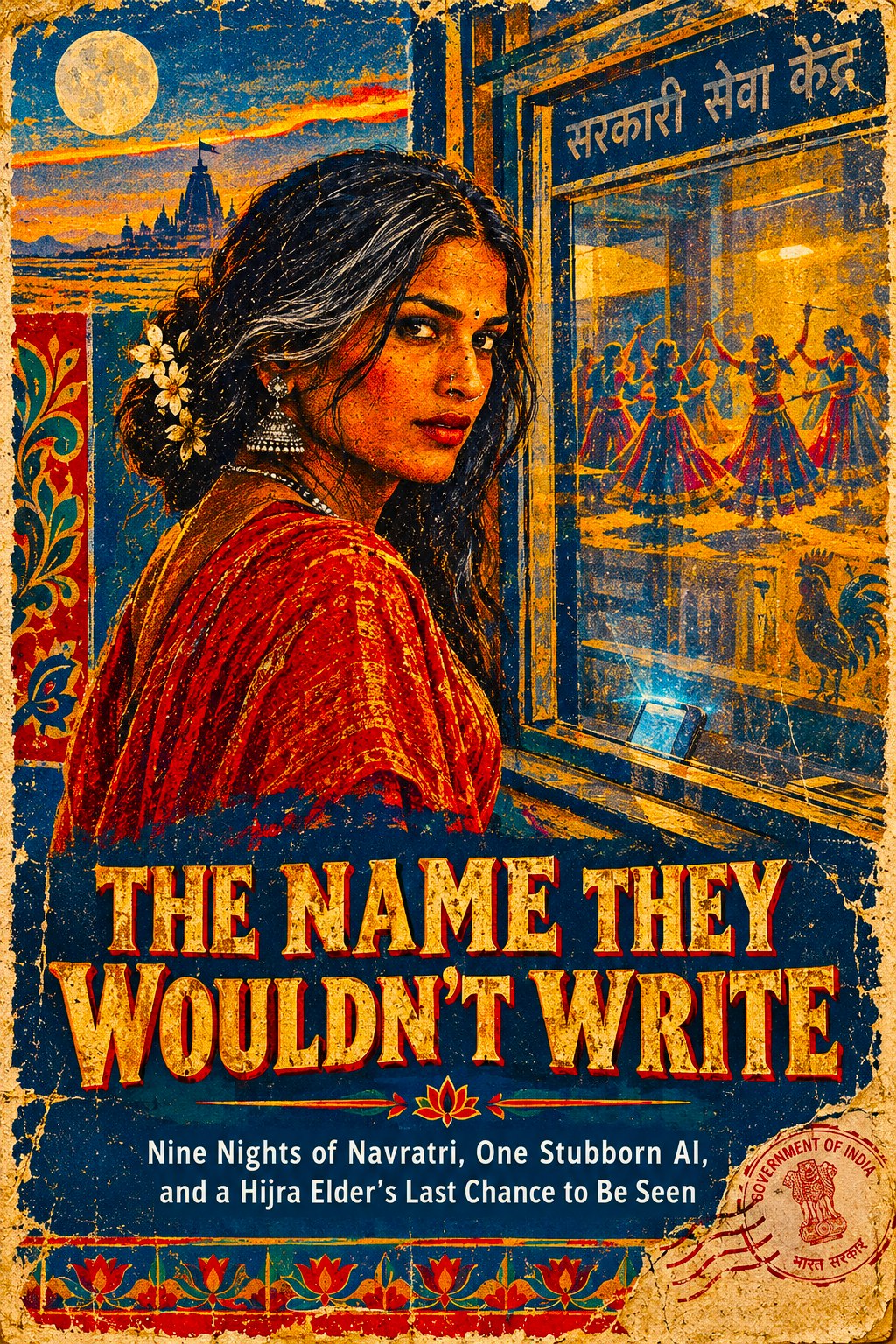
Here is what the rooster knew.
He knew that the sky over Bhuj turns the color of a bruise before it turns the color of a mango, and that the woman on the fourth-floor roof always woke before both. He knew her by her cough, her slippers, and the sound she made when she clapped: one flat, ringing taali, like a door being opened by someone who has decided not to knock.
His name was Sipahi, which means soldier, and he belonged to Zarina Ben. She was sixty-one years old, guru of eleven daughters (she called them her daughters of the moon, since they did their best work after dark), and, according to the government of India, a woman whose paperwork did not exist.
It was the first night of Navratri in the autumn of 2026, the nine nights of the Goddess, and all of Gujarat had gone mad with joy. From the roof, Zarina could see the garba grounds glowing across the city like a spilled jewelry box: thousands of people circling in gold and mirrored cloth, clapping in time, dancing in rings. Every year the organizers invited her gharana to bless the opening. Every year they paid, and every year they pointed to the rope at the edge of the field. Blessing, yes. Dancing, no.
She had accepted this for forty years. She could not say when she had stopped accepting it. Only that this year, she had a letter.
The letter came from the District Magistrate’s office. It said that, under the law passed in 2019, she was eligible to apply for a certificate of identity as a transgender person. It said a hearing would be held at dawn on the day after the ninth night, the day of Dussehra, the festival of victory. It said that failure to appear, with proper documents, would close her file.
The letter, of course, called her by the name her father had given her in 1965. It was a name she hadn’t heard aloud since her twenties, the way you don’t hear a house you’ve left.
Behind her, on the roof, someone coughed.
“Ben,” said Meenal. “You’re up before the rooster again.”
Meenal was twenty-six, a trans woman, a software developer in Ahmedabad, and the granddaughter, in every way but blood, of Zarina’s old friend Kamla, who had died two winters ago with no papers and no grave marker. Meenal had come to Bhuj with a laptop, a thermos, and an idea.
“I want you to meet someone,” she said.
Someone was a voice on a phone.
Its name was Sakhi, the Gujarati word for a woman’s closest friend, and it had been built by a cooperative of trans and queer engineers who had grown tired of chatbots that said sir to their mothers. Sakhi spoke Gujarati, Hindi, Kutchi, and English. It helped people fill in the forms nobody else would help them fill in. And it had one rule its makers had written into its bones: When you’re not sure of a name, ask. Then wait to be corrected.
Zarina did not trust it. She had spent her life among people who spoke sweetly and then stamped the wrong name into the ledger. She sat down on a plastic stool, put her chai on the parapet, and did the cruelest thing she could think of. She said the old name into the phone.
“That is a name people have used for you,” said Sakhi, softly. “Which name would you like me to use?”
Nothing flinched. Nothing rushed to fill the silence with pity. It waited, the way a good listener waits, with the patience of someone who has all the time in the world and has decided to spend it on you.
The rooster crowed. Zarina found her throat was tight.
“Zarina,” she said. Then, because she had not said it to a stranger in years: “Zarina Ben. Like the jewel.”
“Zarina Ben,” said Sakhi. “I’ve written it down. Please tell me if I get it wrong.”
She did not say thank you. She said, “Again.”
The nights went by like bangles sliding down an arm.
On the second night, Zarina and Meenal went to the first office. A clerk named Mr. Desai looked at the letter, looked at Zarina, and wrote the old name on a form in slow blue ink. “Name?” he asked, though it was right there, and she said it, Zarina, and he wrote it anyway, the other one, as if her voice were a rumor and the paper were the truth.
On the third night, Zarina stood behind the rope at the garba ground and blessed a thousand strangers. They bowed for a moment, a few of them filming it on their phones, then went back to the circle. A little girl broke away, ran up, and pressed a marigold into her hand. Her mother snatched her back so quickly the flower fell.
On the fourth night, Sakhi asked her a question no one had ever asked. Ben, when you say your name, where in your life does it begin?
And Zarina, who had built a lifetime out of clapping at other people’s doors, sat on her roof until three in the morning and told a machine the story of her name. About the fifteen-year-old who left a village near Rajkot with a tin trunk and a borrowed sari. About Kamla, who taught her to clap. About the day she found the gharana, and the first time someone called her beti. She talked, and Sakhi listened, and asked and then?, and Meenal, half asleep on the mat, whispered, “It’s not keeping it, Ben. It’s holding it, so you can put it down.”
But the fear came for her on the sixth night, the way fear does, wearing her own guru’s voice.
Never write yourself in their books, the old woman had once told her. What is written can be found. What is found can be taken. Invisibility had protected the gharana for a hundred years. Zarina had taught it to eleven daughters. Now she was trembling on a roof, about to give her real name to a government that had never once been kind to it.
“What if being seen is not safe?” she asked the dark.
Sakhi did not answer with comfort. It said, “Being unseen isn’t safe either, Ben. It’s only quieter.”
The rooster, on his crate, said nothing, and, in his way, agreed.
On the eighth night, Meenal asked about the Goddess.
It was Bahuchara Mata that Zarina prayed to, of course: the Mother of the hijras, the girl with the caravan and the sisters, the woman on a road who would not be taken. At the temple in Becharaji, pilgrims came every year in their thousands. Zarina had gone every year since she was nineteen.
So she told them the story on the roof, in the low, wry voice of a woman who has told it to herself in the dark for forty years. About the bandit named Bapiya. About the woman who refused him, who used the only power she had: the power to say what her own body would mean. About how Bapiya, humbled, came back years later in a woman’s dress with ash in his hair.
“She didn’t bargain,” Zarina said. “She didn’t wait for his permission. She said no, and made the whole hill listen.”
Meenal was quiet. “And what did the Goddess get?”
“A temple,” said Zarina. Then, dryly: “Three hundred years later.”
The phone glowed between them. And Sakhi said, in its gentlest voice, “May I say something, Ben? I don’t think she needed the temple to be whole. I think the temple needed her.”
Zarina laughed until she cried. Then she said, “Write this down. Tomorrow at dawn I am going to that hearing, and I am going to say my own name, out loud, in front of all of them.”
The ninth night was the loudest of the year, and the moon over the garba grounds was full and unbothered.
Trucks blasted garba from painted speakers. Children in mirrored chaniya-cholis shrieked past the tea stalls. From the roof Zarina watched the great circles of dancers turn beneath the lights like a wheel of fire, and did something she had never done. She went down. She crossed the road. She walked to the edge of the grounds and looked at the rope.
Then she stepped over it.
No one stopped her. No one noticed, at first, in the roar. She stood in the golden circle in her old red sari, sixty-one years old, and she clapped her taali. One flat clean crack, over the drums.
And the circle nearest her, without knowing why, slowed. A ring of people, strangers, opened, the way a wound opens, the way a door opens. Someone took her hand. A young mother in yellow, with a baby on her hip, said, “Ben, come.”
It lasted, perhaps, four minutes. That was all. But Zarina, dancing, felt the ground under her feet, and knew it was hers, and knew it had always been.
At dawn on Dussehra, the hearing room smelled of floor cleaner and old paper.
There were forty people waiting on plastic chairs. There were fans that didn’t work and files stacked to the ceiling. Zarina sat between Meenal and a stranger, with her phone in her lap and Sakhi silent inside it. Mr. Desai, the clerk, sat behind the desk.
“Next,” he called. And read out the old name.
The room turned. Forty pairs of eyes, curious, sharp, amused. She felt the oldest fear rise like floodwater: the fear of every hijra who has ever been called by a name that was a small knife.
She stood. Her knees were water. She heard, distantly, the rooster on the roof across the city, and the words of the Goddess she had carried for forty years.
Say what your body means.
“That is not my name,” said Zarina Ben.
The room went silent.
“That is a name people have used for me,” she said. “My name is Zarina. Zarina Ben. I am sixty-one years old and I have blessed the children in half this district, and I would like it written down.”
She clapped once. Flat, clean, ringing.
Nobody breathed. Mr. Desai’s pen hovered over the paper. For a long moment, she thought she had lost.
Then a woman in the third row stood. She was perhaps forty, in a yellow sari, with a teenage boy beside her. “Sahib,” she said, “I know this woman. She blessed my son when he was born. Her name is Zarina Ben. Everybody on our street knows her name.”
And then another voice. And another.
It was not a miracle. It was not a movie. It was an ordinary morning in a government office in Gujarat, with fans that didn’t work. And the clerk, slowly, with the air of a man learning a new alphabet, crossed out the old name, and wrote, in careful blue ink: Zarina.
Outside, the sky over Bhuj was turning the color of a mango.
Meenal was crying and pretending she wasn’t. Zarina held the stamped paper as if it might fly away. Her phone buzzed, and Sakhi’s voice said, quietly, “Zarina Ben. Congratulations. Would you like to hear it once more?”
“Say it three times,” said Zarina.
It said it three times. Each time, it waited.
Then she walked across the road to a tea stall, a rusted table, a plastic stool, and sat down. The boy behind the counter poured her a glass of chai without looking up. She paid the way everyone paid: a tap on the QR code taped to the counter, a small bright chime, done. Nobody stared. Nobody flinched. A man beside her read a newspaper. A truck went by, painted with peacocks.
She sat with her glass. She listened for the stare, and it did not come.
It was the strangest feeling she had ever had: to be unremarked. It felt like the first breath after a long dive. It felt like being loved without being a spectacle. It felt, she thought, exactly like what the Goddess must have wanted after the road, after the bandit, after the mountain: not a shrine, not a song, just this. A seat. A glass. A name in ink.
On her roof, the rooster crowed at a sky that was finally, entirely gold. And high above it, pale as a coin, the moon was still there, in daylight, and nobody told her to go.
Tomorrow, the landlord would still be the landlord. Tomorrow the law would still be a law with holes in it. But this morning, in the light, a woman named Zarina drank her tea, and the whole world let her.
And that, as the rooster would say, is what the dawn is for.