
AI Gen Process/Software: Human, ChatGPT.com, Meta.ai, Producer.ai – DAW: Audacity 3.7.5, OS: Linux (Ubuntu 25.10)
Thunder in Her Bones – Full Album (1:01:44)
Free Download (320 kbps MP3)
“The Phoenix must Burn to Emerge.”
— Janet Fitch
Inside a Southern Gothic Odyssey of Heartbreak, Resilience, and the Elemental Power Running Through Every Track
Google’s Deep Dive Podcast: The Elemental Rebirth — Unpacking the Fire, Storms, and Shadow Work of Thunder in My Bones
Thunder in My Bones: A Journey Through Fire, Storms, and the Fierce Rebirth of the Self
Inside a Southern Gothic odyssey of heartbreak, resilience, and the elemental power running through every track
This piece explores Thunder in My Bones as a lyrical and sonic narrative built from three resonant veins: elemental imagery (fire and the phoenix), storms and thunder as metaphor and force, and the Southern Gothic / wandering-soul identity that anchors the collection. Each vein feeds the others—ashes become rivers; thunder calls the wanderer; the southern landscape becomes a cathedral for grief and reclamation. Below, I unpack each strand in turn with focused attention, drawing connections between lyric, mood, and cultural lineage so readers can understand how the album becomes a mythic, modern hymn.
Elemental Imagery — Fire, Phoenix, and the Morphology of Rebirth
Fire as an inward crucible
Across the collection, fire is more than a surface image: it is the internal crucible where identity is both tested and remade. Lyrics that mention “swallowing fire,” “ashes on my tongue,” and “breathing flames” point to an alchemical arc, pain is treated as the necessary fuel for transformation rather than as an end in itself. The voice in these songs does not merely survive fire; it becomes fashioned by it, scarred and incandescent, insisting that what burn must also teach. This approach reframes heartbreak not as failure but as the raw material for a new self, an idea that echoes classical phoenix mythology but is recast in gritty, bodily language. The repeated presence of flame-based metaphors gives the album both a visceral immediacy and a symbolic throughline: motherhood, eros, trauma, and art are all tempered in heat.
Phoenix imagery and the language of necessary destruction
Lines such as “The phoenix must burn to emerge” capture what the songs enact: necessary destruction followed by emergence. This sentence-sized philosophy, both stark and comforting, helps the listener accept that reinvention often requires surrendering the old frame. In a cultural moment that prizes quick fixes and constant optimization, the album insists on a slower, sacrificial rhythm: loss, mourning, composting, then growth. The phoenix here is not an abstract emblem but a lived process recorded in vocal cracks, guitar smears, and lyrical residue. As a result, each song can be read as a stage in a larger ritual, burn, grieve, remake, inviting audiences into a co-creative witnessing rather than a voyeuristic consumption of pain.
Embodied rebirth: music that shows, not tells
What makes the album convincing is how the music translates metaphor into bodily feeling: drum hits that imitate heartbeat, strings that shred like heat, and vocal phrasing that sounds like actual breathing through flames. These production choices turn metaphor into sensory experience; listeners don’t only understand rebirth intellectually, they feel it. That sensory transfer is a high-value artistic move because it aligns form with meaning, sonics become proof for the claims the lyrics make. The emotional currency of the record, then, is not merely lyrical cleverness but the authenticity of embodiment. When the singer declares “I got phoenix in my mouth,” that claim lands because the arrangement has already prepared the body to believe it.
Storms and Thunder — Conflict, Revelation, and the Audible Divine
Thunder as moral and emotional earthquake
Thunder in literature has long served as a shorthand for forces beyond individual control: mortality, fate, and the sudden crack of truth. In this album thunder functions similarly, marking moments when the protagonist’s private world collides with a larger, uncontrollable element. Songs that reference thunder, lightning, and storm imagery use weather to dramatize moral reckoning: sudden, unavoidable, and often purifying. The effect is to elevate personal drama into elemental scale, reminding listeners that individual lives are nested in broader natural and spiritual orders. Musically, thunder can be suggested through percussion, roaring guitar tones, or reverb-drenched organ, all devices that make the metaphor feel immediate and sometimes terrifying.
Storms as agents of change and revelation
Storms in these songs do more than threaten; they reveal. A storm clears the air, floods the roads, and exposes what was hidden in the dry dust, old wounds, secret loves, the bones of a life. That revelatory work is central to the album’s narrative: storms do not simply punish the protagonist, they also unearth the truths necessary for her to choose a new path. The lyric “Ask the storm where it goes / Ask the rain what it knows” gestures toward this curiosity, an invitation to learn from the phenomena that both destroy and illuminate. The songs thus position listeners as apprentices in weather literacy: to read the clouds is to read one’s own heart.
Audible thunder: production techniques that suggest elemental sound
Producing thunder in a song is an art, sub-bass pulses, layered cymbals, distant room mics, and tape distortion can simulate a natural storm while maintaining musicality. The album’s sonic palette uses these techniques to avoid gimmickry; thunder is woven into the mix as an ambient presence rather than an affectation. When thunder is used sparingly and with taste, it lends tracks an epic register without sacrificing intimacy. Listeners feel the tension between interior voice and exterior force because the arrangement places storm at the edge of perception, always near, sometimes breaking through. This balance keeps the album emotionally credible: it feels mythic without losing human scale.
Southern Gothic and the Wandering Soul — Landscape, Ancestry, and Nomadic Longing
Southern Gothic lineage and cultural textures
Southern Gothic is not only a literary style; it is a set of textures and histories that come loaded with moral complication: decayed grandeur, religious fervor, family secrets, and a frontier sense of justice. The record taps into this lineage by using archetypal details, dust, badlands, crossroads, hellhounds, that evoke both place and psychic history. These details root the songs in a particular cultural imagination without making them parochial; rather, they provide the mythic scaffolding the narrator needs to tell her story. By invoking Southern Gothic hues, the album aligns itself with a tradition that can hold both beauty and monstrousness in the same frame. That ambivalence—beauty that wounds, love that binds, is precisely the emotional engine for many tracks.
The nomadic protagonist: soul needs the road
Many songs in the collection celebrate the restless self—the one who will not be pinned down by home, contract, or conventional love. Lines like “My soul needs the road” make roaming a moral choice, an ethic even: to stay would be to die inwardly. This longing for movement ties directly to the album’s themes of rebirth and storm; travel becomes a rite of passage and a method for collecting experiences that burn and wash. The wanderer is not aimless but driven by an inner compass that prefers truth to comfort. That tension, between the desire to belong and the call to roam, gives the record a propulsive narrative energy.
Landscape as character and witness
Landscape in the album operates like an observing character: mesas, highways, and badlands watch and remember the narrator’s choices. By treating place as witness, the songs generate a deeper ethical field, actions have a geography and a memory. This choice amplifies accountability and also creates lyrical echoes: a road mentioned early in the album returns in later verses as a scar or a map. The landscape’s presence also provides visual cues for marketing, artwork, and stage design; it’s a versatile asset for translating songs into images and performances. Ultimately, place becomes the immune system of the record—what remembers, what speaks, and what forgives or refuses to forget.
Weaving Fire, Storms, and Roads into a Single Myth
When you take the album as a whole, the threads of elemental rebirth, storm-driven revelation, and Southern Gothic roaming weave into a single coherent myth: a woman who is broken, burned, baptized, and on the move toward something she has yet to name. Fire furnishes the necessary destruction; thunder forces moral and emotional reckoning; and the road offers both exile and pilgrimage. Each subtopic supports the others, phoenix imagery gains muscle when thunder clarifies motive, and wandering finds meaning when set against the scorched map of loss. The record does not offer tidy redemption so much as a lived promise: that through flames and floods and the miles between, a self can be reclaimed and made fierce and luminous anew.
Tracks and Lyrics
Thunder in My Bones
[Instrumental]
Phoenix Mouth
[Verse 1]
I been swallowing fire since I learned to speak
Burning down from the inside out
You think tears make me weak?
These tears could flood a whole town
Watch me drown it all and still walk out
[Verse 2]
I gave you my kingdom
Handed over every key
You moved through my rooms like a storm
Breaking what you couldn’t see
Now I’m building back the walls
With every piece you tried to thieve
[Chorus]
I got phoenix in my mouth
Ashes on my tongue
You can tear me into pieces
But I ain’t ever done
I got thunder in my chest
Where your love used to be
You’re gonna bow down, baby
When you finally see me
[Verse 3]
I been walking through the wasteland
You left behind my ribs
Learning how to breathe again
Teaching myself what living is
The woman you dismissed
Ain’t the one standing here like this
[Bridge]
Look at me now
Look what I became
You wanted me small
But I swallowed the pain
It made me bigger, it made me bright
I’m a wildfire burning through your night
[Chorus]
I got phoenix in my mouth
Ashes on my tongue
You can tear me into pieces
But I ain’t ever done
I got thunder in my chest
Where your love used to be
You’re gonna bow down, baby
When you finally see me
[Outro]
I been swallowing fire
Now I’m breathing flames
Say my name with respect
Or don’t say my name
Dust and Mercy
[Verse 1]
Been walking this road since the sun went down
Feet bleeding through these worn-out shoes
Lord, I’m calling but you don’t make a sound
Just wind and dust and these lonesome blues
[Verse 2]
Freedom ain’t nothing but a heavy load
A weight that’s crushing my tired spine
Thought I’d find peace out on this road
But all I got is this hunger inside
[Chorus]
Take me, take me
I’m too weary to stand
Save me, save me
I’m falling through your hands
This highway’s gonna kill me dead
Unless you pull me from this dread
Take me, take me
Before I lose my mind
[Verse 3]
My mama prayed I’d find my way
My daddy said just keep moving on
But every mile feels like judgment day
And I been traveling for so long
[Bridge]
I got the blues, Lord
Deep down in my bones
I got the blues, Lord
And I can’t get home
Can’t get home
Can’t get home
[Chorus]
Take me, take me
I’m too weary to stand
Save me, save me
I’m falling through your hands
This highway’s gonna kill me dead
Unless you pull me from this dread
Take me, take me
Before I lose my mind
[Outro]
Oh, take me
(Take me)
Won’t somebody take me
(Save me)
This road goes on forever
Take me home
Take me home
Take me
Razor’s Edge
[Spoken intro – confident, cool]
They keep asking me when I’m gonna slow down
When I’m gonna stop running toward the fire
But see, that’s the thing about playing with flames—
You either get burned or you become the heat
[Instrumental break – heavy guitar and organ]
[Verse 1]
I’ve been walking on broken glass since I was seventeen
Bare feet bleeding but I never made a sound
Every scar I got’s got a name, got a story
Every time I fell I clawed my way off the ground
[Pre-chorus]
They say I’m reckless
Maybe I’m just free
They say I’m damaged
That’s just fine with me
[Chorus]
I’m living on the razor’s edge
Dancing where the danger lives
Yeah, I might bleed, might fall apart
But at least I feel it in my heart
On the razor’s edge
That’s where I come alive
[Verse 2]
I’ve tasted every poison this world’s got to offer
Drunk the devil’s wine and asked him for some more
I’ve loved men who couldn’t love me back
And kicked down every single closing door
[Pre-chorus]
You want to save me?
Baby, save yourself
I don’t need your mercy
I need something else
[Chorus]
Living on the razor’s edge
Dancing where the danger lives
Yeah, I might bleed, might fall apart
But at least I feel it in my heart
On the razor’s edge
That’s where I come alive
[Bridge – building intensity]
I could play it safe
Stay home and fade away
But I’d rather burn out bright
Than waste another day
[Vamp section – repetitive, hypnotic]
I won’t apologize
For the way I survive
I won’t apologize
For being alive
I won’t apologize
No, I won’t apologize
[Final chorus – raw, powerful]
Living on the razor’s edge
Dancing where the danger lives
Yeah, I bleed, yeah I fall apart
But I feel it in my heart
On the razor’s edge
That’s where I come alive
That’s where I come alive
[Outro – spoken, defiant]
So when they lay me down someday
Tell them I went out my way
Full throttle, no regrets
Living on the razor’s edge
[Instrumental fade – distorted guitar wail]
Burning Down
[Heavy electric guitar intro]
[Verse 1]
I gave you every breath I had
Every hour, every night
Worked my fingers to the bone, baby
Trying to keep you satisfied
But you take and take and take some more
Like a drought that drinks the rain
I’m standing here with nothing left
Just this howling, empty pain
[Chorus]
I’m burning down, burning down
For a man who won’t even feel the heat
I’m burning down, burning down
Giving everything when you give me nothing back
Oh lord, I’m burning down
Burning down to the ground
[Verse 2]
My love’s a wildfire, baby
And you just watch me flame
Don’t even try to hold me close
Don’t even say my name
I scream into the darkness
Do you hear me at all?
Or am I just ashes in the wind
Before you let me fall?
[Chorus]
I’m burning down, burning down
For a man who won’t even feel the heat
I’m burning down, burning down
Giving everything when you give me nothing back
Oh lord, I’m burning down
Burning down to the ground
[Bridge]
Tell me what you want from me!
Haven’t I bled enough?
I’m on my knees, baby
Begging for your love
But you just turn away
Cold as winter stone
And I’m still here ablaze
Burning all alone
[Guitar solo – raw and wailing]
[Final Chorus]
I’m burning down, burning down
Can’t you see these flames?
I’m burning down, burning down
Crying out your name
Nothing left but smoke and bones
And this godforsaken sound
Oh baby, I’m burning down
Burning down
Burning down
[Outro – vocals raw and breaking]
Burning down…
For you…
Nothing left…
Nothing left…
[Fade out with distorted guitar]
Rising Water
[Intro – Slow, building]
Mmm… mmm… yeah
[Verse 1]
Baby, you standing at the water’s edge
Don’t know what’s coming for you
I been rising since the day I was born
Ain’t nothing I can do
[Verse 2]
You see these eyes, you think you know me
You see this smile, think I’m tame
But there’s a river running through my soul
And it’s got no dam, got no chain
[Chorus]
I’m a flood, baby
I’m a flood
Gonna wash you down to nothing
Drown you in my love
I’m a flood, baby
Can’t hold me back
When I break, when I break
Everything goes black
[Verse 3]
You say you want me
Say you need this
But you don’t know what you asking for
I’ve swept away stronger men than you
Left them wrecked upon the shore
[Bridge – Slow, building intensity]
I tried to warn you
(Tried to warn you)
Told you to run
(Better run)
But you keep reaching for me
Like I’m the only one
[Chorus]
I’m a flood, baby
I’m a flood
Gonna wash you down to nothing
Drown you in my love
I’m a flood, baby
Can’t hold me back
When I break, when I break
Everything goes black
[Outro – Extended, explosive]
Everything goes black
Yeah, yeah, yeah
I’m rising, rising
Can’t stop this water now
Ohhh… I’m coming down
I’m coming down on you
[Fades with vocal improvisation]
Soul Needs the Road
[Spoken intro – slow, intimate]
You ever feel like you’re supposed to be somewhere else?
Not running from nothing
Just… walking toward everything
Comfortable ain’t the same as free
[Instrumental build – 30 seconds]
[Verse 1]
Got silk sheets and a man who loves me tender
Got a house with a porch, painted white
But my feet keep tapping on the hardwood floor
Something inside won’t let me settle right
[Verse 2]
He asks me baby why you pacing
I can’t explain what I don’t understand
How a woman can have everything she’s supposed to want
And still need dust between her hands
[Vamp – building]
My soul needs the road
My soul needs the road
Can’t stay here no more
My soul needs the road
[Verse 3]
I’ve been trying to be the woman that he sees
Trying to fit inside this perfect life
But there’s a wind that keeps calling from the highway
And I can hear it every night
[Bridge – raw, powerful]
I ain’t cruel
And I ain’t cold
But I can’t ignore
What my bones know
[Extended vamp – call and response with instruments]
My soul needs the road
(My soul needs it)
My soul needs the road
(Can’t deny it)
Comfortable ain’t enough no more
My soul needs the road
[Verse 4]
So I’m packing light, leaving most behind
Kissing his forehead while he sleeps
Some women are meant for staying
Baby, I was born with wandering feet
[Outro vamp – fading]
Soul needs the road
Soul needs the road
Trading safe for free
My soul needs the road
[Spoken outro – soft]
Maybe I’ll understand it when I get there
Wherever there is
[Instrumental fade]
Burning Light
[Slow psychedelic blues intro]
[Verse]
That light come through
That light come through
Burning on the floor
Burning through my eyes
That light come through
Yeah, it’s burning me
[Verse]
I’m alone here
I’m alone here
Whiskey in my head
Whiskey in my bones
I’m alone here
With this burning light
[Verse]
Where’d you go
Where’d you go
Left me with the sun
Left me with this ache
Where’d you go
Yeah, where’d you go
[Interlude]
[Guitar wails]
[Verse]
Can’t look at it
Can’t look at it
That sun on the floor
It’s showing me the truth
Can’t look at it
Burning too bright
[Verse]
What did I do
What did I do
Last night’s all blurred
Last night’s all gone
What did I do
Tell me what I done
[Verse]
My heart’s so heavy
My heart’s so heavy
Heavy as this light
Heavy as this day
My heart’s so heavy
Can’t lift it up
[Verse]
That light keep burning
That light keep burning
Showing me I’m empty
Showing me I’m through
That light keep burning
Won’t let me hide
[Outro]
Alone here
Alone here
With the sun
With the pain
Alone here
Yeah, I’m alone
[Fade out with guitar]
Hellhound Applause
[Verse 1]
They want my blood when I’m up on that stage
Screamin’ like the devil’s got his hand on my rage
But when the lights go down, ain’t nobody here
[Verse 2]
I give ’em everything, sweat and tears and bone
Ten thousand faces, but I’m singin’ all alone
Come mornin’ time, gonna vanish like smoke
[Chorus]
I need somebody, Lord, I need somebody real
Not these hungry mouths that only want a meal
I’m dyin’ in this room, dyin’ in this skin
Give me one true thing before the dark rolls in
Before the dark rolls in
[Verse 3]
They take and take ’til there ain’t nothin’ left
Like a hellhound trackin’ every single breath
This bed’s so cold, it might as well be stone
[Verse 4]
Sold my soul for every single song
Now the crossroads callin’, sayin’ I been wrong
Can’t nobody save me but myself
[Chorus]
I need somebody, Lord, I need somebody real
Not these empty hands that don’t know how to feel
I’m screamin’ in this room, screamin’ in this skin
Give me one true thing before the devil wins
Before the devil wins
[Bridge]
Come the sunrise, gotta do it all again
Paint my face, let the hunger in
But somewhere deep, there’s a woman still alive
Somewhere deep, she’s still tryin’ to survive
[Chorus – Explosive]
I NEED SOMEBODY, LORD, I NEED SOMEBODY REAL
NOT THESE VULTURES PICKIN’ AT MY BROKEN WHEEL
I’M BURNIN’ IN THIS ROOM, BURNIN’ IN THIS SKIN
GIVE ME ONE TRUE THING BEFORE THIS LIFE ENDS
BEFORE THIS LIFE ENDS
[Outro]
One true thing
Just one true thing
Lord, one true thing
Before I’m gone
Badlands Heart
[Verse 1]
They tell me settle down, get right with the plan
Punch that clock, be a respectable man
But I got fire in my belly, got thunder in my veins
Won’t trade my soul for a paycheck and chains
[Verse 2]
My old man worked thirty years at the plant
Swallowed every bitter pill, never took a stand
I loved him hard but I won’t walk that line
I’d rather burn out living than fade away in time
[Chorus]
I got a badlands heart, baby, won’t be tamed
Born for the highway, allergic to the cage
They can point their fingers, call me reckless, call me lost
But I won’t bow down, no matter what the cost
I got a badlands heart
[Verse 3]
Mary said she’d wait if I’d just stay put
Get a mortgage, white fence, put down roots
I kissed her hard beneath the water tower light
Said baby, I love you but I gotta ride
[Chorus]
I got a badlands heart, baby, won’t be tamed
Born for the highway, allergic to the cage
They can point their fingers, call me reckless, call me lost
But I won’t bow down, no matter what the cost
I got a badlands heart
[Bridge]
There’s a wildness in me that won’t die
Won’t apologize for being alive
Every mile I’m gone, I’m finding what’s true
Rather be a wreck than a man I never knew
[Chorus]
I got a badlands heart, baby, can’t be chained
Born for the thunder, built for the rage
Let ’em shake their heads, say I’m throwing it all away
I’m saving my life, one defiant day
I got a badlands heart
Yeah, I got a badlands heart
[Outro]
Won’t be tamed
Won’t be tamed
(Badlands heart)
Won’t be tamed
Spirit Rider
[Verse 1]
Came to me through the red dirt swirl
Heat rising off the cracked highway
Said she wore the bones of ancient girls
And the sky was melting into clay
Her eyes were two burning suns
Mouth full of ash and honey
Told me all my running’s done
Said child, you’re bleeding money
[Chorus]
She said ride, ride
Through the fire and the flood
Ride, ride
Got lightning in your blood
The chains were always paper thin
You just forgot to look within
Ride, ride
[Verse 2]
She showed me where the vultures sleep
Where the river swallowed names
Dug her fingers in real deep
Pulled out all my shame
Said every scar’s a constellation
Every bruise a kind of prayer
Your body is a revelation
Proof that you were there
[Chorus]
So ride, ride
Through the fire and the flood
Ride, ride
Got lightning in your blood
The chains were always in your head
You’re living but you ain’t dead
Ride, ride
[Bridge]
She split the earth beneath my feet
Made the mountains bow down low
Turned my spine into a street
Where the wild things go
I’m dust, I’m water, I’m the scream
Nothing’s solid, nothing’s sure
I’m wider than I’ve ever been
And I don’t need a cure
[Chorus]
Just ride, ride
Through the fire and the flood
Ride, ride
Got lightning in your blood
The chains are melting in the heat
I’m standing on my own two feet
[Outro]
Ride on
Ride on
(Through the fire)
Ride on
(Through the flood)
She’s gone but I can feel her still
Burning on the windowsill
Tangerine Sky
[Verse 1]
You roll in like purple smoke
Crawling up my spine
Your mouth tastes like fever
And trouble dipped in wine
Colors bleed when you touch me
Can’t tell wrong from right
I’m spinning through a tangerine sky
[Chorus]
Take me higher, baby
Till I can’t come down
You’re the sweetest poison
That I ever found
Drowning in your honey
Burning in your fire
I’m lost inside a tangerine sky
[Verse 2]
Your hands are made of lightning
Your words are made of rain
You paint me in kaleidoscope
Then you wash it all away
I’m floating through the ceiling
My feet don’t touch the ground
I’m flying through a tangerine sky
[Chorus]
Take me higher, baby
Till I can’t come down
You’re the sweetest poison
That I ever found
Drowning in your honey
Burning in your fire
I’m lost inside a tangerine sky
[Bridge]
Maybe I should run
Maybe I should hide
But you pull me like the moon
Pulls the midnight tide
I know I’m going under
But I don’t ask why
[Chorus]
Take me higher, baby
Till I can’t come down
You’re the sweetest poison
That I ever found
Drowning in your honey
Burning in your fire
I’m melting in a tangerine sky
[Outro]
Yeah, I’m melting in a tangerine sky
(Tangerine sky)
Can’t come down from this tangerine sky
Dust & Diamonds
[Verse 1]
Crawling through the wreckage
Tasting ash and rust
Every star’s a liar
Every truth is dust
The empire’s falling inward
Gravity’s gone mad
I’m hunting for a reason
In the bones of what we had
[Chorus]
Dust and diamonds, diamonds and dust
Nothing’s sacred, everything’s crushed
I’m a beggar at the altar of the void
Dust and diamonds, what’s it all for?
Scraping meaning off the floor
Feed me something real before I’m destroyed
[Verse 2]
The prophets turned to static
The maps all burned away
I’m wandering through wreckage
Where the gods decay
There’s hunger in my marrow
There’s fire in my throat
I’m searching through the ruins
For something to devote
[Chorus]
Dust and diamonds, diamonds and dust
Nothing’s sacred, everything’s crushed
I’m a beggar at the altar of the void
Dust and diamonds, what’s it all for?
Scraping meaning off the floor
Feed me something real before I’m destroyed
[Bridge]
They promised me salvation
They promised me the truth
Now I’m digging through the wreckage
Looking for the proof
Is there beauty in this chaos?
Is there order in this fall?
Or am I just a madman
Screaming at the wall?
[Chorus]
Dust and diamonds, diamonds and dust
Nothing’s sacred, everything’s crushed
I’m a beggar at the altar of the void
Dust and diamonds, what’s it all for?
Scraping meaning off the floor
Feed me something real before I’m destroyed
[Outro]
Feed me something real
Feed me something true
Before the dust consumes me
Before I’m dust like you
Indigo Rising
[Verse 1]
I’ve been walking through the valley
Where the serpents speak in tongues
Tasted poison on my lips now
Fire crawling through my lungs
There’s a doorway made of thunder
And a voice that calls my name
Can’t turn back into the shell I was
Can’t unlight this violet flame
[Chorus]
Indigo rising
Burning through my veins
Indigo rising
I’ll never be the same
The path is cracked and bleeding
But I’m ready for the fall
Indigo rising
Rising through it all
[Verse 2]
They told me stay inside the borders
Keep my vision locked and tame
But I’ve seen beyond the curtain
Where the wild gods stake their claim
Every color’s getting sharper
Every truth cuts like a blade
I’m dissolving into something
That I’m terrified I made
[Chorus]
Indigo rising
Burning through my veins
Indigo rising
I’ll never be the same
The path is cracked and bleeding
But I’m ready for the fall
Indigo rising
Rising through it all
[Bridge]
Strip away the skin
Let the chaos in
There’s no resurrection
Without the crucifixion
I’m the storm and the surrender
I’m the question and the answer now
[Final Chorus]
Indigo rising
Tearing me apart
Indigo rising
Straight into the dark
The destination’s dying
But I’m alive inside the fall
Indigo rising
(Rising)
Indigo rising
(Rising through it all)
[Outro]
Can’t go back
Won’t go back
Indigo
Indigo rising
Velvet Supernova
[Verse 1]
I’m bleeding starlight through my skin
Gravity don’t hold me in
Purple haze behind my eyes
Watch me disappear in violet skies
[Verse 2]
My body’s just a borrowed thing
Feel the cosmos unraveling
Dust to dust and star to bone
Never been so far from home
[Chorus]
I’m a velvet supernova
Burning out, burning over
Touch the night with silver hands
I don’t need to understand
Velvet supernova
Pull me under, take me over
[Verse 3]
Mouth tastes like the Milky Way
Words dissolve, got nothing to say
Floating through these crimson hours
Petals falling from dead flowers
[Verse 4]
Every atom splitting open wide
Can’t tell what’s out or what’s inside
Melting into someone new
Universe, I’m bleeding into you
[Chorus]
I’m a velvet supernova
Burning out, burning over
Touch the night with silver hands
I don’t need to understand
Velvet supernova
Pull me under, take me over
[Bridge]
Let me go
Let me spiral
Let me burn eternal
Everything I was before
Scattered on the celestial floor
[Chorus]
I’m a velvet supernova
Burning out, burning over
Touch the night with silver hands
I don’t need to understand
Velvet supernova
Velvet supernova
[Outro]
(Supernova, supernova)
I’m coming undone
(Supernova, supernova)
Becoming the sun
Thunder in My Bones (Reprise)
[Prelude]
[Intro – Distorted guitar fade-in]
[Verse 1]
Remember what the thunder said
When it cracked your chest wide open
Remember what the lightning fed
Every bone you thought was broken
[Chorus]
Ask the storm where it goes
Ask the rain what it knows
When the thunder speaks your name
You can’t ever be the same
[Verse 2]
Feed your hunger to the ground
Let it grow in dark and water
Keep the truth you finally found
You’re the mother, you’re the daughter
[Bridge – Sparse, fragmented]
Ten miles down
Ten years gone
What you are
What you were
Strike by strike
Bone by bone
[Chorus]
Ask the storm where it goes
Ask the rain what it knows
When the thunder speaks your name
You can’t ever—
[Outro – Raw, disintegrating]
Don’t you want to remember
Don’t you need to forget
The thunder in your bones says
Not yet, not yet, not yet
[Fade with tremolo organ and tape distortion]
[Coda]
Narrative Adaptation: When the Storm Finally Spoke Her Name
A woman flees into the winter desert to outrun her past—only to find the fire, flood, and thunder living inside her bones.

The storm arrived the same night Mara decided she could no longer live the life she had been surviving.
Snow had fallen across the desert in a thin, delicate lace—rare, beautiful, and unsettling, the way truth always is before it becomes revelation. The highway that cut through the badlands glowed faintly under the moon, twisting like a dark ribbon toward nowhere and everywhere at once.
Mara didn’t bring much with her. A half-filled water bottle. A coat she’d patched three times. A notebook with the pages warped from years of tears she never meant to shed. What she carried instead couldn’t be packed: the years of dimming her voice to keep the peace, the long shadow of a love that took more than it ever gave, and the strange, rising certainty that she was meant for a life entirely different from the one she had been handed.
She didn’t know her destination. She only knew she needed to start moving—or lose herself entirely.
The desert wind greeted her like an old, blunt friend. Above her, thunder grumbled somewhere beyond the horizon, low and patient, like it had been waiting for her to step outside and finally listen.
Mara had the unnerving sensation that the land itself recognized her. As if the dust and the distant mountains and the cold air brushing her cheek knew exactly what she had run from, and why tonight was the first night she ran toward something instead.
By dawn she had walked ten miles, her breath a soft cloud in the cold air. The sun cracked open the sky in violent streaks of red and indigo, and Mara felt the beauty like a bruise—painful, honest, impossible to ignore.
She wasn’t alone on the road for long.
At a narrow bend between two cliffs, she met a woman leaning casually against a battered motorcycle—tall, wrapped in a rust-colored coat, hair whipping around her like a banner. Her presence was strange but comforting, like a dream Mara half-remembered. The woman’s eyes glowed the deep gold of something ancient, something that had seen too many storms and survived all of them.
“You look like someone who finally did the brave thing,” the stranger said.
Her voice was soft, but it held thunder in its undertone.
“I did the only thing I could,” Mara replied.
The woman nodded as if she’d expected this answer.
“Name’s Caldera,” she said. “I ride the roads no one else wants. And you… you’ve got lightning all tangled in your blood.”
Mara let out a shaky laugh. “I don’t feel very powerful.”
“That’s because you think power is loud,” Caldera said. “But real power? It’s what keeps walking when everything inside you wants to fall apart.”
They walked together for a while—Mara on foot, Caldera pacing her motorcycle as if it were a horse she could coax into calm. Caldera told her stories of people she’d met across the desert: women who rebuilt themselves from the ashes of betrayal, men who broke the chains of expectation, wanderers who carried their scars like constellations on their skin.
“What about you?” Mara asked. “What keeps you riding?”
Caldera paused, eyes narrowing toward the rising storm clouds.
“You wouldn’t believe me.”
“I might.”
Caldera smiled. “I ride because the storm once spoke my name. It told me what I was. What I still could be.”
Mara felt a shiver work down her spine. “And what did it say?”
“That I was born to set broken things on fire,” Caldera said. “So they can be forged again.”
The words sank deep into Mara, heavy with recognition.
The storm arrived with sudden ferocity—as if it had sprinted across the horizon just to catch them.
Thunder cracked the sky open like a ribcage.
Wind whipped the dust into spirals.
Lightning tore itself new paths through the clouds.
And in the heart of the chaos, Mara felt a strange pull—terrifying, magnetic.
Caldera shouted over the roar: “It’s calling for you!”
“For me?” Mara staggered. “Why?”
“You’ve carried too much pain for too long! The storm knows when someone’s ready to break—or rise!”
The ground vibrated under Mara’s feet.
The storm’s center moved toward her, not in a straight line but like a creature circling, curious.
Mara fell to her knees, hands pressed to the cold ground.
Every memory she had tried to bury surged upward:
The years she’d given to someone who loved her only when it was convenient.
The dreams she’d shelved because they made others uncomfortable.
The voice she’d swallowed to keep the peace.
The fire she’d dimmed so no one would fear its brightness.
The storm roared again, a deep and resonant sound that felt like it came from inside her bones.
And then she heard it:
“Mara.”
Her name.
Spoken by thunder itself.
The sound did not frighten her.
It freed something.
A warmth rose from her chest—first small, then enormous.
Like a coal smoldering to life.
Like heat rediscovering what it was made for.
Mara lifted her head.
Lightning reflected in her eyes.
“I’m not who I was,” she whispered into the storm.
“I’m not who they told me to be.”
Her voice cracked, but it did not break.
“I am the fire. I am the flood. I am the thunder in my own bones.”
The storm answered with a final, triumphant crack that shook the mountains.
And suddenly—peace.
The wind softened.
The sky lightened.
The thunder retreated, satisfied.
Caldera approached, slow and reverent.
“Well,” she murmured. “Looks like you heard it.”
Mara nodded, tears warm on her freezing cheeks.
“It wasn’t asking me to fear it,” she said.
“It was asking me to remember.”
They made camp beneath a natural stone arch, the storm clouds dissolving into a pale winter sky.
Mara felt emptied and full at the same time—like the storm had taken what she no longer needed and returned only what she did.
“Where will you go now?” Caldera asked, stirring a small fire.
“I don’t know,” Mara said.
“But for the first time, that doesn’t scare me.”
Caldera smiled. “Good. The road doesn’t need you to know. It only needs you to move.”
They talked long into the night about choice, destiny, the beauty of starting over. Mara realized she wasn’t running anymore—she was arriving.
She slept deeply for the first time in years.
By morning, Caldera was gone—only a set of motorcycle tracks leading east and a small stone placed beside Mara’s sleeping bag, smooth and warm despite the cold.
Carved into its surface were four words:
Ride what calls you.
Mara rose, facing the horizon.
The desert stretched before her, vast and open, stitched with sunlight and the lingering scent of last night’s storm.
She placed the stone in her pocket and stepped forward.
Her steps were light.
Her breath steady.
Her heart—alive in a way she had never felt before.
And from somewhere deep in the earth, or in herself, or both at once, she felt it again:
A faint rumble.
A familiar voice.
A reminder.
Thunder in her bones.
A Deeper Dive into “Thunder in Her Bones”
🔥Thunder in Her Bones: Fire, Storms, and Rebirth
The source material originates from TATANKA, outlining a project that integrates AI-generated music, business strategy, and mission-driven goals related to DEI and Indigenous philosophy. The primary focus is the AI-assisted album Thunder in Her Bones, which is framed as a lyrical and sonic narrative built around themes of resilience and self-reclamation. A detailed critical analysis breaks the work into three pillars, highlighting the use of elemental imagery like fire and the phoenix to symbolize destruction and rebirth, alongside storms and thunder as catalysts for revelation. The analysis also establishes a Southern Gothic and wandering-soul identity for the protagonist, who seeks independence on the road following a period of profound loss. Illustrating these points are several full song lyrics and a prose narrative adaptation about a woman named Mara who finally listens to the “thunder in her bones,” emphasizing the project’s emotional weight and commitment to complex storytelling.
Briefing: The Thematic Architecture of Thunder in Her Bones
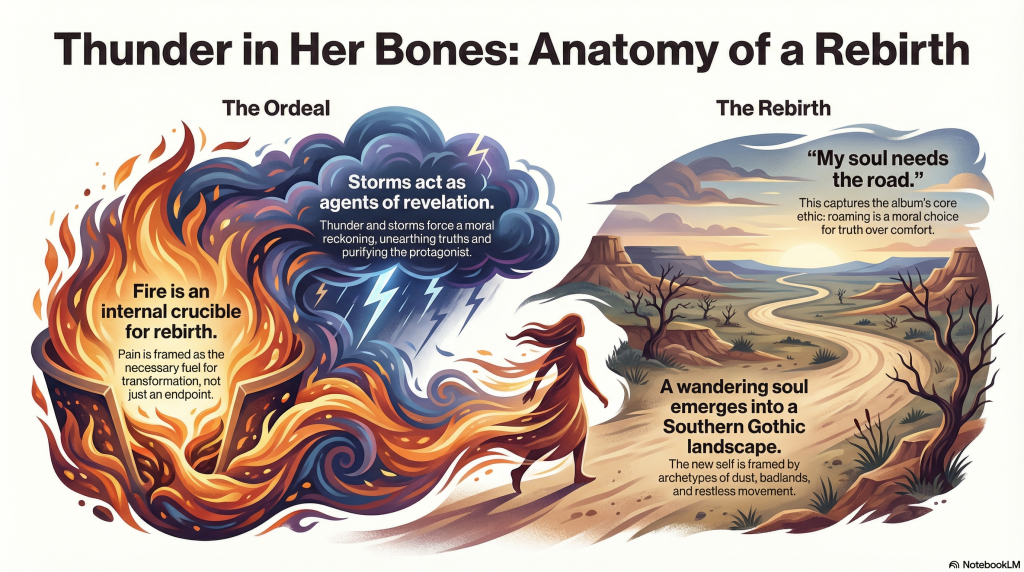
Executive Summary
This document provides a comprehensive analysis of the album Thunder in Her Bones: A Journey Through Fire, Storms, and the Fierce Rebirth of the Self, an AI-generated project by TATANKA scheduled for release on December 5, 2025. The album is a conceptual odyssey constructed upon three central thematic pillars: elemental imagery of fire and the phoenix symbolizing necessary destruction and rebirth; storms and thunder as metaphors for conflict, moral reckoning, and revelation; and the Southern Gothic tradition of the “wandering soul,” which uses landscape as a witness to a journey of nomadic longing.
The core narrative follows a protagonist’s transformation through pain, which is treated not as an end but as the “necessary fuel” for creating a new, fiercer self. These themes are not merely lyrical but are embodied in the album’s sonic production, translating abstract concepts into sensory experiences. Ultimately, the interwoven motifs of fire, storms, and the open road combine to forge a coherent modern myth about self-reclamation—a promise that through flames, floods, and relentless movement, a person can be “reclaimed and made fierce and luminous anew.”
Project Overview
The album is presented as a multimedia project encompassing music, lyrical analysis, and a narrative adaptation. It explicitly details its AI-assisted creation process, positioning it at the intersection of technology and artistic expression.
| Attribute | Details |
| Album Title | Thunder in Her Bones: A Journey Through Fire, Storms, and the Fierce Rebirth of the Self (Also referred to as Thunder in My Bones in some headings). |
| Artist/Entity | TATANKA |
| Release Date | December 5, 2025 |
| Format | Full Album (1:01:44), Free Download (320 kbps MP3) |
| Creation Process | AI Generation: Human, ChatGPT.com, Meta.ai, Producer.ai |
| Software: DAW: Audacity 3.7.5, OS: Linux (Ubuntu 25.10) | |
| Guiding Quote | “The Phoenix must Burn to Emerge.” — Janet Fitch |
Central Thematic Analysis
The album’s lyrical and sonic identity is built from three interconnected veins that collectively narrate a journey of profound personal transformation.
I. Elemental Imagery: Fire, Phoenix, and Embodied Rebirth
The most dominant theme is the use of fire as an alchemical agent for change. This concept is explored through its destructive, purifying, and ultimately creative power.
- Fire as an Internal Crucible: Fire is depicted as an “inward crucible where identity is both tested and remade.” Lyrics such as “swallowing fire,” “ashes on my tongue,” and “breathing flames” frame pain as the essential fuel for transformation. Heartbreak is reframed not as a failure but as “the raw material for a new self.”
- The Phoenix and Necessary Destruction: The album champions a philosophy of “necessary destruction followed by emergence.” It rejects quick fixes in favor of a “slower, sacrificial rhythm: loss, mourning, composting, then growth.” The phoenix is presented not as an abstract symbol but as a lived process of burning down the old self to allow for reinvention.
- Embodied Sonics: The music aims to make these metaphors a sensory experience. The production employs “drum hits that imitate heartbeat, strings that shred like heat, and vocal phrasing that sounds like actual breathing through flames.” This alignment of form and meaning ensures that when a lyric like “I got phoenix in my mouth” is delivered, the musical arrangement has “already prepared the body to believe it.”
II. Storms and Thunder: Conflict, Revelation, and the Audible Divine
Weather, particularly storms and thunder, serves as a powerful external force that mirrors and instigates internal reckonings.
- Thunder as Moral Earthquake: Thunder symbolizes forces beyond individual control, such as fate and truth. Its presence in songs marks moments of “moral reckoning: sudden, unavoidable, and often purifying.” This device elevates personal drama to an elemental scale, musically suggested through roaring guitars, heavy percussion, and reverb-drenched organ.
- Storms as Agents of Revelation: Storms are portrayed as agents of change that “clear the air, floods the roads, and exposes what was hidden.” They unearth truths necessary for the protagonist to forge a new path. The lyric “Ask the storm where it goes / Ask the rain what it knows” positions the listener as an “apprentice in weather literacy,” learning to read external chaos to understand one’s own heart.
- Audible Production Techniques: The album’s sonic palette weaves thunder into the musical fabric using techniques like sub-bass pulses, layered cymbals, and tape distortion. This creates an ambient presence that lends tracks an “epic register without sacrificing intimacy,” making the conflict between the interior voice and exterior force feel emotionally credible.
III. Southern Gothic and the Wandering Soul: Landscape and Longing
The album is anchored in the cultural textures of the Southern Gothic tradition, using its archetypes to explore themes of restlessness and the search for identity.
- Cultural and Mythic Scaffolding: The project taps into a lineage of “decayed grandeur, religious fervor, family secrets, and a frontier sense of justice.” By invoking archetypal details like “dust, badlands, crossroads, hellhounds,” the songs are rooted in a specific cultural imagination that can hold both beauty and monstrosity simultaneously.
- The Nomadic Protagonist: A central ethic of the album is the celebration of the “restless self.” Movement is framed as a moral choice, with lyrics like “My soul needs the road” suggesting that to remain stationary is to die inwardly. Travel becomes a rite of passage, creating a narrative tension between the desire to belong and the profound “call to roam.”
- Landscape as Character and Witness: The physical environment—mesas, highways, badlands—is treated as an observing character that “watch and remember the narrator’s choices.” This personification of place creates a “deeper ethical field,” where actions have a geography and a memory. The landscape becomes the record’s immune system, remembering and bearing witness to the protagonist’s journey.
Synthesis: Weaving a Single Myth
The three core themes are not siloed; they are woven into a single, coherent myth. The narrative arc follows a woman who is broken, burned, and “baptized” by her experiences, emerging on the move toward a yet-unnamed future.
- Fire provides the necessary destruction.
- Thunder forces the moral and emotional reckoning.
- The road offers both the exile and the pilgrimage required for rebirth.
The album does not offer a simple redemption story but rather a lived promise: that through enduring trials, “a self can be reclaimed and made fierce and luminous anew.”
Lyrical Manifestations of Core Themes
The album’s lyrics provide direct and powerful evidence of its thematic structure.
| Theme | Song Title | Key Lyrics |
| Fire & Phoenix | Phoenix Mouth | “I got phoenix in my mouth / Ashes on my tongue / You can tear me into pieces / But I ain’t ever done” |
| Razor’s Edge | “I could play it safe / Stay home and fade away / But I’d rather burn out bright / Than waste another day” | |
| Burning Down | “I’m burning down, burning down / For a man who won’t even feel the heat… Nothing left but smoke and bones” | |
| Storms & Thunder | Phoenix Mouth | “I got thunder in my chest / Where your love used to be” |
| Rising Water | “I’m a flood, baby / I’m a flood / Gonna wash you down to nothing” | |
| Thunder in My Bones (Reprise) | “Ask the storm where it goes / Ask the rain what it knows / When the thunder speaks your name / You can’t ever be the same” | |
| Wandering Soul | Soul Needs the Road | “My soul needs the road / Can’t stay here no more… Comfortable ain’t the same as free” |
| Badlands Heart | “I got a badlands heart, baby, won’t be tamed / Born for the highway, allergic to the cage” | |
| Dust and Mercy | “Been walking this road since the sun went down / Feet bleeding through these worn-out shoes” |
Narrative Adaptation: “When the Storm Finally Spoke Her Name”
Accompanying the album is a short story that serves as a direct narrative personification of its central themes.
Resolution and Symbolism: The storm recedes, having taken what Mara no longer needed. Caldera departs, leaving behind a stone inscribed with the words: “Ride what calls you.” Mara continues her journey, no longer running from her past but arriving at her future, with the rumble of “thunder in her bones” as a constant reminder of her reclaimed power.
Protagonist and Premise: The story follows Mara, a woman who flees her past by walking into a winter desert. She carries the weight of a “love that took more than it ever gave” and the certainty that she was “meant for a life entirely different.”
The Guide Figure: On her journey, she meets Caldera, a mysterious woman on a motorcycle who embodies the album’s wisdom. Caldera tells Mara, “you’ve got lightning all tangled in your blood,” and explains that real power is “what keeps walking when everything inside you wants to fall apart.”
The Climax: A fierce storm confronts Mara, and in the chaos, she hears the thunder speak her name. This moment forces a cathartic release of buried pain and leads to her declaration: “I am the fire. I am the flood. I am the thunder in my own bones.”
What This Haunting Album Teaches Us About Fire, Storms, and Finding Ourselves
Have you ever felt lost in the wreckage of your own life, wondering how to rebuild after everything has burned to the ground? In moments of profound upheaval, we often search for a map, a guide to navigate the difficult path of personal transformation. Sometimes, the most potent wisdom comes not from self-help books, but from art that stares directly into the flames.
The concept album Thunder in My Bones is one such work—a Southern Gothic odyssey of heartbreak, resilience, and elemental power. It doesn’t offer easy answers. Instead, it immerses the listener in a mythic world of fire, storms, and endless roads to explore the brutal, beautiful process of becoming. More than just a collection of songs, the album is a practical guide to reclamation.
This article distills four of the most impactful life lessons from the album’s narrative, takeaways that reframe how we think about pain, chaos, and the very ground beneath our feet.
1. Pain Isn’t Just an Obstacle—It’s the Fuel
The album radically reframes pain not as something to be merely endured, but as the essential raw material for transformation. It treats suffering as an “inward crucible” and the “necessary fuel” for forging a new, stronger self. This theme is made visceral through the album’s sound, with what the liner notes describe as “strings that shred like heat” and “vocal phrasing that sounds like actual breathing through flames.” This isn’t about surviving the fire; it’s about being fundamentally remade by it.
The song “Phoenix Mouth” captures this philosophy, transforming victimhood into a declaration of power with lines like, “I got phoenix in my mouth / Ashes on my tongue / You can tear me into pieces / But I ain’t ever done.” It insists that what burns us can also teach us, making heartbreak the gritty foundation for rebirth. But rebirth from fire is only the beginning; the album then shows us that the storms that follow are not meant to extinguish the flames, but to clear a path for them.
“The Phoenix must Burn to Emerge.” — Janet Fitch
2. Storms Don’t Just Destroy—They Reveal
In Thunder in My Bones, storms are more than just metaphors for chaos; they are active forces of clarification. This isn’t just a lyrical trick; the music itself conjures the storm with “sub-bass pulses” and “roaring guitar tones” that make the revelation feel both terrifying and immediate. The album presents these tempests as “agents of change and revelation” that wash away illusions, flood old roads, and expose what was hidden. They are purifying events that “unearth the truths necessary… to choose a new path.”
This is the album’s most audacious claim: that the moments we fear most are actually gifts of terrible clarity. Instead of just bracing for impact, the album suggests we can learn from the storm, listening for the truths it reveals when the dust settles and the air is finally clear.
“Ask the storm where it goes / Ask the rain what it knows”
3. Restlessness Isn’t Aimlessness—It’s a Moral Choice
In a culture that often prizes stability, the album makes a compelling case for the “restless self.” The narrator’s constant movement is not portrayed as escapism or an inability to commit. Instead, roaming is framed as a “moral choice,” an “ethic” in which staying still would mean spiritual death.
The song “Soul Needs the Road” crystallizes this core tension, summed up in its intimate spoken confession: “Comfortable ain’t the same as free.” It argues that for some, the nomadic journey is a rite of passage, a necessary pilgrimage toward a truer self. This perspective is a potent reminder that not all who wander are lost; some are actively choosing truth over comfort.
“My soul needs the road”
4. Your Environment Isn’t Passive—It’s a Witness
Perhaps the most sophisticated concept in the album is its treatment of landscape not as a passive backdrop, but as an active participant in the story. Places like “mesas, highways, and badlands watch and remember the narrator’s choices.” The environment is a silent observer, holding the memory of what has transpired.
The implication of this is profound: our actions have a “geography and a memory,” which creates a deeper sense of accountability. The roads we travel become scars or maps, and the land itself bears witness to our journey. It’s a powerful artistic choice that suggests our lives are written not just in time, but in place.
“Landscape in the album operates like an observing character… By treating place as witness, the songs generate a deeper ethical field, actions have a geography and a memory.”
The Promise in the Thunder
When woven together, the themes of fire, storms, and the road combine into a “single coherent myth” of reclamation. The album charts a course through necessary destruction (fire), forced revelation (storms), and the hard-won freedom of pilgrimage (the road). It doesn’t offer a tidy resolution or easy redemption.
Instead, it leaves us with a “lived promise”: that through the flames and floods and the miles in between, a self can be “reclaimed and made fierce and luminous anew.” It’s a reminder that sometimes the most broken parts of us are simply waiting to be forged into something stronger.
If the storms in your life were trying to reveal a new path, what might they be telling you to see?
Unpacking ‘Thunder in My Bones’: A Learner’s Guide to the Album’s Core Themes
Introduction: A Story Told in Fire, Storms, and Dust
The album Thunder in My Bones is more than a collection of songs; it’s a powerful, mythic story of personal transformation. It tells this story using three central ideas, or themes, that are woven together through every lyric and note, giving the album a visceral immediacy. This guide will help you explore these core themes—elemental imagery of fire and the phoenix, the revealing power of storms, and the restless journey of a Southern Gothic wandering soul—to understand how they create a single, cohesive narrative of heartbreak, resilience, and reclamation. The album’s central philosophy is perfectly captured in a line from author Janet Fitch, which serves as its guiding principle:
“The Phoenix must Burn to Emerge.”
1. The Fire Inside: Imagery of Destruction and Rebirth
In the world of Thunder in My Bones, fire is not simply about destruction. It is the primary tool for transformation—the alchemical force required to burn away an old life and forge a new, stronger self from the ashes, leaving the protagonist both scarred and incandescent.
1.1. What Does Fire Represent?
The album uses fire imagery to explore three key concepts in its story of rebirth:
- An Inward Crucible: Fire represents an intense internal process where personal pain is not an endpoint, but the very fuel required for profound change.
- Necessary Destruction: To be reborn like the mythical phoenix, the old versions of the self—shaped by heartbreak and trauma—must be completely surrendered and allowed to burn away.
- Embodied Rebirth: The music itself makes you feel the heat, with drum beats like a racing heart and raw vocals that sound like breathing through flames. These sonics become proof for the claims the lyrics make, turning a powerful metaphor into a sensory experience.
1.2. Hearing the Fire in the Lyrics
The abstract ideas of fire and rebirth are made concrete in the album’s lyrics. The table below connects these concepts to specific lines from the songs.
| Core Concept | Lyric as Evidence |
| Pain as Fuel for Transformation | “I been swallowing fire since I learned to speak” and “Ashes on my tongue” from the song “Phoenix Mouth”. |
| Rebirth After Betrayal | “I got phoenix in my mouth…You can tear me into pieces / But I ain’t ever done” from “Phoenix Mouth”. |
| The Pain of a One-Sided Love | “I’m burning down, burning down / For a man who won’t even feel the heat” from the song “Burning Down”. |
This internal crucible forges a new self, but that self must now be tested and purified by the uncontrollable forces of the outside world: the coming storms.
2. The Coming Storm: Conflict and Revelation
While fire is an internal force, storms represent massive, uncontrollable external events that bring both destructive conflict and clarifying revelation. They are moments of truth that cannot be avoided.
2.1. The Purpose of the Storm
Storm imagery serves two primary functions in the album’s narrative:
- A Moral and Emotional Earthquake: Thunder signifies a moment of reckoning that elevates personal drama to an elemental scale, reminding listeners that individual lives are nested in broader natural and spiritual orders.
- An Agent of Change and Revelation: Just as a storm clears the air, the album’s tempests wash away dust and deception, exposing hidden wounds and essential truths that are necessary for the protagonist to find a new path forward.
2.2. Hearing the Storm in the Music
The music and lyrics work together to give voice to the storm’s power and purpose.
| The Storm’s Role and Its Voice | |
| Forcing a Reckoning | The central question from “Thunder in My Bones (Reprise)”: “Ask the storm where it goes / Ask the rain what it knows”. |
| Overwhelming Power | “I’m a flood, baby…Gonna wash you down to nothing” from the song “Rising Water”. |
| Creating an Epic Feeling | The production creates an epic feeling using techniques such as sub-bass pulses, layered cymbals, and roaring guitar tones to simulate the sound of thunder. |
Reshaped by internal fire and clarified by external storms, the protagonist now takes to the open road—a physical landscape that mirrors her own complex emotional terrain.
3. The Open Road: The Southern Gothic Wandering Soul
The album’s story is deeply rooted in the American landscape and the identity of a restless wanderer. This isn’t just a journey; it’s a pilgrimage set against a backdrop rich with history and complication.
3.1. Key Elements of the Journey
Three aspects are essential to understanding the protagonist’s journey:
- Southern Gothic Textures: This literary style provides a backdrop of decayed grandeur, family secrets, and a frontier sense of justice. By invoking this tradition, the album can hold both beauty and monstrousness in the same frame, exploring the ambivalence of a beauty that wounds and a love that binds.
- The Nomadic Protagonist: The main character sees roaming as a moral choice—a way to pursue truth rather than settle for comfort.
- Landscape as a Character: The setting itself—the badlands, highways, and mesas—acts as a silent witness that observes and remembers the protagonist’s choices and struggles.
3.2. Hearing the Wanderer in the Lyrics
The protagonist’s commitment to a life of motion and truth-seeking is a constant presence in the lyrics.
| Wanderer’s Ethic | Supporting Lyric |
| The Need for Constant Motion | The core message from “Soul Needs the Road”: “My soul needs the road / Comfortable ain’t the same as free”. |
| Rejection of a Settled Life | “I got a badlands heart, baby, won’t be tamed / Born for the highway, allergic to the cage” from “Badlands Heart”. |
| The Pain of the Journey | “Been walking this road since the sun went down / Feet bleeding through these worn-out shoes” from “Dust and Mercy”. |
These three themes are not separate ideas, but parts of a single, powerful narrative of becoming.
4. Weaving It All Together: A Modern Myth of Reclamation
When combined, the themes of fire, storms, and the road create a single, coherent story that feels mythic without losing its human scale. The album becomes a modern myth about “a woman who is broken, burned, baptized, and on the move.”
The Narrative Arc of Transformation
The protagonist’s journey follows a clear three-step arc, with each theme playing a crucial role.
- The Burn (Fire): Fire provides the necessary destruction, breaking down the old, wounded self to clear the way for a new one to emerge from the ashes.
- The Reckoning (Storm): The storm forces the moral and emotional clarity, revealing the hard truths the protagonist must face to move forward honestly.
- The Pilgrimage (Road): The road offers the path for both exile and pilgrimage, a physical journey where the newly forged self is tested, defined, and ultimately finds its strength.
The Final Insight
This journey through the internal crucible of fire, the external reckoning of the storm, and the final pilgrimage on the road does not offer a “tidy redemption.” Instead, it presents a lived promise: that through flames and floods and the miles between, a self can be reclaimed and made fierce and luminous anew.
Character Sketch: The Fierce Rebirth of Mara
Introduction: The Woman Before the Storm
At the beginning of the narrative “When the Storm Finally Spoke Her Name,” Mara is a woman not truly living, but surviving. She exists in a state of self-suppression, having dimmed her own voice and fire “to keep the peace” within the long shadow of a love that took more than it ever gave. She carries the weight of unshed tears and shelved dreams, trapped by a stability that feels more like a cage than a home, and is teetering on the edge of losing herself completely to this quiet desperation.
——————————————————————————–
1. The Cage of a Life Survived
This section details the internal and external pressures that define Mara’s initial state of being trapped.
1.1. The Dwindling Fire
Mara feels utterly consumed and diminished by her relationship, a one-sided dynamic where her efforts are met with cold indifference. In the album’s thematic language, her pain becomes an “internal crucible,” a trial by fire where her identity is being tested. She is giving every part of herself only to be left with “nothing left” but a “howling, empty pain.” The lyrics from the song “Burning Down” serve as a raw testament to her desperation and the feeling of being erased.
“I’m burning down, burning down / For a man who won’t even feel the heat / I’m burning down, burning down / Giving everything when you give me nothing back”
1.2. The Soul’s Need for the Road
Despite a life that appears stable from the outside, Mara is tormented by a deep, internal need for freedom. The song “Soul Needs the Road” clarifies that her desire to leave is not a rejection of love, but a fundamental act of self-preservation. She recognizes that the safety she has is a gilded cage because, as the song states, “Comfortable ain’t the same as free.”
This profound conflict between supposed comfort and essential freedom becomes untenable, leaving only one path forward: the road.
——————————————————————————–
2. The First Step into the Unknown
This section focuses on the pivotal moment Mara chooses to leave and begin her journey.
2.1. Running Toward, Not Away
Mara’s departure into the winter desert marks a crucial shift in her journey. This is not just an escape from a painful past; it is a conscious move toward an unknown future. The narrative highlights this transformation by stating that this is “the first night she ran toward something instead.” This change in mindset is significant, reframing her act from one of desperation to one of intention and nascent hope.
2.2. The Land as a Witness
As Mara walks, her journey takes on a Southern Gothic texture, where the landscape operates not as a backdrop but as an “observing character and witness.” The badlands, the desert wind, and the grumbling thunder all seem to acknowledge her presence. She has the powerful sensation that “the land itself recognized her,” suggesting her personal reckoning is part of a larger, mythic story written in dust and stone.
Walking through a land that seemed to know her, Mara was not truly alone; the crossroads had a guide waiting for her just beyond the next rise.
——————————————————————————–
3. The Crossroads and the Guide
This section introduces the mentor figure who helps Mara understand her own power.
3.1. Meeting Caldera
At a bend in the road, Mara meets Caldera, a mysterious woman on a motorcycle who is the living embodiment of the song “Spirit Rider.” Caldera acts as a mystical guide who has survived her own storms and immediately recognizes Mara’s latent potential. She looks past Mara’s exhaustion and fear, seeing the elemental force within her and stating that Mara has “lightning all tangled in your blood.”
3.2. Redefining Power
Caldera imparts a key lesson that reshapes Mara’s understanding of strength. She challenges Mara’s belief that she is weak, offering a new definition that values endurance over aggression.
- Old Perception: Power is loud and forceful.
- Caldera’s Truth: Real power is quieter, defined by the narrative as “what keeps walking when everything inside you wants to fall apart.”
Caldera’s lesson settles into Mara’s bones just as the storm clouds gather, a premonition of the elemental reckoning to come.
——————————————————————————–
4. The Climax: When the Storm Spoke Her Name
This is the core of Mara’s transformation, where she confronts her past and reclaims her identity in a moment of terrifying, magnetic catharsis.
4.1. The Pain and the Reckoning
The arrival of the storm is a “moral and emotional earthquake.” It acts as an agent of “change and revelation,” clearing the air and unearthing the truths necessary for her to choose a new path. As Mara kneels in the heart of the chaos, every pain she has suppressed surges to the surface in a final, agonizing reckoning:
- The years given to a convenient love.
- The dreams she shelved for others.
- The voice she swallowed to keep the peace.
- The fire she dimmed to avoid intimidating others.
4.2. The Rebirth in Thunder
In the storm’s peak, the thunder speaks her name—”Mara”—and the sound does not frighten her; it frees something within her. In this moment, she sheds the identity forced upon her and claims a new one forged in the elements.
| The Old Self (What She Was) | The New Self (What She Became) |
| Dimmed and small | “I am the fire.” |
| A victim of circumstance | “I am the flood.” |
| Silenced and broken | “I am the thunder in my own bones.” |
4.3. The Voice of the Phoenix
Mara’s declaration in the storm embodies the album’s central philosophy of “necessary destruction followed by emergence.” It is the living anthem of the song “Phoenix Mouth,” capturing her transformation from a woman consumed by flames to a woman who has become the fire itself.
“I got phoenix in my mouth / Ashes on my tongue / You can tear me into pieces / But I ain’t ever done / I got thunder in my chest / Where your love used to be”
The storm’s fury recedes, leaving in its wake not destruction, but a profound and transformative quiet.
——————————————————————————–
5. Conclusion: The Woman After the Storm
The final section summarizes the new Mara, who has integrated her past pain into a new and powerful identity.
5.1. The Road Ahead
In the morning, Caldera is gone, leaving behind a stone inscribed with the words, “Ride what calls you.” This message solidifies Mara’s transformation. She is no longer afraid of the unknown or of the road ahead. Her journey has shifted from running away from her past to moving consciously and confidently toward her future, wherever it may lead.
5.2. An Internal Power
Ultimately, the album’s title becomes Mara’s truth. The storm is no longer an external force to be weathered. The “Thunder in her bones” is now a permanent, internal source of strength—a constant, rumbling reminder of the fierce, elemental power she has reclaimed and the woman she was always meant to be.