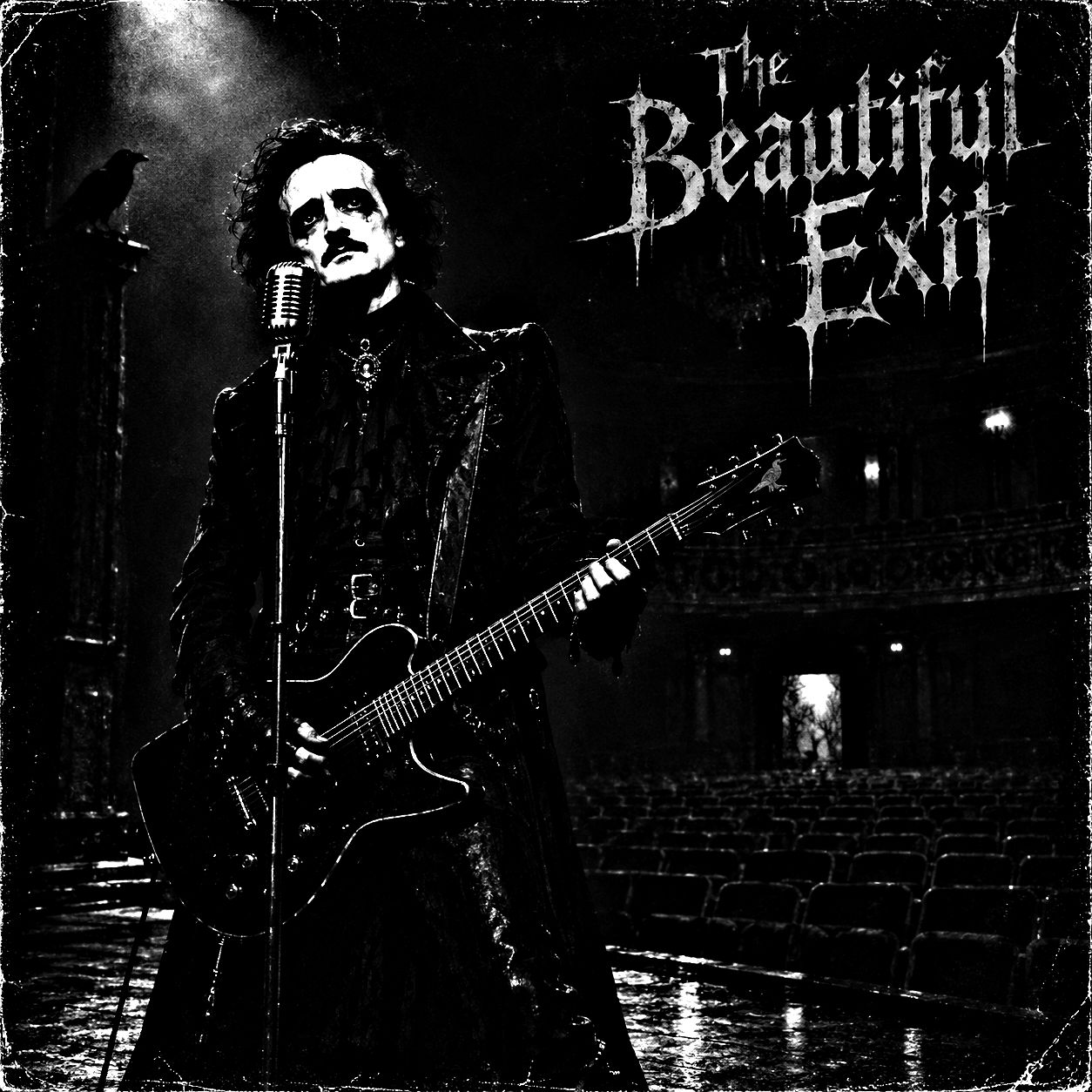
The Ballad of Edgar Allan Poe: A 1980s Gothic Rock Album Adaptation
Human-AI Collaboration/Open Source Software: Composer/Sound Designer (Linktr.ee/j_j_j), Google Flow Music (Lyria 3.5), Claude.ai, ChatGPT, Perchance.org – DAW, Audacity4.0.1, OS, Linux (Ubuntu 26.04.5)
A TOAST TO NEVERMORE: The Ballad of Edgar Allan Poe – A 1980s Gothic Rock Album Adaptation – Full Album Mix (28:28)
Download Free Full Mix 320 kbps MP3 (65.2 MB)
PROJECT OVERVIEW
Album title: A Toast to Nevermore Subtitle: The Ballad of Edgar Allan Poe Structure: 10 chapters, 10 songs (Prelude to Coda arc) Target runtime: about 47 minutes (update once final audio is edited) Sound: 1980s gothic rock / post-punk / deathrock, sung by a haunting, ethereal, vulnerable male voice
A note on the framework: it mentions the broader TATANKA narrative. I wove in the closest honest echo, Maria “Muddy” Clemm, the matriarch who held Poe’s household together, and the human-AI collaboration behind the music itself. Nothing else was forced.
GOOGLE DEEP DIVE PODCAST: RESURRECTING POE THROUGH AI GOTH ROCK
A NOTE FROM JJ, SOUND DESIGNER TO YOU, THE LISTENER
Before you press play, here is a short guide to what you’re about to hear and how it was made.
What This Is
A Toast to Nevermore: The Ballad of Edgar Allan Poe is a gothic rock concept album in 10 tracks. It runs about 47 minutes [update with final runtime]. It has singing, one lone male voice, and it tells one story from beginning to end, the life, the death and the afterlife of Edgar Allan Poe. It is meant to play start to finish, though each track also stands alone.
About The Title, A Toast to Nevermore
For roughly sixty years, a mysterious figure in black visited Poe’s grave each January 19th, his birthday, left three roses and a bottle of cognac, and vanished. Fans called him the Poe Toaster. In 2009 he stopped coming, and nobody knows why. “Nevermore” is the one word Poe’s raven ever says, and also the word that now describes that visitor. A toast is a way of honoring someone while they are gone. So the title is a glass raised to grief, to a ghost, and to the art that will not die.
The Sound
This is 1980s gothic rock and post-punk, chorus-drenched guitars, a prowling, melodic bass, tight gated drums and drum machines, cold synthesizer pads, and a lot of echo. It is dark but not cruel, romantic but not sweet. The voice is deliberately vulnerable and ethereal, closer to a confession than a performance. The sound aims to feel like a cassette you found in a coat pocket, slightly worn and entirely haunting. It pays homage to the era’s feeling rather than copying any artist.
Lyrics And Vocalist
The lyrics follow Poe from his childhood in Richmond to his mysterious final days in Baltimore, and then beyond, to the legend of the grave visitor. Recurring images are the heartbeat, the raven, the cold, the three roses and the glass of cognac. Some of what is sung is documented fact, and some is myth, and I have taken artistic license in the spaces between, much as Poe’s legend itself does. The vocalist is a single AI-generated male voice, directed to sound like a 1980s emo-goth singer, breathy, fragile and close to the microphone. One note of care, Poe’s wife, Virginia, was only 13 when they married, which is deeply uncomfortable by modern standards. The song about her focuses on her illness and his helplessness, and it does not romanticize the marriage.
How It Was Made: A Human-AI Collaboration
This album was built by one human composer working with several tools, with the artist steering at every step. In plain terms:
- Human (the Sound Designer): concept, direction, selection, arrangement, editing, sequencing, and final decisions on everything you hear.
- Google Flow Music (Lyria 3.5): AI music generation, used to produce raw musical and vocal material.
- Claude.ai and ChatGPT: AI assistants used for research, lyric drafting, prompt writing, track naming and notes like these.
- Perchance.org: a free, open web generator used for [specify, e.g. artwork or idea generation].
- Audacity 4 (alpha): the audio editor where the material was shaped, trimmed, layered and mixed.
- Linux (Ubuntu 26.04): the operating system everything was assembled on.
The AI produced raw material only after the human songwriter decided what the album themes and construction would be, what stayed on the record, what was cut, and how it all fits together. Please treat the result as a collaboration, not a push-button product.
Track By Track
- Eliza’s Curtain Call: an actress dies, and an orphan learns that grief can be performed.
- The Gambler’s Winter: debts, disownment and a soldier with an alias.
- Red Handkerchief at the Piano: Virginia’s illness, and Muddy holding the house together.
- Nevermore: the raven, sudden fame and an empty wallet.
- Beating Beneath the Boards: the guilty heart, and the genius of dread.
- Cold Cottage, Black Cat: a winter death in Fordham.
- Ligeia in the Wallpaper: the living women he courted, and the dead one who haunted them.
- Borrowed Coat: four lost days, a stranger’s clothes, and a last prayer.
- The Griswold Lie: the obituary that turned a man into a monster.
- The Visitor at Westminster: the mystery of his death and the cognac ghost who vanished.
Listen And Download
The download is free. It’s the best-sounding version, so it’s worth grabbing for headphones or night drives.
A Few Listening Suggestions
- Use headphones, and listen after dark if you can.
- Read the companion short story, The Cognac Ghost of Baltimore, while you listen.
- Don’t skip the last track. It is the whole reason the album exists.
- If you have a glass of something, raise it at the end, middle, and beginning.
Transparency And Sharing
This album was made with AI assistance, and I’m saying so openly, per usual, at the top of all projects. I compose with AI assistance because it opens new artistic pathways and lets me explore far more sonic ideas than I could alone, while I still shape, edit and decide every detail of the final music, so the result is human-directed and publicly shared with anyone who wants to listen.
All of my work is free and not monetized in any manner, so please download this and any of my other musical projects at will.
Thank You For Listening
Thank you for giving this time to the music.
Poe turned his pain into art and the world kept it.
I hope you find something worth keeping here too.
– JJ, Composer/Sound Designer
THEME RENDERING / SUMMARY
A Toast to Nevermore is a gothic rock elegy for a man who turned every wound into a verse. It follows Edgar Allan Poe from an orphaned childhood in Richmond, through debt, disownment, illness, grief and fleeting fame, to four unexplained days in Baltimore that ended his life. It then steps past death into legend, ending with the strange tradition of the figure who left roses and cognac on his grave every January, and who suddenly stopped. The album accepts that part of Poe is myth, and treats the myth as part of the art. Facts, rumor and invention are woven together the way Poe himself wove them.
The emotional core is transformation, pain as raw material, loneliness as ink, and mystery as the last gift of a master of dread. Its tone is haunting, nocturnal, vulnerable, romantic and wintry, with a flicker of dark humor and defiance. Genre fusion: 1980s gothic rock, post-punk, deathrock and dark wave, with ethereal textures and a fragile male voice. The echoes of the wider framework are Maria “Muddy” Clemm, the matriarch who kept a poet alive, and the collaboration between human intent and machine-made sound, which, like Poe’s legend, proves that a work can be haunted by more than one hand.
NARRATIVE ARC ADAPTATION FOR LYRICS
Structure: Prelude, Symphony, Coda.
Prelude (Track 1): The orphan. A boy loses his mother and learns that sorrow can be turned into performance.
Symphony (Tracks 2 to 9): The wounded artist. He is disowned (2), watches his wife wither while a matriarch carries the household (3), is crowned by the raven and still stays poor (4), proves that terror lives in the human heart (5), loses Virginia in the cold (6), reaches for living love while haunted by the dead (7), vanishes for four days into a borrowed coat (8), and is posthumously slandered into a monster, which only makes him immortal (9).
Coda (Track 10): The mystery. His death stays unsolved, and the unknown visitor at his grave becomes the last chapter of the story, possibly staged by Poe himself.
Key motifs and archetypes: the Orphan, the Gambler, the Matriarch (Muddy), the Raven, the Heartbeat, the Borrowed Coat, the Monster, the Visitor. The emotional journey runs loss, defiance, devotion, haunting, disappearance and then mythic transcendence. Recurring sonic and lyrical threads, the heartbeat and the word “nevermore,” tie every song into one unfolding story.
GENERAL TEXT-TO-MUSIC PROMPT (ALBUM-LEVEL)
Best-fitting genre fusion: 1980s British-style gothic rock and post-punk, blended with deathrock, dark wave and a touch of dream-pop shimmer. Gothic rock fits a story about a haunted writer, a cold grave and a mysterious ghost, and the genre’s romantic melancholy is a natural match for Poe.
Create a 1980s gothic rock and post-punk album sound with a fragile, ethereal, vulnerable male baritone-tenor voice, breathy and close to the microphone, sung like an introverted emo poet confessing in the dark.
Chorus-drenched clean electric guitar arpeggios with flanger and long reverb, occasional shimmering e-bow and angular, reverb-soaked rhythm guitar, a prowling melodic bass guitar playing the lead hook, tight gated-reverb live drums and a cold analog drum machine, tom-driven rhythms, analog synthesizer pads and icy string-machine textures, a faint church-organ drone and a distant heartbeat thump.
Tempos range from 76 to 142 BPM, mostly in minor keys.
Convey midnight snow, candle smoke, and the sorrow of a gifted man who turned pain into art, as if a raven were singing through a cassette left in a coat pocket.
Melancholy, romantic, theatrical, haunted, with a hypnotic, addictive, singable chorus in every song.
Warm analog production, tape hiss, wide stereo echoes.
SONG-BY-SONG DEVELOPMENT
01 · The House That Wasn’t Mine
Theme summary: A child is separated from his parents and raised in another household. The song begins the album’s central wound, belonging can be given, withdrawn, and remembered as a place that never quite existed.
Sound
1980s Gothic rock, post-punk, angular post-punk guitar, chorus-soaked electric guitar, flanger electric guitar, pulsing melodic bass, tight gated drums, Linn-style drum machine, live toms, icy keyboard motif, cold analog synth pads, vulnerable male baritone voice, intimate low register, fragile high register, 116 bpm.
Lyrics
Intro
A door swings shut before I know its name
A winter coat, a borrowed flame
Somebody says that I will be all right
The house grows quiet around the night
Verse 1
My mother leaves a portrait in the air
A face I learn to find in everywhere
My father is a rumor down the hall
A name that cannot catch me when I fall
Verse 2
A kinder roof, a stricter kind of love
A hand that points to what I must become
I learn the shape of gratitude and debt
And keep a little room for what I can’t forget
Verse 3
The streets are full of doors that open wide
Then close before the child gets inside
I make a kingdom out of what is gone
And teach the dark to keep the lantern on
Verse 4
If home is only somewhere I have been
Why does each room feel borrowed from within?
I wear my loneliness beneath my clothes
A secret only every stranger knows
Chorus
I was the boy behind the glass
Watching every good thing pass
Call me home, then let me go
I learned the ache before the snow
Bridge
No ghost was waiting in the stair
Only absence learning how to wear
A human face, a human name
A little boy who learned to make a flame
Outro
The door swings shut, the years begin
I carry every house within
02 · The Uniform of a Stranger
Theme summary: Poe searches for order and escape through school, military service, and early literary ambition. Discipline and rebellion coexist; every uniform feels like a costume fitted to someone else’s life.
Sound
1980s Gothic rock, post-punk, driving bass riff, martial snare drums, sharp chorus electric guitar, cold analog synth, vulnerable male baritone vocal, restless and defiant, 120 bpm.
Lyrics
Intro
Button the coat and bury the boy
March to the rhythm that promises joy
A borrowed future, a borrowed skin
Tell me where the real life begins
Verse 1
I learn to stand where the line is drawn
To wake at the hour before the dawn
But every command has a crack in its sound
And every straight road turns me around
Verse 2
I trade my name for a number and pay
In hours that vanish and words I can’t say
The uniform shines, but the lining is torn
I leave with a hunger the ranks never warned
Verse 3
A printed page becomes my private shore
I set my small ships past the locked front door
The world says talent must wait its turn
My hands are cold, but the pages burn
Verse 4
I gamble on a sentence, a room, a chance
A poor man’s future in a printer’s dance
Each rejection wears a familiar face
Each yes gives me one more inch of space
Chorus
I will not die in somebody’s frame
I will make a door from a printed name
If I must beg, let the words be mine
If I must break, let the break keep time
Bridge
The drum says left, the blood says run
I chase the page like a second sun
The coat comes off, the mask remains
A little order inside the rains
Outro
No rank can tell me who I am
The ink runs red beneath the hand
03 · A Name Made of Ink
Theme summary: The young writer becomes an editor and critic, trying to survive through literary work while sharpening a reputation for uncompromising judgment. The song explores the cost of turning precision into armor.
Sound
1980s Gothic rock, post-punk, repeating bass ostinato, crisp snare, shimmering guitar chorus, faint typewriter-like percussion, cold analog synth, vulnerable male baritone voice, 108 bpm.
Lyrics
Intro
A candle gutters, the deadline stays
I sell my sleep for another page
The city coughs outside the pane
I sign my name against the rain
Verse 1
The editor’s desk is a narrow throne
A kingdom of paper, a room on loan
I cut through sentences, clean and severe
While my own heart trembles somewhere near
Verse 2
They want a monster, a wit, a fool
A sharp black coat and a golden rule
I give them a blade with a polished side
And hide the hand that shakes inside
Verse 3
A promise comes folded in printer’s twine
A week of work for a little less than mine
I learn that genius cannot pay the rent
And praise is a coin already spent
Verse 4
The page remembers what people erase
The sentence survives the face
I build my name where the cold lamps shine
A little more famous, a little less mine
Chorus
Write me in ink, write me in flame
You can keep the story, I will keep the name
Cut me down to a sentence or two
The page will outlive what you think you knew
Bridge
I sharpen each word till it catches the light
Then sleep with the door locked tight
A critic’s tongue and a beggar’s coat
A paper kingdom, a sinking boat
Outro
The ink dries black; the bills remain
My name keeps walking through the rain
04 · The Girl in the Window Light
Theme summary: Virginia Clemm enters Poe’s life as a young cousin who becomes his wife. The track focuses on tenderness and the intimate domestic world they made, without reducing Virginia to a symbol or romanticizing her illness.
Sound
1980s Gothic rock, dream-goth ballad, clean chorus electric guitar, warm synth pad, melodic fretless bass, brushed toms, fragile male baritone voice, intimate, tender, domestic, quietly foreboding, 82 bpm.
Lyrics
Intro
The window keeps a square of gold
A quiet room against the cold
You laugh, and all the clocks grow still
The world becomes a smaller hill
Verse 1
We make a home from borrowed chairs
From little jokes and private prayers
No grand estate, no silver spoon
Just one more hour beneath the moon
Verse 2
Your hand finds mine beside the flame
The world outside forgets our name
I am not clever, I am not cursed
I am a man who loves you first
Verse 3
The cough arrives, the candle bends
The days grow narrow at their ends
I bargain with the dark for time
And turn my fear to measured rhyme
Verse 4
I cannot promise dawn will stay
Or keep the winter far away
I only know when you are near
The room has less to fear
Chorus
Stay in the window light with me
Where the world is kind enough to be
A cup, a chair, a hand, a song
A little place where we belong
Bridge
Love is not a cure, nor a spell
It is the hand that stays as well
When every answer falls apart
It keeps a room around the heart
Outro
The window holds its square of gold
I hold your hand against the cold
05 · The Long Winter in the Room
Theme summary: Virginia’s illness and death in 1847 leave Poe bereaved. Rather than using grief as spectacle, the song makes time itself the antagonist, a house full of objects that continue to exist after the person they belonged to is gone.
Sound
1980s Gothic rock, slow spacious goth ballad, deep bass pulse, sparse piano, long chorus electric guitar swells, restrained toms, distant bell, close-miked vulnerable male baritone voice, 74 bpm.
Lyrics
Intro
The kettle cools beside the bed
The pillow keeps the shape of your head
A clock goes on because it can
I learn the cruelty of a plan
Verse 1
The winter settles in the walls
The hallway lengthens, silence crawls
I count the breaths, I count the days
I count the ways a heart can stay
Verse 2
Your ribbon waits upon the chair
The room is full of almost-there
I speak your name into the seam
Between the waking and the dream
Verse 3
The neighbors pass, the city moves
The streetlamp paints the empty rooms
I wear my grief like Sunday clothes
A private storm nobody knows
Verse 4
They tell me time will change its face
But time has taken up your place
I turn toward words because they stay
When everything else drains away
Chorus
Winter in the room, winter in my chest
No prayer can make the broken rest
I call your name; the walls reply
Not with an answer, just a colder sky
Bridge
If love survives, where does it sleep?
In the promise that I could not keep?
Or in the song I cannot end
A wound that calls itself a friend?
Outro
The kettle cools, the clock moves on
The room remembers what is gone
06 · The Man They Sold
Theme summary: The public image of Poe begins to overtake the complicated person. This track confronts gossip, caricature, professional struggle, and the market’s preference for a neat scandal over a difficult human being.
Sound
1980s Gothic rock, mid-tempo goth rock, punchy bass, snare-forward drums, jagged guitar stabs, sweeping melodic chorus, cynical, wounded, near-spoken bridge, 112 bpm.
Lyrics
Intro
They sell the shadow by the yard
They make the wound look cheap and hard
A face becomes a caution sign
A life reduced to a punchline
Verse 1
They print the rumor, lose the source
They call the bruise its own cause
A thousand mouths repeat one lie
Until the lie can testify
Verse 2
I have my faults; I know their weight
I have been proud, I have been late
But no man fits a single frame
No life is only vice or fame
Verse 3
The paper wants a simple beast
A little scandal for the feast
They leave the work outside the door
And ask the wound to bleed some more
Verse 4
I walk through rooms that know my face
But never offer me a place
The legend enters, dressed in black
The living man comes limping back
Chorus
You can sell the shadow, never the whole
You can name the sin, never own the soul
Turn me into a warning, a joke, a flame
I am still more than the shape of my name
Bridge
I will not plead to every eye
I will not make the rumor die
But somewhere past the printed page
A human heart outlives the cage
Outro
The paper fades, the ink runs thin
The man remains beneath the skin
07 · A City Full of Doors
Theme summary: Poe’s later years are restless and financially precarious, moving between cities, work, hope, and disappointment. The track is a nocturnal road song about chasing one last chance to make a life hold together.
Sound
1980s Gothic rock, post-punk road song, propulsive repeating bassline, ticking percussion, chorus guitar arpeggios, distant station-like metallic ambience, urgent but weary male baritone voice, wide anthemic chorus, 118 bpm.
Lyrics
Intro
A train pulls sparks from the dark
I carry one coat and a stubborn heart
The station clock has lost its hands
I leave again before I understand
Verse 1
Another room, another key
Another promise made to me
The rent comes due, the letters pile
I practice hope in a borrowed smile
Verse 2
The city changes, the ache stays still
A new address, the same old bill
I write by lamplight, chase the day
The world keeps moving the goalposts away
Verse 3
A friend says wait, a stranger says go
The road has answers it will not show
I count my coins and fold my pride
A restless ghost with nowhere to hide
Verse 4
Baltimore waits beyond the rain
A familiar street, an unfamiliar name
I step from the carriage into the blur
And something in the dark begins to stir
Chorus
A city full of doors, none open wide
A thousand streets with nowhere to hide
I keep on walking, I keep the spark
A living man against the dark
Bridge
If the road is a sentence, where is the end?
If the night is a witness, can it be a friend?
I hear my name in the wheels below
But no one says where I must go
Outro
The train pulls out; the lamps burn blue
The last door opens into the unknown
08 · The Clothes Were Not My Own
Theme summary: In October 1849, Poe was found in Baltimore in grave distress, wearing clothes reported as not his own, and died on October 7. The song stays inside the known uncertainty instead of inventing a definitive cause.
Sound
1980s Gothic rock, slow-burning gothic post-punk, low analog synth drone, heartbeat kick drum, muted electric guitar, falling bass notes, vulnerable male baritone voice close to breaking, 78 bpm.
Lyrics
Intro
A streetlamp trembles in the rain
A stranger calls out my name
The coat sits wrong upon my skin
I cannot say where I have been
Verse 1
The city blurs to a yellow line
The clock forgets the shape of time
A voice asks questions through the wall
I try to answer, lose it all
Verse 2
There are hands, a bed, a paper cup
A ceiling I cannot make look up
The room keeps turning without a sound
My name is lost and then found
Verse 3
Was it sickness, chance, a hand unseen?
A street, a crowd, a gap between?
The record thins where answers should be
A locked door with no key
Verse 4
No final witness holds the thread
No clean explanation for the bed
The morning comes; the lamps burn low
The man goes where we cannot go
Chorus
Who dressed the body? Who closed the door?
What did the last night ask him for?
No answer rises from the stone
The final room is not our own
Bridge
Do not make certainty from grief
A theory is not a belief
Let the dark be dark, let the record stand
An empty space in a human hand
Outro
The streetlamp shakes; the rain moves through
The last known hour keeps no view
09 · Three Roses at Three A.M.
Theme summary: Decades after Poe’s death, an anonymous visitor begins leaving roses and cognac at the grave around his birthday. The ritual is based on the documented Poe Toaster tradition; the song invents an interior monologue for the visitor while preserving the mystery.
Sound
1980s Gothic rock, classic goth, melodic bass, echoing clean electric guitar, ritualistic tom drums, distant church bell, icy synth pads, vulnerable male baritone voice, hypnotic nocturnal chorus, 96 bpm.
Lyrics
Intro
Three roses dark against the stone
A bottle left, a man alone
The city sleeps behind the gate
A little ritual, a little late
Verse 1
A black coat crosses winter ground
No footstep asks to make a sound
The bottle catches one thin star
The grave is near, the world is far
Verse 2
Three roses laid in careful line
A toast to loss, a borrowed sign
The visitor kneels, or seems to do
The night keeps what the day can’t prove
Verse 3
Who is the stranger? Who taught the part?
A son, a friend, a faithful heart?
A private joke passed down the years?
A small defiance against our fears?
Verse 4
Perhaps the dead can lend a face
To someone longing for a place
Perhaps the living need the dead
To hear the things they never said
Chorus
Three roses, one bottle, a name in the snow
A promise to come where the cold winds go
Whoever you are, leave the question alive
Some stories need darkness in which to survive
Bridge
I lift the glass; the glass is cold
The same old secret, never told
I leave no note, I leave no claim
Only the flowers beside the name
Outro
Three roses fade, the bottle shines
The gate remembers different times
10 · The Beautiful Exit (Nevermore, Never Known)
Theme summary: The final track joins Poe’s unexplained death to the later disappearance of the grave visitor. The visitor’s identity and motives remain unresolved. As a fictional possibility only, the song imagines Poe as a master of performance staging a final echo of himself, while leaving the more plausible human explanations alive beside it.
Sound
1980s Gothic rock, slow finale, 72 bpm, low baritone voice, bass harmonics, distant bell, building chorus guitar, slow toms, analog synth, fading out on unresolved bass note with repeating low voice saying Nevermore into silence.
Lyrics
Intro
The gate is open; no one came
The roses sleep without a name
The bottle’s gone, the dawn is bare
A shape is missing from the air
Verse 1
For years the stranger kept the date
A shadow slipping past the gate
Three roses, cognac, winter breath
A toast to life, a wink at death
Verse 2
Then one cold morning, nothing there
No footsteps folded in the air
The watchers count the hours slow
The oldest ritual lets go
Verse 3
Was it a family hand grown tired?
A private vow whose flame expired?
A lover, scholar, friend, or son?
A story finished, not undone?
Verse 4
Or did the poet leave a clue
A final curtain no one knew?
Not proof, not history, only art
A ghost-shaped question in the heart
Chorus
Nevermore, never known
Who leaves the roses at the stone?
Nevermore, the night replies
A name dissolving before our eyes
Bridge
Perhaps he died where the records end
Perhaps a stranger became a friend
Perhaps the mask outlived the face
Perhaps we need the empty place
Outro
The gate is shut; the roses are gone
The name remains when the night moves on
No final answer, no curtain call
Just one small shadow that belongs to us all
Nevermore… nevermore… nevermore… nevermore… nevermore… nevermore… nevermore…
NARRATIVE ADAPTATION
The Cognac Ghost of Baltimore
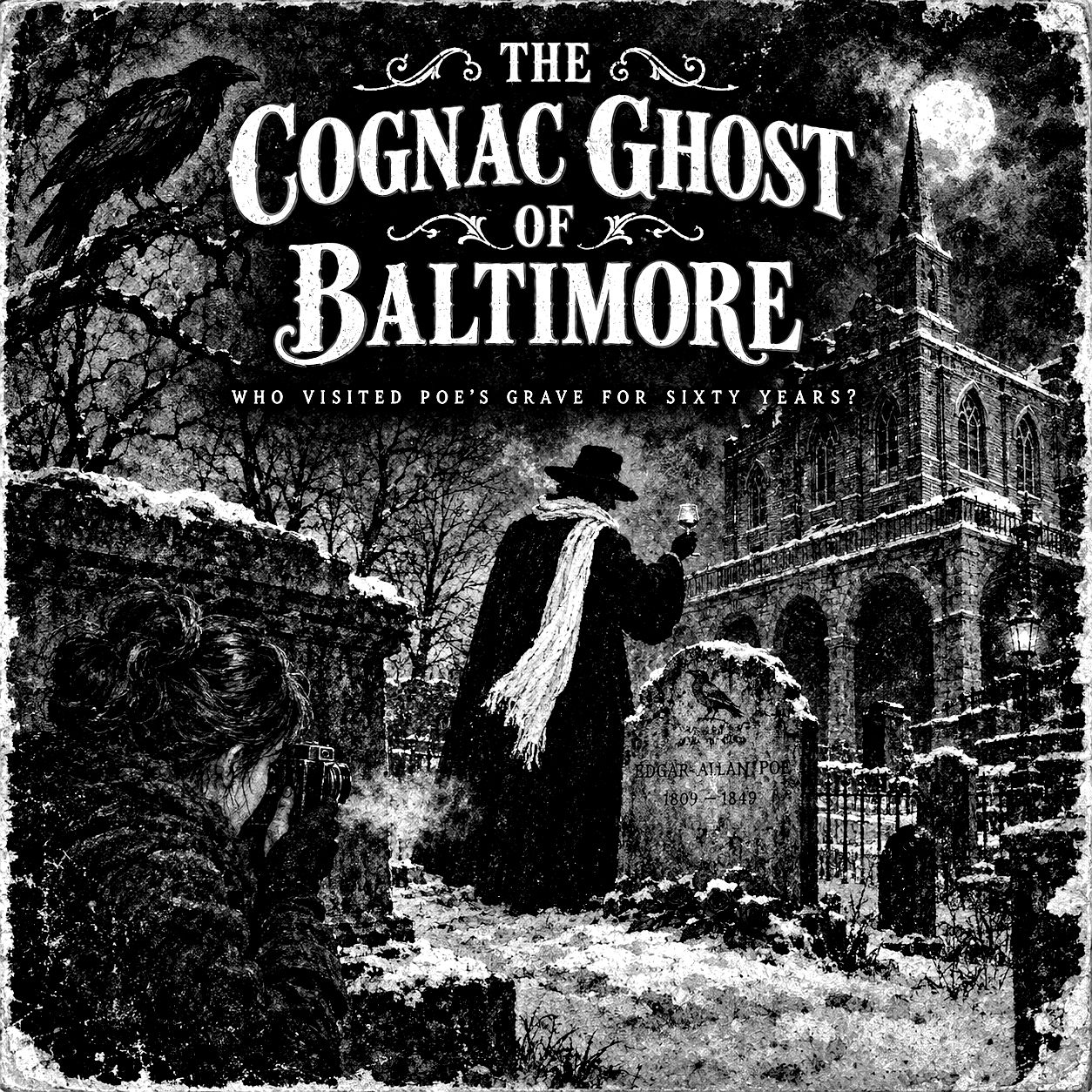
Who Left Roses and a Bottle on Edgar Allan Poe’s Grave for Sixty Years, and Why Did He Never Come Back?
My grandmother used to say that the dead keep better appointments than the living. I did not understand her until the night I hid behind a tomb in Baltimore, in the snow, waiting for a ghost to keep his.
It was January the nineteenth, 2009, the two hundredth birthday of Edgar Allan Poe. I was twenty-six, a reporter at a newspaper that was dying slowly and politely, with a borrowed camera and an editor who wanted exactly one thing from me, a name.
“A mystery gets you a paragraph,” he had said. “A name gets you the front page.”
So I went to Westminster Hall, a brick church at the corner of Fayette and Greene, lifted up on arches so that the old graveyard lies beneath it, like a thought the church can’t finish. Poe is buried there, in the corner, under a gray monument, and the city around him has never decided whether to be proud of him or embarrassed. I understood that. I come from a family of people who left.
Here is what everyone in Baltimore knows. In September of 1849, Edgar Allan Poe left Richmond, cheerful, sober and engaged to be married. Six days later he was found outside a tavern that doubled as a polling place, delirious, wearing clothes that were not his own. Four days after that, in a hospital bed, he died. His last words, according to the doctor, were a prayer, Lord, help my poor soul. The night before, he had called out for a man named Reynolds. Nobody has ever found the Reynolds. The death certificate vanished. The theories bloomed like candle flames in a mirror, drink, rabies, a brain tumor, a failing heart, a gang that herded drugged men from poll to poll to vote again and again. Everybody had an answer, and not one answer held.
And then, every year on his birthday, the mystery got a visitor.
Since at least 1949, between midnight and dawn on January the nineteenth, a figure in black had slipped into that graveyard, a hat brim as wide as a wing, a white scarf wound to the nose, a face no one had ever seen. He knelt at the stone. He raised a glass of cognac. He poured out a little for the dead and drank a little for himself. Then he left three red roses and the bottle, half full, standing upright on the grave, and he vanished. Sixty years. Fans waited by the fence with their breath smoking. A note once claimed that the torch had passed from a father to his son. Nobody ever caught a face. People called him the Toaster, as if he were a harmless bit of tradition, but the Toaster didn’t feel harmless to me. He felt like a very long poem, being recited one stanza a year.
So I waited.
By one in the morning I could no longer feel my feet. By two, I had stopped feeling brave. I crouched behind a tomb the color of old teeth, with my camera wrapped in my coat, and I thought about my father, who left when I was four with a guitar and a promise and never once called. I have spent my whole career interviewing strangers so that I would never have to ask the right question of the one person who mattered. I think that is why I came. I wanted to catch someone in the act of leaving. I wanted, just once, to find out whether a person who disappears is a coward or an artist.
At twelve past three, the gate sighed.
He came the way fog comes, without any particular sound. Black cloak. Hat. The white scarf glowing like a bandage. He carried a glass in one hand, a bottle in the other, and three roses in the crook of his arm, so red they looked wet. He did not hurry. He walked as if the snow were an audience and he did not wish to disappoint it.
I raised the camera. My hands were shaking.
“The snow will fog your lens,” said the man, without turning. “Wipe it with the inside of your sleeve.”
I stood up so fast that my knees cracked. The voice was old, or young, or neither, soft as a page turning in an empty library. He still had his back to me.
“I have been seen sixty times,” he said, “and I have never once been caught. You are the first to hide so badly. I find it charming.”
“I’m a reporter,” I said, which was a stupid thing to say to a ghost.
“I know. They always want a name.” He knelt at the stone and laid down the roses, one, two, three. “Names are small. Every thief has a name. Do you know what I think about, when I come here?”
I did not.
“A boy of two, at a window in Richmond, watching his mother’s breath turn to frost. He learns the first lesson of his life before he learns to read, that what you love can be taken. So he does the only thing a child can do with a grief that big. He makes it rhyme.” The glass caught the light of my own lens and flared like a small amber star. “He gambled his future away and was disowned. He wrote the darkest tales in America to buy bread. He watched a wife he loved coughing blood into a handkerchief, and he wrote the sickroom into poems that people still whisper. A raven made him famous, and it paid him almost nothing. And when he died, a rival wrote his obituary and turned him into a monster, and the monster outlived the man. Do you know what that is?”
“Tragedy,” I said.
“Craft,” he said. “He did not turn his pain into art because it was noble. He did it because pain was the only coin he had. And he spent every cent.”
The wind turned and the snow came sideways. I stepped closer. My editor’s voice was in my ear. A name gets you the front page.
“Are you him?” I asked.
The figure laughed, a dry, delighted sound that scared me more than anything yet. “Think about it. Four days no one can account for. A borrowed coat. A name nobody can find. A death certificate that evaporates. If you were the greatest architect of dread this country had ever produced, and someone whispered that you would be forgotten, wouldn’t you stage the longest haunting in history? Wouldn’t you want an ending so unfinished that the world would have to keep finishing it?”
“That’s a story,” I said. “That’s not evidence.”
“Everything worth keeping is a story.”
He stood. He lifted the glass toward me, and I understood that this was my moment. I had a face, almost. I had a jaw, a hint of silver beneath the hat brim, a chance. I had a picture that would end a hundred and sixty years of wondering. I had my editor’s front page, my paycheck, my future. I raised the camera. My finger found the button.
And I thought of my father.
I thought about how some people leave because they are cruel, and some people leave because staying would end the song. I thought about how a mystery is the last thing a dead man has left to give, and how a photograph is only a way of killing it. A picture is a pin through a butterfly. The Toaster wasn’t asking me to be afraid of him. He was asking me to be kind.
I lowered the camera.
He did not thank me. He only inclined his head, the brim of his hat dipping like the wing of a bird, and poured half the cognac onto the snow, where it steamed and smoked and was gone. He drank the rest.
“To nevermore,” he said.
“To nevermore,” I whispered.
He set the bottle upright on the stone, beside the three roses, and walked toward the gate. I did not follow him. I had made a promise I couldn’t name. But when I looked down at the snow, I counted the footprints, because that is what reporters do, and I found a path that came to the grave and did not leave it. Only mine, wandering after, and the faint mark of a bottle. It was just wind, I told myself. It was just snow.
The sun came up gray over the city. I wrote about the empty snow and the three roses and the half-full bottle, and I never mentioned a cloak, a hat or a voice. My editor called it the worst thing I had ever filed. The paper folded before the year was out, and I never found out whether he was right.
The following January, I came back, with a bottle of my own and three roses from a gas station. I stood in the snow until the stars went pale. Nobody came. Nobody came the next year, either, or the year after, and the newspapers filled up with theories, the tradition had died with the man, the family had grown tired, the torch had been dropped, the whole thing had been a hoax from the start. Everyone had an answer, and not one answer held.
But I think I know. I think there was never one man in that hat, or there was only one, and he is far older than any of us. I think he came every year to keep the story alive until the audience was ready to carry it, and one night, he decided we were. The last stanza of the long poem is not his. It’s ours.
So every January the nineteenth, I go to the grave and pour a measure into the snow. I set down three roses. I say the word that the raven says. And once, only once, from somewhere beneath the church, I heard the old stones knock, soft and slow, like a glass being set down on a table, or like applause.
I choose to believe it was applause.