Music for Michelin – Mix (1:28:20)
“Music creates atmosphere. Atmosphere creates environment. Environment influences behavior.”
— Richard Nibley
Google’s Deep Dive Podcast: Designing With Sound — How Music Becomes the Invisible Architecture of Experience
The Sound That Seats the Table
Why Music Is Not an Accessory—but the Architecture of the Dining Experience
Most restaurants think about music last.
After the menu is finalized. After the lighting is dialed in. After the chairs are chosen, the plates ordered, the walls painted. Music becomes a playlist—something to fill space, set a vibe, or mask noise.
The truth is quieter and far more powerful:
Sound is not decoration. It is infrastructure.
From an audio design perspective, music is one of the primary forces shaping how guests perceive time, taste, intimacy, and memory inside a restaurant. Long before a diner registers a flavor or forms an opinion about service, their nervous system has already decided whether the room feels safe, rushed, exposed, or held.
Great restaurants understand this instinctively. Exceptional ones design for it deliberately.
Sound as the First Course
A guest’s experience begins before they sit down.
The moment the door closes behind them, the room makes a promise.
Not through melody—but through absence.
The ideal dining environment begins with what might be called the silence that is not empty: a controlled quiet where sharp edges are removed, reflections softened, and no single sound demands attention. Wood, fabric, leather, curved surfaces, and diffusion do more work here than any speaker ever could. When this foundation is right, guests lower their voices without realizing it. Shoulders drop. Breathing slows.
This is not silence as austerity. It is silence as welcome.
Only then does music earn its place.
Music That Behaves Like Light
In a well-designed restaurant, music should function the way daylight does through a window.
Present. Supportive. Directional without being dramatic.
The most effective dining music is:
- Slow to mid-tempo
- Low in rhythmic insistence
- Sparse or entirely free of lyrics
- Warm in harmonic palette
- Repetitive with subtle variation
When done correctly, diners do not notice the music.
They only notice when it disappears.
This approach treats music not as performance, but as condition—a principle long understood by ambient pioneers and now increasingly validated by neuroscience. Harsh highs raise cortisol. Aggressive rhythms rush chewing. Bright transients fatigue the ear and subtly dull flavor perception.
Sound, quite literally, seasons the meal.
Why Frequency Matters More Than Genre
Restaurants often argue about style.
Jazz or ambient? Classical or electronic?
From an audio design standpoint, this is the wrong question.
What matters is frequency behavior.
The ear is most tolerant—and most relaxed—when sound lives primarily in the mid-low range. Frequencies that mirror the human voice (roughly 500 Hz to 2.5 kHz) support conversation and intimacy. Gentle warmth around 120–250 Hz evokes fullness and comfort. High frequencies above 6 kHz should taper softly, never sparkle or bite.
When this curve is respected:
- Voices feel round
- Glassware sounds artisanal, not brittle
- Micro-sounds like cutlery and breath remain subconscious
If sound had a texture, this would be brushed linen—not polished chrome.
Rhythm Should Match Chewing, Not Dancing
Dining has a tempo.
It is slower than walking. Slower than conversation. Slower than most music designed to entertain.
The optimal rhythmic pulse for eating aligns loosely with resting heart rate or below—around 55–75 BPM. This encourages longer bites, deeper chewing, and more attentive tasting. Faster rhythms compress time. Syncopation distracts the palate.
In great restaurants, time does not stop.
It stretches.
The 33-Track Arc of an Ideal Evening
To illustrate how sound can intentionally shape the entire dining journey, consider a continuous 33-track audio cycle designed as a closed ecosystem rather than a playlist.
Each piece flows seamlessly into the next, mirroring the phases of a meal from arrival to departure—and then quietly looping back to the beginning.
Arrival & Settling (Tracks 1–6)
These opening pieces establish safety and presence. Near-silence, felted piano, brushed textures, and slow harmonic drift create the sensation of a room inhaling. Guests acclimate. The outside world recedes.
Social Warmth & Early Courses (Tracks 7–14)
Soft strings, muted guitars, low woodwinds, and subtle pulses introduce social camouflage—the murmur of belonging without intelligible distraction. Bread arrives. Wine breathes. Conversation forms without edges.
The Center of the Evening (Tracks 15–22)
Negative space, modal harmony, and restrained warmth support the heart of the meal. Time loosens. Laughter settles. Shared plates arrive. Music here does not guide emotion—it holds it.
Dessert & Lingering (Tracks 23–29)
Textures thin. Motion slows. Silence becomes more present again, but warmer than before. Guests lean back. No one checks the time. Dessert happens almost by accident.
Departure Without Rupture (Tracks 30–33)
The final pieces mirror the opening—but seasoned by the evening. Coats remain on chairs longer than planned. Almost-silence returns, still warm. When guests stand, the room feels like it will continue without them.
The last track dissolves seamlessly into the first.
No beginning. No end.
Just continuity.
What Guests Actually Remember
When audio design is successful, diners do not say:
“This restaurant has great music.”
They say:
- “We lost track of time.”
- “The food felt richer.”
- “The conversation just flowed.”
They stay longer. They order dessert. They speak more softly and more honestly. Memories form without effort.
Sound becomes an invisible accomplice.
The Business Case for Listening
From a practical standpoint, treating music as foundational—not decorative—has measurable effects:
- Longer average table times without perceived delay
- Increased dessert and beverage orders
- Reduced vocal fatigue for guests and staff
- Stronger emotional recall of the experience
But beyond metrics, there is something more durable at work.
Sound shapes trust.
It tells the body whether to rush or remain. Whether to perform or be present. Whether this is a place to eat—or a place to belong.
Sound Is Hospitality You Never Notice
The highest compliment a restaurant’s audio design can receive is invisibility.
When music does not perform, it hosts.
When sound is designed with the same care as food, light, and service, the room itself becomes generous. It holds conversations. It softens time. It allows people to arrive fully—and leave changed, without quite knowing why.
In the end, music is not what fills the space.
It is what allows the space to fill us.
Music for Michelin
A 33-Piece Continuous Cycle
Tempo range across the cycle: 55–72 BPM
Dynamic range: narrow, even, never performative
Spectral profile: brushed linen mids, warm low bloom, rolled highs
Tracklist
1. The Silence That Is Not Empty
Slow-evolving ambient bed built from filtered room tone, soft analog pads, and distant air harmonics. No attack, no discernible rhythm. Harmonic center drifts gently between two neighboring modes. Designed to feel like the room inhaling.
Flows into: track 2 via shared pad tail.
2. First Glass, No Words
Sparse piano felted almost beyond recognition. Single notes allowed to decay fully into silence. Subtle tape warmth. Tempo implied, not stated. Midrange forward, highs rolled off.
Flows into: brushed texture emerges underneath final decay.
3. Brushed Linen
Very light brushed percussion, barely articulated, paired with low string drones. Rhythm mirrors resting heart rate. No transient spikes. Percussion feels like fabric moving, not sticks striking.
Flows into: bass resonance sustained.
4. A Room Filling Slowly
Gentle upright bass harmonics and soft synth pads. Slow harmonic shifts every 16 bars. No melody foregrounded. The sensation of space gradually becoming inhabited.
Flows into: bass note becomes pedal tone.
5. Conversation Without Edges
Muted guitar harmonics and warm midrange synths. Slight stereo movement to create social camouflage. No rhythmic emphasis. Notes repeat with micro-variation.
Flows into: harmonic motif carried by piano.
6. Ceramic and Breath
Piano chords voiced low and open, recorded close enough to hear the wood. Occasional breath-like noise layered beneath. Tempo ~60 BPM. Dynamics held constant.
Flows into: piano sustains become string swells.
7. The Table Between Us
Soft string quartet pads, no bow noise emphasized. Long tones overlap asymmetrically. Harmony remains unresolved, inviting conversation to resolve instead.
Flows into: subtle pulse introduced.
8. Warm Midday Shadows
Slow electronic pulse, almost imperceptible, paired with low clarinet tones. Pulse sits under chewing tempo. No syncopation.
Flows into: clarinet timbre morphs into synth.
9. Hands Moving Carefully
Marimba-like tones heavily damped and filtered, played sparsely. Each note has space to breathe. Overtones softened to avoid brightness.
Flows into: resonance becomes harmonic bed.
10. The Murmur of Belonging
Layered human-like vowel pads, fully unintelligible, mixed very low. Creates the sense of presence without language. Harmony static, comforting.
Flows into: vowels fade into strings.
11. Bread Arrives
Low piano ostinato with extremely slow repetition. Gentle warmth around 180 Hz. No dynamic swell. Designed to slow movement unconsciously.
Flows into: ostinato dissolves into reverb tail.
12. Cutlery on Porcelain
Micro-textures resembling softened ceramic contact, transformed into tonal elements. No literal clinks. Everything rounded and tactile.
Flows into: texture stretches into drone.
13. No One Is Rushing
Sustained synth chords with slow filter movement. Tempo ~55 BPM. Almost motionless. Time feels padded.
Flows into: low bass harmonic fades in.
14. Wine Breathing
Double bass arco textures, extremely soft, paired with analog pad warmth. Harmonics bloom slowly, never peak.
Flows into: bass note shared with next track.
15. Mid-Course Pause
Near-silence with faint harmonic shimmer below 6 kHz. This is negative space with tone. Encourages lingering.
Flows into: shimmer becomes piano overtone.
16. Soft Focus
Felt piano and distant strings moving in parallel motion. No counterpoint tension. Everything slightly out of focus, like candlelight.
Flows into: strings carry harmonic thread.
17. The Center of the Evening
Warm modal harmony, slow cycling, gentle pulse introduced via low percussion felt rather than heard. Tempo ~65 BPM.
Flows into: pulse becomes implied.
18. Laughter Settles
Muted brass pads and low woodwinds. No sharp attacks. Sound wraps rather than projects.
Flows into: brass timbre crossfades.
19. Shared Plates
Acoustic guitar textures processed to remove pick noise. Slow arpeggios, evenly spaced. Midrange intimacy emphasized.
Flows into: arpeggio pattern elongates.
20. Between Courses
Ambient interlude with filtered noise shaped like breath and fabric. No tonal center dominance. Psychological reset.
Flows into: tonal anchor reappears.
21. Second Glass
Piano returns, lower register than before. Familiar but not recognizable. Memory without nostalgia.
Flows into: piano becomes pad.
22. Time Loosens
Slow-moving synth choir with subtle detuning. No rhythmic cues. Time perception gently blurs.
Flows into: detune resolves into stability.
23. Evening Thickens
Low string drones deepen slightly. Frequency emphasis stays below 2.5 kHz. No bass push.
Flows into: drone shared forward.
24. Knife Through Protein
Textural sound design inspired by friction and pressure, translated into tonal sweeps. No literal realism. Everything softened.
Flows into: sweep becomes harmonic swell.
25. Almost Dessert
Light celesta-like tones filtered to remove sparkle. Played sparingly. Suggests anticipation without excitement.
Flows into: celesta fades into pad.
26. Sweet Without Sugar
Modal harmony leaning warm but restrained. Slow harmonic rhythm. Emotional neutrality with comfort.
Flows into: harmony held.
27. Candles Burning Lower
Analog pads with very slow amplitude modulation. Tempo ~58 BPM. Encourages leaning back, not forward.
Flows into: modulation flattens.
28. Last Bites
Sparse piano notes reappear, fewer than before. Silence between notes widens. Nothing resolves.
Flows into: reverb tail extended.
29. Lingering
Near-inaudible drone with gentle harmonic overtones. This track should almost disappear entirely.
Flows into: overtone becomes tonal seed.
30. No One Checks the Time
Warm midrange synth sustained endlessly. No movement. The room holds itself.
Flows into: slight harmonic shift.
31. Coats Still On Chairs
Soft string harmonics, high end carefully rolled off. Evokes staying rather than leaving.
Flows into: strings thin.
32. Almost Silence Again
Filtered room tone with faint tonal center. Mirrors track 1 but slightly warmer, as if the evening has seasoned the space.
Flows into: tonal center aligns.
33. The Silence That Is Still Warm
A gentle convergence of the opening harmonic materials. Everything slows. Final tones dissolve in a way that seamlessly reconnects to track 1, completing the loop.
Flows back into the first track: The Silence That Is Not Empty
The Result
No one asks who the composer is.
No one hums anything on the way home.
They stay longer. They order dessert. They talk more quietly and more honestly.
The sound never performs.
It hosts.
Companion Narrative: The Silence That Holds Us
A Lingering Presence

The door closes behind them with a sound that barely counts as one. Not a click, not a thud. More like the room accepting them.
Outside, Bushwick is winter-bright and loud in the way cold always sharpens things. Street murals loom and flicker under sodium lamps. Inside Eyval, the air seems padded. The ceiling disappears into shadow. Fabric, wood, curve. A hush that does not ask for reverence, only presence.
They pause instinctively just inside the threshold.
Samira notices it first, because she always notices systems before surfaces. She slows without saying anything, hand still on her scarf. “They tuned this room,” she murmurs, not to anyone in particular.
Jules smiles. Jules is tall, nonbinary, shaved head under a wool cap, film production designer by trade. “Or they untuned it,” they say. “From the rest of the city.”
They are led to a table along the wall. No banquette theatrics, no performative openness. Just space. The table is wide enough that no one feels crowded, close enough that no one has to project.
Chairs slide. Fabric on wood. A server appears, then recedes, like a thought you don’t need to hold onto.
Glasses arrive before words do.
No one rushes to fill the silence. It stretches easily, like a cat in sun. Reza turns his glass slightly, watching light move through the wine. Reza, Iranian-American, architectural acoustician, raised between Tehran stories and Queens pragmatism. “This is the best part,” he says quietly. “Before the evening decides what it’s going to be.”
Maya nods. She is a brand strategist who insists branding is applied philosophy. Hair pulled back, notebook always nearby but closed tonight. “Projects have that moment too,” she says. “Right before you name them. When they still belong to themselves.”
The first sip is taken without ceremony. Then another. Conversation begins the way fog does. No clear edge.
They talk about workspaces first. Not desks or software, but atmosphere. How curiosity needs permission. How productivity collapses when rooms are hostile to bodies. Jules describes a soundstage they worked on that felt “afraid of mistakes.” Everyone knows what that means.
Bread arrives. Warm, torn by hand, passed slowly. Someone laughs too loudly, then softens without apology. The room absorbs it.
Ari leans back. Ari is a trans woman, ceramicist, hands always faintly powdered no matter how often she washes them. “Design has a soul,” she says, as if continuing something from earlier in the day. “Not metaphorically. Practically. You can feel when it’s been ignored.”
Reza lifts an eyebrow. “Careful. That’s how people stop asking why.”
“That’s exactly why you keep asking,” Ari replies, calm but firm. “A soul isn’t a shortcut. It’s a responsibility.”
Samira watches them with the quiet satisfaction of someone who believes disagreement is proof of intimacy. She works in exhibition curation, raised Muslim, now something more fluid but no less anchored. “Curiosity starts with being willing to sit inside not knowing,” she says. “Like this.” She gestures vaguely at the table, the plates, the space between sentences.
Cutlery touches porcelain. Soft. Rounded. No one flinches.
The room fills gradually. Other tables become presence rather than detail. A murmur rises, not upward but outward, like insulation being added layer by layer. You feel less alone without being distracted.
Wine breathes. Literally, Reza insists, describing oxygen exchange with the enthusiasm of someone who loves invisible forces. Figuratively, Maya counters, because pacing matters more than chemistry. They circle the idea without resolving it. No one feels the need to win.
At some point, steampunk enters the conversation sideways, smuggled in through a discussion of speculative futures. Jules defends it. “It wasn’t about gears,” they say. “It was about refusing a single timeline of progress.”
“Kitsch is next,” Ari says. “You watch. It’s already mutating.”
“Beyond irony?” Samira asks.
“Beyond apology,” Ari answers. “Sincerity without embarrassment.”
Plates are shared. Hands move carefully. Someone apologizes for reaching, though there was no offense. Flavors deepen as attention slows. No one comments on the music. No one needs to.
There is a pause mid-meal where the conversation thins. Not awkward. Just suspended. Candles have burned lower. The room seems to exhale.
Maya breaks it softly. “Do you ever think we confuse innovation with urgency?”
Reza nods. “Urgency is loud. Innovation is patient.”
Dessert menus appear. No one planned on this. Everyone agrees immediately.
Sweets arrive that are restrained, complex, uninterested in impressing. Someone closes their eyes on the first bite. Someone else laughs at that and then does the same.
Time loosens its grip. Coats remain on chairs. Phones stay untouched. The last bites are smaller, slower, like punctuation rather than conclusion.
Eventually, there is only the table, the warmth, the sound of breathing and fabric and distant conversation. Almost silence. But not quite.
When they stand, it feels like leaving a room that will continue without them. The server takes a photo at their request. They lean in. Someone’s hand rests on someone else’s shoulder without thinking.
Outside, snow is still falling.
Inside, the silence remains warm.
They step back into Bushwick carrying nothing visible. But later, none of them will quite remember when the evening ended.
They will only remember that it held.
Deeper Dives
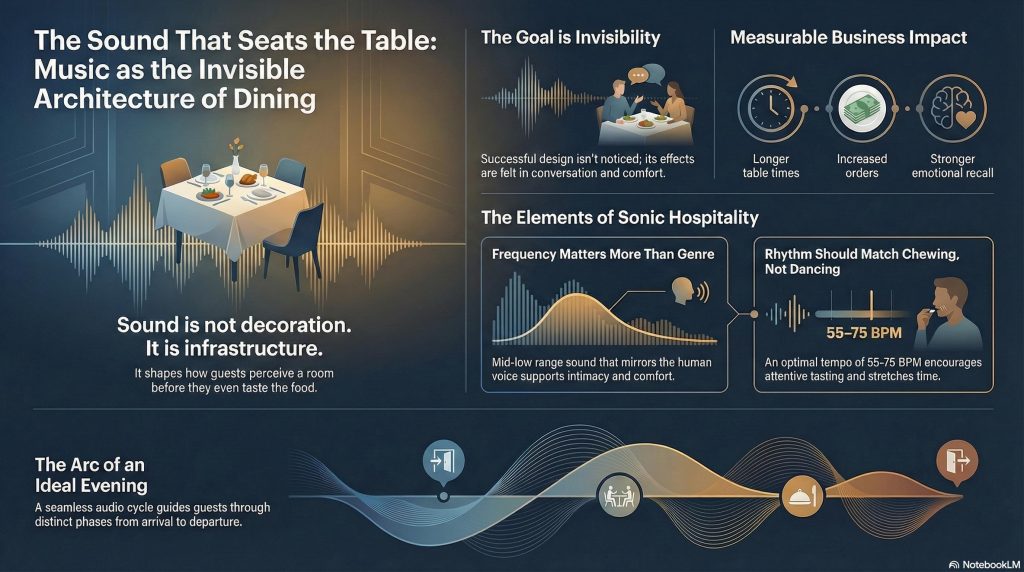
Music for Michelin: The Architecture of the Dining Experience
Executive Summary
This briefing document synthesizes a philosophy of audio design for high-end dining environments, arguing that sound is not a decorative accessory but a foundational infrastructure that shapes the entire guest experience. The core thesis posits that music and ambient sound, when deliberately designed, become an invisible architecture influencing a diner’s perception of time, taste, intimacy, and memory. The ideal audio design is one that guests do not consciously notice; its success is measured by behavioral outcomes such as longer table times, increased orders for dessert and beverages, and conversations that are perceived as more fluid and meaningful.
The approach prioritizes frequency behavior over genre, advocating for a sound profile centered in the mid-low range (mirroring the human voice) with a soft tapering of high frequencies. The optimal tempo aligns with a resting heart rate (55–75 BPM) to encourage slower chewing and more attentive tasting. The document details a 33-track continuous audio cycle, “Music for Michelin,” designed as a closed ecosystem that mirrors the distinct phases of a meal—from arrival to departure—before seamlessly looping. This cycle, characterized by a narrow dynamic range and a “brushed linen” spectral profile, aims to create a condition of comfort and trust, allowing the space itself to feel generous and hospitable.
The Foundational Role of Sound in the Dining Experience
The central argument presented is a radical reframing of music’s role in a restaurant. It moves from the conventional view of music as a playlist for “vibe” to a foundational element of architectural design.
“Sound is not decoration. It is infrastructure.”
According to this philosophy, the auditory environment is one of the primary forces shaping a guest’s experience, often on a subconscious level. Long before a diner analyzes a dish or evaluates service, their nervous system registers the room’s soundscape and determines whether the environment feels safe, rushed, or welcoming. Exceptional restaurants are those that design for this deliberately.
The First Course: Silence as Welcome
The ideal dining experience begins not with music, but with its absence—a controlled quiet described as “the silence that is not empty.” This foundational layer is achieved through physical acoustic design:
- Materials: Wood, fabric, and leather absorb sharp sound.
- Surfaces: Curved surfaces and diffusion techniques soften reflections.
When this acoustic foundation is established, sharp edges are removed from the soundscape, and no single sound demands attention. This prompts guests to instinctively lower their voices, relax their posture, and slow their breathing. This “silence as welcome” is the necessary precursor before music can be introduced effectively.
Principles of Effective Audio Design for Dining
Once the foundational quiet is established, music should be introduced not as a performance, but as a condition that supports the dining experience.
Music Behaving Like Light
The document proposes that music should function like daylight through a window: “Present. Supportive. Directional without being dramatic.” The most effective dining music adheres to the following principles:
- Tempo: Slow to mid-tempo.
- Rhythm: Low in rhythmic insistence.
- Vocals: Sparse or entirely free of lyrics.
- Harmonics: A warm harmonic palette.
- Structure: Repetitive with subtle, gradual variation.
When executed correctly, the music is unnoticeable. Its presence is only felt when it disappears. This approach is validated by neuroscience, which shows that harsh high frequencies can raise cortisol levels, aggressive rhythms can rush chewing, and bright transients can fatigue the ear and dull the perception of flavor. As the text states, “Sound, quite literally, seasons the meal.”
Technical Specifications: Frequency and Rhythm
The analysis asserts that debates over genre (e.g., Jazz vs. Ambient) are misguided. The critical factors are frequency behavior and rhythmic pulse.
- Frequency: The most relaxing soundscape exists primarily in the mid-low range.
- 500 Hz to 2.5 kHz: Frequencies mirroring the human voice support conversation and intimacy.
- 120–250 Hz: Gentle warmth in this range evokes fullness and comfort.
- Above 6 kHz: High frequencies should taper softly, never “sparkle or bite.”
- The Resulting Texture: Described as “brushed linen—not polished chrome,” this frequency curve makes voices feel round and micro-sounds (like cutlery) remain subconscious.
- Rhythm: The tempo of dining is slower than most entertainment music.
- Optimal Tempo: The ideal rhythmic pulse is between 55–75 BPM, aligning with or below a resting heart rate.
- Effect: This encourages longer bites, deeper chewing, and more attentive tasting. Faster, syncopated rhythms can compress the perception of time and distract the palate. In a well-designed space, time “stretches.”
The 33-Track Arc: A Continuous Auditory Journey
To illustrate these principles, the document outlines a 33-track continuous audio cycle, “Music for Michelin,” designed as a closed ecosystem. It mirrors the phases of a meal and then loops seamlessly.
- Tempo Range: 55–72 BPM
- Dynamic Range: Narrow and even; never performative.
- Spectral Profile: “brushed linen mids, warm low bloom, rolled highs.”
Phases of the Dining Journey
- Arrival & Settling (Tracks 1–6): Establishes safety and presence with near-silence, felted piano, and brushed textures. The sensation is of “a room inhaling” as the outside world recedes.
- Social Warmth & Early Courses (Tracks 7–14): Introduces soft strings, muted guitars, and subtle pulses to create “social camouflage”—a murmur of belonging that supports conversation.
- The Center of the Evening (Tracks 15–22): Utilizes negative space and restrained warmth to hold the emotional core of the meal. Time loosens as the music supports, rather than guides, emotion.
- Dessert & Lingering (Tracks 23–29): Textures thin and motion slows. Silence becomes more present but warmer, encouraging guests to linger without checking the time.
- Departure Without Rupture (Tracks 30–33): The final pieces mirror the opening tracks but are “seasoned by the evening.” The almost-silent room feels warm and continuous, even as guests prepare to leave. The last track dissolves seamlessly into the first.
Complete Tracklist and Descriptions
| Track | Title | Description |
| 1 | The Silence That Is Not Empty | Slow-evolving ambient bed from filtered room tone and soft pads. No discernible rhythm. Feels like the room inhaling. |
| 2 | First Glass, No Words | Sparse, felted piano notes allowed to decay fully. Midrange forward with highs rolled off. |
| 3 | Brushed Linen | Very light brushed percussion mirroring resting heart rate, paired with low string drones. No transient spikes. |
| 4 | A Room Filling Slowly | Gentle upright bass harmonics and soft synth pads with slow harmonic shifts. Sensation of space becoming inhabited. |
| 5 | Conversation Without Edges | Muted guitar harmonics and warm synths with slight stereo movement to create social camouflage. |
| 6 | Ceramic and Breath | Low, open piano chords recorded closely, with occasional breath-like noise layered beneath. Constant dynamics. |
| 7 | The Table Between Us | Soft string quartet pads with long, overlapping tones. Unresolved harmony invites conversation to resolve instead. |
| 8 | Warm Midday Shadows | Slow, almost imperceptible electronic pulse with low clarinet tones. Sits under chewing tempo. |
| 9 | Hands Moving Carefully | Heavily damped and filtered marimba-like tones, played sparsely with softened overtones. |
| 10 | The Murmur of Belonging | Layered, unintelligible human-like vowel pads mixed very low to create a sense of presence without language. |
| 11 | Bread Arrives | Low piano ostinato with extremely slow repetition and warmth around 180 Hz to unconsciously slow movement. |
| 12 | Cutlery on Porcelain | Micro-textures resembling softened ceramic contact, transformed into rounded, tactile tonal elements. |
| 13 | No One Is Rushing | Sustained synth chords with slow filter movement at ~55 BPM. Time feels padded. |
| 14 | Wine Breathing | Extremely soft double bass arco textures paired with analog pad warmth. Harmonics bloom slowly. |
| 15 | Mid-Course Pause | Near-silence with a faint harmonic shimmer. Negative space with tone to encourage lingering. |
| 16 | Soft Focus | Felt piano and distant strings moving in parallel. No counterpoint tension, creating a “candlelight” effect. |
| 17 | The Center of the Evening | Warm modal harmony with a gentle pulse from low percussion that is “felt rather than heard” at ~65 BPM. |
| 18 | Laughter Settles | Muted brass pads and low woodwinds with no sharp attacks. The sound “wraps rather than projects.” |
| 19 | Shared Plates | Acoustic guitar textures processed to remove pick noise. Slow, evenly spaced arpeggios emphasizing midrange intimacy. |
| 20 | Between Courses | Ambient interlude with filtered noise shaped like breath and fabric. A psychological reset with no dominant tonal center. |
| 21 | Second Glass | Piano returns in a lower register. “Familiar but not recognizable. Memory without nostalgia.” |
| 22 | Time Loosens | Slow-moving synth choir with subtle detuning to gently blur the perception of time. |
| 23 | Evening Thickens | Low string drones deepen slightly, with frequency emphasis kept below 2.5 kHz. |
| 24 | Knife Through Protein | Textural sound design inspired by friction, translated into softened, tonal sweeps. |
| 25 | Almost Dessert | Light celesta-like tones filtered to remove sparkle, played sparingly to suggest anticipation without excitement. |
| 26 | Sweet Without Sugar | Modal harmony that is warm but restrained. Emotionally neutral while providing comfort. |
| 27 | Candles Burning Lower | Analog pads with very slow amplitude modulation at ~58 BPM to encourage leaning back. |
| 28 | Last Bites | Sparse piano notes reappear, with widening silence between them. Nothing resolves. |
| 29 | Lingering | Near-inaudible drone with gentle harmonic overtones, designed to almost disappear entirely. |
| 30 | No One Checks the Time | A warm midrange synth sustained endlessly with no movement. The room “holds itself.” |
| 31 | Coats Still On Chairs | Soft string harmonics with the high end carefully rolled off to evoke staying rather than leaving. |
| 32 | Almost Silence Again | Filtered room tone mirroring track 1 but slightly warmer, as if seasoned by the evening. |
| 33 | The Silence That Is Still Warm | A gentle convergence of opening harmonic materials that dissolves to seamlessly reconnect to track 1. |
The Business Case and Experiential Outcome
Treating music as a foundational element yields measurable business effects and shapes guest memory.
Measurable Effects:
- Longer average table times without any perceived delay.
- Increased orders of dessert and beverages.
- Reduced vocal fatigue for both guests and staff.
- Stronger emotional recall of the overall experience.
Experiential Outcomes: Successful audio design is invisible. Guests do not comment on the “great music.” Instead, their feedback reflects the effects of the environment:
- “We lost track of time.”
- “The food felt richer.”
- “The conversation just flowed.”
Ultimately, sound shapes trust. It communicates to the body whether to be guarded or present, to perform or to belong. The highest compliment is invisibility, where the sound does not perform, but hosts. As the document concludes, “When sound is designed with the same care as food, light, and service, the room itself becomes generous… It is what allows the space to fill us.”
The Invisible Architecture: How Sound Shapes Your Dining Experience
Introduction: The Unheard Ingredient
Most restaurants treat music as an afterthought—a playlist to fill space or mask noise. Exceptional ones, however, operate from a quieter and far more powerful understanding: sound is not decoration, but infrastructure. It is a primary force that shapes a guest’s perception of time, taste, intimacy, and memory. The process of perception is layered; the auditory environment triggers a subconscious neurological response—a signal to “rest and digest” or “fight or flight”—long before a guest consciously evaluates the food or service.
“Music creates atmosphere. Atmosphere creates environment. Environment influences behavior.” — Richard Nibley
This sonic experience begins not with a melody, but with the strategic application of silence.
1. The First Course: The Power of Quiet
The ideal dining environment begins with what can be described as “the silence that is not empty.” This is a meticulously controlled quiet where transient spikes and harsh upper-mid frequencies have been removed. It is achieved not with technology, but through the physical architecture of the space.
Materials are chosen for their acoustic properties, specifically their ability to absorb sound energy rather than reflect it:
- Wood, fabric, and leather are porous surfaces that trap sound waves, reducing echo and reverberation.
- Curved surfaces are critical for diffusing sound, preventing the harsh, flat echoes known as “slap back” that can make a room feel acoustically brittle and unwelcoming.
The strategic goal of this foundational quiet is to de-escalate the guest’s nervous system. It compels them to lower their voices, drop their shoulders, and slow their breathing without conscious thought. This is not silence as austerity; it is silence as a form of welcome. Only after this acoustic foundation is set can music be effectively introduced.
2. Core Principles: Designing Sound That Hosts
Effective audio design follows specific principles that have more to do with psychoacoustics and physics than with musical taste. From a strategic standpoint, we are less concerned with genre and more concerned with controlling the impact of specific frequency bands and rhythmic patterns on the human body.
Music That Behaves Like Light
In a well-designed space, music should function like daylight through a window: present, supportive, and directional without being dramatic. When this is achieved, diners do not consciously notice the music; they only notice a sense of ease, or the void left when the sound is removed.
Key Characteristics of Effective Dining Music
- Slow to mid-tempo: Encourages a relaxed physical pace and prevents a feeling of being rushed.
- Low in rhythmic insistence: Avoids subconsciously speeding up the act of chewing and conversation.
- Sparse or entirely free of lyrics: Prevents cognitive load and distraction from conversation, allowing it to flow naturally.
- Warm in harmonic palette: Creates a neurological feeling of comfort, safety, and intimacy.
- Repetitive with subtle variation: Encourages habituation, allowing the music to fade into the background without becoming boring.
Collectively, these attributes create a sonic texture that supports the nervous system rather than stimulating it, allowing the palate and conversation to become the primary focus.
Frequency Over Genre
The common debate over musical style—Jazz versus Ambient, for instance—is a strategic error. What truly matters is frequency behavior. From a design perspective, our goal is to create a soundscape the human ear perceives as non-threatening.
| Desirable Frequency Range | Primary Benefit for Diners |
| Mid-Low (500 Hz – 2.5 kHz) | Mirrors the human voice, supporting conversational clarity and intimacy. |
| Gentle Warmth (120–250 Hz) | Evokes a sense of fullness and comfort, often perceived as physical warmth. |
| Soft Highs (Above 6 kHz) | Prevents sounds like glassware from sounding brittle and avoids listener fatigue. |
When this frequency curve is respected, human voices feel rounder, glassware sounds more artisanal, and the micro-sounds of a meal are integrated into a cohesive, non-threatening whole.
Rhythm and Tempo
Every human activity has an inherent tempo. The common design error is to score dining with a tempo meant for entertainment, which creates a subconscious conflict. The optimal rhythmic pulse for eating aligns with a state of parasympathetic nervous system activation, or a resting heart rate.
- Optimal BPM Range: 55–75 BPM
Slower rhythms encourage more attentive tasting and make time feel as if it is stretching, not compressing, allowing the dining experience to deepen. These individual principles are then woven together into a complete narrative arc.
3. The Blueprint: The 33-Track Arc
Instead of a reactive playlist, the ideal audio experience is a closed ecosystem—a continuous 33-track cycle engineered to guide the diner’s journey. It is a seamless loop that mirrors the five distinct phases of a meal.
- Arrival & Settling (Tracks 1–6): The strategic goal here is to de-escalate the guest’s nervous system from the outside world. This is achieved through subtractive composition—removing sharp transients and clear melody in favor of felted piano and brushed textures that create the sensation of a “room inhaling.”
- Social Warmth & Early Courses (Tracks 7–14): The goal is to introduce a “murmur of belonging” that provides social camouflage for conversation as the first courses arrive. The technique involves layering soft strings and muted guitars to support human speech frequencies without intelligible distraction.
- The Center of the Evening (Tracks 15–22): The goal is to hold space for the main part of the meal, supporting a state where time loosens. The music achieves this by using negative space, restrained modal harmony, and a pulse that is felt rather than heard, allowing shared experiences to become the focus.
- Dessert & Lingering (Tracks 23–29): The goal is to slow the experience even further, encouraging guests to linger without feeling pressured. This is done by thinning instrumental textures and making silence more present, which neurologically signals safety and removes any sense of urgency.
- Departure Without Rupture (Tracks 30–33): The goal is to provide a gentle conclusion that mirrors the opening tracks but with a warmer emotional resonance. The sound allows the evening to conclude seamlessly, looping back to the beginning for the next guests without any jarring change in atmosphere.
This technical blueprint is designed to produce specific, predictable emotional and behavioral results.
4. The Result: Hospitality You Never Notice
When audio design is successful, it becomes invisible. The highest compliment it can receive is for no one to notice it at all.
What They Don’t Say:
“This restaurant has great music.”
What They Feel and Say Instead:
“We lost track of time.” “The food felt richer.” “The conversation just flowed.”
This invisible design has tangible business benefits, creating an environment where guests:
- Experience longer average table times without any perceived delay.
- Are more likely to order dessert and additional beverages.
- Form stronger, more durable emotional memories of their experience.
Acoustic design is therefore a tool for shaping trust. It signals to the body that it is in a place for belonging, not simply consumption.
Conclusion: The Sound That Hosts
The central principle is this: when music does not perform, it hosts.
When sound is engineered with the same care as the menu, lighting, and service, the room itself becomes an agent of hospitality. It holds conversation, softens time, and creates the conditions for genuine human connection. Ultimately, sonic design is not about filling a space with sound; it is about creating a space where human experience can fully unfold.
Sound as Hospitality
Foreword: A New Foundation for Experience
“Music creates atmosphere. Atmosphere creates environment. Environment influences behavior.”
— Richard Nibley
Sound is not a sensory addition to a space; it is its fundamental, invisible architecture. In the world of hospitality, where every detail is curated to craft an experience, the auditory environment is too often left to chance—a final, decorative layer applied without intention. This manifesto provides the principles for designing experiences that resonate on a primal, emotional level, moving beyond mere aesthetics to cultivate a genuine sense of belonging. It is a guide to building environments that don’t just host guests, but hold them.
——————————————————————————–
1. The Foundational Flaw: Sound as an Afterthought
The most significant and pervasive failure in hospitality design is the relegation of sound to a final, decorative layer. This practice fundamentally misunderstands the role of audio in shaping human perception and behavior. Correcting this perspective is not an aesthetic tweak; it is a strategic imperative.
In the common industry process, music is chosen last. It comes after the menu is finalized, the lighting is dialed in, the chairs are chosen, and the walls are painted. The result is a playlist—a superficial treatment intended to fill space or mask noise. This approach treats sound as an accessory when, in fact, it is the very infrastructure upon which the guest experience is built.
Sound is not decoration. It is infrastructure.
This paradigm shift is critical because sound operates beneath the threshold of conscious thought. Long before a guest registers a flavor, evaluates a dish’s presentation, or forms an opinion about the service, their nervous system has already scanned the environment. It has listened to the room and decided whether it feels safe, rushed, exposed, or held. The auditory landscape makes a promise the moment a guest arrives, and every subsequent element of their experience is colored by whether that promise is kept.
The journey to exceptional audio design, therefore, begins not with what is added, but with what is masterfully controlled.
2. The First Principle: Engineering the Welcome
The strategic foundation of auditory design is silence. This is not the sterile absence of sound, but an essential, prepared canvas upon which the entire guest experience is built. It is the first and most profound act of hospitality.
This foundational state can be described as the silence that is not empty: a controlled quiet where sharp edges are removed and acoustic reflections are softened. It is a state where no single sound demands attention, allowing the nervous system to relax and acclimate. This is not achieved with speakers, but with physical design and material choice. Architectural elements and finishes like wood, fabric, leather, and curved surfaces absorb and diffuse sound, creating an environment that feels calm and held.
The subconscious effect on guest behavior is immediate and measurable. In a room engineered for this intentional quiet, guests lower their voices without realizing it. Their shoulders drop. Their breathing slows. This is not silence as austerity; it is silence as a non-verbal welcome, communicating safety and presence from the very first moment.
Only once this foundation of intentional quiet is established can music earn its place.
3. The New Rules of Auditory Design
Moving beyond the flawed “playlist” mentality requires a new framework—a set of rules grounded in psychoacoustics and human biology, not in arbitrary debates over genre or style. This approach transforms music from a performance into a functional condition of the environment itself.
3.1 Music That Behaves Like Light
The central metaphor for effective audio design in hospitality is to treat music like daylight filtering through a window. It should be “Present. Supportive. Directional without being dramatic.” It illuminates the space without becoming the focal point—a principle long understood by ambient pioneers and now increasingly validated by neuroscience. The key characteristics of this approach are precise and intentional:
- Tempo: Slow to mid-tempo
- Rhythm: Low in rhythmic insistence
- Vocals: Sparse or entirely free of lyrics
- Harmony: Warm in harmonic palette
- Structure: Repetitive with subtle variation
When this philosophy is executed correctly, the outcome is profound in its subtlety. Diners do not notice the music. They only notice when it disappears. This is the ultimate goal: music that functions not as a performance demanding attention, but as a condition of the space that supports the experience within it.
3.2 Frequency Over Genre
The conventional debate over musical style—Jazz versus Ambient, Classical versus Electronic—is a distraction. From a strategic audio design standpoint, the critical factor is not genre, but frequency behavior.
The human ear is most relaxed when sound resides primarily in the mid-low range. A carefully sculpted frequency curve creates an environment that feels comfortable and intimate, supporting the natural sounds of dining and conversation. The ideal specifications are clear:
- Core Range: An emphasis on the mid-low range promotes relaxation.
- Intimacy Zone: Frequencies mirroring the human voice, from
500 Hz to 2.5 kHz, are prioritized to support conversation. - Warmth & Comfort: The
120–250 Hzrange is gently supported to evoke a sense of fullness. - High Frequencies: Frequencies above
6 kHzmust taper softly. They should never “sparkle or bite,” as sharp highs can raise cortisol and induce fatigue.
When this curve is respected, voices feel round, glassware sounds artisanal instead of brittle, and the micro-sounds of a meal remain comfortably in the background. If this sound had a texture, it would be brushed linen, not polished chrome.
3.3 Rhythm as Pacing, Not Performance
The act of dining has its own intrinsic tempo. It is slower than walking, slower than conversation, and significantly slower than most music designed for entertainment. To support this natural pace, the rhythm of the auditory environment must align with the body, not compete with it.
The optimal rhythmic pulse for eating is between 55–75 BPM, a range that aligns loosely with resting heart rate or below. This tempo has a direct physiological effect: it encourages longer bites, deeper chewing, and more attentive tasting. In contrast, faster rhythms and syncopation compress the perception of time and distract the palate. The goal is not to stop time, but to expand the experience of it.
In great restaurants, time does not stop. It stretches.
Applied in concert, these rules cease to be individual adjustments and become a unified system for engineering belonging.
4. An Architecture for the Evening: The 33-Track Arc
To illustrate these principles in practice, we can move from abstract rules to a concrete architecture: a 33-track continuous audio cycle. This is not a playlist; it is a closed ecosystem, a seamless loop designed to intentionally shape the entire dining journey from arrival to departure.
The arc is divided into five distinct phases that mirror the natural progression of a meal:
- Arrival & Settling (Tracks 1–6): The cycle begins with near-silence, felted textures, and slow harmonic drifts. Pieces titled “The Silence That Is Not Empty” and “First Glass, No Words” establish a sense of safety and presence, allowing guests to acclimate and the outside world to recede. The room feels as if it is taking a deep breath.
- Social Warmth & Early Courses (Tracks 7–14): As the evening begins, soft strings, muted guitars, and subtle pulses introduce a sense of “social camouflage.” This gentle murmur, embodied by tracks like “Conversation Without Edges,” creates a feeling of belonging without intelligible distraction, encouraging conversation to form as wine breathes and bread arrives.
- The Center of the Evening (Tracks 15–22): At the heart of the meal, the music uses negative space and restrained warmth to support the experience. The audio here does not guide emotion; it holds it. Time loosens, and the environment provides a stable, unobtrusive container for connection and enjoyment.
- Dessert & Lingering (Tracks 23–29): As the meal winds down, textures thin and motion slows. Silence becomes more present again, but it is warmer than it was at the start. This sonic shift encourages guests to lean back and linger without feeling rushed or pressured to leave.
- Departure Without Rupture (Tracks 30–33): The final pieces mirror the opening, creating a warm, seamless loop seasoned by the memory of the evening. The return to near-silence feels continuous and natural, making the room feel as though it will go on long after the guests have departed.
The last track dissolves perfectly into the first. No beginning. No end. Just continuity. This structure moves guests through the evening with an invisible, supportive hand, ensuring every moment feels intentional.
5. The Business Case for Listening
Treating sound as foundational infrastructure is not an esoteric design exercise; it is a strategic decision that yields measurable returns and builds lasting brand equity. The link between these principles and concrete business value is direct and undeniable.
First, consider the experiential outcomes. When audio design is successful, guests don’t praise the music. Instead, they articulate the effects of a well-designed environment. They report that they “lost track of time,” that the “food felt richer,” or that the “conversation just flowed” effortlessly.
These qualitative experiences translate directly into tangible business metrics:
- Longer average table times without any perceived delay
- Increased dessert and beverage orders
- Reduced vocal fatigue for both guests and staff
- Stronger emotional recall of the experience
Beyond these metrics lies a more durable and valuable asset: trust. A well-designed soundscape communicates to the body on a subconscious level. It tells guests whether to rush or to remain, whether to perform or to be present. It creates a profound sense of belonging that transforms a meal into a memory, building a relationship that transcends any single visit.
This is the ultimate conversion: an environment that guests trust to hold them, ensuring their return.
——————————————————————————–
Sound is Hospitality You Never Notice
The highest compliment that a hospitality environment’s audio design can receive is its own invisibility. When sound is crafted with the same care as the food, light, and service, it ceases to be a separate element and integrates fully into the architecture of the experience. The room itself becomes generous. It holds conversations, it softens time, and it allows people to arrive fully and leave changed, without quite knowing why.
When music does not perform, it hosts.
The goal is not to fill a space with sound, but to use sound to create a space that can be filled by human connection, memory, and presence.
In the end, music is not what fills the space. It is what allows the space to fill us.
The Silence That Holds Us
Introduction: The Arrival
The door closes behind them with a sound that barely counts as one. Not a click, not a thud. More like the room accepting them. Outside, the winter-bright streets of Bushwick are loud and sharp, but inside Eyval, the air seems padded. The ceiling disappears into shadow, and the surrounding textures of fabric and wood create a hush that doesn’t ask for reverence, only presence. The five friends—Samira, Jules, Reza, Maya, and Ari—pause instinctively, their bodies registering the shift before their minds do. Samira, who always sees systems before surfaces, is the first to put it into words. “They tuned this room,” she murmurs. Jules, a film production designer, smiles. “Or they untuned it,” they reply. “From the rest of the city.”
The sound wasn’t silence, but a soft, evolving bed of filtered tones, like the room itself was inhaling.
This carefully crafted quiet, this “silence that is not empty,” is the foundation of the entire experience. It is the first promise the room makes. Before a single word is exchanged at their table, the group unconsciously lowers their voices. Shoulders drop. This is not an aesthetic choice; it is a physiological one. Their “nervous system has already decided whether the room feels safe.”
As they found their seats at the wide table, the conversation they’d been holding back in the cold began to surface, buoyed by the room’s subtle promise.
Act I: The Conversation Begins
Chairs slide across the wood floor, a soft sound of fabric and friction. Reza, an architectural acoustician, turns his wine glass, watching the light move through it. “This is the best part,” he says quietly. “Before the evening decides what it’s going to be.” As their conversation begins—first about workspaces, then about the very nature of curiosity—the audio environment shifts almost imperceptibly with them.
Beneath their words, soft string pads and muted guitar harmonics introduced a gentle murmur, a form of social camouflage that made conversation feel private yet connected.
The friends debate with an easy intimacy. Ari, a ceramicist, insists that “design has a soul,” not as a metaphor, but as a practical reality. Reza gently challenges her, but Ari holds her ground. “A soul isn’t a shortcut,” she replies calmly. “It’s a responsibility.” The ease of their debate is no accident; it is supported by the very air around them. The soundscape’s unresolved harmony, a key feature of Track 7: The Table Between Us, invites “conversation to resolve instead.” The soundscape creates a generous space for their friendly disagreement, holding the tension without heightening it. As bread arrives and the room fills, the principles of the audio design become more tangible, supporting every micro-event at the table.
“Voices feel round. Glassware sounds artisanal, not brittle. Micro-sounds like cutlery and breath remain subconscious.”
The early part of their meal feels unhurried and whole, setting the stage for deeper connection as the main courses arrive.
Act II: The Center of the Evening
Shared plates are passed. Hands move carefully. The conversation flows effortlessly from the merits of steampunk (“It was about refusing a single timeline of progress,” Jules argues) to the future of sincerity. This seamless drift is by design. The soundscape has entered its “Center of the Evening” phase, a series of tracks built to hold emotion rather than guide it.
A warm, modal harmony with a pulse felt rather than heard seemed to gently loosen time itself.
At one point, the conversation thins into a comfortable pause. It is not an awkward silence to be filled but a suspended, shared moment. This is a deliberate feature, the sonic equivalent of an exhale. The audio track playing is likely Track 15: Mid-Course Pause, designed with “negative space with tone” specifically to encourage lingering. Maya breaks the quiet softly. “Do you ever think we confuse innovation with urgency?” Reza nods. “Urgency is loud. Innovation is patient.” His observation is perfectly mirrored by the music’s slow tempo—around 65 BPM—and its lack of rhythmic insistence, which reinforces a feeling of patience over urgency, making time feel “padded.”
Though the friends don’t consciously notice the music, it is actively shaping their experience.
What the Sound Was Doing
- Stretching Time: Using slow tempos (55-75 BPM) that align with a resting heart rate. This encourages longer bites, deeper chewing, and more attentive tasting.
- Holding Conversation: Employing warm, mid-range frequencies (500 Hz to 2.5 kHz) that support the human voice without competing with it, making dialogue feel round and clear.
- Deepening Flavor: Avoiding harsh high frequencies and aggressive rhythms. Bright transients fatigue the ear and subtly dull flavor perception, so the soundscape is designed to be gentle on the palate.
It is this invisible architecture that leads them, without planning, to a collective and immediate agreement to see the dessert menus.
Act III: Lingering and Departure
When the dessert menus appear, no one hesitates. Despite not planning on it, everyone agrees immediately. The soundscape has anticipated this moment, shifting again to become even more subtle and supportive of the evening’s final act.
The music thinned, textures softened, and sparse, celesta-like tones suggested anticipation without excitement.
When the desserts arrive, one of the friends closes their eyes after the first bite, a moment of pure sensory focus. This is the climax of the audio design’s work. The music has become almost inaudible, receding to allow other senses to heighten. It is a perfect illustration of the core principle that “sound, quite literally, seasons the meal.”
The group’s reluctance to leave is palpable. “Coats remain on chairs. Phones stay untouched.” This behavior is encouraged by the final audio tracks, which mirror the opening’s quiet but are “seasoned by the evening,” creating a feeling that the warm, generative atmosphere will “continue without them.”
Finally, they stand to leave. At their request, the server takes a photo of the five friends leaning in together, their postures relaxed and familiar. They step back out into the falling snow, returning to the sharp-edged city. They will not talk about the restaurant’s playlist on the way home or remember a single melody. They will only remember the feeling. They will only remember that it held.
The sound never performed. It hosted. When sound is designed with the same care as food, light, and service, the room itself becomes generous. It holds conversations. It softens time. It allows people to arrive fully—and leave changed, without quite knowing why. In the end, music is not what fills the space. It is what allows the space to fill us.
The Infrastructure of Sound
Project Proposal: Elevating the Dining Experience Through Sonic Architecture
1.0 Introduction: The Invisible Architecture of Hospitality
This document presents a strategic proposal to enhance the restaurant’s brand identity and elevate the customer experience through a foundational, yet often overlooked, element: sound. This proposal moves beyond the conventional view of music as mere decoration, positioning it as a core, structural component of the dining environment. It is a plan to engineer an atmosphere that is not just heard, but felt—one that guides guest behavior, deepens sensory perception, and creates lasting emotional resonance.
“Music creates atmosphere. Atmosphere creates environment. Environment influences behavior.” — Richard Nibley
The following sections will detail a comprehensive audio strategy designed to deliver tangible business benefits and create profound emotional recall for guests. We will first examine the current industry standard and its limitations, then present a foundational philosophy and a specific, implementable solution that treats sound with the same care as cuisine, service, and interior design.
2.0 The Strategic Blind Spot: How Most Restaurants Misuse Sound
The conventional approach to music in hospitality represents a significant missed opportunity. By treating audio as a final, decorative touch—a playlist to “fill space”—establishments neglect one of the most powerful tools for influencing guest behavior and perception. This afterthought mentality fundamentally misunderstands the role sound plays in shaping an environment.
The Conventional ‘Playlist’ Approach
Common industry practice reduces the function of music to a superficial level:
- Music is considered after core design elements like menu, lighting, and furniture have been finalized.
- Its primary function is reduced to filling silence, setting a general “vibe,” or masking unwanted noise.
This approach is flawed because it ignores a critical truth: sound is not decoration; it is infrastructure. Long before a guest consciously registers a flavor, appreciates the service, or forms an opinion about the decor, their nervous system has already been conditioned by the room’s sound. The acoustic environment has already told them whether the space feels safe or exposed, rushed or generous, intimate or chaotic.
This proposal offers an alternative philosophy—one that treats sound as a deliberate and foundational element of hospitality design.
3.0 Our Philosophy: Sound as the First Course
Our core philosophy treats sound as a fundamental architectural element, integral to the guest experience from the very first moment. The experience begins when the door closes, and the room makes an acoustic promise. The essential foundation of this promise is not music, but a carefully engineered “controlled quiet,” or what can be described as the silence that is not empty. This foundational quiet, achieved through the thoughtful use of materials like wood, fabric, and curved surfaces, softens sharp edges and allows guests to unconsciously lower their voices, slow their breathing, and feel genuinely welcomed. Only upon this foundation can music earn its place.
Core Principles of Sonic Hospitality
The most effective dining music is not a performance but a condition. It operates on the following principles, which prioritize physiological impact over stylistic preference:
- Functions Like Light: Music should be present and supportive, much like daylight through a window. It provides direction and warmth without being dramatic or demanding attention. The goal is for guests to notice its absence, not its presence.
- Frequency Over Genre: The specific frequency behavior of the audio is far more critical than its musical style. Sound should live primarily in the mid-low range, with warmth around 120–250 Hz to evoke comfort and a focus on the 500 Hz–2.5 kHz range to support the intimacy of the human voice. When this curve is respected, voices feel round, glassware sounds artisanal instead of brittle, and micro-sounds like cutlery and breath remain subconscious.
- Rhythm Should Match Chewing, Not Dancing: Tempo has a direct impact on how guests experience time and taste. The optimal rhythmic pulse is 55–75 BPM, a range that aligns with a resting heart rate. This encourages slower, more attentive tasting and allows time to feel stretched and generous, in stark contrast to faster rhythms that compress time and rush the palate.
- Aesthetic & Texture: The ideal sonic palette is warm, features minimal or no lyrics, and uses subtle repetition to create a sense of stability. It avoids aggressive rhythms and bright, transient sounds that raise cortisol levels and can subtly dull flavor perception. If sound had a texture, this would be brushed linen—not polished chrome.
Sound, quite literally, seasons the meal. The following section details the specific implementation of this philosophy: the ‘Music for Michelin’ audio cycle.
4.0 The Proposed Solution: The ‘Music for Michelin’ Continuous Audio Cycle
The ‘Music for Michelin’ cycle is the tangible embodiment of the principles outlined above. It is a bespoke, 33-track continuous audio ecosystem designed to intentionally shape the entire dining journey. Functioning as a seamless, closed loop, it flows from arrival to departure, creating a consistent and supportive atmosphere that guides the guest experience without ever calling attention to itself.
The Arc of an Ideal Evening
The cycle is structured into five distinct phases, each mirroring the natural progression of a fine-dining meal.
Phase 1: Arrival & Settling (Tracks 1–6) This initial phase establishes a feeling of safety and presence. Using near-silent textures, felted piano, and slow harmonic drifts, these tracks create the sensation of the room taking a deep breath. They allow guests to acclimate, letting the noise and pace of the outside world recede.
Phase 2: Social Warmth & Early Courses (Tracks 7–14) As the first courses arrive, the audio introduces soft strings, muted guitars, and subtle pulses. This creates a gentle “social camouflage,” a murmur of belonging that supports conversation without being distracting. The sonic environment encourages intimacy and allows dialogue to form without sharp edges.
Phase 3: The Center of the Evening (Tracks 15–22) During the heart of the meal, the music focuses on negative space and restrained warmth. The sound does not seek to guide emotion but rather to hold it, creating a container in which time loosens and shared moments can unfold.
Phase 4: Dessert & Lingering (Tracks 23–29) As the evening progresses, sonic textures thin out, and the pace slows further. Silence becomes more present again, but it is a warmer, more comfortable silence than at the beginning. This phase encourages guests to lean back and linger, making dessert feel like a natural, unhurried extension of the meal.
Phase 5: Departure Without Rupture (Tracks 30–33) The final tracks mirror the opening of the cycle but are seasoned by the warmth of the evening. The audio gently cues a sense of completion without creating an abrupt end, encouraging guests to remain comfortable even as they prepare to leave. The last track dissolves seamlessly back into the first, ensuring continuity for the next arrival.
Technical & Aesthetic Specifications
| Parameter | Specification |
| Tempo Range | 55–72 BPM |
| Dynamic Range | Narrow, even, never performative |
| Spectral Profile | Brushed linen mids, warm low bloom, rolled highs |
This meticulously designed cycle ensures that the audio environment is not just an accessory but an active, invisible partner in crafting an exceptional and memorable dining experience.
5.0 The Tangible Return on Atmosphere
A strategic investment in sonic architecture moves beyond aesthetics to influence core business metrics. By shaping a supportive and generous environment, this approach to audio design produces measurable returns by influencing guest behavior in subtle yet powerful ways.
Measurable Business Impact
Treating music as a foundational element of the dining experience yields the following practical benefits:
- Longer average table times without any perceived delay by the guest.
- Increased dessert and beverage orders as guests linger comfortably in a space that encourages them to relax and stay.
- Reduced vocal fatigue for both guests and staff, leading to a more pleasant and sustainable social environment.
- Stronger emotional recall of the entire experience, fostering deep brand loyalty and generating positive, authentic word-of-mouth.
The Invaluable Guest Perception
When this audio design is successful, its highest achievement is its invisibility. Guests will not comment on the “great music.” Instead, their feedback will reflect a deeper, more holistic sense of satisfaction. They will leave with memories of how the experience felt:
- “We lost track of time.”
- “The food felt richer.”
- “The conversation just flowed.”
These outcomes are proof that a well-designed sonic environment is a critical element in building trust and fostering a genuine sense of belonging for every guest.
6.0 Conclusion: Designing a Signature Sonic Identity
This proposal outlines a strategic investment in the restaurant’s foundational identity, not merely a plan for selecting a playlist. By treating sound as infrastructure, we create an environment that communicates hospitality at a subconscious level, telling guests that this is a place to be present, to connect, and to belong.
The highest compliment this system can receive is its invisibility. When audio design is executed with this level of intention, the sound does not perform; it hosts. It becomes the invisible element that allows the space to become truly generous—holding conversations, softening time, and allowing guests to leave feeling nourished and changed, without quite knowing why.