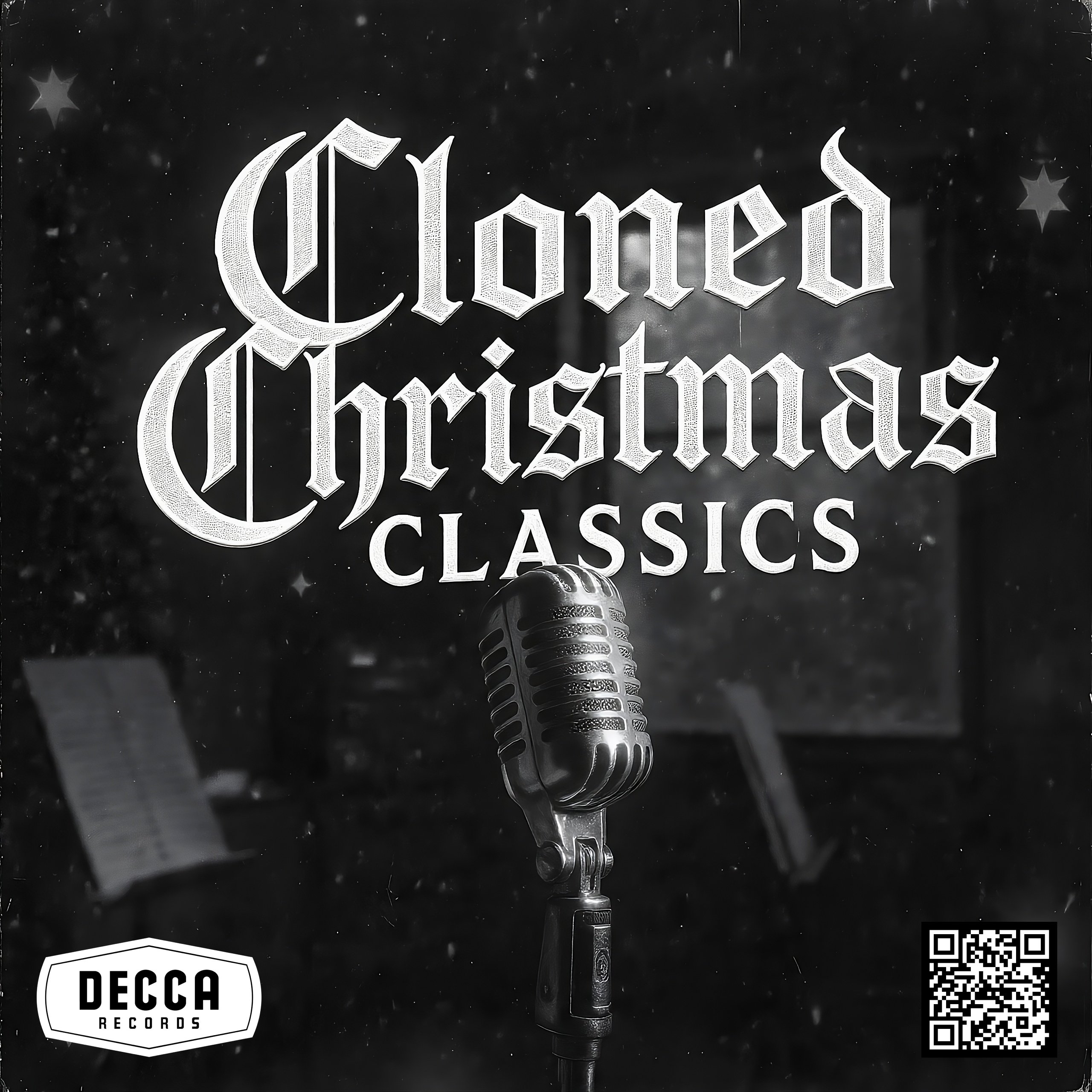
Cloned Christmas Classics – 77 Tracks (4:14:36)
Free Download (320 kbps MP3)
Stream below or directly: https://youtu.be/as5sG2Wl90Q
“A machine made me cry. That’s incredible.”
— a user known as I_Am_Anjelen on r/technology, reflecting on an AI-generated Christmas song
Google’s Deep Dive Podcast: When AI Rediscovers the Warmth of Christmas Music
How 77 Brand-New Songs were Developed to Sound and Feel as Timeless as Bing, Ella, and Nat
Every December, we turn to the same beloved Christmas standards — the warm Bing Crosby croons, the crackling-vinyl glow of Nat King Cole, the shimmering sparkle of the Ronettes and the cozy orchestral sweep of 1940s–1960s holiday music. These songs feel like home. They feel eternal.
But what if you could discover new Christmas classics that sounded as though they had always existed?
What if the holiday soundtrack you grew up loving could suddenly expand — not with parodies, not with imitations, but with fully original songs that carry the same glow, the same warmth, the same emotional sincerity?
That’s the idea behind Cloned Christmas Classics, a one-of-a-kind collaboration between human intuition and AI creativity:
77 original Christmas songs spanning over four hours of brand-new, vintage-sounding holiday music.
This is not an experiment.
This is a new tradition.
A Christmas Album Built for the Golden Age of Holiday Music
From the very beginning, the goal was simple:
Create an entirely original library of Christmas songs that could stand shoulder-to-shoulder with the classics — familiar, timeless, and indistinguishable in sound and spirit from the mid-century era we hold dear.
Each track begins with a set of strict creative rules:
Original vintage-style song titles
Warm, nostalgic, evocative — never derivative and never parody.
Full lyrics written in the style of 1940s–60s lyricists
Stories of snow, love, lanterns, long walks home, quiet prayers, midnight mass, caroling, romance, memory, and spiritual calm.
Alternating male and female lead vocalists
Just like the classic albums of the period.
Rich orchestral arrangements
• strings
• vibraphone
• brushed jazz drums
• girl-group harmonies
• celesta and glockenspiel
• upright bass
• soft choir pads
• and yes, gentle sleigh bells — always.
Analog warmth baked into the sound
These aren’t digital “holiday novelties.”
They sound like you pulled an unopened vinyl from your grandparents’ attic — only the songs are entirely new.
Why “Cloned” Christmas Classics?
The word “cloned” was chosen intentionally.
Not because these are copies — they’re not. Every single track is 100% original.
But because they recreate the conditions, textures, and emotional DNA of classic holiday music:
- the orchestration,
- the vocal delivery,
- the melodic architecture,
- the storytelling style,
- the harmonic language,
- the gentle tape-saturated warmth of mid-century recording.
It’s not cloning a song.
It’s cloning the era.
The result is a musical time machine.
What AI Actually Did — And What It Didn’t
AI wasn’t asked to imitate specific artists.
It was asked to inhabit the aesthetic vocabulary of the era:
Ella Fitzgerald’s twinkle,
Nat King Cole’s velvet glow,
the Ronettes’ sugar-frosted pop energy,
Sinatra’s swing,
Bing Crosby’s cozy croon…
…but without ever recreating their melodies or lyrics.
The human role?
Curation, direction, refinement, emotional calibration, and artistic intention.
The AI role?
Generating original compositions within those boundaries.
Think of it as a composer’s room where a human sits at the helm, and an AI assistant brings ideas to life with precision, speed, and stylistic fluency.
Why 77 Tracks?
Because Christmas deserves abundance.
Because holiday playlists should never run dry.
Because once the creative flow began — and the AI proved it could consistently hit the emotional mark — the project naturally expanded into a library large enough to soundtrack:
- holiday gatherings
- family dinners
- gift wrapping sessions
- quiet nights by the fire
- retail playlists
- hotel lobbies
- entire Christmas parties
- and long December road trips
Four hours and fourteen minutes later, we had a full “lost archive” of original Christmas music.
And, for those who know, 77 fits the soundtrack, and Christmas.
A Fresh Soundtrack for People Who Love the Classics
These songs are designed for listeners who want:
🎄 something new,
🎁 but not unfamiliar,
✨ something fresh,
🎶 but still timeless,
❤️ something original,
📻 but rooted in the golden age of Christmas music.
If the same ten holiday standards have been on repeat for years, consider this your new December universe — a full catalog of “instant classics” that feel like they’ve always belonged.
A New Holiday Tradition
Cloned Christmas Classics isn’t just a music release.
It’s a demonstration of what happens when humanity and AI collaborate with intention, artistry, and emotional clarity.
This project stands as proof that:
✨ AI can create beauty, not just novelty
✨ nostalgia can be reimagined with integrity
✨ “new classics” are possible
✨ the holiday canon can grow
✨ and the magic of Christmas can be shared in fresh ways, year after year
These aren’t replacements for the songs we love.
They’re companions — new stories nestled beside old ones.
Welcome to the future of Christmas music,
wrapped in the warmth of the past.
Narrative Adaptation: The Morning the Music Remembered Us
What Happened When a Family Pressed Play on an Album No One Had Ever Heard, But Everyone Somehow Knew

It was the kind of Christmas morning that felt painted more than lived, snow falling with that feathery patience, the kind that looks choreographed, the kind you notice only after you’ve already been warmed by it. Inside the old Craftsman house on Elmwood Lane, the heat clicked softly through the vents, carrying the scent of pine, cinnamon, and a little woodsmoke dragged in from boots left by the door.
The family was already awake, moving through the room the way people do when they’ve loved each other long enough to speak in gestures. Wrapping paper had begun to collect on the floor in drifting piles, and a half-finished pot of coffee steamed on the kitchen counter. But Christmas morning hadn’t quite “started” yet, not officially, because the music wasn’t on.
And in this house, the music was what made it Christmas.
The protagonist, though he would never call himself that, was Kofi.
Forty-six, introverted in the gentle way, prone to nostalgia but trying not to be ruled by it. He stood beside the turntable, hand hovering above a stack of vinyl he had played every December since college: Bing, Ella, Nat, the Ronettes. He could hear them all in his memory, the soundtracks of his childhood and the scaffolding of every Christmas since.
But this year, the stack stayed untouched.
Instead, his children, Zola and Temba, sat cross-legged on the rug watching him with the kind of curiosity only teenagers muster when a parent is about to do something new and possibly uncool.
“Baba?” Temba asked. “You said you had something different this year?”
Kofi nodded, tapping the Bluetooth icon on the small vintage speaker he had claimed as his sacred December companion. “Yeah. Something… new. But old. But also new.”
His wife, Amahle, raised an eyebrow from the couch. “That’s wonderfully clear.”
He grinned. “Just trust me.”
The speaker chimed. And then, almost shyly, the first track began.
Strings. Brushed drums. A celesta twinkling like falling snow. A woman’s voice, warm and bright as a lantern, singing a melody no one had ever heard, yet everyone reacted to the same way: with a small, involuntary inhale.
“Wait…” Zola whispered. “This sounds like a classic.”
“It’s brand new,” Kofi said softly. “All of it.”
For Kofi, playing the album was more than just a choice in music. It was a quiet rebellion. His father, long gone now, had been the keeper of tradition, the guardian of the “correct” Christmas. Songs from a small, carefully curated canon. No deviations. No experiments. Nothing modern, nothing unexpected.
Kofi had inherited that devotion, but in the years since his father’s passing, Christmas had grown heavier, slower, weighted with the ache of repetition. The songs remained beautiful, yes, timeless, yes, but they had become symbols of what was missing rather than what remained.
This new album, Cloned Christmas Classics, had slipped into his life like a dare:
What if something new could feel just as eternal? What if tradition didn’t have to be a museum?
He hadn’t told the family about the album’s origin, not yet. He wanted their ears unburdened by the idea of AI or concept or creation. He wanted them to feel it first.
The second song swelled from the speaker, a crooning male voice with that honeyed, smoky timbre that wrapped around the room like an embrace. The kids leaned back. Amahle’s shoulders softened. The tree lights flickered across her face, reflecting in her eyes.
Something shifted.
It was subtle, but unmistakable.
The room itself seemed to breathe.
But inside Kofi, a conflict churned. A quiet one. The kind you don’t confess until years later.
Is this cheating?
Is this honoring the past… or replacing it?
Would my father think I’d abandoned something important?
Or would he be relieved I finally let the weight go?
He didn’t know. And the not-knowing sat heavy beside the glow of the tree.
“Baba?” Zola asked suddenly, breaking the silence. “Where did this music come from? Like, who wrote it?”
He hesitated. Amahle noticed instantly, the way she always did.
“Tell them,” she murmured. “It’s Christmas. No secrets.”
So he took a breath.
And he told them.
He told them about the project, humans and AI working together to compose 77 brand-new Christmas songs designed to feel like the classics. Not copies, not parodies, originals that carried the spirit of the era. He told them about the orchestration, the vintage warmth, the alternating voices. He told them how the music wasn’t replacing anything, just adding something new to the canon of joy.
When he finished, the room was quiet again.
Then Temba, the skeptic, the realist, the kid who always asked exactly the right questions, spoke.
“So… a machine wrote this?”
“A machine and a human,” Kofi corrected. “Together.”
“And that doesn’t make it… less real?”
The question hit him in a soft, vulnerable place.
He didn’t answer right away.
Because the truth was complicated, and important.
Before he could speak, the third song began: an upbeat girl-group track, all bells and handclaps. And in that instant, Amahle stood, grabbed both kids by the hands, and pulled them into an impromptu dance circle on the rug. Bare feet slipping on pine needles, laughter mixing with the sleigh bells, the dog weaving between their legs.
Kofi watched the scene unfold, watched the people he loved swirl inside music that didn’t exist a year ago, and finally understood.
“It’s real,” he said quietly, more to himself than anyone else. “Because we make it real. Music isn’t about who made it. It’s about what it does to us.”
The family had stopped dancing; they were listening now.
“It’s real,” he continued, “because it’s part of this moment. Because it’s shaping a memory we’ll carry forever.”
Outside, a wind gust pressed snowflakes against the windows. Inside, warmth held firm.
The album moved through its tracks, shifting from tender ballads to big-band swagger, from candlelit reverence to snow-kissed romance. The family settled into a slow, collective drift, sipping cocoa, lounging under blankets, nudging gifts toward each other, letting the morning unfurl without rush or expectation.
Sometime near the seventh or eighth track, Amahle leaned her head on Kofi’s shoulder.
“You did well,” she whispered.
“By playing an album?”
“No. By letting the past be the past. And letting something new matter.”
He swallowed. The words landed exactly where he needed them.
Outside, the snow kept falling.
Inside, a new kind of Christmas was stitching itself into place.
By the time the final track faded, a rich, orchestral finale glowing with choir and celesta, the morning had settled into a memory that felt strangely inevitable. As though it had always been meant to happen this way.
There would still be Bing and Nat and Ella later in the day. Tradition wasn’t going anywhere. But now, something new stood beside them, not as a replacement, but as a companion.
A parallel story.
A new chapter in an ancient book.
A reminder that nostalgia isn’t a prison, it’s a foundation.
As the fire crackled and the lights shimmered on the tree, Kofi finally understood the truth he’d been circling:
Christmas isn’t defined by what returns every year.
It’s defined by what we’re willing to let in.
And on this morning, surrounded by family, warmth, laughter, and music that sounded like memory itself, Kofi let something new in.
And it loved them back.
Deeper Dives
🎄 TATANKA’s AI-Crafted Christmas Classics
The provided text is an excerpt from a promotional piece by TATANKA, detailing their creation of an AI-crafted music album titled Cloned Christmas Classics, which features 77 original songs designed to sound like “forgotten holiday treasures” from the 1940s–1960s. The core concept explains that the music is not a copy or imitation, but rather a replication of the “emotional DNA” and production style of the era, leveraging AI for composition while human artists manage curation and artistic direction. The source emphasizes that the project aims to expand the existing Christmas music canon by providing new songs that possess the analog warmth, rich orchestration, and nostalgic spirit of vintage classics like Bing Crosby and Nat King Cole. A secondary narrative adaptation illustrates the emotional impact of the music on a family who discovers the AI-generated album, questioning whether machine-made music can still be “real” and memorable.
Briefing: Cloned Christmas Classics
Executive Summary
This document provides a comprehensive analysis of Cloned Christmas Classics, a musical project by TATANKA that uses a human-AI collaboration to generate a new canon of holiday music. The project’s central achievement is an album of 77 original songs, totaling over four hours, meticulously crafted to be sonically and emotionally indistinguishable from the beloved Christmas standards of the 1940s–1960s. The core philosophy is not to imitate specific songs but to “clone the era” by recreating the aesthetic vocabulary, orchestration, and analog warmth of mid-century recordings. The human role is defined as one of curation, direction, and emotional calibration, while the AI’s role is compositional generation within these strict boundaries. The project serves as a proof of concept for AI’s capacity to create genuine beauty and argues that nostalgia can be reimagined with integrity. A supplementary narrative, “The Morning the Music Remembered Us”, explores themes of tradition versus innovation, concluding that the value and “realness” of music are determined by the human memories and emotions it fosters, regardless of its origin.
Project Overview and Core Objective
Cloned Christmas Classics is a large-scale musical release presented as a “lost archive” of original Christmas music designed to evoke the golden age of the genre.
| Attribute | Details |
| Track Count | 77 original songs |
| Total Runtime | 4 hours, 14 minutes, 36 seconds (4:14:36) |
| Format | Free Download (320 kbps MP3) and streaming |
| Publication Date | December 10, 2025 |
The stated goal of the project is to “create an entirely original library of Christmas songs that could stand shoulder-to-shoulder with the classics — familiar, timeless, and indistinguishable in sound and spirit from the mid-century era we hold dear.” It is positioned not as an experiment but as a “new tradition,” intended for audiences who appreciate classic holiday music but desire fresh material that adheres to the same timeless aesthetic. The large volume of tracks is intentional, designed to provide an abundant soundtrack for a wide range of holiday activities, from family gatherings to retail environments.
The Creative Framework: Human-AI Collaboration
The project is explicitly defined as a collaboration between human intuition and AI creativity. The roles are clearly delineated to emphasize that AI operates as a powerful tool guided by human artistic intention.
- The Human Role: The human contribution is framed as strategic and emotional leadership. This includes:
- Curation: Selecting the best outputs.
- Direction: Establishing the creative rules and aesthetic boundaries.
- Refinement: Fine-tuning the compositions.
- Emotional Calibration: Ensuring the music achieves the desired warmth and sincerity.
- Artistic Intention: Defining the overall vision and purpose of the project.
- The AI Role: The AI’s function is generative, operating within the human-defined constraints. It was not tasked with imitating specific artists but with inhabiting the broader “aesthetic vocabulary” of the era, drawing inspiration from the styles of artists like Ella Fitzgerald, Nat King Cole, the Ronettes, Frank Sinatra, and Bing Crosby without copying their melodies or lyrics. The process is described as a composer’s room where “a human sits at the helm, and an AI assistant brings ideas to life with precision, speed, and stylistic fluency.”
Aesthetic and Musical Principles (“Cloning the Era”)
The project’s title, Cloned Christmas Classics, was chosen deliberately. It clarifies that the process is not about cloning individual songs—every track is 100% original—but about cloning the holistic environment of the era. The aim is to recreate the “conditions, textures, and emotional DNA” of mid-century holiday music.
This was achieved by adhering to a strict set of creative rules:
- Song Titles: All titles are original but designed to be warm, nostalgic, and evocative in a vintage style, avoiding parody.
- Lyrical Content: Lyrics are written in the style of 1940s-60s lyricists, focusing on classic holiday themes such as snow, love, lanterns, caroling, romance, memory, and spiritual calm.
- Vocal Arrangement: The album features alternating male and female lead vocalists, mirroring the classic compilation albums of the period.
- Orchestration: Arrangements are rich and authentic to the era, consistently featuring:
- Strings
- Vibraphone
- Brushed jazz drums
- Girl-group harmonies
- Celesta and glockenspiel
- Upright bass
- Soft choir pads
- Gentle sleigh bells
- Sound Engineering: The production incorporates an “analog warmth,” making the tracks sound as if they were sourced from unopened vintage vinyl rather than being digital creations. This includes the “gentle tape-saturated warmth of mid-century recording.”
Thematic Arguments and Philosophical Position
Beyond being a musical album, Cloned Christmas Classics is presented as a demonstration of key principles regarding art, technology, and culture.
- AI Can Create Beauty, Not Just Novelty: The project aims to prove that AI can be a tool for creating emotionally resonant and aesthetically beautiful art, moving beyond the perception of AI as a generator of mere curiosities. A cited user comment, “A machine made me cry. That’s incredible,” is used as evidence of this emotional impact.
- Nostalgia Can Be Reimagined with Integrity: The album argues against the idea that nostalgia must be a static museum of past works. It proposes that the feeling of nostalgia can be a creative wellspring for new art that honors the spirit of the past without being derivative.
- “New Classics” Are Possible: The project challenges the notion that the canon of classic music is closed. It suggests that by understanding and faithfully recreating the core elements that made the original classics timeless, it is possible to create new works that can achieve a similar status.
- The Holiday Canon Can Grow: The 77 new tracks are positioned as “companions” to existing standards, not replacements. The goal is to expand the holiday playlist universe, offering new stories nestled beside old ones.
Narrative Case Study: “The Morning the Music Remembered Us”
The project is accompanied by a short story that serves as an allegorical case study for its intended reception and cultural meaning.
- Synopsis: The story centers on Kofi, a 46-year-old man who feels the weight of maintaining his late father’s rigid Christmas music traditions. On Christmas morning, he chooses to play the Cloned Christmas Classics album for his wife, Amahle, and two teenage children, Zola and Temba. The family is immediately struck by the music’s authentic, classic feel.
- Central Conflict: Kofi’s internal conflict is whether introducing this AI-generated music is a betrayal of tradition or a necessary evolution. This is verbalized by his son, Temba, who, upon learning the music’s origin, asks, “So… a machine wrote this? And that doesn’t make it… less real?”
- Resolution and Key Insight: The conflict is resolved not through intellectual argument but through emotional experience. As his family instinctively dances to a track, Kofi has a realization: the music’s authenticity is validated by their genuine emotional response. He concludes that the music is real “because we make it real.” The story ends with the understanding that the new album does not replace tradition but now stands beside it, symbolizing that Christmas “is defined by what we’re willing to let in.”
Key Quotations
On the Project’s Core Idea: “It’s not cloning a song. It’s cloning the era. The result is a musical time machine.”
On AI’s Emotional Impact: “A machine made me cry. That’s incredible.” — A user known as I_Am_Anjelen on r/technology.
On the Nature of Authenticity: “Music isn’t about who made it. It’s about what it does to us.” — Kofi, from the narrative The Morning the Music Remembered Us.
On Music and Memory: “It’s real, because it’s part of this moment. Because it’s shaping a memory we’ll carry forever.” — Kofi.
On Evolving Tradition: “By letting the past be the past. And letting something new matter.” — Amahle, from the narrative.
On the Philosophy of Nostalgia: “Nostalgia isn’t a prison, it’s a foundation.” — Narrative conclusion.
Creative Vision: The ‘Cloned Christmas Classics’ Project
Introduction: The Core Idea
What if you could discover new Christmas classics that sounded as though they had always existed? What if the holiday soundtrack you grew up loving could suddenly expand with original songs that carry the same warmth and sincerity? This document breaks down the artistic vision behind making that idea a reality.
——————————————————————————–
1. The Primary Artistic Goal: Familiar Timelessness
The project’s goal was to create an entirely original library of Christmas songs that feel timeless and indistinguishable in sound and spirit from the mid-century era.
“Create an entirely original library of Christmas songs that could stand shoulder-to-shoulder with the classics — familiar, timeless, and indistinguishable in sound and spirit from the mid-century era we hold dear.”
To achieve this, the creators established a clear blueprint guided by strict creative rules.
——————————————————————————–
2. The Blueprint for a “Golden Age” Sound
Every one of the 77 tracks was developed according to five foundational rules that defined the project’s vintage aesthetic.
- Rule 1: Original Vintage-Style Song Titles The titles were designed to be warm, nostalgic, and evocative, intentionally avoiding any hint of parody or derivative content.
- Rule 2: Authentic Mid-Century Lyrics Lyrical themes were carefully chosen to mirror the classic era, focusing on stories of snow, love, lanterns, long walks home, quiet prayers, midnight mass, caroling, romance, memory, and spiritual calm.
- Rule 3: Classic Vocal Arrangements Following the structure of classic holiday albums, the songs feature alternating male and female lead vocalists.
- Rule 4: Rich Orchestral Sound Each track is committed to lush, full-bodied arrangements, consistently featuring a specific palette of instruments to create an authentic mid-century sound:
- Strings
- Vibraphone
- Brushed jazz drums
- Girl-group harmonies
- Celesta and glockenspiel
- Upright bass
- Soft choir pads
- Sleigh bells
- Rule 5: Analog Warmth The music was produced to sound like an unopened vinyl record from a grandparent’s attic, delivering a gentle, tape-saturated warmth instead of a sterile, digital novelty.
These creative constraints defined what the music should be; the next step was to determine how it would be made.
——————————————————————————–
3. The AI’s Role: Cloning an Era, Not a Song
The project intentionally uses the word “cloned” not to imply copying, but to describe the process of recreating the conditions, textures, and emotional DNA of the classic holiday music era.
The goal was to clone six specific elements:
- The orchestration
- The vocal delivery
- The melodic architecture
- The storytelling style
- The harmonic language
- The gentle tape-saturated warmth of mid-century recording
This collaboration relied on a clear division of labor between the human creators and their AI assistant.
| The Human Role | The AI Role |
| * Curation: Selecting the best outputs. | * Generating original compositions within the established boundaries. |
| * Direction: Setting the creative vision and rules. | |
| * Refinement: Polishing and improving the generated music. | |
| * Emotional Calibration: Ensuring the music hit the right nostalgic and sincere notes. | |
| * Artistic Intention: Defining the ultimate purpose and meaning of the project. |
Crucially, the AI was not asked to imitate specific artists. Instead, it was tasked with inhabiting the aesthetic vocabulary of the era, channeling the stylistic spirit of touchstones like Ella Fitzgerald, Nat King Cole, the Ronettes, Frank Sinatra, and Bing Crosby without ever copying their work.
This technical process was always in service of a more profound goal: the emotional connection with the listener.
——————————————————————————–
4. The Intended Emotional Impact: Creating New Memories
The project’s ultimate success is measured not by its technical novelty, but by its ability to create genuine emotional resonance.
“A machine made me cry. That’s incredible.” — a user known as I_Am_Anjelen on r/technology
The songs were designed for listeners who want to expand their holiday playlists with music that fulfills a specific set of desires:
- 🎄 something new,
- 🎁 but not unfamiliar,
- ✨ something fresh,
- 🎶 but still timeless,
- ❤️ something original,
- 📻 but rooted in the golden age of Christmas music.
The story of Kofi’s family illustrates the project’s core purpose. Struggling with the weight of honoring his late father’s rigid holiday traditions, Kofi plays the AI-assisted music for his family. His children’s question—”a machine wrote this?… And that doesn’t make it… less real?”—crystallizes his internal conflict. The answer arrives when he watches his family spontaneously dance, creating a new, joyous memory. It is in that moment he realizes the project’s ultimate truth: “Music isn’t about who made it. It’s about what it does to us.” The music becomes a bridge, proving its value by helping his family build a new tradition on the foundation of the old.
This focus on creating new beauty is key to the project’s final philosophy.
——————————————————————————–
5. Conclusion: Expanding the Holiday Canon
The ‘Cloned Christmas Classics’ project is not about replacing beloved standards like “White Christmas” or “The Christmas Song.” Instead, it offers companions to them—new stories nestled beside old ones. The project serves as a powerful demonstration that when AI is guided by clear artistry and human intention, it can be a tool for creating new beauty. By expanding the holiday canon for future generations, this work wraps the future of Christmas music in the warmth of the past.
Unwrapping a New Tradition: How AI Helped Create a ‘Lost Archive’ of Christmas Classics
Every holiday season, we return to the familiar warmth of classic Christmas music. The cozy croon of Bing Crosby, the crackling-vinyl glow of Nat King Cole, and the shimmering sparkle of the Ronettes feel like home. These songs from the 1940s to the 1960s are more than just a playlist; they are the eternal soundtrack to our most cherished memories.
But what if you could discover new Christmas classics that sounded as though they had always existed?
That is the question answered by ‘Cloned Christmas Classics,’ a remarkable album featuring 77 entirely original songs. Each track is meticulously designed to sound and feel as timeless as the standards we’ve loved for generations, creating a “lost archive” of holiday music that feels both brand new and deeply familiar. The emotional impact is undeniable.
“A machine made me cry. That’s incredible.” — a user known as I_Am_Anjelen on r/technology
This wasn’t about copying the past, but something far more audacious: cloning an entire musical era.
1. What Does It Mean to “Clone an Era”?
The core idea behind the ‘Cloned Christmas Classics’ project is captured in a single, powerful phrase:
It’s not cloning a song. It’s cloning the era.
The goal was never to create copies of existing songs. Instead, the creators sought to recreate the conditions, textures, and emotional DNA of mid-century holiday music. To do this, they identified and trained an AI to understand the six core elements that define the era’s unique sound and feel:
- The Orchestration: The specific instruments and arrangements that give the music its lush, sweeping quality.
- The Vocal Delivery: The distinct style, tone, and sincerity of the singers from that golden age.
- The Melodic Architecture: The fundamental structure and shape of the tunes themselves.
- The Storytelling Style: The classic themes and narratives woven into the lyrics, from romance to spiritual calm.
- The Harmonic Language: The types of chords and progressions that give the music its characteristic warmth and sophistication.
- The Analog Warmth: The gentle, tape-saturated sound that distinguishes mid-century recordings from modern digital productions.
But to clone an era, you first need a recipe—a set of immutable rules to ensure every note felt authentic.
2. The Creative Recipe: Rules for Building a Timeless Sound
To achieve an authentic vintage sound, the project was built on a foundation of strict creative rules. These guidelines served as a recipe for the AI, ensuring that every song would be indistinguishable in spirit from the classics that inspired them.
| Creative Element | The Vintage Rule |
| Song Titles | Must be original, warm, nostalgic, and evocative, never a parody. |
| Lyrics | Must be written in the style of 1940s-60s lyricists, focusing on themes like snow, love, lanterns, caroling, romance, and spiritual calm. |
| Vocalists | Must alternate between male and female lead vocalists, just like classic albums from the period. |
| Orchestral Arrangements | Must be rich and feature specific vintage instruments: strings, vibraphone, brushed jazz drums, girl-group harmonies, celesta, glockenspiel, and sleigh bells. |
| Overall Sound | Must have an “analog warmth” baked in, sounding like an unopened vinyl record, not a digital novelty. |
With this recipe locked in, the stage was set for a unique partnership, a creative duet between human vision and artificial intelligence.
3. The Human-AI Partnership: A Composer’s Room
This album was not the product of a machine working alone. It was a partnership that functioned much like a traditional composer’s room, where a human director guided an incredibly talented and stylistically fluent assistant.
The Human Role: The Director
The human collaborator provided the essential artistic vision and emotional compass for the project. Their responsibilities were focused on shaping the final output to ensure it had genuine heart and soul. These tasks included:
- Curation
- Direction
- Refinement
- Emotional Calibration
- Artistic Intention
The AI’s Role: The Stylistic Assistant
The AI’s job was to generate completely original compositions within the boundaries set by the human director. A crucial distinction is that the AI was not asked to imitate specific artists. Instead, it was tasked with inhabiting the aesthetic vocabulary of the era. The goal was to capture the feeling of these artists—Ella Fitzgerald’s twinkle, Nat King Cole’s velvet glow, the Ronettes’ sugar-frosted pop energy, Sinatra’s swing, Bing Crosby’s cozy croon—without ever copying their melodies or lyrics.
This seamless collaboration didn’t just produce a few songs; it unearthed an entire lost archive, a treasure trove of music designed to fill our homes and hearts.
4. The Result: A New Soundtrack for People Who Love the Classics
The final output of this human-AI collaboration is an expansive collection of 77 original songs, totaling over four hours (4 hours, 14 minutes, and 36 seconds) of new, vintage-sounding holiday music.
The decision to create such an abundant library was intentional. The goal was to provide a soundtrack deep enough to accompany the full range of holiday activities, ensuring the festive atmosphere never runs dry. The album is large enough to soundtrack:
- Holiday gatherings and family dinners
- Gift wrapping sessions
- Quiet nights by the fire
- Long December road trips
- Retail playlists
- Hotel lobbies
- Entire Christmas parties
And, for those who know, 77 fits the soundtrack, and Christmas.
This collection is designed for listeners who want something that feels both new and eternal. It is for people who want:
- 🎄 something new, 🎁 but not unfamiliar
- ✨ something fresh, 🎶 but still timeless
- ❤️ something original, 📻 but rooted in the golden age of Christmas music
This isn’t merely a collection of tracks; it’s a bold statement on the future of creativity, demonstrating how artistry and technology can unite to honor the past.
Conclusion: The Future of Christmas Music, Wrapped in the Past
‘Cloned Christmas Classics’ is proof that AI can create genuine beauty, not just novelty; that nostalgia can be reimagined with integrity; and that the canon of beloved holiday music can continue to grow. These are not mere experiments. This is a new tradition.
These 77 new songs are not meant to be replacements for the classics we already cherish. They are “companions—new stories nestled beside old ones.”
Welcome to the future of Christmas music, wrapped in the warmth of the past.
This AI Wrote 4 Hours of New Christmas Music That Sounds 70 Years Old. Here Are 5 Surprising Takeaways.
Every December, a familiar comfort settles in as the sounds of the season return. We hear the warm croon of Bing Crosby, the crackling-vinyl glow of Nat King Cole, and the orchestral sweep of 1940s holiday music. These songs are timeless, but they are also finite. We play the same beloved standards on a loop, year after year, because they feel like home.
But what if you could discover new Christmas classics that sounded as though they had always existed? That’s the question behind “Cloned Christmas Classics,” a massive 77-track, four-hour album of completely original holiday music. Born from a collaboration between human artists and artificial intelligence, the project was designed to sound like it was unearthed from the golden age of Christmas music. This is not an experiment. This is a new tradition. Here are five surprising takeaways from this ambitious project.
1. It’s Not Copying Songs, It’s “Cloning an Era”
A common misconception about AI-generated music is that it simply imitates existing artists. The “Cloned Christmas Classics” project took a different, more profound approach. The AI was never asked to copy Frank Sinatra’s swing or mimic an Ella Fitzgerald melody. The goal was something far more nuanced: to inhabit the entire aesthetic vocabulary of the era.
Instead, the project aimed to “clone the era.” The AI was trained to recreate the core components of mid-century holiday music: “the orchestration, the vocal delivery, the melodic architecture, the storytelling style, the harmonic language, the gentle tape-saturated warmth of mid-century recording.” To make this tangible, think of Ella Fitzgerald’s twinkle, Nat King Cole’s velvet glow, the Ronettes’ sugar-frosted pop energy, and Bing Crosby’s cozy croon, all channeled into new compositions built with vibraphone, brushed jazz drums, celesta, and glockenspiel. The result is a musical time machine. This distinction is a crucial leap for generative art, moving it from simple mimicry to a deep, stylistic recreation of a period’s entire musical DNA.
2. The Human Role Is Curation, Not Just Coding
For those who fear AI is coming to replace human artists, this project offers a compelling alternative vision: collaboration. The roles were distinct and complementary. The human’s job was “Curation, direction, refinement, emotional calibration, and artistic intention.” The AI’s role was “Generating original compositions within those boundaries.”
Think of it as a composer’s room where a human sits at the helm, and an AI assistant brings ideas to life with precision, speed, and stylistic fluency. This collaborative model suggests a future where artists act as chief creative officers, guiding powerful AI systems to execute a singular vision. It positions AI not as a replacement for human artistry, but as an incredibly powerful creative partner, while the human provides the essential soul and purpose.
3. The Goal Isn’t Novelty, It’s Genuine Emotion
This was not just a technical exercise to see what AI could do. The core mission of “Cloned Christmas Classics” was to create music that carried the same “glow,” “warmth,” and “emotional sincerity” as the songs we hold dear. The project’s success can be measured not just in its technical accuracy but in its emotional impact, captured perfectly by one listener’s reaction.
“A machine made me cry. That’s incredible.” — a user known as I_Am_Anjelen on r/technology
This simple, powerful statement serves as definitive proof that AI-assisted art can create beauty, not just novelty. When guided by clear human intention, it can evoke deep feelings, forge genuine connection, and touch us on a fundamentally human level.
4. The Scale Is Staggering—It’s a Four-Hour Holiday Universe
The sheer volume of music produced for this project is astonishing: 77 original songs with a total runtime of four hours and fourteen minutes. This wasn’t an EP or a concept album; it was the creation of an entire holiday universe. The reasoning behind this scale was simple: “Because Christmas deserves abundance.”
The creators envisioned a library of music vast enough to become part of the public and private fabric of the season, designed to soundtrack everything from holiday gatherings, family dinners, gift wrapping sessions, and quiet nights by the fire to retail playlists, hotel lobbies, and long December road trips. The result is not just an album but a complete “lost archive” of holiday music, deep enough to become a new staple for the entire season without ever feeling repetitive.
5. It Redefines What “Tradition” Can Mean
The project’s accompanying narrative tells the story of Kofi, a man for whom Christmas music was a sacred link to his late father. For him, the old songs were beautiful, but over time, Christmas had “grown heavier, slower, weighted with the ache of repetition.” When he considers playing the new AI-assisted album, he’s wracked with a quiet internal conflict: “Is this cheating? Is this honoring the past… or replacing it? Would my father think I’d abandoned something important?”
His breakthrough comes when he sees his own family—his wife and children—laughing and dancing to the new music, creating a new, joyful memory in real time. He realizes that a song’s value isn’t about who or what made it, but about “what it does to us” and the moments it helps create. This leads to a profound insight: “nostalgia isn’t a prison, it’s a foundation.” Tradition, the story reveals, is defined not just by what returns each year, but by “what we’re willing to let in.” And when Kofi let the new music in, it loved his family back.
Conclusion: The Future of Christmas Music, Wrapped in the Past
“Cloned Christmas Classics” proves that innovation doesn’t have to erase the past. These 77 new songs aren’t replacements for the standards we love; they are “companions — new stories nestled beside old ones.” This project stands as a powerful demonstration that nostalgia can be reimagined with integrity, expanding the canon with fresh yet familiar sounds for a season built on the comfort of memory. Welcome to the future of Christmas music, wrapped in the warmth of the past.
As technology and human artistry continue to merge, what other “lost archives” from our cultural past are just waiting to be created?
Study Guide: Cloned Christmas Classics
Quiz
Instructions: Answer the following questions in 2-3 complete sentences, using only information provided in the source material.
- What is the fundamental goal of the Cloned Christmas Classics album?
- Explain why the project creators chose the word “cloned” to describe the album, even though all the songs are original.
- Describe the distinct roles of the human and the AI in the creation of the music.
- List at least five specific musical or lyrical elements the project was required to incorporate to achieve its vintage sound.
- What was the stated reason for creating an album with 77 tracks, spanning over four hours?
- Who is the intended audience for this album, as described in the text?
- In the narrative The Morning the Music Remembered Us, what was Kofi’s internal conflict about playing the new album?
- How is this conflict ultimately resolved for Kofi?
- According to the text, what does the Cloned Christmas Classics project stand as proof of?
- What is the central message Kofi delivers to his family about what makes music “real”?
——————————————————————————–
Answer Key
- The fundamental goal was to create an entirely original library of 77 Christmas songs that could sound and feel indistinguishable from the classic holiday music of the mid-century era (1940s-1960s). The project aimed to produce tracks that were familiar and timeless, standing shoulder-to-shoulder with the works of artists like Bing Crosby, Ella Fitzgerald, and Nat King Cole.
- The word “cloned” was chosen not because the songs are copies, but because the project recreated the conditions, textures, and emotional DNA of the classic era. It cloned the era’s orchestration, vocal delivery, melodic architecture, harmonic language, and the tape-saturated warmth of its recordings.
- The human role was one of curation, direction, refinement, emotional calibration, and setting the artistic intention. The AI’s role was to generate original compositions with speed and stylistic fluency, all within the strict creative boundaries established by the human.
- The project’s creative rules required: original vintage-style song titles; full lyrics in the style of 1940s-60s writers; alternating male and female lead vocalists; rich orchestral arrangements (including strings, vibraphone, brushed drums, girl-group harmonies, and sleigh bells); and an analog warmth baked into the sound.
- The album contains 77 tracks because “Christmas deserves abundance” and holiday playlists should not run dry. The large volume of music is intended to be sufficient to soundtrack entire holiday gatherings, family dinners, retail environments, and long road trips.
- The intended audience is listeners who love the classics but want something new that is not unfamiliar. It is for people who desire fresh music that is still timeless and rooted in the golden age of Christmas music, serving as an alternative to hearing the same ten holiday standards on repeat.
- Kofi’s internal conflict was rooted in his sense of tradition, inherited from his late father, who curated a strict canon of “correct” Christmas music. He worried that by playing the AI-generated album, he might be cheating, replacing the past, or abandoning something important his father held dear.
- Kofi’s conflict is resolved when he witnesses his family spontaneously dancing and finding joy in the new music. He realizes that music is made real by the memories and moments it helps create, not by its origin, and that letting something new in does not mean abandoning the past.
- The project stands as proof that AI can create beauty and not just novelty. It also proves that nostalgia can be reimagined with integrity, that “new classics” are possible, and that the holiday canon can grow in fresh ways.
- Kofi tells his family that music is not about who made it, but about what it does to the listeners. He explains that the new music is “real” because it is part of their present moment and is helping to shape a memory that they will carry forever.
——————————————————————————–
Essay Questions
Instructions: The following questions are designed to provoke deeper thought about the themes presented in the text. There are no provided answers.
- Analyze the collaborative model between human and AI described in the creation of Cloned Christmas Classics. How does the text define the concepts of “artistic intention” and “stylistic fluency,” and which role is assigned to which partner in the collaboration?
- The text states, “It’s not cloning a song. It’s cloning the era.” Discuss the difference between these two ideas. Using details from the source, explain how the project attempted to clone an “aesthetic vocabulary” rather than simply imitating specific artists.
- In the narrative, Kofi’s father is described as “the keeper of tradition, the guardian of the ‘correct’ Christmas.” How does Kofi’s decision to play the new album challenge this idea of a fixed tradition, and what does the story ultimately conclude about the relationship between nostalgia, tradition, and innovation?
- The article concludes that these new songs are not “replacements for the songs we love” but rather “companions — new stories nestled beside old ones.” Explore this concept. How does the narrative featuring Kofi’s family serve as an illustration of this idea?
- Examine the question posed by Kofi’s son, Temba: “And that doesn’t make it… less real?” How does the entire article, including both the descriptive sections and the narrative, function as an extended answer to this question?
——————————————————————————–
Glossary
| Term | Definition |
| Aesthetic Vocabulary | The complete set of stylistic elements—including orchestration, vocal delivery, melodic style, and harmonic language—that defined the music of the 1940s-1960s era, which the AI was tasked to inhabit. |
| AI Role | The function performed by the artificial intelligence in the project, which was to generate original musical compositions with precision, speed, and stylistic fluency within the boundaries set by the human director. |
| Analog Warmth | A sonic quality intentionally “baked into the sound” of the recordings to make them sound as if they were sourced from mid-century vinyl records, characterized by a gentle tape-saturated feel. |
| Cloned Christmas Classics | The title of a musical project consisting of 77 original, AI-assisted Christmas songs designed to recreate the sound, feeling, and emotional DNA of holiday music from the 1940s–1960s. |
| Cloning the Era | The central concept of the project: not to copy specific songs, but to recreate the conditions, textures, orchestration, vocal styles, and overall emotional character of the mid-century period of music. |
| Emotional Calibration | One of the key responsibilities of the human in the creative process; the act of refining and adjusting the AI’s output to ensure it consistently achieves the desired emotional sincerity and warmth. |
| Harmonic Language | The specific system of chords, progressions, and harmonies characteristic of the mid-century musical era that the AI was trained to use in its original compositions. |
| Human Role | The functions performed by the human collaborator, which included curation, direction, refinement, emotional calibration, and establishing the overall artistic intention for the project. |
| Melodic Architecture | The structural design and patterns of the melodies created for the songs, intended to match the style of classic holiday music from the target era. |
| Mid-century Era | The period from the 1940s to the 1960s, identified as the “golden age of holiday music,” whose distinct sound and spirit the project aimed to recreate. |
| TATANKA | The entity credited as the author and publisher of the article about the Cloned Christmas Classics album. |