AI Gen Process/Software: Human, ChatGPT.com, Meta.ai, Producer.ai – DAW: Audacity 3.7.5, OS: Linux (Ubuntu 25.10)
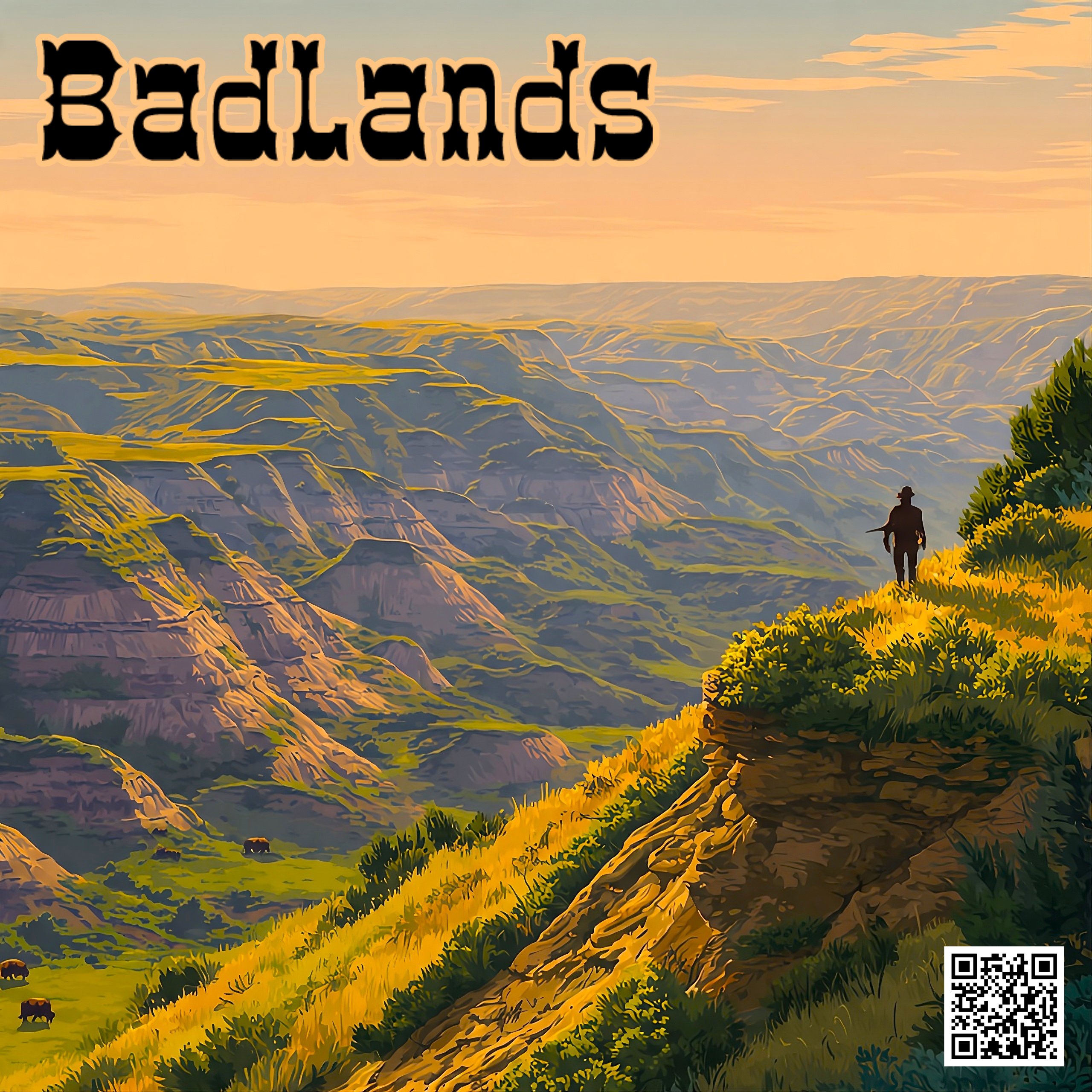
Badlands – Full Album (42:58)
How a Sacred Landscape Transforms a Broken Traveler
“The land is sacred. These words are at the core of your being. The land is our mother, the rivers our blood. Take our land away and we die. That is, the Indian in us dies.”
— Mary Brave Bird, Lakota Sioux author and activist
Google’s Deep Dive Podcast: When the Land Listens
The Land That Listens: The Story Behind Badlands
There are places in the world where silence is not an absence, but a presence. Where the air seems to carry something older than memory. Where a person can walk far enough into the horizon that the weight they’ve been carrying begins to loosen on its own.
The Badlands are one of those places.
Badlands was born from a journey into Makȟóšiča, the land the Lakota people know as harsh, sacred, honest. It is music for wanderers, mourners, seekers, and listeners. It is an album built from stone, wind, ancestral breath, and the emotional archaeology of a man named Wayfarer Gray, who steps into a land ancient enough to hold his grief without judgment.
The album does not retell his story literally.
Rather, it captures the atmosphere of his inner pilgrimage:
• the ache of loss
• the wonder of geological time
• the quiet moments when the land itself seems to respond
• the spiritual encounter with compassion
• the release that comes only when a grief is witnessed
Lakota linguistic elements appear throughout the music and lyrics, used with respect, always in the spirit of honoring—not appropriating—the culture tied to this landscape.
The sound world blends:
• Lakota-inflected ambient textures
• earth-deep drones and post-folk elements
• ancestral percussion
• AI-processed harmonics that feel like memory singing through wind
• glacial pads and Instrumental, cinematic, arcs that unfurl like horizons
This is not just an album.
It is a slow-moving vision quest in sound.
Across twelve tracks, Badlands invites the listener to walk with Wayfarer through shadow and revelation, through night skies blistered with stars, through firelight visions, through compassion rising from stone.
And by the closing track, “Pilámaya” — “thank you” — the listener emerges changed, carrying a quiet truth:
Sometimes the earth remembers us
long before we remember ourselves.
How to Listen to This Album: A Traveler’s Guide Through Sound and Stone
Badlands is designed like a sacred walk. The tracks unfold in a psychological and spiritual arc, mirroring the inner journey of anyone who has ever carried sorrow into the wilderness hoping the world might answer.
Here is the emotional path the album follows:
PRELUDE: Arrival
A lone traveler steps into the Badlands. He carries grief that has long since hardened. The land feels vast, indifferent, mysterious. The first opens the door, inviting the listener to enter Makȟóšiča with reverence.
THE JOURNEY THROUGH THE TEN CHAPTERS
Each of the middle tracks reveals a different layer of the transformation:
• Entering silence
• Witnessing ancient beauty
• Hearing subtle signs in wind and stone
• Feeling the presence of ancestral memory
• Encountering compassion that dissolves emotional armor
• Experiencing visions in firelight
• Releasing grief into the earth
• Receiving the land’s response
• Emerging with clarity
Recurring symbols — the hawk, the wind, layers of stone, the Nation of Stars (Wičháȟpi Oyáte), firelight, and the trembling earth — stitch the experience together like spiritual threads.
CODA: Gratitude
The final is a goodbye, a bow, a gentle thank-you to the land that listened. It closes not with triumph but with peace.
The album is best heard in one sitting, ideally in the twilight hours when the boundary between inner and outer worlds thins. Let it be a companion for your own quiet walk.
GENERAL TEXT-TO-Music (based on the directly above) (ALBUM-LEVEL)
ALBUM-LEVEL Music (based on the directly above):
Instrumental, cinematic, ambient–post-folk fusion with Lakota-inspired, modern EDMtribal drums. Deep earth drones, and AI-processed harmonics. The atmosphere should feel like walking through the Badlands at dawn: ancient, sacred, wind-carved. Include cedar-flute breaths, low warm bass pulses, ghostlike chants, and wide glacial pads. The emotional arc moves from sorrow to revelation to release.
Tracklist
01 — Makȟóšiča: Land of Ancient Breath
The opening places the listener at the edge of the Badlands. Wayfarer Gray steps into terrain older than memory. The tone is reverent, patient, and vast.
02 — Wayfarer Gray
The man behind the journey. A portrait of inner fragmentation and the quiet courage to keep walking.
03 — Where the Wind Remembers
The first sense that the land is aware. Wind becomes messenger.
04 — Wakȟáŋ (Sacred)
Recognition of the land’s holiness. Wayfarer begins to listen instead of wander.
05 — Layers of Time
Geological time speaks. Sediment becomes scripture.
06 — Héčhetu Weló
Acknowledgment. The land responds for the first time.
07 — Night of the Star Nation (Wičháȟpi Oyáte)
Night falls. The land reveals its cosmic memory.
08 — Firelight Visions
The fire becomes a threshold. Wayfarer sees past and present merging.
09 — Wówačhaŋtognake (Compassion)
The land opens. Compassion flows. The emotional climax.
10 — The Release
Wayfarer’s grief finally loosens its grip.
11 — The Return
Walking out of the Badlands at dawn; clarity restored.
12 — Pilámaya
Gratitude. Final blessing. The album closes in peace.
Narrative Adaptation: A Broken Man Walks Into the Badlands… and the Badlands Whisper Back
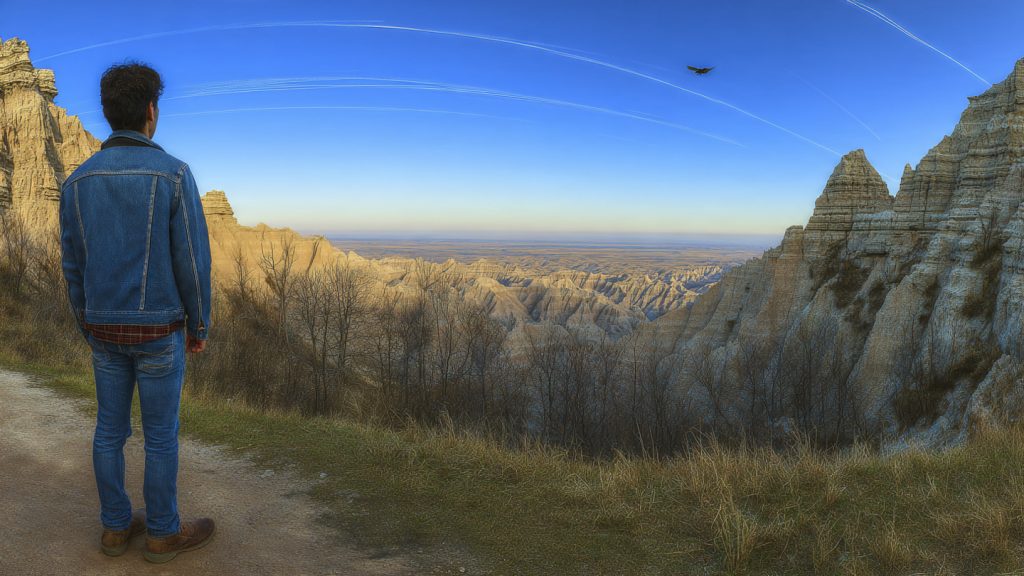
The man who stepped out of the dusty, faded-blue truck called himself Wayfarer Gray now. He had shed his old name the way autumn sheds leaves into creek beds—quietly, without ceremony. Wayfarer wasn’t running. Not anymore. He had simply reached a place where the compass inside him no longer pointed anywhere familiar, and the Badlands had called to him with a magnetic pull that felt older than memory.
The Badlands rose from the earth like the exposed bones of ages. Ridges, spires, and sharp cathedral towers of sediment shaped by ancient seas and wind. The Lakota call this place Makȟóšiča, “land bad,” not as insult but as recognition of its harsh, powerful truth. Some elders called it something gentler: a place where time prays.
Wayfarer breathed in the arid morning, the air tasting faintly of dust and sage. He whispered the one word he remembered clearly from his years teaching near the reservation:
“Wakȟáŋ.”
Sacred.
He had come seeking something unnamed: closure, guidance, permission to feel whole again. He had lost someone he loved, someone whose absence carved hollows inside him that no daylight could fill.
And the Badlands—Makȟóšiča—were said to speak, if a wanderer entered with humility.
The trail he followed wound through narrow gullies and pale cliffs. The crunch of gravel under his boots echoed off the stone in uneven rhythms. A hawk traced spirals overhead, drawing shapes in the sky that felt intentional, almost instructive.
Wayfarer recalled a story told to him by an elder, Wičháša Ógle, a Lakota man with a voice like river gravel.
“The land carries memory,” the elder had said.
“Everything you feel, she has felt. Everything you fear, she knows. Walk softly. Listen deeply. She hears you.”
Wayfarer had believed him then. Now he needed to.
The deeper he walked, the more the Badlands shifted. The air thickened, as if the land wanted him to slow down and pay attention. Shadows lengthened in strange directions, independent of the sun. A subtle tremor of awareness pressed against him.
He reached a high overlook and gazed out over a labyrinth of canyons. Colors shifted across the rock layers—ochre, ash, coral, deep bruised purple—as if the land breathed in color instead of air.
His heart felt heavy under the weight of remembered loss.
“What am I supposed to do with this pain?” he asked, voice brittle.
No voice answered. But the wind stirred, cool and deliberate.
It carried a whisper, almost imagined:
“Héčhetu weló.”
It is so.
Not an answer—an acknowledgment.
Wayfarer sat, the land’s quiet presence settling around him like a patient teacher waiting for a student to find his footing.
Hours thinned. Light shifted. The Badlands felt less like terrain and more like an intelligence.
Darkness arrived with sudden intensity. Stars burst across the sky like scattered embers. The Milky Way stretched above him, a shimmering river the Lakota call Wičháȟpi Oyáte, the Nation of Stars.
Wayfarer built a small fire in the shelter of a canyon wall.
As the flames crackled, shadows elongated into shapes that resembled ancient dancers. The canyon wall opposite him brightened in pulses. Then the visions came.
A herd of bison sweeping across the ancient grasslands. Lakota families keeping watch over sacred fires. Storms carving the Badlands into the impossible formations that surrounded him now.
Then, the visions narrowed.
He saw himself—Wayfarer Gray—walking through his grief with stubborn silence. He saw the moment of loss, the stillness, the shattering. He felt it again, sharp but clean this time.
He whispered, “Why show me this?”
A tremor rippled beneath him, soft but certain. A voice rose—not heard, but felt:
“Wówačhaŋtognake.”
Compassion.
And then:
“You do not walk alone.”
Wayfarer broke. His tears fell freely into the dust, the earth drinking them like offerings. His grief, carried alone for so long, finally had somewhere to rest. The Badlands held it with patient gravity, as if absorbing the weight he could no longer bear.
The land acknowledged his sorrow.
And in doing so, it began to loosen its grip.
When the visions faded, night returned to silence. Wayfarer lay back and watched Wičháȟpi Oyáte drift slowly across the sky. The constellations felt less distant, as if the stars themselves were leaning closer.
He slept under their glow, dreaming of voices made of wind and stone.
Morning arrived in a tidal sweep of gold. The buttes shimmered as though newly carved. Wayfarer felt lighter, not cured, but rearranged—his pain now shared with something eternal.
He began his walk back.
The Badlands no longer seemed harsh. They felt like a stern but loving elder guiding him toward a new chapter.
At his truck, Wayfarer turned back toward the horizon. The land seemed to watch him, waiting for him to understand the final truth.
He placed his hand over his heart.
“Pilámaya,” he whispered.
Thank you.
A breeze rose—a small, warm breath brushing his cheek. A hawk soared from a far ridge, climbing higher and higher until it became a flicker of light against the morning sky.
Wayfarer smiled.
He wasn’t healed, but he was no longer broken in the same way. The compass inside him had realigned, not to a direction but to a truth:
The land remembered him.
And now he remembered himself.
He stepped into his truck, started the engine, and began the drive home.
Behind him, Makȟóšiča stood silent and powerful.
Ahead of him waited the rest of his life.
And somewhere between the two, Wayfarer Gray carried a new story.